
APP-210 · Lesson 6 of 12 · 21 min
Defrost systems and timers
▶ Video coming soon A video version of this lesson is on the way.
"Frost is the refrigerator's own fault," Hiro said at the start of the November 3 session, holding up a frosted evaporator he had pulled from the scrap pile, its fins packed solid with ice. "Every time somebody opens a door, warm damp air comes in. The water in it ends up on the coldest thing in the box, which is the evaporator. If nothing takes it off, you get this, and no air can get through." He set the evaporator on the bench next to a defrost timer, an adaptive defrost control board, a defrost heater and a bimetal termination thermostat, and spent the evening on how they work together. Kiran had already met one of them: the open defrost thermostat on his November 5 call in APP-120 was the classic defrost failure.
A frost-free refrigerator or freezer is not frost-free inside. Frost forms on its evaporator all the time. What makes it frost-free is that the refrigerator melts the frost off automatically several times a day, drains the water away and evaporates it in the machine compartment. This lesson covers the defrost cycle, the parts that run it, how to tell which part has failed and the drain system that carries the water away. A defrost failure is the single most common cause of a warm fresh food section in a frost-free refrigerator.
The defrost cycle
A defrost cycle has three parts. First, the control stops the compressor and the evaporator fan and switches on the defrost heater, which sits against or inside the evaporator. Second, the heater warms the evaporator until the frost has melted and the evaporator has reached a set temperature, when a termination device switches the heater off. Third, the control waits for a few minutes, the drip time, while the last water runs off, before restarting the compressor; on many models the fan stays off for a short time after that, until the evaporator is cold again, so it does not blow warm, wet air into the freezer.
A typical defrost heater on a household refrigerator is rated a few hundred watts, often between about 300 W and 600 W at 120 V. A typical defrost lasts somewhere between 10 and 40 minutes, depending on how much frost there is. Most refrigerators defrost between once and a few times a day. The heater is one of three types: a glass-tube radiant heater, a metal-sheathed calrod heater bonded to the evaporator, or a foil or ribbon heater. All of them are tested by their resistance with power off, which should match the value from the rating: for a 450 W, 120 V heater, R = 120² ÷ 450 = 32 Ω, the reading Kiran found good on November 5.
Mechanical defrost timers
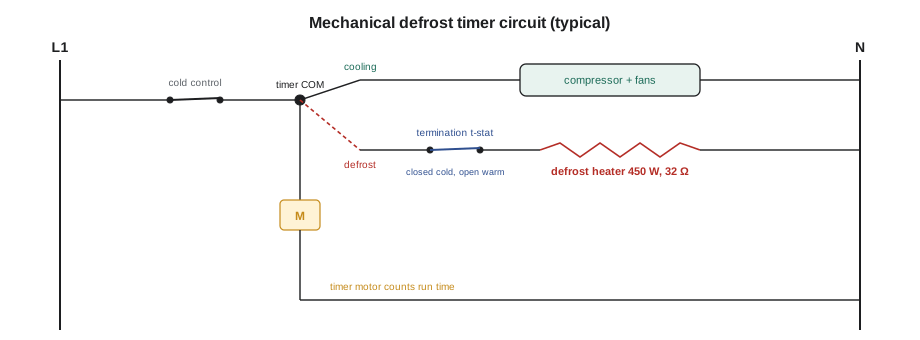
Refrigerators built until the early 2000s, and many simpler ones since, use an electromechanical defrost timer. A small synchronous motor turns a cam, and the cam works a switch. For most of its turn, the switch powers the compressor and fan. For a short part of each turn, it moves to the defrost position and powers the heater. The timer motor usually runs only while the compressor runs, so the timer counts compressor run time rather than clock time: a common setting is one defrost for every 6, 8 or 12 hours of compressor running, with a defrost period of about 20 to 30 minutes. The termination thermostat usually ends the heating well before the timer moves back, so the remaining minutes of the defrost period become drip time.
Timers fail in two ways. The motor stops, leaving the switch stuck in one position: stuck in cooling, the refrigerator never defrosts and frosts up over a week or two; stuck in defrost, the compressor never runs and the refrigerator warms up quickly. Or the switch contacts burn. A timer can be checked by turning its advance slot with a screwdriver until it clicks into defrost, which should start the heater and stop the compressor, and on into cooling, which should restart the compressor, typically after a short delay. Its terminals and contacts can be checked with an ohmmeter against the tech sheet's diagram.
Adaptive defrost controls
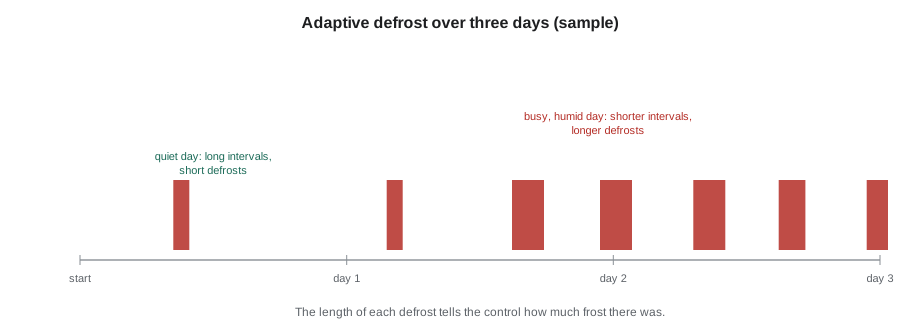
Most refrigerators built in the last twenty years use an adaptive defrost control, either a small dedicated board or part of the main control board. It decides when to defrost by watching how the refrigerator is being used: how long the compressor has run, how often and for how long the doors have been opened, and how long the last defrost took. If the last defrost ended quickly, there was little frost, and the control lengthens the time before the next one; if it took a long time, the control shortens the interval. This saves energy, because each defrost puts heat into the freezer that the compressor must then remove.
Many adaptive controls use a thermistor on the evaporator, rather than a bimetal thermostat, to end the defrost, and some read the thermistor to judge how much frost was present. An adaptive control usually has a test method, either a service-mode command or a button sequence, that starts a defrost immediately, so a technician does not have to wait for the control to decide. The tech sheet gives the method, the expected heater current and the expected time.
Worked problem
How often does it defrost?
A refrigerator with a mechanical timer is set for one defrost every 8 hours of compressor run time. The compressor runs about 62 in 100 of the time, as in lesson 1. The heater is rated 450 W and, on a typical defrost, the termination thermostat opens after 22 minutes. About how many defrosts happen each day, and about how much energy does the heater use per defrost and per day?
Show solution
- Compressor run time per day: 24 h × 0.62 = 14.9 h.
- Defrosts per day: 14.9 h ÷ 8 h = about 1.9, so the refrigerator defrosts about twice a day.
- Energy per defrost: 450 W × 22 min ÷ 60 = 165 Wh.
- Energy per day: 165 Wh × 1.86 = about 307 Wh, or about 0.3 kWh.
Answer: About two defrosts a day, using roughly 165 Wh each, a little over 0.3 kWh a day for the heater, plus the extra compressor run time to remove that heat.
The termination thermostat and the bimetal
The defrost termination thermostat is clipped to the evaporator, usually near its top, where the frost melts last. It is a bimetal disc that is closed when cold and opens when warm, typically closing below about 20 °F and opening above about 50 °F. Because it is closed only when the evaporator is cold, it lets the heater run only when there is frost to melt and cuts it off when the job is done. It also protects the evaporator and the plastic around it from overheating if the timer sticks in defrost.
The thermostat must be tested while it is cold, because when it is warm it is supposed to be open. The reliable test is the one Kiran used on November 5: with the evaporator still frosted, and the thermostat still clipped to it, read the thermostat with power off. It should read close to 0 Ω. If it reads OL while cold, it has failed open, and the heater can never run. On board-controlled systems with a thermistor in place of the bimetal, read the thermistor's resistance against the tech sheet's table at a known temperature, as lesson 7 explains.
Some refrigerators also have a thermal fuse in the defrost heater circuit, clipped near the heater. It opens permanently if the evaporator overheats, for example if the termination thermostat fails closed and the timer sticks in defrost. A blown defrost fuse means the defrost circuit overheated, and the cause must be found.
Diagnosing a defrost failure
A refrigerator whose evaporator is packed with frost, especially if the frost is solid and white and covers the whole coil, has a defrost failure. The test sequence is simple. Force a defrost, with the timer slot or the board's test mode. Measure the heater current with a clamp meter, or listen and look for the heater glowing or ticking as it warms. If the heater draws current close to its rating, the heater, the thermostat and the wiring are good, and the fault is in the timer or the board's decision to defrost. If no current flows, unplug the unit and read the heater and the thermostat, cold. Whichever is open has failed. If both read correctly, the timer or board is not powering the circuit.
| Finding | Likely cause | Next check |
|---|---|---|
| Heater draws rated current when defrost is forced | Heater and thermostat good | Timer motor or board decision to defrost |
| No heater current; heater reads OL | Heater open | Replace heater; check why it failed |
| No heater current; thermostat reads OL while cold | Thermostat failed open | Replace thermostat |
| No heater current; both read good | Timer contact or board relay not powering the heater | Voltage at the heater during forced defrost |
| Compressor never runs; heater stays on | Timer stuck in defrost, or thermostat and timer both failed | Advance the timer; check for a blown thermal fuse |
Once the cause is fixed, the frost must be removed before the refrigerator can cool properly again. The quickest method is to let the forced defrost run, or to use a hand-held steamer to melt the ice. Never use a heat gun, hair dryer or open flame near the evaporator on any refrigerator, and especially not on one with R-600a: a hot element is an ignition source, and the evaporator area is exactly where a leak of flammable refrigerant would collect. The manufacturers' safe-servicing guidance names a hand-held steamer as acceptable for defrosting coils.
The drain, the drain heater and the pan
The defrost water runs off the evaporator into a trough under it, down a drain tube through the cabinet and into the drain pan in the machine compartment, where the warm air from the condenser fan, or a loop of warm discharge tube, evaporates it. On many refrigerators a short drain heater, or a metal drain clip or probe hung from the defrost heater, keeps the drain opening warm during defrost so the water can get out before it refreezes. If that clip is missing or the drain is blocked by debris, the water freezes in the trough and builds up into ice under the evaporator, often eventually blocking the fan or the air return. Dee's October 14 case was exactly this.
Drain problems show as ice in the bottom of the freezer, under the evaporator, or as water on the floor of the fresh food section or the floor of the kitchen. A clogged drain can often be cleared with warm water poured down it or a length of flexible tube pushed through, after the ice has been melted. Several makers have issued service bulletins and drain kits for models with a known drain freezing problem, and the bulletin, not improvisation, is the right fix.
Defrost and customer use
How a refrigerator is used affects its defrost. Every door opening lets in warm, moist air, and every warm or uncovered item put inside adds moisture. A household that opens the freezer often in humid summer weather builds frost much faster than one that opens it rarely in winter, and a gasket that does not seal adds moisture all the time. An adaptive control responds to this by defrosting more often; a mechanical timer does not, and a refrigerator with a timer in a busy, humid kitchen can begin to frost up even though every part works. In that case, the fix is to find and stop the extra moisture: a leaking gasket, a door that does not close by itself, or a habit of leaving the door open.
Customers sometimes notice signs of defrost and think something is wrong: a sizzle from the freezer, water dripping into the drain pan, a short period when the fan is off and the compressor silent, or a little warmer air for a few minutes afterwards. Explaining what defrost is, and that it happens a few times a day, often answers the question without any repair.
Common mistakes
MistakeTesting a defrost thermostat after the evaporator has warmed up.
InsteadTest it while it is still cold; when warm it is meant to be open.
MistakeMelting the ice with a heat gun or hair dryer.
InsteadUse a forced defrost or a hand-held steamer; never use a heat source near a refrigerant coil.
MistakeReplacing the heater without checking the thermostat and timer.
InsteadTest all three; any one can stop defrost.
MistakeLeaving the drain clip off after a repair.
InsteadRefit it; without it the drain may freeze.
MistakeWaiting for an adaptive control to decide to defrost.
InsteadUse the tech sheet's forced-defrost method.
MistakeRestarting a frosted refrigerator without clearing the ice.
InsteadRemove the frost fully, or the airflow problem remains.
Summary and key terms
- Frost forms on the evaporator from the moisture in air that enters the cabinet.
- A defrost cycle stops the compressor and fan, heats the evaporator, ends on temperature and allows drip time.
- Mechanical timers count compressor run time; adaptive controls adjust the interval to how the unit is used.
- The termination thermostat is closed when cold and open when warm; test it while it is cold.
- A heater's resistance should match its rating: for 450 W at 120 V, 32 Ω.
- Force a defrost and measure heater current to split the circuit into heater side and control side.
- Remove frost with a forced defrost or a steamer, never a heat gun.
- Drain clips, drain heaters and service bulletins keep the drain from freezing.
- Defrost heater
- A heating element on or near the evaporator that melts the frost during defrost.
- Defrost timer
- An electromechanical timer that switches between cooling and defrost by compressor run time.
- Adaptive defrost control
- A control that changes the interval between defrosts according to door openings, run time and the length of the last defrost.
- Termination thermostat
- A bimetal device on the evaporator that ends the defrost heating when the evaporator warms.
- Drip time
- The few minutes after the heater stops, before cooling restarts, while water runs off.
- Drain clip
- A metal strip or probe that carries heat from the defrost heater into the drain opening.
- Drain pan
- The tray in the machine compartment where defrost water collects and evaporates.
- Forced defrost
- Starting a defrost on demand, by advancing a timer or using a test mode, to test the circuit.
Practice problems
Work each problem on paper first, then reveal the answer to check.
What three things happen in a defrost cycle?
Show answer
The compressor and fan stop and the heater runs; the heater stops on temperature; a drip time passes before cooling restarts.
A defrost heater reads 32 Ω. What is its power at 120 V?
Show answer
120² ÷ 32 = 450 W.
When should a defrost termination thermostat be tested?
Show answer
While it is cold, still on the frosted evaporator.
During a forced defrost the heater draws its rated current. What does that rule out?
Show answer
The heater, the thermostat and their wiring.
Why must a heat gun not be used to defrost an evaporator?
Show answer
It is an ignition source, which is especially dangerous on an R-600a system.
Lesson quiz · 5 questions
Score 60% or more to complete this lesson.
Create a free account to save your progress, take quizzes and earn a certificate.