
APP-210 · Lesson 2 of 12 · 22 min
Refrigerator styles and their layouts
▶ Video coming soon A video version of this lesson is on the way.
On Hiro's first Tuesday night, after the cut-away, he walked Kiran around the shop's back room, where four scrapped refrigerators waited for Quarrington's next pickup: a top-freezer, a bottom-freezer with a drawer, a side-by-side with a dispenser and a French-door model. "Same four parts in every one," he said, tapping the cabinets in turn. "What changes is where they put them, how the air gets around and how hard it is to get at them. Before you take a panel off, you should already know where the evaporator is, where the fan is and which way the air goes." He gave Kiran ten minutes with each unit and a flashlight, and asked him to point to the evaporator, the evaporator fan, the defrost drain, the condenser and the compressor without opening anything.
Knowing the layout saves time on every call. It tells a technician which panel to remove first, where frost will build up if defrost fails, where a blocked drain will leak, and which complaints are common for that style. This lesson walks through the main styles of household refrigerators and freezers, where their parts usually are and the service points that go with each. Details vary by maker and model, so the tech sheet is always the final word.
Top-freezer refrigerators
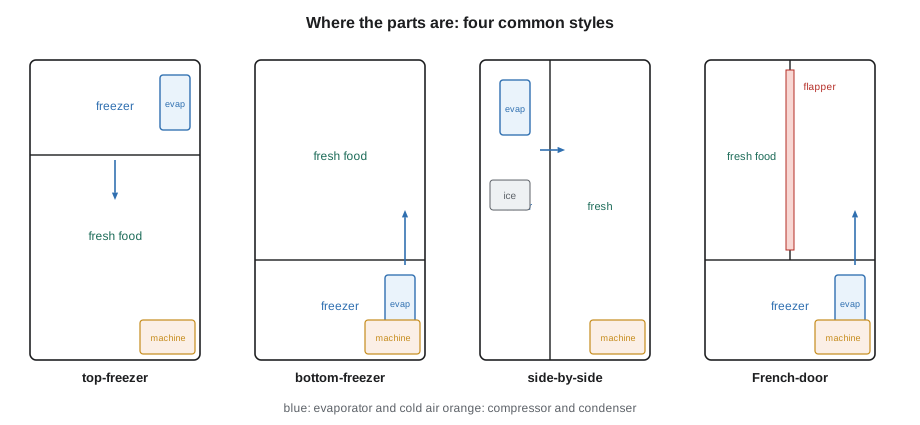
The top-freezer refrigerator is the oldest common style and still the simplest. The freezer is above the fresh food section, the evaporator is in the freezer, usually behind a panel at the back wall or under the freezer floor, and an evaporator fan blows air across it. Cold air goes to the freezer and, through an opening in the divider, down to the fresh food section. A manual or automatic air door, often a simple sliding baffle worked by the fresh food temperature control, sets how much goes down.
The condenser and compressor are at the bottom rear, in a compartment called the machine compartment. In most modern top-freezers the condenser is a fan-cooled coil in that compartment, reached from the back or behind the toe grille at the front; some older and smaller units have a static wire-and-tube condenser on the back of the cabinet. The defrost water runs down a drain from the evaporator area to a drain pan near the compressor, where the warm compressor and the condenser fan help it evaporate. Top-freezers are easy to service: the evaporator is reached by taking out the freezer back panel, and the machine compartment is open at the back.
Bottom-freezer refrigerators
In a bottom-freezer refrigerator the freezer is a drawer or door at the bottom and the fresh food section is at eye level, which most users prefer. The evaporator is usually at the back of the freezer, behind a panel, with the fan above it pushing air up a duct in the back wall to the fresh food section. Because cold air must travel up to the fresh food section rather than falling into it, the duct and its damper matter more, and a duct blocked by frost or a stuck damper gives a warm fresh food section with a cold freezer, the most common bottom-freezer complaint.
The machine compartment is again at the bottom rear, now behind the freezer, so it is often shallower and more crowded. The defrost drain has a short run from the evaporator to the pan and is prone to freezing if the drain heater or drain clip fails, which leaves ice in the bottom of the freezer. Kiran's November 5 call in APP-120, the bottom-freezer with a frosted evaporator and an open defrost thermostat, was a classic bottom-freezer fault: a warm fresh food section because no cold air was getting up the duct.
Side-by-side refrigerators
A side-by-side refrigerator has the freezer and fresh food sections next to each other, full height, with doors that open from the middle. The freezer is usually on the left. The evaporator is at the back of the freezer, behind a tall panel, and the fan blows air into the freezer and through ports in the divider wall to the fresh food side. Many side-by-sides have an ice and water dispenser in the freezer door, with the ice maker and ice bin at the top of the freezer and water lines running through the door hinge.
Side-by-sides have more parts to fail than top-freezers: the dispenser, its door heater and switches, the ice maker, the water valve and the tubing in the door. Their narrow freezers also make the ice maker area crowded, and ice maker and dispenser complaints are common. Lesson 8 covers them. Because the sections are side by side and share a long divider, a failed divider heater or mullion heater can let the divider sweat or form frost along the front.
French-door refrigerators
French-door refrigerators have two doors on the fresh food section at the top and a freezer drawer at the bottom. They are bottom-freezers with a different door arrangement, and they share the bottom-freezer's air path concerns. Two features make them distinct. First, one door has a hinged flapper or mullion that swings across the gap between the doors when they close, so the gasket has something to seal against; that flapper has a small heater to stop it sweating, and a flapper that does not flip into place is a frequent cause of a warm fresh food section and condensation. Second, many French-door models put the ice maker in the fresh food section, in an insulated box on the left door or ceiling, cooled by freezer air ducted up to it.
Many current French-door models have two evaporators, or a variable-speed compressor and several fans and dampers under the control of a main board. They are the most complex household refrigerators and the ones where the board's service mode, covered in APP-320, saves the most time. A French-door refrigerator that came into the shop in October had five fans and three dampers listed on its tech sheet.
Freezers: chest and upright
Chest freezers are the simplest household refrigeration appliances. Most are manual defrost. The evaporator is a tube bonded to the outside of the inner liner, inside the insulation, so the walls of the inside are the cold surface and frost builds on them. The condenser is usually a tube bonded to the inside of the outer cabinet wall, a hot-wall condenser, so the cabinet feels warm to the touch, which customers sometimes report as a fault when it is normal. The compressor sits in a small compartment at one end. There are no fans, no defrost heater and often only a mechanical thermostat.
Upright freezers come in manual-defrost and frost-free versions. Manual-defrost uprights have evaporator tubes in the shelves, and frost builds on the shelves. Frost-free uprights have an evaporator and fan behind a rear panel and a defrost system like a refrigerator's. Both kinds may have a hot-wall condenser or a fan-cooled one in a machine compartment. Many older uprights also have a heated door frame, a loop of hot refrigerant tube behind the cabinet front, to stop the gasket area from sweating; lesson 4 explains this loop.
Compact and built-in units
Compact refrigerators, the small cube units found in dorms and offices, often use a single evaporator plate that forms a small freezer compartment, a static condenser on the back or in the side walls, and a mechanical thermostat. They are usually manual defrost, and their low price means that a sealed-system failure is almost always the end of the unit. Some very small units, including many wine and beverage coolers, use thermoelectric cooling instead of a compressor; APP-330 covers those.
Built-in and column refrigerators, designed to sit flush with kitchen cabinets, have their condenser and compressor at the top or the bottom of the unit, with air drawn in and pushed out through a grille at the front, because there is no air space behind or around them. Their airflow depends entirely on that front grille staying clear. They are also heavy and secured to the cabinetry, so the installation instructions for removing them from the opening must be followed exactly; APP-110's lifting rules apply.
Capacity, clearances and where the unit stands
Refrigerator capacity is stated as the inside volume. In Canada it is usually given in liters, often with cubic feet as well; in the United States it is given in cubic feet. One cubic foot is about 28.3 L. Capacity helps when comparing a replacement unit, but the dimensions and door swing matter more on an installation.
Worked problem
Comparing a replacement
A customer with a 25 cu ft French-door refrigerator asks whether a replacement listed at 24.7 cu ft is about the same size. The kitchen opening is 36 in wide and the new unit is 35 3/4 in wide. The installation instructions ask for at least 1/8 in at each side. Will it fit, and is it about the same capacity?
Show solution
- Capacities: 25 cu ft old, 24.7 cu ft new, a difference of about 1 in 100, which is effectively the same.
- Width needed: 35 3/4 in + 2 × 1/8 in = 36 in.
- The opening is 36 in, so it just fits, with no extra room. Check the height and depth, and that the doors can open fully against a nearby wall, before ordering.
Answer: It is about the same size and it just fits the width, but the height, depth and door swing must be checked too.
Every installation instruction gives clearances: at the sides, top and back, and often an air gap above the unit. Those clearances matter most for refrigerators that cool their condenser by natural air movement, but even fan-cooled units need the air path at the front grille and at the back to be clear. A refrigerator pushed tight against a wall, with its condenser at the back blocked by a stack of grocery bags, will run long and warm. Clearance and ventilation are the first things to check on a warm-refrigerator call, before any panel is removed.
| Style | Evaporator usually | Common complaints |
|---|---|---|
| Top-freezer | Freezer back or floor | Frost on evaporator from defrost failure; warm fresh food when air door sticks |
| Bottom-freezer | Freezer back, fan above | Warm fresh food with cold freezer; frozen defrost drain |
| Side-by-side | Freezer back, tall panel | Ice maker and dispenser faults; divider sweating |
| French-door | Freezer back; some have two | Flapper not closing; ice maker in fresh food section; fan and damper faults |
| Chest freezer | Bonded to the liner | Frost build-up; warm cabinet reported as a fault; sealed-system leaks |
| Upright freezer | Shelves or rear panel | Frost on shelves; door gasket and heated frame problems |
Moving and transporting refrigerators
Refrigerators are moved more often than people think: to clean behind them, during renovations and on delivery. The way they are moved affects the sealed system. Most makers recommend keeping a refrigerator upright when it is transported. If it has to be laid down, the instructions usually say which side it may lie on, and that it should stand upright for a period before it is plugged in, often a few hours and sometimes as long as it was lying down, so that oil that has run out of the compressor into the tubing can drain back. Starting a compressor with oil in its discharge line, or with too little oil in its sump, can damage its valves.
When a refrigerator is pulled out from the wall, it should be rolled straight out on its rollers, with the leveling legs raised, and with care for the water line behind it, which can be pulled off its valve or crushed. Doors may need to come off to pass through a narrow doorway, and on models with a dispenser that means disconnecting the water tube at the hinge and the wiring harness, as lesson 8 explains. Before pushing the refrigerator back, check that the water line is coiled so it will not kink, that the power cord is not trapped and that the condenser air path at the back or the front grille is clear.
A technician who has to move a refrigerator to reach the machine compartment should protect the floor with a sheet of hardboard or an appliance mat, especially on hardwood, vinyl or tile, and use the appliance dolly and lifting methods from APP-110 for anything heavier than a light top-freezer. A loaded refrigerator should be emptied, or at least have its door shelves cleared, before it is moved any distance, because the weight of jars and bottles in the doors can twist the hinges.
Common mistakes
MistakeTaking panels off before thinking about the layout.
InsteadKnow where the evaporator, fan, drain and machine compartment are before you start.
MistakeReporting a warm chest freezer cabinet as a fault.
InsteadA hot-wall condenser makes the outside of the cabinet warm; that is normal.
MistakeIgnoring the French-door flapper.
InsteadA flapper that does not flip into place lets warm air in and causes sweating; check it early.
MistakeOrdering a replacement on capacity alone.
InsteadCheck width, height, depth, door swing and the clearances in the instructions.
MistakeDiagnosing a warm unit without checking clearances.
InsteadA blocked condenser air path is common and costs nothing to fix.
MistakeAssuming every model of a style is laid out the same.
InsteadUse the tech sheet; makers move parts between models.
Summary and key terms
- All styles use the same four main parts; the layout and air path differ.
- Top-freezers drop cold air down from the freezer; bottom-freezers must push it up a duct.
- A warm fresh food section with a cold freezer usually means the air path or defrost has failed.
- Side-by-sides and French-doors add ice makers, dispensers, heaters and more fans and dampers.
- Chest freezers and many uprights use bonded evaporators and hot-wall condensers, with no fans.
- Built-in units breathe through a front grille that must stay clear.
- One cubic foot is about 28.3 L.
- Check clearances and ventilation before opening any panel.
- Machine compartment
- The space at the bottom rear of most refrigerators that holds the compressor, the fan-cooled condenser and the drain pan.
- Air door
- A baffle or damper that sets how much freezer air goes to the fresh food section.
- Flapper
- The hinged strip on one French door that swings across the gap between the doors so the gaskets can seal.
- Mullion
- The divider between two compartments or doors; on a French-door model, the flapper is often called the mullion.
- Hot-wall condenser
- A condenser tube bonded to the inside of the outer cabinet wall, which releases heat through the cabinet.
- Bonded evaporator
- An evaporator tube attached to the liner inside the insulation, used in chest freezers.
- Frost-free
- A design with an automatic defrost system, so frost does not build up in the cabinet.
- Built-in
- A refrigerator made to sit flush with cabinets, with its condenser air drawn through a front grille.
Practice problems
Work each problem on paper first, then reveal the answer to check.
Why is a warm fresh food section with a cold freezer common in bottom-freezer models?
Show answer
Cold air must be pushed up a duct, so frost or a stuck damper easily blocks it.
Why does a chest freezer's cabinet feel warm?
Show answer
Its hot-wall condenser releases heat through the outer cabinet wall.
What is the flapper on a French-door refrigerator for?
Show answer
It swings across the gap between the doors so the gaskets have a surface to seal against.
About how many liters is 25 cu ft?
Show answer
About 708 L.
What should be checked before removing any panel on a warm-refrigerator call?
Show answer
Clearances and the condenser air path.
Lesson quiz · 5 questions
Score 60% or more to complete this lesson.
Create a free account to save your progress, take quizzes and earn a certificate.