
APP-210 · Lesson 11 of 12 · 23 min
Door seals, leveling and noise complaints
▶ Video coming soon A video version of this lesson is on the way.
Dee's case file from Friday, October 16 was a call that had been booked as "refrigerator not cooling, sweating, noisy". The refrigerator was a 2022 French-door model, R-600a, delivered and installed a month earlier by the store that sold it. The customer, Neil Callahan, had found water running down the outside of the left door in the mornings, a fresh food section that drifted warm, and a range of noises at night that worried him. Dee measured the temperatures, which were close to target, then laid her level on the cabinet. The refrigerator leaned forward. With the front lower than the back, the doors did not swing shut on their own, the left door's flapper was not flipping fully into place, and warm, humid kitchen air was finding its way past the gaskets. She raised the front leveling legs until the cabinet tilted slightly back, adjusted the doors so they lined up, and checked the gaskets with a strip of paper. The sweating stopped that night. The noises, she explained to Mr. Callahan, were mostly the normal sounds of a modern refrigerator, and she wrote him a short list of which ones they were.
Door seals, leveling and noise account for a large share of refrigerator service calls, and many of them can be fixed in minutes without any parts. They are also the calls where a technician's explanation matters most, because the customer often thinks something expensive has failed. This lesson covers door gaskets and how to test and replace them, how to level a refrigerator and align its doors, the heaters that stop the cabinet face sweating, and how to tell normal refrigerator sounds from the ones that point to a fault.
Door gaskets
The door gasket is a flexible vinyl or rubber seal around the inside edge of each door, with a magnetic strip inside it that pulls it against the steel face of the cabinet. A good gasket seals all the way round and keeps warm, moist kitchen air out. A gasket that is torn, flattened, twisted or hardened, or that has been pushed out of its channel, lets air leak in. Leaking air warms the cabinet, makes the compressor run longer and brings moisture that becomes frost on the evaporator and around the leak, and condensation on the outside of the cabinet where cold air leaks out.
The traditional test is the paper or dollar-bill test: close the door on a strip of paper and pull it out. The paper should drag noticeably all the way round the door. Where it slides out freely, the gasket is not sealing. A flashlight placed inside the cabinet, pointed at the gasket in a darkened room, shows gaps as light leaking out. Frost on the freezer gasket or inside the freezer near one corner, or sweat on the cabinet face beside the fresh food gasket, marks a leak.
A gasket that is merely distorted can often be reshaped by warming it gently with warm water or a hair dryer on a low setting at a safe distance, then closing the door and letting it set; on R-600a refrigerators, the hair dryer must be kept well away from the cabinet's interior and the machine compartment, and many technicians simply use warm water. A torn or hardened gasket is replaced with the maker's part for that model. Most gaskets press into a channel in the door liner or are held by screws under the gasket's edge. A new gasket is usually folded in its packaging and may need to be warmed and left to relax before it lies flat.
Leveling the refrigerator
Most installation instructions call for the refrigerator to be level from side to side and tilted slightly back from front to back, so that the doors swing closed on their own and the gaskets seat firmly. A common instruction is to have the front about 1/4 in higher than the back, or to raise the front leveling legs until the cabinet tilts back slightly and the doors close by themselves from half open. The legs or rollers at the front are adjusted with a wrench or screwdriver, and many refrigerators have anti-tip brackets or stabilizing legs that must also be set.
Worked problem
How much tilt is that?
The instructions for Mr. Callahan's refrigerator ask for the front to be about 1/4 in higher than the back, measured over the cabinet depth of 27 1/2 in. What slope is that, and how would it show on a level?
Show solution
- Slope: 1/4 in rise over 27 1/2 in run = 0.25 ÷ 27.5 = 0.0091.
- As an angle: the arctangent of 0.0091 is about 0.52°, roughly half a degree.
- On a standard level, that shows as the bubble sitting a little off center toward the front. It is a small tilt, but enough to make the doors swing closed.
Answer: About half a degree of backward tilt: small, but it makes the doors close by themselves and seat their gaskets.
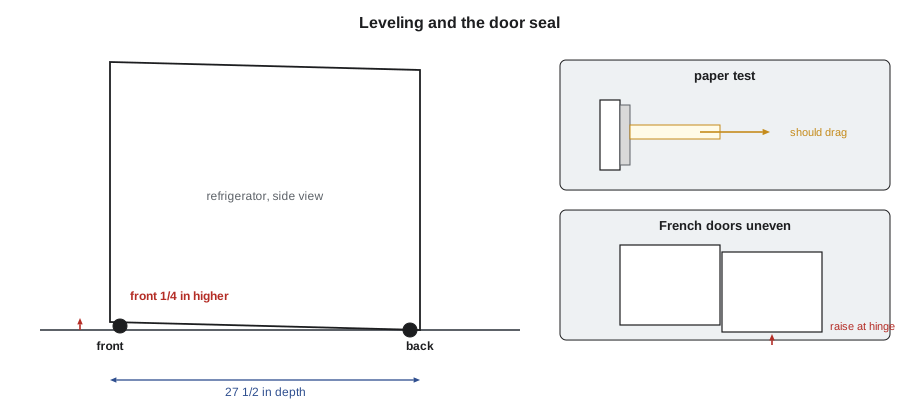
Floors are rarely level, and a refrigerator set on a sloping kitchen floor, or with one roller resting on the edge of a mat, can look level by eye and still lean. Always use a level, both across the top of the cabinet and front to back along its side. Check again after the refrigerator has been loaded, because a full refrigerator can settle the legs or flex a soft floor.
Door alignment and French-door flappers
On side-by-side and French-door refrigerators, the doors must also line up with each other. Most have an adjustment at the bottom hinge, a screw or a nut that raises or lowers one door, so the tops of the two doors can be made even. A door that sags, often because children swing on it or it holds heavy bottles, can be raised the same way. Hinges and their bushings wear, and a door that drops again soon after adjustment may need a new hinge or bushing.
The French-door flapper, or mullion, described in lesson 2, swings across the gap between the doors as the left door closes. A guide on the cabinet ceiling turns it into place. If the doors are uneven, the cabinet leans forward or the guide is broken, the flapper may stay folded, leaving a gap for warm air. Its small heater keeps it from sweating; a failed flapper heater shows as water on the flapper and the door gasket beside it. Check the flapper's movement by closing the left door slowly and watching it flip, and read its heater's resistance against the tech sheet.
Anti-sweat heaters
Refrigerators keep the cabinet face around the doors slightly warm so that moisture from the room does not condense on it where cold air leaks along the gasket. Lesson 4 described the yoder loop of warm refrigerant tube that some models use. Others use small electric heaters: a mullion heater in the divider between the freezer and fresh food sections, a flapper heater on French doors, heaters around the dispenser and, on some models, heaters in the cabinet face. Some refrigerators have a switch or board setting that turns these heaters down in dry weather to save energy and up in humid weather, and a customer who has turned it to the energy-saving setting in a humid summer may find the cabinet sweating.
When the outside of the cabinet sweats, check in this order: the room humidity and the energy-saver setting, the leveling and door alignment, the gaskets, the flapper, and then the heater or yoder loop. A cabinet face that sweats only in very humid weather, with everything else in order, may be working within its design.
Normal refrigerator sounds
Modern refrigerators are quiet, but they are not silent, and many of their sounds are normal. A steady hum is the compressor running; on variable-speed models the pitch rises and falls with speed. Fans make a soft whoosh. A hiss, gurgle or bubbling sound is refrigerant flowing through the capillary into the evaporator, especially just after the compressor starts or stops. Clicks come from the cold control or a relay switching, from the defrost timer or board, and from the damper motor. Cracks and pops come from the cabinet and plastic liners expanding and contracting as the temperature changes, especially during and after defrost. A sizzle during defrost is water dripping on the hot defrost heater. A buzz or the sound of water running every so often is the inlet valve filling the ice maker, and a clatter is the ice dropping into the bin.
| Sound | Usual source | Normal? |
|---|---|---|
| Steady hum, pitch changing on newer models | Compressor | Yes |
| Hiss, gurgle or bubbling | Refrigerant entering the evaporator | Yes |
| Click every few minutes, no cooling | Overload: compressor not starting | No: see lesson 3 |
| Click when cycling | Cold control, relay or board | Yes |
| Crack or pop | Liner expanding or contracting | Yes |
| Sizzle during defrost | Water on the defrost heater | Yes |
| Grinding, chattering or ticking from the freezer | Fan blade hitting ice or a failing fan motor | No: see lessons 5 and 6 |
| Rattle from the bottom | Drain pan, loose tube touching the cabinet, condenser fan | Usually a simple fix |
| Loud knock when the compressor stops | Broken compressor mounting spring | No |
Abnormal sounds are usually louder, rougher or new. A fan blade hitting ice, as in Dee's October 14 case, grinds or chatters. A fan motor with worn bearings squeals or rumbles, and the noise often changes when the door is opened and the fan stops. A rattle at the bottom of the cabinet is often the drain pan, a tube in the machine compartment touching the cabinet or the condenser fan blade striking debris; it can be cured by repositioning the pan or gently moving the tube away from the cabinet, taking care never to kink it. A refrigerator standing on an uneven or hollow floor can transmit and amplify every sound.
Explaining sounds to the customer
Many noise calls end with an explanation rather than a repair. Customers replacing a refrigerator that was twenty years old are often surprised by the sounds of a newer one, especially a variable-speed model that runs almost all the time at low speed. A clear, honest explanation of which sounds are normal, given without dismissing the customer's concern, is part of the job. Dee's habit is to stand with the customer and identify each sound as it happens, then leave a short written list.
Worked problem
Adding sound levels
A customer complains that her new refrigerator is louder than her old one. With a sound level meter, Dee measures 40 dBA from the compressor alone with the fans off, and 38 dBA from the fans alone with the compressor off, both at the same position. What would the meter read with both running, and is that a large increase?
Show solution
- Sound levels in decibels add logarithmically, not arithmetically.
- Total = 10 × log₁₀(10^(40 ÷ 10) + 10^(38 ÷ 10)) = 10 × log₁₀(10,000 + 6,310) = 10 × log₁₀(16,310).
- log₁₀(16,310) = 4.212, so the total is about 42.1 dBA.
- Adding the fans raises the level by about 2 dB above the compressor alone, a small change that most people notice only in a quiet room.
Answer: About 42 dBA with both running, only about 2 dB more than the compressor alone, which is a typical level for a quiet modern refrigerator.
When the customer's kitchen is the cause
Some door and sweating complaints come from the kitchen rather than the refrigerator. A refrigerator built into a tight cabinet opening with no air space, placed beside a range or a heat register, or standing in direct afternoon sun runs longer and sweats more. A kitchen with very high humidity, from cooking, a humidifier or a damp basement, can make even a perfectly sealed refrigerator sweat at the cabinet face. Point these causes out tactfully, with the installation instructions' clearances and the room conditions, and suggest the simple changes that help.
Common mistakes
MistakeTreating sweating on the cabinet as a sealed-system fault.
InsteadCheck humidity, the energy-saver setting, leveling, gaskets, the flapper and the heaters first.
MistakeLeveling a refrigerator by eye.
InsteadUse a level side to side and front to back; most makers want a slight backward tilt.
MistakeReplacing a gasket that is only distorted.
InsteadWarm it gently and let it reseat; replace it only if it is torn or hard.
MistakeUsing a heat gun to soften a gasket on a hydrocarbon unit.
InsteadUse warm water, or a hair dryer on low held well away from the cabinet's interior and machine compartment.
MistakeDismissing a noise complaint without listening.
InsteadIdentify each sound with the customer, and explain which are normal.
MistakeBending a tube away from the cabinet roughly to stop a rattle.
InsteadMove it gently, never kink it, and secure it as the maker intended.
Summary and key terms
- Leaking gaskets warm the cabinet, waste energy and cause frost and sweating; test with paper or a flashlight.
- Distorted gaskets can often be reseated; torn or hardened ones are replaced with the maker's part.
- Most makers want the cabinet level side to side and tilted slightly back so the doors close by themselves.
- A 1/4 in rise over the cabinet depth is about half a degree of tilt.
- French-door flappers must flip into place; uneven doors or a forward lean stop them.
- Anti-sweat heaters and yoder loops keep the cabinet face from sweating; energy-saver settings reduce them.
- Hums, hisses, gurgles, clicks, pops and defrost sizzles are normal sounds.
- Grinding, squealing and loud knocks point to faults; explain normal sounds clearly to the customer.
- Door gasket
- The magnetic seal around a refrigerator door that closes against the cabinet face.
- Paper test
- Closing a door on a strip of paper to check that the gasket grips it all the way round.
- Leveling leg
- An adjustable foot or roller used to level and tilt the refrigerator.
- Anti-tip bracket
- A bracket that stops a refrigerator or range from tipping forward.
- Mullion heater
- A small heater in the divider between compartments that stops it from sweating.
- Energy-saver switch
- A control that reduces the anti-sweat heaters in dry weather to save energy.
- Hinge bushing
- A plastic sleeve in a door hinge that wears and lets the door sag.
- dBA
- Decibels on the A-weighted scale, which matches how the ear hears sound levels.
Practice problems
Work each problem on paper first, then reveal the answer to check.
How is a door gasket tested with paper?
Show answer
Close the door on a strip of paper; it should drag all the way round.
Why do most makers want a refrigerator tilted slightly back?
Show answer
So the doors swing closed by themselves and the gaskets seat firmly.
A 1/4 in rise over the cabinet depth is about how many degrees?
Show answer
About half a degree.
Name three normal refrigerator sounds.
Show answer
Compressor hum, refrigerant hiss or gurgle, and the click of the controls; also pops, fan noise and defrost sizzle.
What does a grinding or chattering noise from the freezer usually mean?
Show answer
A fan blade hitting ice or a failing fan motor.
Lesson quiz · 5 questions
Score 60% or more to complete this lesson.
Create a free account to save your progress, take quizzes and earn a certificate.