
APP-210 · Lesson 5 of 12 · 21 min
Fans and airflow paths
▶ Video coming soon A video version of this lesson is on the way.
Dee's case file from Wednesday, October 14 was a noise complaint that turned into an airflow lesson. A 2018 side-by-side made a grinding, chattering sound every few minutes, then went quiet. The customer had also noticed that the fresh food side was warmer than usual. Dee opened the freezer, heard the noise come from behind the back panel and found that the evaporator fan blade was striking a ridge of ice that had built up on the fan shroud. The ice came from defrost water that could not get away: the drain at the bottom of the evaporator was frozen solid. She melted it with a steamer, cleared the drain, fitted the drain clip the manufacturer had issued in a service bulletin and confirmed the fan ran quietly. "The noise was the fan," she wrote, "but the fault was the drain. The warm fresh food side was the fan blade slowing down every time it hit the ice."
In a frost-free refrigerator, the sealed system cools only the evaporator. Everything else depends on air: the evaporator fan moves cold air into the freezer and the fresh food section, and the condenser fan carries heat away from the condenser and the compressor. A refrigerator with a perfect sealed system can still be warm if its air does not move. This lesson covers the fans, the ducts and dampers that direct the air, the temperatures each section should reach, and the airflow faults that technicians find most often.
The evaporator fan
The evaporator fan sits next to the evaporator, usually above it, behind the freezer's rear panel. It pulls air from the freezer and the fresh food return across the evaporator coil and pushes the cold air out through outlets into the freezer and through a duct to the fresh food section. In most older refrigerators it is a small shaded-pole motor running on 120 V with a plastic blade; in most newer ones it is a brushless DC motor running from a low-voltage supply on the main board, often at variable speed. APP-120 covered both motor types, and APP-320 covers the DC fans and their control signals.
The evaporator fan normally runs whenever the compressor runs, and stops during defrost so that it does not blow the defrost heat into the freezer. On most refrigerators it also stops when the freezer door is opened, through a door switch, so it does not blow cold air out of the open door. That door switch is a useful test: with the compressor running and the freezer door open, press the switch and the fan should start. A fan that does not start may be failed, may have no voltage because the switch or board is not powering it, or may be blocked by ice.
The condenser fan
The condenser fan is in the machine compartment. It pulls room air through the condenser coil and across the compressor and pushes it out, usually past the drain pan. Like the evaporator fan, it is either a 120 V shaded-pole motor or a DC motor on a board. It normally runs whenever the compressor runs. A failed condenser fan lets the condenser and compressor overheat, raises the high-side pressure, cuts the cooling and can trip the compressor overload; it also leaves defrost water in the drain pan, which may overflow onto the floor.
When the condenser fan has failed, the customer usually reports that the refrigerator is warm and the compressor area is very hot, and sometimes a smell of warm dust. The fan blade should spin freely by hand with the unit unplugged; a blade that is stiff or wobbles has worn bearings. The motor can be checked for voltage while the compressor runs and for winding continuity with power off. APP-110's November 13 call found an open condenser fan motor and a coil full of lint, a combination that is very common, because a clogged coil makes the fan work harder and run hotter.
How the air moves
In a single-evaporator refrigerator, the evaporator fan creates the only forced air flow in the cabinet. Cold air leaves the evaporator compartment and divides: most goes to the freezer, and some goes through a duct to the fresh food section. Warm air returns from both sections to the evaporator through return openings, usually at the bottom of the freezer's back panel and through a return duct from the fresh food section. Every opening matters. Blocking a freezer return with a frozen pizza box, or a fresh food outlet with a jug of milk, changes the flow and the temperatures.
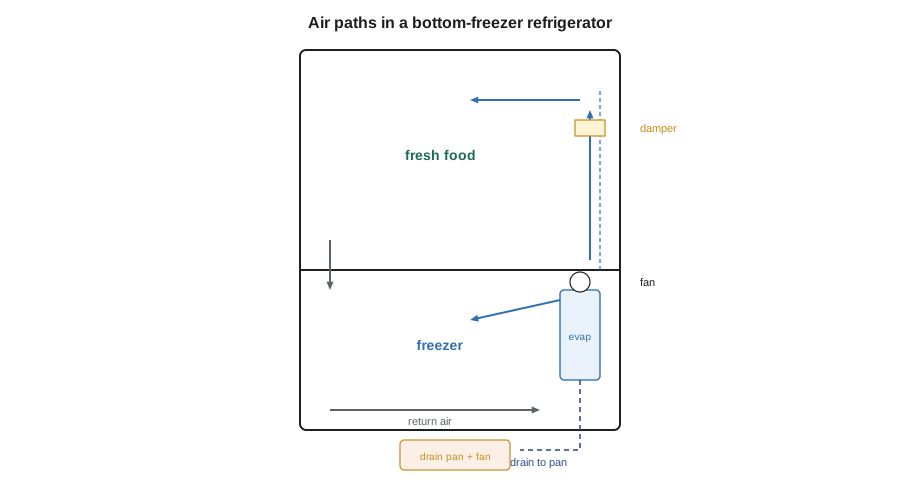
The fresh food temperature is controlled by how much cold air the damper lets in. In older refrigerators the damper is a mechanical baffle, worked by a capillary thermostat in the fresh food section or simply by the user's control knob. In newer refrigerators it is a motorized damper, a small door driven by a stepper or synchronous motor and opened and closed by the main board in response to a fresh food thermistor. A damper stuck closed gives a warm fresh food section and a cold freezer. A damper stuck open gives a fresh food section that freezes lettuce and milk.
The freezer temperature is set by how long the compressor and fan run, controlled by a freezer thermostat or thermistor. That is why, on a single-evaporator refrigerator, the two controls interact. Turning the freezer colder makes the compressor run longer, which also cools the fresh food section. Turning the fresh food section colder opens the damper more, which takes cold air from the freezer. Customers who turn both dials to the coldest setting, or one to the coldest and the other to the warmest, often create the problem they called about.
Temperatures to expect
Measure air temperatures with a thermometer probe placed in a glass of water left in the section for some hours, or with a probe in the air at the center of the section after the doors have been closed for a while. A single reading of the air just after the door has been opened is misleading. Typical targets are about 37 °F in the fresh food section and about 0 °F in the freezer, and many refrigerators let the user set values a few degrees either side.
| Location | Typical target | Food safety guidance |
|---|---|---|
| Fresh food section, center | 35 to 39 °F | At or below 40 °F |
| Freezer, center | −4 to 3 °F | At or below 0 °F |
| Air leaving the evaporator fan (running) | About −13 to −4 °F | Not a food guideline; a diagnostic reading |
| Condenser discharge air (running) | 10 to 20 °F above the room | Not a food guideline; a diagnostic reading |
Worked problem
A warm fresh food section
On Dee's October 14 call, before she found the ice, she placed probes and let the unit run for 30 minutes with the doors closed. The freezer read −2 °F and the fresh food side read 46 °F. The air leaving the evaporator fan outlet was −9 °F. What do the readings tell her?
Show solution
- Freezer: −2 °F is on target, so the sealed system and the compressor are producing cold.
- Evaporator outlet air: −9 °F is normal, so the evaporator is cold and air is leaving it.
- Fresh food: 46 °F is 6 °F too warm and above the 40 °F food safety guideline.
- Cold is being made but not delivered to the fresh food side: the problem is in the air path to it, the fan speed, the damper or a blocked duct, not the sealed system.
Answer: The fault is in the airflow to the fresh food section. In this case the fan was being slowed by ice on its shroud.
Common airflow faults
Most airflow faults fall into a few groups. The fan itself fails: an open motor, worn bearings, or a DC fan or its control board that no longer runs it. Ice blocks the fan or the ducts, almost always because defrost has failed or the defrost water could not drain, so the root cause is in lesson 6. The damper sticks, from ice, a failed motor or a broken door. Food blocks an outlet or a return. A door gasket leaks, letting warm moist air in and building frost fast. And, on French-door models, the flapper fails to close. When the fresh food section is warm and the freezer is cold, check these in order of ease: the controls, the food loading, the flapper and gaskets, the fan with the door switch pressed, and then the evaporator behind its panel.
Frost tells a technician a lot about where the air is going. A light, even frost on the evaporator is normal. A heavy frost that has filled the gaps between fins means defrost is not working, and the air cannot pass. Frost and ice at one corner of the evaporator compartment may come from a leaking gasket, a cracked panel or a drain that has overflowed. Frost on food packages in the freezer, rather than on the evaporator, usually means warm moist air is getting in through the door.
On models with DC fans and motorized dampers, the board runs them through its own logic. A board-controlled fan may be designed to run at several speeds or to pause at times, so a fan that is not running at a given moment is not necessarily failed. The service mode, which most makers provide, lets the technician command each fan and damper on and off and read the thermistors, which is far more reliable than waiting for the board to do it on its own schedule. APP-320 covers service modes; for now, the rule is to check the tech sheet before condemning a DC fan.
Ice-maker and dispenser air
Refrigerators with the ice maker in the fresh food section or the door get the ice maker's cold from a separate duct and, often, its own small fan. If that fan or duct fails, ice production slows or stops and the ice may clump and melt. If the duct seal leaks, frost builds in the ice maker compartment. Lesson 8 covers ice makers; their air supply is simply one more air path to check when the ice maker is slow and the rest of the refrigerator is fine.
Testing fans and dampers step by step
A clear order of tests saves time on any fan or damper call. With the refrigerator running and the compressor on, open the freezer door and press the door switch closed with a finger: the evaporator fan should start, and you should feel air from the outlets. If it does not, unplug the refrigerator and spin the blade by hand. A blade that will not turn is jammed by ice or has seized bearings. A blade that turns freely points to the motor or to the supply. On a 120 V shaded-pole fan, read the winding resistance and, with power restored, the voltage at the motor connector while the fan should be running. On a DC fan, use the service mode to command it on and read the supply and control voltages at its connector against the tech sheet.
A motorized damper is checked in the same way. In service mode, command the damper open and closed and watch or listen for it moving; on many models it can be seen through the fresh food air outlet with a flashlight. If it does not move, read the damper motor's winding resistance with power off and compare it with the tech sheet, and check for ice around the damper door. A damper frozen shut usually means water has dripped into it from a blocked drain or a leaking gasket, and the source has to be fixed as well as the damper freed.
After any fan or damper repair, let the refrigerator run with its doors closed and measure the section temperatures again after an hour or more. A fresh food section that was warm because of an airflow fault will come down steadily once the air is moving again, but it takes time, and food that was loaded while it was warm takes longer. Tell the customer what to expect and when to call back if the temperatures have not settled by the next day.
Common mistakes
MistakeChecking temperatures straight after opening the door.
InsteadLet the unit run closed, and use probes in water or at the center of each section.
MistakeReplacing a fan that was stopped by ice.
InsteadFind why the ice formed; usually defrost or the drain has failed.
MistakeCondemning a DC fan because it is not running right now.
InsteadBoard-controlled fans may pause or vary speed; use the service mode to command it.
MistakeIgnoring the condenser fan on a warm-refrigerator call.
InsteadA failed condenser fan overheats the compressor and cuts cooling; check it early.
MistakeLeaving both controls at their coldest setting.
InsteadThe controls interact; set them to the maker's recommended positions and retest.
MistakeForgetting food that blocks outlets and returns.
InsteadLook at the loading before removing panels.
Summary and key terms
- In a frost-free refrigerator, the evaporator fan moves all the cold air; the condenser fan carries heat away.
- The evaporator fan normally stops during defrost and when the freezer door opens.
- A motorized or mechanical damper sets how much cold air reaches the fresh food section.
- A cold freezer with a warm fresh food section points to the air path, not the sealed system.
- Typical targets are about 37 °F and 0 °F; food safety guidance is at or below 40 °F and 0 °F.
- Ice on fans and ducts usually means defrost or drainage has failed.
- Food, gaskets and French-door flappers cause many airflow complaints.
- Use the service mode to command board-controlled fans and dampers.
- Evaporator fan
- The fan that moves air across the evaporator and into the freezer and fresh food sections.
- Condenser fan
- The fan in the machine compartment that cools the condenser and compressor.
- Damper
- A movable door in the air duct that controls how much cold air reaches the fresh food section.
- Return air
- Warmer air flowing back from the cabinet sections to the evaporator.
- Shroud
- The housing around a fan blade that directs the air.
- Door switch
- A switch that stops the evaporator fan, and lights the lamp, when a door opens.
- Brushless DC fan
- A fan driven by a low-voltage electronically commutated motor, often at variable speed.
- Service mode
- A test mode on board-controlled appliances that lets the technician run loads and read sensors.
Practice problems
Work each problem on paper first, then reveal the answer to check.
When does the evaporator fan normally stop?
Show answer
During defrost and when the freezer door is opened.
The freezer is cold and the fresh food section warm. Where is the problem likely to be?
Show answer
In the air path to the fresh food section: fan, damper, duct or ice.
What are typical fresh food and freezer targets?
Show answer
About 37 °F and 0 °F.
Why might a DC evaporator fan not be running when you check it?
Show answer
The board may pause it or vary its speed; command it in service mode.
What does a failed condenser fan often leave in the machine compartment?
Show answer
Water in the drain pan, as well as an overheated compressor.
Lesson quiz · 5 questions
Score 60% or more to complete this lesson.
Create a free account to save your progress, take quizzes and earn a certificate.