
APP-210 · Lesson 1 of 12 · 22 min
The household refrigeration cycle
▶ Video coming soon A video version of this lesson is on the way.
On Tuesday evening, October 27, Hiro Nakashima rolled a cut-away refrigerator into the middle of the Penfold shop. Its back panel was off, its cabinet had been sliced open down one side, and every tube of its sealed system had a colored tag. Hiro had built it from a scrapped unit over the summer, after its refrigerant had been recovered, for exactly one purpose: teaching apprentices how a household refrigerator actually moves heat. "Everybody thinks a fridge makes cold," he told Kiran. "It doesn't. It pumps heat out of the box and dumps it in your kitchen. Once you can follow the heat, you can follow every fault." That was the first of Hiro's Tuesday sealed-system nights, which ran on October 27, November 3 and November 10, and this course follows them, Dee's case files from earlier in the fall and the calls Kiran went on, ending with a Saturday on call on November 14.
The refrigeration fundamentals courses covered the vapor-compression cycle, pressure and temperature, superheat and subcooling, and the rules for handling refrigerants. This course takes those ideas into the household refrigerator and freezer, which are the appliances a service technician sees most often. It covers the styles and layouts of refrigerators, the compressors and start parts, the condensers, evaporators and capillary tubes, the fans and air paths, defrost, the controls and boards, ice makers and water dispensers, how to diagnose the sealed system without guessing, how a sealed system is repaired and recharged, and the door seal, leveling and noise complaints that make up a surprising share of calls. It ends with three case studies from Kiran's Saturday.
Heat moves from warm to cold
Heat always flows from a warmer place to a colder one. Food in a refrigerator is cooler than the kitchen, so heat leaks in all the time: through the insulated walls, through the door gaskets, every time the door opens and with every warm item put inside. The refrigerator's job is to remove that heat as fast as it leaks in, so that the inside stays at about 37 °F in the fresh food section and about 0 °F in the freezer. These are typical targets; US food safety agencies advise keeping a refrigerator at or below 40 °F and a freezer at or below 0 °F.
To move heat from a cold place to a warm one, against its natural direction, the refrigerator uses a refrigerant that boils at a low temperature. Inside the evaporator, the refrigerant boils at a temperature well below the freezer air, so heat flows from the air into the refrigerant. The compressor then squeezes the vapor to a higher pressure, which raises its boiling and condensing temperature above the kitchen air. In the condenser, the refrigerant gives its heat to the room and condenses back to a liquid. A metering device, in a household refrigerator almost always a capillary tube, drops the pressure again so the liquid can boil in the evaporator once more.
The four main parts and the loop
Every household refrigerator has the same four main parts joined in a closed loop: the compressor, the condenser, the capillary tube and the evaporator. A filter-drier sits between the condenser and the capillary tube to catch moisture and debris, and most refrigerators also have a heat exchanger, where the capillary tube is soldered to or run inside the suction line on its way back to the compressor. The whole loop is sealed at the factory, brazed or welded shut, with no service valves. That is why the industry calls it the sealed system, and why opening it is a significant repair.
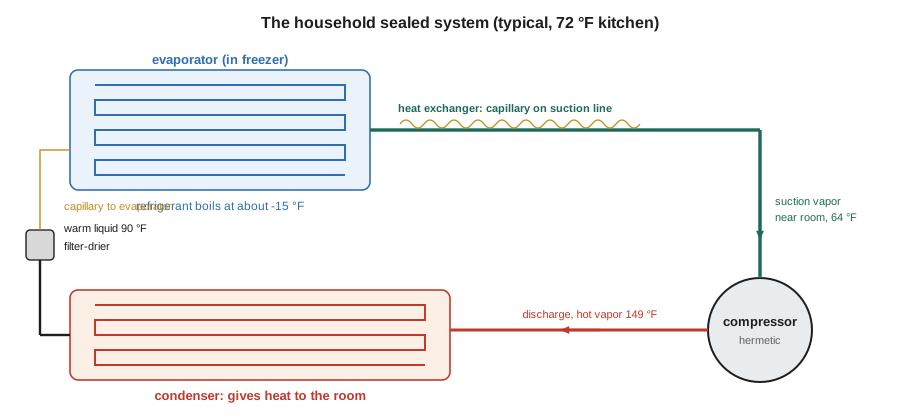
Follow the refrigerant once around the loop on Hiro's cut-away. Low-pressure vapor enters the compressor through the suction line, at a temperature not far below the kitchen because the heat exchanger has warmed it. The compressor raises the pressure several times over and the vapor leaves the discharge line hot, often warm enough to be uncomfortable to touch. The vapor enters the condenser, gives up its heat to the room and condenses to a liquid. The warm liquid passes through the filter-drier and into the capillary tube, a copper tube with a bore not much wider than a pin, that may be 10 feet long or more. Friction in the capillary drops the pressure steadily, and by the time the refrigerant reaches the evaporator it is a cold mixture of liquid and vapor. In the evaporator it boils, taking heat from the freezer air, and leaves as a cool vapor to return to the compressor.
The heat exchanger between the capillary tube and the suction line does two useful jobs. It cools the liquid in the capillary, so more of it is still liquid when it reaches the evaporator and can absorb heat there. And it warms the suction vapor, so that any last droplets of liquid boil off before they reach the compressor and so that the suction line does not sweat or frost outside the cabinet. That is why the suction line on a correctly working refrigerator is usually close to room temperature where it reaches the compressor.
Where the heat goes
The heat that a refrigerator removes from its cabinet does not disappear. It is released in the kitchen by the condenser, together with the energy the compressor and the fans use. A refrigerator therefore always adds heat to the room; it never cools a kitchen, even with its door open. If the condenser cannot shed its heat, because it is clogged with dust, because the fan has failed or because the refrigerator is boxed into a cabinet with no air space, the pressure and temperature on the high side rise, the compressor works harder and cooling suffers. Kiran's first lead call on November 13, a bottom-freezer refrigerator with a failed condenser fan motor and a clogged condenser, was exactly this kind of fault.
Because the refrigerator is a heat pump, the temperature of the room it stands in matters. Most manufacturers give an ambient range in which the refrigerator is designed to work, typically from about 55 °F to 110 °F. Below that range, in an unheated garage in winter for example, the fresh food section may get so little cooling demand that the compressor hardly runs, and in a single-thermostat design the freezer can warm up. Some models made for garages have a heater or special control to handle this; most do not. The installation instructions always state the range.
Refrigerants in household appliances
Household refrigerators have used several refrigerants over the decades. Units built before the mid-1990s used R-12, a chlorofluorocarbon (CFC) that damages the ozone layer; a few of these are still running, and many more turn up in old basement freezers like the 1992 chest freezer that Penfold prepared for Quarrington on November 9. From the mid-1990s, manufacturers changed to R-134a, a hydrofluorocarbon (HFC) that does not harm the ozone layer but is a strong greenhouse gas, with a global warming potential (GWP) of about 1,430. Over the last fifteen years, North American manufacturers have moved to R-600a, isobutane, a hydrocarbon with a GWP of about 3.
The move to hydrocarbons is now required. Under the AIM Act's Technology Transitions rule, the US Environmental Protection Agency (EPA) set a GWP limit of 150 for new household refrigerators and freezers, with compliance for manufacture and import from January 1, 2025 and a later date, January 1, 2028, after which remaining stock of older products may no longer be sold. The units already in American kitchens are not affected, and an R-134a refrigerator is still serviced with R-134a. A technician should expect to meet R-134a units for many years yet, and R-600a in almost everything built in the last few years.
R-600a is flammable. It is classed A3 in the refrigerant safety groups, the same class as propane, and that changes how the sealed system is serviced, as lessons 9 and 10 explain. The charge in a household refrigerator is small, usually well under 100 g, and the current safety standard for household refrigerators allows at most 150 g per refrigerant circuit, but a small charge released into a small room near a spark can still ignite. Every R-600a refrigerator carries flammable-refrigerant warning labels and a red mark on its process tube, and the nameplate states the refrigerant and its exact charge.
| Refrigerant | Type | Typical era in household units | Safety class | Approximate GWP |
|---|---|---|---|---|
| R-12 | CFC (ozone-depleting) | Before about 1994 | A1 | About 10,900 |
| R-134a | HFC | About 1994 to the early 2020s | A1 | About 1,430 |
| R-600a (isobutane) | Hydrocarbon | Growing from about 2010; the standard for new units since 2025 | A3 (flammable) | About 3 |
Reading the nameplate
Every refrigerator has a nameplate or rating label, usually inside the fresh food section on a side wall or behind the crisper drawers. Besides the model and serial numbers covered in APP-110, the nameplate gives the voltage and current rating, the defrost heater wattage on many models, and, most important for the sealed system, the refrigerant and its charge in grams, often with ounces as well. When the sealed system is repaired, that charge is weighed back in exactly. The nameplate is also where a technician first learns whether the unit uses a flammable refrigerant.
Worked problem
Run time from the energy rating
The refrigerator in Hiro's demonstration used to be a 2016 bottom-freezer model. Its energy label showed about 520 kWh per year. On the bench, with a watt meter, the compressor and fans together drew 96 W while running. If almost all the energy goes to the compressor and fans, about what fraction of the time did the refrigerator run?
Show solution
- Hours in a year: 365 × 24 = 8,760 h.
- Average power over the year: 520,000 Wh ÷ 8,760 h = about 59.4 W.
- Fraction of time running: 59.4 W ÷ 96 W = about 0.62.
- This ignores the defrost heater and the lights, which use some of the energy, so the real run time is a little less.
Answer: The refrigerator runs roughly 60 in 100 of the time, a little under two-thirds, which is normal for a modern unit in a warm kitchen.
Run time is one of the simplest clues a technician has. A modern refrigerator that has just been loaded with warm food will run continuously for a while, but one that runs all the time for days, or one that hardly runs at all and is warm inside, has a problem. Lesson 9 returns to run time, current and wattage as diagnostic readings.
Single-evaporator and dual-evaporator systems
Most household refrigerators have one evaporator, in the freezer, and cool the fresh food section by blowing some of the freezer's cold air into it through a duct and an air door, or damper. The proportion of air that goes to each section sets their relative temperatures, as lesson 5 explains. Some higher-end models have two evaporators, one for each section, fed in turn by a valve that switches the refrigerant flow between them, or a separate sealed system for each section. Dual-evaporator designs keep the fresh food section more humid and stop freezer odors drifting into it, but they add a valve and more controls that can fail.
Chest freezers and upright manual-defrost freezers are simpler still. They usually have no fans at all. The evaporator is a tube bonded to the inside of the cabinet liner or built into the shelves, and the condenser is often a tube bonded to the inside of the outer cabinet wall, so the outside of the cabinet feels warm. Lesson 4 covers these hot-wall condensers.
What the technician can and cannot measure
On a commercial or air conditioning system, a technician connects gauges to service valves and reads the pressures directly. On a household refrigerator there are no service valves, and the manufacturers' service instructions generally say not to attach gauges unless the sealed system is going to be opened anyway, because every connection is a chance for a leak or contamination. Most of the diagnosis is therefore done from the outside: from temperatures, frost patterns, current and wattage, and the sounds the system makes. Lesson 9 shows how much a careful technician can learn that way, and lesson 10 covers what happens when the system does have to be opened.
In the United States, anyone who opens the sealed system of a small appliance that contains a regulated refrigerant such as R-134a or R-12 must hold EPA Section 608 certification, Type I or Universal, and the refrigerant must be recovered, not released. EPA has exempted isobutane in household refrigerators from the venting prohibition, but the manufacturer's flammable-refrigerant procedure must be followed. Kiran does not yet hold Section 608 certification. He plans to take the Type I test in early December, and until then he watches and helps while Dee or Hiro handles the refrigerant.
Common mistakes
MistakeSaying the refrigerator makes cold.
InsteadIt removes heat from the cabinet and releases it, plus the energy it uses, into the room.
MistakeAssuming the refrigerant from the age of the unit.
InsteadRead the nameplate every time; the refrigerant and its exact charge are printed there.
MistakePutting gauges on a sealed system to check it.
InsteadDiagnose from the outside first; most makers say not to attach gauges unless the system is being opened.
MistakeTreating R-600a like R-134a.
InsteadR-600a is flammable; follow the manufacturer's flammable-refrigerant procedure every time.
MistakeExpecting a refrigerator to work in a freezing garage.
InsteadCheck the ambient range in the installation instructions; most units are not designed for it.
MistakeIgnoring a hot discharge line or a warm cabinet wall.
InsteadThese are normal; a cold or frosty suction line at the compressor is the one to notice.
Summary and key terms
- A refrigerator pumps heat out of its cabinet and releases it into the room through the condenser.
- The sealed system is a closed loop of compressor, condenser, filter-drier, capillary tube and evaporator, with no service valves.
- The capillary tube drops the pressure; the heat exchanger cools the liquid and warms the suction vapor.
- Typical targets are about 37 °F for fresh food and 0 °F for the freezer.
- Household refrigerants have moved from R-12 to R-134a and now to R-600a, a flammable hydrocarbon.
- New household refrigerators must use a refrigerant with a GWP of 150 or less from January 1, 2025.
- The nameplate gives the refrigerant and its exact charge in grams.
- Most diagnosis is done from outside the sealed system: temperatures, frost, current, wattage and sound.
- Sealed system
- The closed refrigerant loop of a household appliance, brazed or welded shut with no service valves.
- Evaporator
- The coil where refrigerant boils and absorbs heat from the cabinet air.
- Condenser
- The coil where hot refrigerant vapor gives up heat to the room and condenses to a liquid.
- Capillary tube
- A long, very thin tube that drops the refrigerant pressure between the condenser and the evaporator.
- Heat exchanger
- The section where the capillary tube runs alongside the suction line, cooling the liquid and warming the vapor.
- Filter-drier
- A small canister of desiccant and screen that catches moisture and debris before the capillary tube.
- GWP
- Global warming potential, a measure of how strongly a gas warms the climate compared with carbon dioxide.
- R-600a
- Isobutane, a flammable hydrocarbon refrigerant now standard in new household refrigerators.
Practice problems
Work each problem on paper first, then reveal the answer to check.
Where does the heat removed from a refrigerator's cabinet go?
Show answer
Into the room, released by the condenser together with the energy the refrigerator uses.
What does the capillary tube do?
Show answer
It drops the refrigerant pressure between the condenser and the evaporator.
Why is the suction line usually near room temperature at the compressor?
Show answer
The heat exchanger warms it with heat from the liquid in the capillary tube.
A refrigerator rated 520 kWh a year draws 96 W while running. About how much of the time does it run?
Show answer
About 60 in 100 of the time: 59.4 W average ÷ 96 W.
Where do you find the refrigerant type and charge?
Show answer
On the nameplate, usually inside the fresh food section.
Lesson quiz · 5 questions
Score 60% or more to complete this lesson.
Create a free account to save your progress, take quizzes and earn a certificate.