
AI-450 · Lesson 12 of 12 · 24 min
Safety, standards, deployment and capstone
A robot that works in a demonstration is a long way from a robot that can be deployed in a factory, warehouse, hospital or home. Deployment requires showing that the robot is safe for the people around it, that it meets the standards and regulations of its market, that it performs reliably over thousands of hours, and that it can be monitored, maintained and updated as a fleet. Learned components make each of these harder, because their behavior is less predictable and harder to verify than hand-designed software. This final lesson covers robot hazards and risk assessment, the main safety standards for industrial, collaborative and mobile robots, the four collaborative operating modes including speed and separation monitoring, functional safety, how to make learned systems safe enough to deploy, regulatory developments for AI in machinery, deployment and fleet operations, societal considerations, and the course capstone project.
Hazards and risk assessment
Robots can harm people through impact and crushing by moving parts, pinching between links or against fixtures, dropped or thrown objects, unexpected start-up, electrical and stored-energy hazards, and, for mobile robots, collisions and tipping. Risk assessment, following ISO 12100, systematically identifies hazards for every task and life-cycle phase (installation, operation, teaching, maintenance, cleaning), estimates risk from severity and probability, and reduces it in order of preference: first by inherently safe design (lower speeds, lighter arms, rounded edges), then by safeguarding and protective measures (fences, light curtains, scanners, safety-rated functions), and finally by information for use (warnings, training, procedures). The process is iterated until residual risk is acceptable and documented.
Safety standards
Robot safety standards are largely international, adopted nationally:
- ISO 10218-1 and 10218-2 cover safety requirements for industrial robots and their integration into robot systems and cells. A major revision was published in 2025, incorporating much of the earlier collaborative robot guidance from ISO/TS 15066, including body-region force and pressure limits for contact.
- ISO 13849-1 and IEC 62061 define the reliability required of safety-related control functions, as performance levels (PL a to e) or safety integrity levels (SIL 1 to 3).
- ISO 3691-4 covers driverless industrial trucks, including many autonomous mobile robots in industrial settings; ANSI/A3 R15.08 addresses industrial mobile robots in North America.
- ISO 13482 covers personal care robots, such as mobile servant robots and physical assistant robots.
In the United States, ANSI/A3 R15.06 adopts ISO 10218 for industrial robots, and ANSI/A3 R15.08 covers industrial mobile robots. OSHA has no robot-specific standard, but employers must address robot hazards under the General Duty Clause and standards such as machine guarding and lockout/tagout (29 CFR 1910.147).
Collaborative operation
Collaborative applications let people and robots share space without fences, using one or more of four modes:
- Safety-rated monitored stop: the robot stops when a person enters the collaborative space and resumes when they leave.
- Hand guiding: a person moves the robot directly using a guiding device with an enabling switch.
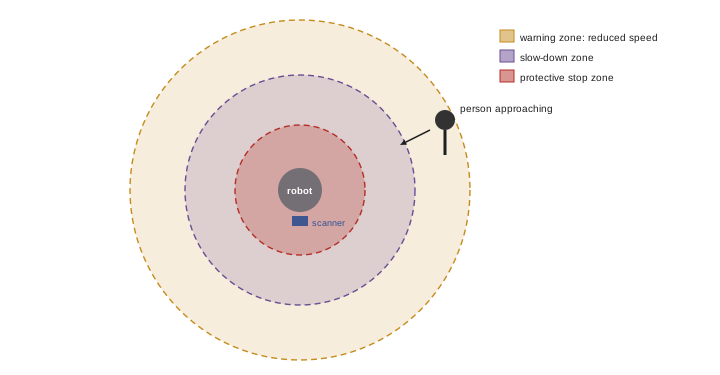
- Speed and separation monitoring (SSM): sensors track people, and the robot slows or stops to keep a protective separation distance.
- Power and force limiting (PFL): contact may occur, but the robot's design and control limit forces and pressures to values that do not cause injury to the body region involved.
Note that "collaborative" describes an application, not just a robot: a cobot carrying a knife is not safe for collaboration simply because the arm is force-limited.
# Speed and separation monitoring: protective separation distance (simplified ISO/TS 15066 form)
v_h = 1.6        # human walking speed toward the robot, m/s
t_r = 0.10       # sensing and reaction time of the safety system, s
c = 0.20         # intrusion distance allowance (reach into the sensing zone), m
z_d, z_r = 0.10, 0.05   # position uncertainty of the person and of the robot, m

def stop_time(v_r):
    return 0.15 + 0.25 * v_r            # braking takes longer at higher speed, s

def separation(v_r):
    t_s = stop_time(v_r)
    s_h = v_h * (t_r + t_s)             # person keeps moving until the robot has stopped
    s_r = v_r * t_r                     # robot moves during the reaction time
    s_s = 0.5 * v_r * t_s               # robot braking distance
    return s_h + s_r + s_s + c + z_d + z_r

for v in (0.25, 0.5, 1.0, 1.5, 2.0):
    print(f"robot speed {v:4.2f} m/s: protective separation {separation(v):.2f} m (stop time {stop_time(v):.2f} s)")

def max_speed(distance):
    lo, hi = 0.0, 3.0
    for _ in range(50):
        mid = (lo + hi) / 2
        lo, hi = (mid, hi) if separation(mid) <= distance else (lo, mid)
    return lo

for d in (1.5, 1.2, 0.9):
print(f"person detected at {d:.1f} m: robot may move at up to {max_speed(d):.2f} m/s")robot speed 0.25 m/s: protective separation 0.90 m (stop time 0.21 s) robot speed 0.50 m/s: protective separation 1.07 m (stop time 0.28 s) robot speed 1.00 m/s: protective separation 1.45 m (stop time 0.40 s) robot speed 1.50 m/s: protective separation 1.89 m (stop time 0.53 s) robot speed 2.00 m/s: protective separation 2.40 m (stop time 0.65 s) person detected at 1.5 m: robot may move at up to 1.06 m/s person detected at 1.2 m: robot may move at up to 0.68 m/s person detected at 0.9 m: robot may move at up to 0.25 m/s
The simplified calculation adds the distance a person walking at 1.6 m/s covers while the safety system reacts and the robot stops, the distance the robot travels in that time, an intrusion allowance and measurement uncertainties. At 0.25 m/s the robot needs about 0.9 m of separation, but at 2 m/s it needs 2.4 m, because stopping takes longer at higher speed and the person keeps approaching meanwhile. Inverting the relationship gives speed limits: when a person is detected at 1.2 m, the robot may move at no more than about 0.68 m/s. Real SSM implementations use certified sensors, validated stopping data from the robot manufacturer and the full equations of the standards.
Functional safety and learned components
Safety functions such as protective stops, speed limits and zone monitoring must achieve required performance levels, which means certified hardware, redundant channels, diagnostics and validated software. Neural networks and other learned components cannot currently be certified to these levels in the way traditional safety software can. The standard practice is therefore architectural separation: learned components may decide what the robot tries to do, but independent, certified safety functions limit what it can physically do. Additional techniques for making learned systems safer include:
- Runtime monitors and safety filters (sometimes called shields) that check each commanded action against constraints, such as joint limits, workspace boundaries, speed limits and predicted collisions, and override unsafe commands.
- Out-of-distribution detection that recognizes unfamiliar situations and switches to a conservative fallback behavior or asks for help.
- Extensive scenario-based testing in simulation and the real world, including rare and adversarial cases.
- Formal verification of simpler components where possible.
- Human oversight, with clear ways to pause, take over or stop the robot.
Regulation of AI in machinery
Regulation is catching up with learned robots. In the European Union, the Machinery Regulation (EU) 2023/1230, applying from January 2027, replaces the Machinery Directive and explicitly addresses machinery with self-evolving behavior and safety functions relying on machine learning, requiring third-party conformity assessment for certain such systems. The EU AI Act treats AI systems that are safety components of products such as machinery as high-risk, with obligations whose application dates were adjusted by the 2026 Digital Omnibus amendments. Manufacturers selling into multiple markets must track these developments alongside product liability rules, which increasingly cover software and AI.
In the United States, robot manufacturers and integrators should track the EU rules for exported machinery, product liability law, OSHA enforcement, and state and federal developments in AI governance, alongside voluntary frameworks such as the NIST AI Risk Management Framework.
Deployment and fleet operations
Deployed robots are managed as fleets. Operations include monitoring health and performance (task success, interventions per hour, faults, battery state), logging sensor data and decisions so failures can be diagnosed, remote assistance where a human operator helps a stuck robot, scheduled maintenance, and software and model updates. Updating learned models in a deployed fleet needs the same discipline as other safety-relevant changes: version control of models and data, regression testing against stored scenarios, staged rollouts to a few robots before the whole fleet, monitoring for regressions, and the ability to roll back. Field data, especially failures and interventions, is the most valuable input for improving policies, closing a data flywheel between deployment and training.
Worked problem
Measuring deployment readiness
A warehouse picking robot completes 1,200 picks per shift with 18 failed picks requiring human intervention. The customer requires at most one intervention per 200 picks. Does the robot meet the requirement, and how might the team improve it?
Show solution
- Intervention rate: 18 ÷ 1,200 = 1.5 %, or one per 66.7 picks.
- Requirement: one per 200 picks = 0.5 %.
- The robot is three times worse than required.
- Improvement: categorize the 18 failures (perception, grasp, placement, item type), collect targeted data for the top categories, add recovery behaviors such as automatic re-grasping, and re-evaluate over many shifts.
Answer: Not yet: 1.5 % against a 0.5 % target. Systematic failure analysis and targeted data collection usually yield the largest gains.
Societal considerations
Robots change work. Automation can remove dangerous and repetitive tasks and address labor shortages, but it also displaces jobs and changes skill requirements; responsible deployment involves workers in planning, training and redesign of roles. Robots in homes, hospitals and public spaces collect images and audio of people, raising privacy obligations about what is recorded, stored and shared. Accessibility, fairness in how robots perceive and serve different people, and clear accountability when things go wrong are part of responsible robotics, as are the concerns about dual use and misuse of capable autonomous machines.
Capstone project
The capstone integrates the course. In simulation (for example with MuJoCo, Isaac Lab, PyBullet or Gazebo), build a mobile manipulator or arm system that performs a pick-and-place task from a language instruction:
- Robot model and kinematics: load a robot description, implement or use forward and inverse kinematics, and verify frames (Lessons 2 and 3).
- Perception: detect the target object with a depth camera and estimate its pose (Lesson 4).
- Estimation and mapping (for mobile bases): localize in a map (Lessons 5 and 6).
- Planning and control: plan collision-free motions and track them with appropriate controllers (Lessons 7 and 8).
- Learning: train or fine-tune one component with RL or imitation learning, using domain randomization or DAgger-style data where relevant (Lessons 9 and 10).
- Language: use a language or vision-language model to choose among skills, grounded by feasibility checks (Lesson 11).
- Safety: implement a safety filter enforcing speed and workspace limits, a simple speed and separation monitor for a simulated person, and a risk assessment (Lesson 12).
Evaluate success over at least 50 randomized trials, analyze failures, and present the system with a short report covering design decisions, results with confidence intervals, limitations and safety considerations.
Common mistakes
MistakeCalling a robot collaborative because it is a cobot.
InsteadAssess the whole application, including tools and parts.
MistakeRelying on a neural network for safety functions.
InsteadUse certified safety functions independent of learned components.
MistakeRunning fast near people without SSM calculations.
InsteadCompute protective separation and limit speed accordingly.
MistakeUpdating fleet models all at once.
InsteadTest, stage rollouts, monitor and keep rollback ready.
MistakeIgnoring workers and privacy in deployment.
InsteadInvolve workers and handle personal data responsibly.
Summary and key terms
- Risk assessment per ISO 12100 identifies hazards and reduces risk by design, safeguards and information.
- ISO 10218 (revised 2025), ISO 13849, IEC 62061, ISO 3691-4 and ISO 13482 govern robot safety.
- Collaborative modes are monitored stop, hand guiding, speed and separation monitoring, and power and force limiting.
- Protective separation grows quickly with robot speed; SSM sets speed limits by distance.
- Learned components sit inside certified safety layers, runtime monitors and fallbacks.
- The EU Machinery Regulation and AI Act add requirements for AI in machinery.
- Fleet deployment needs monitoring, logging, staged updates and attention to workers and privacy.
- Risk assessment
- Identifying hazards and estimating and reducing risk.
- ISO 10218
- The international standard for industrial robot safety.
- Performance level
- A measure of safety function reliability under ISO 13849.
- Collaborative application
- A task where people and robots share space.
- Speed and separation monitoring
- Keeping a protective distance by slowing or stopping.
- Power and force limiting
- Limiting contact forces to safe values.
- Protective separation distance
- The minimum distance needed to stop safely.
- Safety filter
- A runtime check that overrides unsafe commands.
- Staged rollout
- Deploying updates gradually to a fleet.
- Data flywheel
- Using field data to improve models continuously.
Practice problems
Work each problem on paper first, then reveal the answer to check.
What is the order of preference for risk reduction?
Show answer
Inherently safe design, safeguards and protective measures, information for use.
Name four robot safety standards.
Show answer
ISO 10218, ISO 13849, IEC 62061, ISO 3691-4, ISO 13482.
List the four collaborative modes.
Show answer
Monitored stop, hand guiding, SSM, PFL.
Why is a cobot not automatically safe?
Show answer
The application, including tools and parts, may be hazardous.
What separation is needed at 1 m/s in the example?
Show answer
About 1.45 m.
What speed is allowed with a person at 0.9 m?
Show answer
About 0.25 m/s.
Why can neural networks not provide certified safety functions today?
Show answer
Their behavior cannot be verified to the required levels.
Name three techniques for safer learned systems.
Show answer
Safety filters, out-of-distribution detection, scenario testing, human oversight.
When does the EU Machinery Regulation apply?
Show answer
From January 2027.
A robot has 6 interventions in 900 picks. What is the rate?
Show answer
About 0.67 %, one per 150 picks.
Lesson quiz · 5 questions
Score 60% or more to complete this lesson.
Create a free account to save your progress, take quizzes and earn a certificate.