
AI-450 · Lesson 10 of 12 · 24 min
Imitation learning from demonstrations
For many manipulation tasks, it is far easier to show a robot what to do than to write a reward function or a controller. Folding a shirt, loading a dishwasher, or plugging in a cable involve subtle sequences of contacts and adjustments that a human operator performs naturally. Imitation learning trains policies from demonstrations of the task, and since around 2023 it has become the leading approach for learning dexterous manipulation, driven by low-cost teleoperation hardware and new policy architectures that handle the variety in human demonstrations. Imitation learning has its own pitfalls, most famously the compounding of small errors once the robot drifts away from the states it saw in training. This lesson covers how demonstrations are collected, behavior cloning, distribution shift and DAgger, the problem of multimodal demonstrations and the architectures that address it (action chunking and diffusion policies), the importance of data scale, diversity and quality, other forms of learning from humans, and how to evaluate learned policies honestly.
Collecting demonstrations
Demonstrations pair observations (camera images, joint states) with the actions the demonstrator took. Common collection methods include:
- Kinesthetic teaching: physically guiding a compliant robot arm through the task while it records joint trajectories. Simple, but the demonstrator's hands appear in camera images and two-handed tasks are awkward.
- Teleoperation with leader-follower arms: the operator moves a small "leader" arm whose joint angles are copied by the robot "follower" arms. Low-cost bimanual systems of this kind have made high-quality data collection accessible to many labs.
- Virtual reality and motion capture: the operator's hand and head motions, tracked by a VR headset or gloves, are mapped to the robot's arms and grippers, useful for humanoids and dexterous hands.
- Handheld data collection devices: hand-held grippers with cameras that record demonstrations without a robot present, later transferred to robots with matching grippers, allowing data collection in many real environments.
Teleoperation quality matters: lag, poor depth perception and missing force feedback make demonstrations slower and less smooth, and policies learn whatever is in the data, including hesitations and mistakes.
Behavior cloning
The simplest approach, behavior cloning (BC), treats imitation as supervised learning: train a network to predict the demonstrator's action from the observation, minimizing the difference between predicted and demonstrated actions. BC is straightforward, uses standard deep learning tools, and can learn complex visuomotor skills from tens to hundreds of demonstrations for a single task. It underlies most modern manipulation policies, including large multi-task models (Lesson 11).
Distribution shift and compounding errors
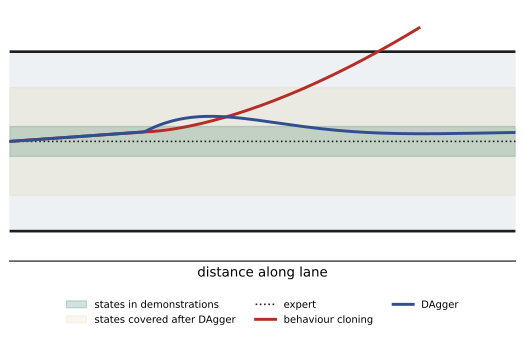
BC has a fundamental weakness. The policy is trained only on states the expert visited. When it makes a small mistake at test time, it reaches a state slightly outside the training data, where its predictions are less reliable, leading to larger mistakes and states further from the data. Errors compound, and in theory can grow quadratically with the length of the task. The example below shows the effect with a simple lookup-table policy for lane keeping.
import numpy as np
# Behavior cloning versus DAgger for lane keeping with a lookup-table policy
rng = np.random.default_rng(10)
dt = 0.1
def dynamics(s, u):
    y, th = s                                   # lateral offset (m), heading (rad)
    th = th + u * dt + rng.normal(0, 0.02)      # steering changes heading, with noise
    y = y + 2.0 * np.sin(th) * dt               # 2 m/s forward speed
    return np.array([y, th])

def expert(s):
    return float(np.clip(-1.5 * s[0] - 3.0 * s[1], -1, 1))

edges_y, edges_t = np.linspace(-2, 2, 41), np.linspace(-1, 1, 41)
def key(s):
    return (int(np.digitize(s[0], edges_y)), int(np.digitize(s[1], edges_t)))

def rollout(policy, steps=150, start_sd=0.05, push=False):
    s = rng.normal(0, start_sd, 2); visited = []
    for t in range(steps):
        if push and t == 30:
            s = s + np.array([0.0, 0.35])       # a disturbance, like a gust or a pothole
        visited.append(s.copy())
        s = dynamics(s, policy(s))
        if abs(s[0]) > 1.5:
            return visited, True                # left the lane
    return visited, False

def make_policy(table):
    return lambda s: table.get(key(s), 0.0)     # unseen states: go straight

table = {}
for _ in range(50):                             # behavior cloning: expert demonstrations only
    states, _ = rollout(expert)
    for s in states:
        table[key(s)] = expert(s)

def failure_rate(policy, trials=300):
    return np.mean([rollout(policy, push=True)[1] for _ in range(trials)])

print(f"expert failure rate with disturbance: {failure_rate(expert):.1%}")
print(f"behavior cloning ({len(table)} table entries): {failure_rate(make_policy(table)):.1%}")
for it in range(1, 6):                          # DAgger: run the learner, ask the expert to label what it visits
    for _ in range(30):
        states, _ = rollout(make_policy(table), push=True)
        for s in states:
            table[key(s)] = expert(s)
print(f"DAgger iteration {it} ({len(table)} entries): {failure_rate(make_policy(table)):.1%}")expert failure rate with disturbance: 0.0% behavior cloning (19 table entries): 99.7% DAgger iteration 1 (160 entries): 0.3% DAgger iteration 2 (162 entries): 0.0% DAgger iteration 3 (163 entries): 0.0% DAgger iteration 4 (164 entries): 0.0% DAgger iteration 5 (164 entries): 0.0%
Trained only on the expert's smooth demonstrations, the behavior cloning policy has seen only a narrow band of states near the lane center. After a disturbance pushes the vehicle into unfamiliar states, it has no idea what to do and leaves the lane almost every time. DAgger (dataset aggregation) fixes this by running the learner's own policy, recording the states it actually visits, asking the expert what it would have done in each, and adding those labels to the training set. After a single iteration, the table covers the states the learner gets itself into, and failures almost disappear.
In real robotics, DAgger-style corrections are gathered by letting the robot run while an operator intervenes when it goes wrong (interactive or human-gated imitation), and by deliberately collecting recovery demonstrations from perturbed states. Adding noise to the demonstrator's actions during collection (so the data includes small deviations and corrections) also helps. Real policies use neural networks that generalize better than a lookup table, but the underlying problem of distribution shift remains.
Multimodal demonstrations
Humans do not perform a task the same way every time. To go around an obstacle, a demonstrator may pass left in some demonstrations and right in others. A policy trained with a simple regression loss predicts the average of these actions, straight into the obstacle. Demonstrations are also noisy and inconsistent in timing. Modern imitation learning architectures address these problems:
- Action chunking: predicting a sequence of future actions (for example the next 50 to 100 steps) rather than one step at a time, executed with temporal smoothing. Chunking reduces compounding errors, handles pauses and hesitations in the data, and produces smoother motion. The Action Chunking with Transformers (ACT) architecture popularized this for bimanual manipulation.
- Diffusion policies: generating action sequences by iteratively denoising random noise, conditioned on observations, just as image diffusion models generate pictures. They represent multimodal action distributions naturally, choosing one coherent way of doing the task rather than averaging several, and have become a leading approach for visuomotor policies. Flow matching provides a related, often faster, generative approach.
- Discretized or tokenized actions, predicted with classification or by transformers as sequences of tokens, which also represent multiple modes.
Data scale, diversity and quality
Policies trained on a few hundred demonstrations in one setting often fail when lighting, backgrounds, object positions or object types change. Generalization requires diverse data: many objects, scenes, lighting conditions, camera positions and operators. Large multi-institution datasets pooling demonstrations from many robots and tasks, such as the Open X-Embodiment collection, support cross-embodiment training (Lesson 11). Data quality matters as much as quantity: consistent, efficient, successful demonstrations produce better policies than a large volume of hesitant or inconsistent ones, and data curation, filtering failed or poor demonstrations, is an important practical step. Collection costs real time and money, so teams plan data collection like an engineering project.
Worked problem
Planning a data collection campaign
A team wants 2,000 demonstrations of a kitchen task across 20 kitchens (100 per kitchen). Each demonstration takes 45 seconds plus 75 seconds for resetting the scene and saving, and an operator can work productively for 5 hours a day. How many operator-days are needed, and how could they reduce the cost?
Show solution
- Time per demonstration: 45 + 75 = 120 s = 2 minutes.
- Total time: 2,000 × 2 = 4,000 minutes ≈ 66.7 hours.
- Operator-days: 66.7 ÷ 5 ≈ 13.3, so about 14 days, plus travel and setup in 20 kitchens.
- Reducing cost: faster resets (reset is most of the time), multiple operators in parallel, handheld collection devices that avoid moving a robot between kitchens, and filtering to avoid collecting redundant data.
Answer: About 14 operator-days of collection. Resetting dominates the cost, so improving resets or collecting longer multi-step demonstrations is the biggest saving.
Other ways of learning from humans
- Inverse reinforcement learning infers a reward function that explains the demonstrations, then optimizes it, potentially generalizing beyond the demonstrated states.
- Learning from human videos: internet and egocentric videos of people doing tasks contain vast information about how objects are manipulated, though they lack robot actions; methods extract hand trajectories, object motions or learned latent actions, and use video for pre-training representations.
- Corrections and preferences: humans correct robot behavior during execution or rank alternative behaviors, providing feedback cheaper than full demonstrations.
- Combining imitation and RL: imitation provides a starting policy and RL fine-tunes it in simulation or the real world for robustness and speed.
Evaluating learned policies
Evaluating robot policies is harder than evaluating classifiers. Success depends on random object placements, lighting and small details, so results from a handful of trials are noisy. Good practice includes running many trials (tens to hundreds) with randomized but documented conditions, reporting success rates with confidence intervals, testing on unseen objects and scenes to measure generalization, recording failure modes, and comparing against baselines under identical conditions. Simulation benchmarks help reproducibility but may not reflect real-world performance, so real-world evaluations remain essential for claims about deployment readiness.
Imitation learning in industry
Imitation learning is moving from research labs into commercial applications. Companies use teleoperated demonstrations to teach robots tasks such as kitting, packing irregular items, laboratory sample handling and garment handling, where traditional programming is impractical. A common pattern is a human-in-the-loop service: robots operate autonomously most of the time, remote operators take over when the robot is unsure or fails, and those interventions become new training data. This approach delivers value while the policy is still imperfect and steadily reduces the need for human help, but it requires careful attention to latency, operator training, data privacy and the cost of remote support.
Whatever the setting, the quality of an imitation-learned policy is bounded by the quality of the demonstrations and the coverage of situations it will meet. Planning data collection deliberately, with recoveries, variety and honest evaluation, is the core engineering skill of this approach.
Teams should also budget for re-collecting data when hardware changes. A new gripper, a moved camera or a different robot arm can invalidate a dataset, so documenting the exact setup used for each demonstration is essential for reproducing and extending results.
Common mistakes
MistakeCollecting only perfect, smooth demonstrations.
InsteadInclude recoveries, perturbations and interventions.
MistakeTraining a simple regression policy on multimodal demonstrations.
InsteadUse action chunking, diffusion or tokenized actions.
MistakeTraining and testing in one unchanged scene.
InsteadCollect diverse data and test on unseen conditions.
MistakeKeeping failed or hesitant demonstrations without review.
InsteadCurate data for quality and consistency.
MistakeReporting success from a few trials.
InsteadRun many trials with confidence intervals and baselines.
Summary and key terms
- Imitation learning trains policies from demonstrations collected by kinesthetic teaching, teleoperation, VR or handheld devices.
- Behavior cloning treats imitation as supervised learning of actions from observations.
- Distribution shift causes compounding errors; DAgger and recovery data address it.
- Multimodal demonstrations break averaging policies; action chunking and diffusion policies handle them.
- Generalization needs diverse, high-quality data, often pooled across robots.
- Inverse RL, human videos, corrections and RL fine-tuning complement imitation.
- Honest evaluation uses many trials, unseen conditions, confidence intervals and baselines.
- Imitation learning
- Learning a policy from demonstrations.
- Teleoperation
- Controlling a robot remotely to perform a task.
- Leader-follower arms
- A teleoperation setup where a robot copies a hand-moved arm.
- Behavior cloning
- Supervised learning of actions from observations.
- Distribution shift
- Test states differing from training states.
- DAgger
- Dataset aggregation with expert labels on learner-visited states.
- Action chunking
- Predicting sequences of future actions.
- Diffusion policy
- A policy generating actions by iterative denoising.
- Multimodality
- Several distinct valid ways to perform a task.
- Inverse reinforcement learning
- Inferring a reward from demonstrations.
Practice problems
Work each problem on paper first, then reveal the answer to check.
Name four ways to collect demonstrations.
Show answer
Kinesthetic teaching, leader-follower teleoperation, VR, handheld devices.
What does behavior cloning minimize?
Show answer
The difference between predicted and demonstrated actions.
Why do errors compound in BC?
Show answer
Mistakes lead to unfamiliar states where predictions are worse.
How does DAgger fix distribution shift?
Show answer
It labels states the learner visits with expert actions.
What happened after one DAgger iteration in the example?
Show answer
Failures fell from almost 100 % to under 1 %.
Why does averaging fail with multimodal demonstrations?
Show answer
The average of left and right can go straight into the obstacle.
What are two benefits of action chunking?
Show answer
Fewer compounding errors and smoother motion.
How long would 600 demonstrations at 90 s each take?
Show answer
15 hours.
Name two alternatives to full demonstrations.
Show answer
Corrections and preferences, human videos.
How should policies be evaluated?
Show answer
Many trials, unseen conditions, confidence intervals and baselines.
Lesson quiz · 5 questions
Score 60% or more to complete this lesson.
Create a free account to save your progress, take quizzes and earn a certificate.