
AERO-420 · Lesson 8 of 12 · 26 min
Interplanetary trajectories
Most of this course concerns Earth orbit, but the same mechanics carry spacecraft to the Moon, the planets and beyond. The division has been invited to join a study with NASA and several universities for a small Mars orbiter that would carry an atmospheric instrument from Flint Hills State University. The study will not commit to anything for years, but Dr. Watanabe wants the team to speak the language of interplanetary mission design: patched conics, excess speed, launch energy, porkchop plots and gravity assists. Arjun produces a first-cut trajectory for a Mars mission, and the numbers set the size of the spacecraft and the launcher class the study would need.
Interplanetary flight is dominated by the Sun. Once a spacecraft has left the Earth's neighborhood, the Sun's gravity is thousands of times stronger than the Earth's, and the spacecraft follows a heliocentric orbit, an ellipse around the Sun, until it approaches its target. The planets themselves move at tens of kilometers per second around the Sun, and the art of trajectory design is to arrange departure and arrival so that the spacecraft and the target planet meet at the same point at the same time.
Patched conics
A full trajectory is governed by the Sun and every planet at once, a problem that must be integrated numerically. For preliminary design the patched-conic approximation is remarkably good. Space is divided into regions. Near each planet, within its sphere of influence, only that planet's gravity counts and the spacecraft follows a hyperbola relative to the planet. Outside, only the Sun counts and the path is a heliocentric conic. The pieces are joined at the boundaries, where the spacecraft's velocity relative to the planet becomes its hyperbolic excess velocity \(v_\infty\). The Earth's sphere of influence has a radius of about 925,000 km, roughly 0.006 astronomical units, so on the scale of the solar system the departure and arrival hyperbolas are points, and the heliocentric transfer can be drawn from the center of the Earth to the center of Mars.
The radius of the sphere of influence comes from comparing the planet's perturbation of the Sun-centered motion with the Sun's perturbation of planet-centered motion, giving
where \(a_p\) is the planet's distance from the Sun. For Mars it is about 577,000 km.
The heliocentric Hohmann transfer
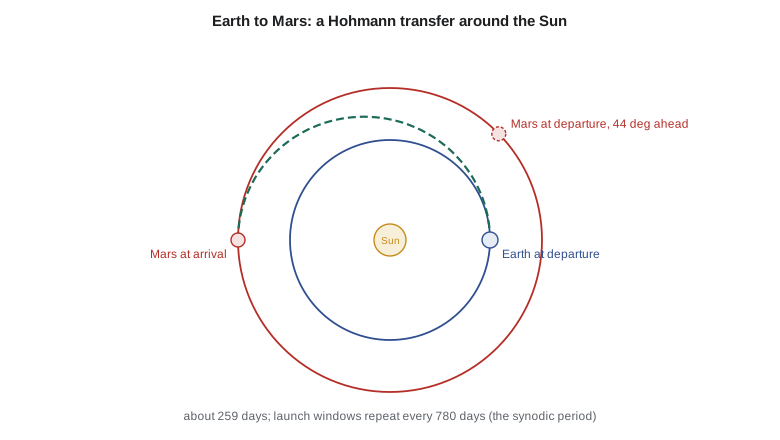
The simplest transfer between two planets on circular, coplanar orbits is a Hohmann transfer around the Sun, exactly as in Lesson 4 but with the Sun's gravitational parameter, \(\mu_\odot = 1.327 \times 10^{11}\) km³/s². The transfer ellipse touches the Earth's orbit at perihelion and the orbit of Mars at aphelion. The spacecraft must leave the Earth with a speed relative to the Sun higher than the Earth's own orbital speed, and the difference is the departure excess speed. At Mars it arrives slower than Mars, so Mars catches up with it, and the difference is the arrival excess speed.
# Patched-conic Earth-Mars Hohmann transfer: v-infinity, C3, departure burn from a 300 km parking orbit,
# Mars orbit insertion, transfer time and synodic period.
import math
MU_SUN = 1.32712440018e11; AU = 1.495978707e8
MU_E, R_E = 398600.4418, 6378.137
MU_M, R_M = 42828.37, 3389.5
r1, r2 = 1.000*AU, 1.524*AU
at = (r1 + r2)/2
v1, v2 = math.sqrt(MU_SUN/r1), math.sqrt(MU_SUN/r2)
vp_t = math.sqrt(MU_SUN*(2/r1 - 1/at)); va_t = math.sqrt(MU_SUN*(2/r2 - 1/at))
vinf_dep, vinf_arr = vp_t - v1, v2 - va_t
t_transfer = math.pi*math.sqrt(at**3/MU_SUN)
print(f"heliocentric: Earth {v1:.3f} km/s, Mars {v2:.3f} km/s; transfer perihelion {vp_t:.3f}, aphelion {va_t:.3f} km/s")
print(f"v_inf departure {vinf_dep:.3f} km/s (C3 = {vinf_dep**2:.2f} km^2/s^2), arrival {vinf_arr:.3f} km/s")
print(f"transfer time {t_transfer/86400:.0f} days")
rp = R_E + 300
v_park = math.sqrt(MU_E/rp); v_hyp = math.sqrt(vinf_dep**2 + 2*MU_E/rp)
print(f"departure burn from 300 km: {v_hyp - v_park:.3f} km/s")
rpm = R_M + 400
v_hyp_m = math.sqrt(vinf_arr**2 + 2*MU_M/rpm)
v_circ_m = math.sqrt(MU_M/rpm)
a_cap = (rpm + R_M + 33000)/2; v_cap = math.sqrt(MU_M*(2/rpm - 1/a_cap))
print(f"Mars insertion at 400 km: into circular {v_hyp_m - v_circ_m:.3f} km/s, into 400 x 33,000 km capture ellipse {v_hyp_m - v_cap:.3f} km/s")
T_E, T_M = 365.256, 686.980
syn = 1/abs(1/T_E - 1/T_M)
phase = 180 - math.degrees(2*math.pi/T_M*(t_transfer/86400))
print(f"synodic period {syn:.0f} days ({syn/365.25:.2f} years); Mars must lead Earth by {phase:.1f} deg at departure")heliocentric: Earth 29.785 km/s, Mars 24.127 km/s; transfer perihelion 32.731, aphelion 21.477 km/s v_inf departure 2.946 km/s (C3 = 8.68 km^2/s^2), arrival 2.650 km/s transfer time 259 days departure burn from 300 km: 3.590 km/s Mars insertion at 400 km: into circular 2.081 km/s, into 400 x 33,000 km capture ellipse 0.918 km/s synodic period 780 days (2.14 years); Mars must lead Earth by 44.3 deg at departure
The Earth moves around the Sun at 29.79 km/s and Mars at 24.13 km/s. The transfer ellipse needs 32.73 km/s at perihelion, so the spacecraft must leave the Earth's sphere of influence with 2.95 km/s of excess speed, in the direction of the Earth's motion. The square of this speed is the launch energy \(C_3\), here 8.68 km²/s². Launch vehicle user guides quote their performance as payload mass against \(C_3\), so this single number tells the study team what launcher class it needs. At arrival the spacecraft moves at 21.48 km/s and Mars at 24.13 km/s, so it approaches Mars at 2.65 km/s relative to the planet.
Departure and capture
The excess speed is achieved by a burn deep in the Earth's gravity well. A spacecraft in a 300 km parking orbit moves at 7.73 km/s. The departure hyperbola that gives \(v_\infty = 2.95\) km/s has, at the same altitude, a speed
which is 11.32 km/s, so the departure burn is 3.59 km/s. The burn is much larger than the 2.95 km/s excess speed, but much smaller than the 2.95 km/s plus the 3.2 km/s escape increment would suggest if the two were added naively. Burning deep in the gravity well, where the spacecraft is already moving fast, converts propellant into kinetic energy most efficiently. This is the Oberth effect, and it is why departure and capture burns are always made as close to the planet as is safe.
At Mars the same physics runs backward. Arriving at 2.65 km/s, the spacecraft reaches 400 km altitude at a much higher speed, and a burn there captures it. Capture directly into a low circular orbit needs 2.08 km/s. Capture into a long ellipse, 400 km by 33,000 km, needs only 0.92 km/s, because the spacecraft is left with nearly enough energy to escape. Most Mars orbiters capture into a long ellipse and then lower the apoapsis, either with further burns or by aerobraking: dipping repeatedly into the upper atmosphere to shed speed by drag, as Mars Global Surveyor, Mars Odyssey, Mars Reconnaissance Orbiter and Trace Gas Orbiter did. Aerobraking saves hundreds of meters per second of propellant at the cost of months of careful operations.
Phasing and the synodic period
The transfer takes 259 days, during which Mars moves through about 136 degrees of its orbit. To meet the spacecraft at aphelion, Mars must therefore be 44 degrees ahead of the Earth at departure. That alignment recurs only once every synodic period, the time for the faster Earth to gain a full lap on Mars:
which is 780 days, about 2.14 years. Mars launch windows therefore open roughly every 26 months, and missions that miss a window wait more than two years for the next. Recent windows have been in 2020, 2022, late 2024 and late 2026, which is why Mars missions cluster in those years.
Real orbits and porkchop plots
The orbits of Earth and Mars are neither circular nor coplanar. Mars has an eccentricity of 0.093, so its distance from the Sun varies between 1.38 and 1.67 astronomical units, and its orbit is inclined 1.85 degrees to the Earth's. As a result, the cost of a Mars mission changes noticeably from one window to the next over a cycle of about 15 to 17 years. Real missions are designed by solving Lambert's problem, from Lesson 3, for every combination of departure date and arrival date in a window. The departure \(C_3\) and the arrival \(v_\infty\) are then plotted as contours against the two dates. The plots have a characteristic shape that gives them their name, porkchop plots, and the mission team picks a launch period, usually two to four weeks long, inside the lowest contours.
A pure Hohmann transfer turns out to be impractical between non-coplanar orbits, because a transfer of exactly 180 degrees needs a large plane change. Real transfers are either a little shorter than 180 degrees, called type I, or a little longer, called type II, and the porkchop plot shows both families as separate low-energy regions.
Gravity assists
A spacecraft that flies past a planet leaves with the same speed relative to the planet that it arrived with, but in a different direction. Relative to the Sun, however, that change of direction can add or remove a great deal of speed, because the planet's own orbital velocity is added to a rotated vector. This is a gravity assist. It costs no propellant and it has made possible most missions to the outer planets: Voyager 2 used Jupiter, Saturn and Uranus to reach Neptune, and Cassini reached Saturn after flybys of Venus twice, the Earth and Jupiter. Missions to Mercury, such as BepiColombo, use repeated flybys of Earth, Venus and Mercury itself to slow down, because reaching Mercury from Earth needs a large reduction in orbital energy. The bending of the trajectory depends on how close the spacecraft passes, through the hyperbola's turning angle, and mission designers can tune the flyby altitude to send the spacecraft to its next target.
The Moon as a stepping stone
Lunar missions sit between Earth orbit and interplanetary flight. The Moon is about 384,400 km away and moves at about 1.02 km/s around the Earth. A direct transfer from a low parking orbit needs a burn of about 3.1 km/s and takes three to five days, very close to a Hohmann transfer with the Moon's gravity added near arrival. Low-energy transfers that loop out toward the Sun–Earth Lagrange points take three to four months instead, but need noticeably less propellant for lunar orbit insertion; small missions such as NASA's CAPSTONE in 2022 used this route. The Moon also serves as a gravity-assist body: a lunar flyby can add or remove several hundred meters per second for a spacecraft heading into deep space.
The Artemis II crew flew around the Moon in April 2026, the first crewed lunar flight since 1972, and the commercial lunar landers flying under NASA's programs give the study partners in Wichita a practical interest in cislunar trajectories as well as Mars.
Navigation and communication
Interplanetary navigation relies on radio tracking from large ground antennas, such as NASA's Deep Space Network, with stations in California, Spain and Australia so that a spacecraft is always in view of one. Two-way Doppler measures the line-of-sight velocity to a fraction of a millimeter per second, ranging measures distance to meters, and interferometry between two stations measures direction precisely. Trajectory correction maneuvers, typically a few meters per second each, refine the path several times during the cruise. The light time to Mars varies from about 3 to 22 minutes each way, so the spacecraft must carry out time-critical events such as orbit insertion autonomously.
| Quantity | Earth to Mars Hohmann | Comment |
|---|---|---|
| Departure excess speed | 2.95 km/s | \(C_3 = 8.68\) km²/s² |
| Departure burn from 300 km | 3.59 km/s | Oberth effect |
| Transfer time | 259 days | half the transfer ellipse period |
| Arrival excess speed | 2.65 km/s | relative to Mars |
| Capture into 400 x 33,000 km | 0.92 km/s | then aerobrake or lower apoapsis |
| Synodic period | 780 days | windows about every 26 months |
Worked problem
Excess speed
Find the departure excess speed for an Earth to Mars Hohmann transfer.
Show solution
- \(a_t = (1 + 1.524)/2 = 1.262\) AU \(= 1.888\times10^{8}\) km.
- \(v_p = \sqrt{\mu_\odot(2/r_1 - 1/a_t)} = 32.73\) km/s; \(v_E = \sqrt{\mu_\odot/r_1} = 29.78\) km/s.
Answer: \(v_\infty = 2.95\) km/s.
Worked problem
Departure burn
From a 300 km parking orbit, what burn gives \(v_\infty = 2.95\) km/s?
Show solution
- \(r_p = 6678\) km; \(v_p = \sqrt{2.95^2 + 2(398600)/6678} = \sqrt{8.68 + 119.38} = 11.32\) km/s.
- Parking orbit speed \(= \sqrt{398600/6678} = 7.73\) km/s.
Answer: 3.59 km/s.
Worked problem
Synodic period
Find the synodic period of Mars as seen from Earth.
Show solution
- \(1/T_{syn} = 1/365.256 - 1/686.980 = 0.0027378 - 0.0014556 = 0.0012822\) per day.
Answer: 780 days.
Common mistakes
MistakeTreating the departure burn as \(v_\infty\).
InsteadThe burn is made deep in the gravity well and differs from \(v_\infty\).
MistakeAdding escape speed and \(v_\infty\) to get the burn.
InsteadSpeeds combine by energy: \(v_p^2 = v_\infty^2 + 2\mu/r_p\).
MistakeCapturing directly into a low orbit.
InsteadCapture into an ellipse is much cheaper; lower it afterward.
MistakeAssuming every Mars window costs the same.
InsteadEccentricity and inclination make the cost vary over about 15 to 17 years.
MistakeExpecting a gravity assist to change speed relative to the flyby planet.
InsteadIt changes direction relative to the planet and speed relative to the Sun.
Summary and key terms
- Interplanetary trajectories are designed with patched conics: hyperbolas near each planet joined to a heliocentric orbit through the hyperbolic excess speed.
- An Earth to Mars Hohmann transfer needs a departure excess speed of 2.95 km/s, a launch energy of 8.68 km²/s² and 259 days, with windows every 780 days.
- Burns are made deep in gravity wells to exploit the Oberth effect, and capture into an ellipse followed by aerobraking saves propellant.
- Real missions use Lambert solutions plotted as porkchop plots, and gravity assists open the outer solar system.
- Patched conics
- An approximation that joins two-body conics in different spheres of influence.
- Sphere of influence
- The region where a planet's gravity dominates the spacecraft's motion.
- Hyperbolic excess speed
- The speed relative to a planet far from it on a hyperbola.
- C3
- The launch energy, the square of the departure excess speed.
- Oberth effect
- The greater efficiency of burns made at high speed deep in a gravity well.
- Synodic period
- The time between repeats of the same planetary alignment.
- Porkchop plot
- Contours of launch energy and arrival speed against departure and arrival dates.
- Gravity assist
- A planetary flyby that changes the heliocentric velocity without propellant.
Practice problems
Work each problem on paper first, then reveal the answer to check.
How long does an Earth to Mars Hohmann transfer take?
Show answer
About 259 days.
How far ahead of Earth must Mars be at departure?
Show answer
About 44 degrees.
Why are capture burns cheaper into an ellipse?
Show answer
The spacecraft keeps most of its energy and needs only a small speed reduction.
What does C3 tell a mission designer?
Show answer
The launch energy, which sets the launcher and payload mass.
Why do Mars windows repeat about every 26 months?
Show answer
That is the synodic period of 780 days.
Name one mission that used aerobraking at Mars.
Show answer
Mars Reconnaissance Orbiter, among others.
Lesson quiz · 5 questions
Score 60% or more to complete this lesson.
Create a free account to save your progress, take quizzes and earn a certificate.