
AERO-420 · Lesson 4 of 12 · 26 min
Orbital maneuvers and Hohmann transfers
A launch vehicle rarely puts a satellite exactly where it needs to be. Crocus-1 will ride to orbit on a rideshare mission with dozens of other payloads, and the rideshare drops everyone into a single orbit chosen to suit the largest customer. For the next launch on the manifest that orbit is 525 km, sun-synchronous, while Crocus-1 needs 550 km so that its ground track repeats in the pattern Dr. Benali's crop mapping requires. Dr. Nakamura's propulsion team must close the gap, and the tool for doing so is the subject of this lesson: changing an orbit with short engine burns, and in particular the Hohmann transfer, the most economical two-burn transfer between circular orbits in most practical cases.
Orbital maneuvers are measured in delta-v, the change in velocity a burn produces. Delta-v is the currency of spaceflight. It adds up across a mission, it is independent of the spacecraft's mass, and the propellant needed for a given delta-v follows from the rocket equation. A mission's delta-v budget lists every maneuver from separation to disposal, with margins, and the propulsion system is sized to deliver the total.
Impulsive burns and the rocket equation
Most orbit-changing burns last seconds to minutes, which is short compared with an orbital period of 95 minutes. For planning they are treated as impulsive: the velocity changes instantly, and the position does not change during the burn. The new velocity, together with the unchanged position, defines a new orbit through the relations in Lessons 1 and 2. The propellant mass for a burn of size \(\Delta v\) comes from Tsiolkovsky's rocket equation,
where \(I_{sp}\) is the specific impulse of the engine in seconds, \(g_0 = 9.80665\) m/s² is standard gravity, \(m_0\) the mass before the burn and \(m_f\) the mass after it. For small burns the propellant fraction is nearly \(\Delta v/(I_{sp} g_0)\). A monopropellant hydrazine thruster delivers about 220 s, a bipropellant engine about 310 to 320 s, and an electric thruster 1000 to 3000 s, though at a thrust so low that its burns are not impulsive at all. Crocus-1 carries a small propulsion module with roughly 220 s of specific impulse, a choice Dr. Nakamura made for its simplicity and heritage on small satellites.
Changing the size of an orbit
A burn along the direction of motion, called prograde, adds energy and raises the far side of the orbit; a burn against the motion, retrograde, removes energy and lowers it. The point where the burn happens stays on the new orbit, so a single prograde burn on a circular orbit turns it into an ellipse whose perigee is the burn point and whose apogee is higher. Half an orbit later the spacecraft reaches that apogee, and a second prograde burn there raises the perigee to match, giving a new, larger circle. This pair of burns is the Hohmann transfer, described by the German engineer Walter Hohmann in 1925.
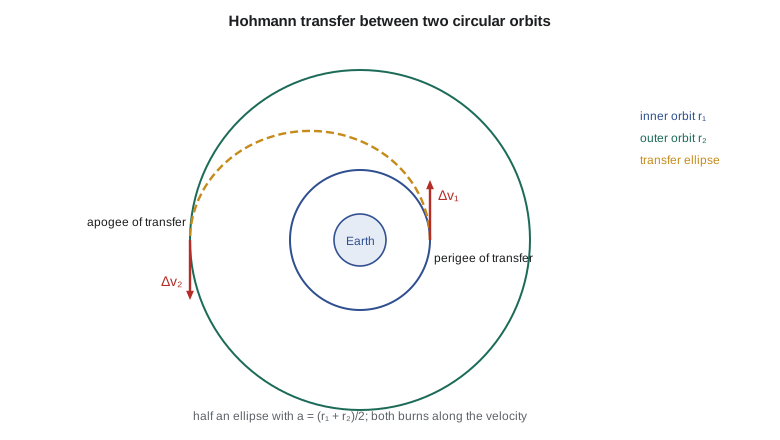
The transfer ellipse has its perigee on the inner circle and its apogee on the outer circle, so its semi-major axis is \(a_t = (r_1 + r_2)/2\). The two burns follow from vis-viva:
and the transfer takes half the period of the ellipse, \(t = \pi\sqrt{a_t^3/\mu}\). Both burns are tangent to the orbit, which is why the Hohmann transfer is efficient: no part of the velocity change is wasted turning the velocity vector. For a transfer between two circles it is the two-impulse transfer with the lowest total delta-v, and for most radius ratios it is the cheapest transfer of any kind.
# Hohmann and bi-elliptic transfers: Crocus-1 orbit raising after a rideshare drop, and a LEO-to-GEO comparison.
import math
MU = 398600.4418; RE = 6378.137; G0 = 9.80665
def hohmann(r1, r2):
    at = (r1 + r2)/2
    dv1 = math.sqrt(MU*(2/r1 - 1/at)) - math.sqrt(MU/r1)
    dv2 = math.sqrt(MU/r2) - math.sqrt(MU*(2/r2 - 1/at))
    return dv1, dv2, math.pi*math.sqrt(at**3/MU)
def bielliptic(r1, r2, rb):
    a1, a2 = (r1 + rb)/2, (r2 + rb)/2
    dv1 = math.sqrt(MU*(2/r1 - 1/a1)) - math.sqrt(MU/r1)
    dv2 = math.sqrt(MU*(2/rb - 1/a2)) - math.sqrt(MU*(2/rb - 1/a1))
    dv3 = math.sqrt(MU*(2/r2 - 1/a2)) - math.sqrt(MU/r2)
    t = math.pi*(math.sqrt(a1**3/MU) + math.sqrt(a2**3/MU))
    return abs(dv1) + abs(dv2) + abs(dv3), t
d1, d2, t = hohmann(RE + 525, RE + 550)
dv = d1 + d2
m0, isp = 130.0, 220.0           # kg wet mass, s (monopropellant-class thruster)
mp = m0*(1 - math.exp(-dv*1000/(isp*G0)))
print(f"Crocus-1 525 -> 550 km: burns {d1*1000:.2f} + {d2*1000:.2f} = {dv*1000:.2f} m/s, transfer {t/60:.1f} min, propellant {mp:.2f} kg")
r1, r2 = RE + 300, 42164.0
d1, d2, t = hohmann(r1, r2)
print(f"LEO 300 km -> GEO Hohmann: {d1:.3f} + {d2:.3f} = {d1+d2:.3f} km/s in {t/3600:.2f} h")
for k in (11.94, 15.58, 20, 40):
    r2b = k*r1; dh = sum(hohmann(r1, r2b)[:2])
    db, tb = bielliptic(r1, r2b, 2*r2b)
print(f"ratio {k:5.2f}: Hohmann {dh:.4f} km/s, bi-elliptic via 2*r2 {db:.4f} km/s ({tb/86400:.1f} days)")Crocus-1 525 -> 550 km: burns 6.86 + 6.86 = 13.72 m/s, transfer 47.7 min, propellant 0.82 kg LEO 300 km -> GEO Hohmann: 2.426 + 1.467 = 3.893 km/s in 5.28 h ratio 11.94: Hohmann 4.1263 km/s, bi-elliptic via 2*r2 4.1668 km/s (3.8 days) ratio 15.58: Hohmann 4.1430 km/s, bi-elliptic via 2*r2 4.1166 km/s (5.6 days) ratio 20.00: Hohmann 4.1312 km/s, bi-elliptic via 2*r2 4.0609 km/s (8.1 days) ratio 40.00: Hohmann 4.0178 km/s, bi-elliptic via 2*r2 3.8910 km/s (22.7 days)
The results put numbers on the discussion. Raising Crocus-1 from 525 km to 550 km takes two burns of 6.86 m/s each, 13.72 m/s in all, about 48 minutes apart, and uses 0.82 kg of propellant from a 130 kg spacecraft. Dr. Nakamura carries 3.5 kg of propellant in total, so the orbit raising uses less than a quarter of the tank and leaves the rest for drag make-up, collision avoidance and the final lowering burn at the end of the mission. The same formulas for a transfer from a 300 km parking orbit to geostationary orbit give 2.43 km/s at perigee and 1.47 km/s at apogee, about 3.89 km/s in total and a little over five hours of coasting. That is why geostationary satellites are among the heaviest spacecraft launched: much of their launch mass is propellant or upper stage.
Small transfers and the half-orbit rule
For a small change in radius the two burns are nearly equal, and each is close to \(\Delta v \approx (v/4)(\Delta r/r)\), where \(v\) is the circular speed. At 550 km, where \(v = 7.59\) km/s and \(r = 6928\) km, raising the orbit by 1 km costs about 0.27 m/s per burn, roughly 0.55 m/s in total. Mission analysts remember the rule as about half a meter per second per kilometer of altitude in low Earth orbit. It is handy for checking drag make-up budgets: if drag lowers Crocus-1 by 2 km in a year at moderate solar activity, keeping it on station costs about 1.1 m/s a year.
Orbit adjustments are seldom made in one large pair of burns. Small thrusters have limited thrust, and the attitude control system must hold the spacecraft steady against thruster misalignment torques during each burn. The propulsion team therefore splits the 13.72 m/s orbit raise into several pairs over two weeks, checking the orbit from GNSS data after each pair and adjusting the next burns. This also protects against a thruster fault: if a valve sticks, only one small burn is affected. The spacecraft never sits on a dangerous orbit, because every intermediate orbit is a safe, slightly elliptical one between 525 and 550 km.
The bi-elliptic transfer
For very different orbit sizes a three-burn transfer can beat Hohmann. The bi-elliptic transfer first burns to a very high apogee \(r_b\), beyond the target orbit; at that apogee a small burn raises the perigee to the target radius; and at that new perigee a retrograde burn circularizes. The intermediate burn is cheap because the spacecraft is moving slowly far from Earth. The code shows the trade-off for an intermediate apogee of twice the target radius. At a radius ratio of 11.94 Hohmann still wins. At 15.58 the bi-elliptic transfer becomes cheaper, though only by a little, and at higher ratios the gain grows, while the transfer time grows from days to weeks. The exact break-even ratio depends on how far out the intermediate apogee is placed; with the apogee very far away the bi-elliptic transfer wins for every ratio above about 11.94, and for any choice of apogee it wins above about 15.58. In practice the extra time and the risk of a long coast mean bi-elliptic transfers are rare around Earth, but the idea appears in lunar and interplanetary trajectory design.
Phasing and the timing of burns
A Hohmann transfer changes the size of an orbit, but often the goal is to reach a particular place on the orbit at a particular time. A phasing maneuver does this. The spacecraft makes a small burn to enter a slightly larger or smaller orbit, waits one or more revolutions while its different period lets it drift ahead or behind, then burns back. A spacecraft that needs to move forward along its orbit enters a smaller, faster orbit; one that needs to fall back enters a larger, slower one. Phasing is how geostationary satellites move between slots and how constellation satellites are spread out after a launch that deploys them all in one cluster.
Crocus-1 will need phasing only if a partner later launches a second satellite into the same plane, but Arjun works through the case anyway. If the second satellite must sit half an orbit away, a drift in argument of latitude of 180 degrees is needed. Lowering the orbit by 10 km shortens the period by about 12.4 seconds, so the satellite gains about 0.78 degrees per revolution and reaches 180 degrees after about 230 revolutions, roughly 15 days. The two burns cost about 5.5 m/s each way. A larger altitude difference shortens the drift time but costs more delta-v, which is the usual trade between time and propellant.
Finite burns and gravity losses
The impulsive model breaks down when burns are long compared with the orbit. An electric thruster raising a satellite from transfer orbit to geostationary orbit may fire for months, slowly spiraling outward. Because the thrust is never perfectly placed at perigee and apogee, the total delta-v for a low-thrust spiral between circles equals the difference of the circular speeds, \(v_1 - v_2\), which for LEO to GEO is about 4.6 km/s instead of Hohmann's 3.9 km/s. Electric propulsion still saves a great deal of propellant because its specific impulse is about ten times higher. Many commercial geostationary satellites now use electric orbit raising and accept the months of transfer time in exchange for a lighter launch.
Even chemical burns lose a little efficiency when they last several minutes, because the thrust is spread around the perigee rather than concentrated at one point. Flight software computes a finite-burn correction: it centers the burn on the ideal point and lengthens it slightly. For Crocus-1's burns of a few seconds this correction is negligible.
| Transfer | Burns | Total delta-v | Time |
|---|---|---|---|
| Crocus-1, 525 to 550 km | 6.86 + 6.86 m/s | 13.7 m/s | 48 min |
| Parking orbit 300 km to GEO | 2.43 + 1.47 km/s | 3.89 km/s | 5.3 h |
| Low-thrust spiral, LEO to GEO | continuous | about 4.6 km/s | months |
| Phasing by 180 deg at 550 km | 2 pairs of about 5.5 m/s | about 11 m/s | about 15 days |
Worked problem
Crocus-1 orbit raising
Find the two Hohmann burns from a 525 km to a 550 km circular orbit.
Show solution
- \(r_1 = 6903.1\) km, \(r_2 = 6928.1\) km, \(a_t = 6915.6\) km.
- \(v_1 = \sqrt{398600/6903.1} = 7.5988\) km/s; perigee speed on the transfer \(= 7.6057\) km/s; \(\Delta v_1 = 6.86\) m/s.
- By symmetry for small transfers \(\Delta v_2 \approx 6.86\) m/s.
Answer: About 13.7 m/s in total.
Worked problem
Propellant for the burns
With \(m_0 = 130\) kg and \(I_{sp} = 220\) s, how much propellant does 13.72 m/s need?
Show solution
- \(\Delta v/(I_{sp} g_0) = 13.72/2157.5 = 0.00636\).
- \(m_p = 130(1 - e^{-0.00636}) = 0.82\) kg.
Answer: 0.82 kg.
Worked problem
Rule of thumb
Estimate the delta-v to raise an orbit at 550 km by 20 km.
Show solution
- \(\Delta v \approx (v/4)(\Delta r/r)\) per burn \(= (7585/4)(20/6928) = 5.5\) m/s.
- Two burns give about 11 m/s.
Answer: About 11 m/s, consistent with half a meter per second per kilometer.
Common mistakes
MistakeAdding the two Hohmann burns as vectors.
InsteadBoth are along the velocity at different points; add their magnitudes.
MistakeForgetting that the burn point stays on the new orbit.
InsteadA single burn cannot circularize at a new radius; two burns are needed.
MistakeUsing total mass after all burns in the rocket equation for the first burn.
InsteadApply the equation burn by burn with the mass at each burn.
MistakeAssuming bi-elliptic always wins for large changes.
InsteadIt wins only above a radius ratio of about 11.94 to 15.58, at the cost of time.
MistakeTreating months-long electric burns as impulsive.
InsteadLow-thrust spirals cost close to the difference in circular speeds.
Summary and key terms
- Orbital maneuvers are planned in delta-v, and the rocket equation converts delta-v into propellant.
- A Hohmann transfer between circular orbits uses two tangential burns half an orbit apart on an ellipse with \(a = (r_1 + r_2)/2\), and is the cheapest two-burn transfer.
- The bi-elliptic transfer can be cheaper for very large radius ratios but takes much longer.
- Phasing maneuvers change position along an orbit by spending time on a slightly different orbit.
- Low-thrust spirals cost more delta-v but much less propellant.
- Crocus-1's orbit raising costs 13.7 m/s and 0.82 kg of propellant.
- Delta-v
- The change in velocity produced by a burn, the currency of mission planning.
- Specific impulse
- Thrust per unit weight flow of propellant, in seconds.
- Impulsive burn
- A burn treated as an instant change of velocity.
- Hohmann transfer
- A two-burn transfer between circular orbits on a tangent half ellipse.
- Bi-elliptic transfer
- A three-burn transfer through a high intermediate apogee.
- Phasing maneuver
- A temporary change of period to move along an orbit.
- Delta-v budget
- The list of all maneuvers in a mission with margins.
- Low-thrust spiral
- A gradual orbit change by continuous low thrust.
Practice problems
Work each problem on paper first, then reveal the answer to check.
What is the transfer time from 300 km to GEO?
Show answer
About 5.28 hours.
Roughly how much delta-v raises a low orbit by 1 km?
Show answer
About 0.55 m/s for the two burns.
Why are both Hohmann burns efficient?
Show answer
They are tangent to the velocity, so no delta-v turns the velocity vector.
To move ahead along its orbit, should a satellite raise or lower its orbit?
Show answer
Lower it, to shorten the period.
Why do electric spirals save propellant despite costing more delta-v?
Show answer
Their specific impulse is about ten times higher.
How much of Crocus-1's 3.5 kg of propellant does orbit raising use?
Show answer
0.82 kg, under a quarter.
Lesson quiz · 5 questions
Score 60% or more to complete this lesson.
Create a free account to save your progress, take quizzes and earn a certificate.