
AERO-420 · Lesson 10 of 12 · 26 min
Spacecraft power and thermal design
A spacecraft is a small, self-contained world. It must make all its own electricity, store enough to survive the dark part of every orbit, and keep every component within its temperature limits while one side faces the full Sun and the other faces space at a few kelvin. Power and thermal design are tightly linked: almost every watt of electricity the spacecraft uses ends up as heat that must be radiated away, and the solar arrays and radiators compete for the same outside surfaces. This lesson sizes Crocus-1's solar array and battery and works through the radiative balance that sets its temperatures.
The orbit drives both problems. Lesson 6 placed Crocus-1 in a 10:30 sun-synchronous orbit at 550 km. That choice fixes the angle between the Sun and the orbit plane, called the beta angle, at around 20 to 25 degrees, varying slightly with the season, and the beta angle in turn sets how much of each orbit is spent in the Earth's shadow. Marcus Webb's structure team and the electrical team led by Priya Raman, who joins the division from the company's avionics group, work from the same orbit model that Arjun produced.
Eclipses
For a circular orbit of radius \(r\), treating the Earth's shadow as a cylinder, the fraction of the orbit in eclipse depends on the altitude \(h\) and the beta angle \(\beta\):
The expression applies while the argument of the inverse cosine is less than one; at high beta angles the satellite stays in sunlight for the whole orbit. A dawn–dusk sun-synchronous orbit, with its node at 6:00 or 18:00, has a beta angle near 90 degrees and almost no eclipses, which is why missions that need constant power, such as radar satellites, often fly them. Crocus-1's mid-morning orbit has eclipses on every revolution.
# Power and thermal: eclipse fraction, solar array and battery sizing, and radiative equilibrium temperature.
import math
RE = 6378.137; MU = 398600.4418
h = 550; r = RE + h
P = 2*math.pi*math.sqrt(r**3/MU)/60                 # min
beta = math.radians(22.0)                           # sun angle to the orbit plane for a 10:30 orbit (typical)
rho = math.asin(RE/r)
frac_ecl = math.acos(math.sqrt(h*(h + 2*RE))/(r*math.cos(beta)))/math.pi
Te, Td = P*frac_ecl, P*(1 - frac_ecl)
print(f"period {P:.1f} min, eclipse {Te:.1f} min ({frac_ecl*100:.1f} %), sunlight {Td:.1f} min")
Pe, Pd = 95.0, 135.0             # W average load in eclipse and in daylight (payload images over land in daylight)
Xe, Xd = 0.60, 0.80              # path efficiencies, battery route and direct route
P_sa = (Pe*Te/Xe + Pd*Td/Xd)/Td
S, eta_cell, Id, cos_t = 1361.0, 0.29, 0.77, math.cos(beta)
life_deg = (1 - 0.0275)**5      # 2.75 % per year for five years (illustrative)
P_bol_area = S*eta_cell*Id*cos_t
area = P_sa/(P_bol_area*life_deg)
print(f"array must supply {P_sa:.0f} W in sunlight; needs {area:.2f} m^2 of triple-junction cells at end of life")
E_ecl = Pe*Te/60                  # W h
dod = 0.25                        # LEO: about 15 eclipses a day, so keep depth of discharge low for cycle life
cap = E_ecl/(dod*0.9)
cycles = 365.25*24*60/P*5
print(f"eclipse energy {E_ecl:.0f} W h; battery capacity {cap:.0f} W h at {dod*100:.0f} % depth of discharge; {cycles:,.0f} cycles in 5 years")
sigma = 5.670e-8
def temp(alpha, eps, A_abs, A_rad, Qint, albedo=0.30, ir=237.0, F=0.3):
    q = alpha*S*A_abs + alpha*albedo*S*A_abs*F + eps*ir*A_rad*F + Qint
    return (q/(eps*sigma*A_rad))**0.25 - 273.15
for name, a_, e_ in (("white paint", 0.20, 0.88), ("black paint", 0.95, 0.88), ("bare aluminum", 0.15, 0.05), ("silvered radiator", 0.08, 0.80), ("chosen blend of surfaces", 0.50, 0.85)):
print(f"{name:18s} alpha {a_:.2f} eps {e_:.2f}: hot-case box temperature {temp(a_, e_, 0.6, 2.4, 110.0):6.1f} C")period 95.6 min, eclipse 34.6 min (36.2 %), sunlight 61.1 min array must supply 258 W in sunlight; needs 1.05 m^2 of triple-junction cells at end of life eclipse energy 55 W h; battery capacity 243 W h at 25 % depth of discharge; 27,494 cycles in 5 years white paint alpha 0.20 eps 0.88: hot-case box temperature -27.2 C black paint alpha 0.95 eps 0.88: hot-case box temperature 36.8 C bare aluminum alpha 0.15 eps 0.05: hot-case box temperature 165.6 C silvered radiator alpha 0.08 eps 0.80: hot-case box temperature -40.7 C chosen blend of surfaces alpha 0.50 eps 0.85: hot-case box temperature 5.8 C
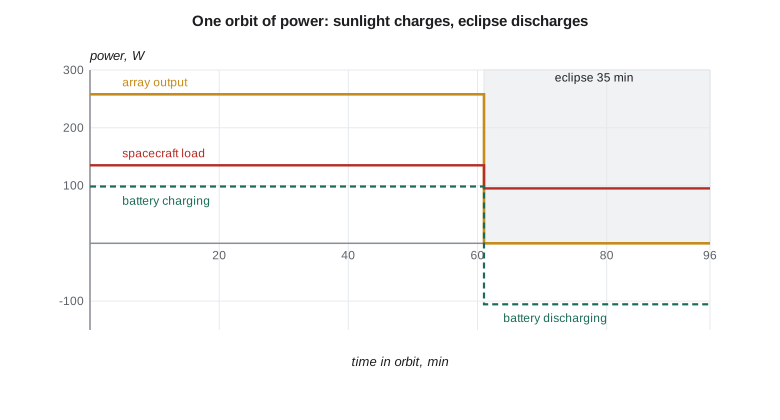
At a beta angle of 22 degrees, Crocus-1 spends 34.6 minutes of each 95.6 minute orbit in eclipse, 36 percent of the time, and 61.1 minutes in sunlight. These two numbers drive everything that follows.
Sizing the solar array
The array must supply the daytime load and recharge the battery for the next eclipse, all during the sunlit part of the orbit. With average loads \(P_e\) in eclipse and \(P_d\) in daylight, and path efficiencies \(X_e\) through the battery and \(X_d\) directly to the loads, the array power required during sunlight is
Crocus-1 draws about 95 W in eclipse, when the camera is off but heaters and the computer run, and 135 W in daylight, when imaging and downlinks add load. With path efficiencies of 0.60 and 0.80, typical of a direct energy transfer system, the array must supply 258 W while the satellite is in sunlight. The power per square meter of array is the solar constant, 1361 W/m², times the cell efficiency, about 29 percent for triple-junction gallium arsenide cells, times an inherent degradation factor of 0.77 for wiring, shadowing and temperature, times the cosine of the Sun's angle to the array. Cells also lose output to radiation damage over the mission; with a loss of 2.75 percent a year, the end-of-life output is 87 percent of the beginning. The code gives an array of 1.05 m², which Raman's team implements as two deployable wings of about 0.55 m² each, with a small margin.
Sizing the battery
The battery must deliver the eclipse energy, \(P_e T_e\), which for Crocus-1 is 55 W h, on every orbit. Lithium-ion cells could deliver much more of their capacity, but the cycle life of a battery depends strongly on its depth of discharge. In low Earth orbit there are about 15 eclipses a day, and Crocus-1 will see 27,500 charge and discharge cycles in five years. To survive that, the depth of discharge is held to about 25 percent. Allowing 90 percent transfer efficiency from battery to bus, the battery needs a capacity of 243 W h. A geostationary satellite, by contrast, sees only about 90 eclipses a year, in two seasons around the equinoxes, and can discharge its batteries far more deeply.
The battery also carries the spacecraft through launch and early operations, before the arrays deploy, and through safe-mode events. Raman checks that a full battery can power the essential loads for at least two orbits with the arrays pointed away from the Sun, the worst case after a tumble. The power control unit protects the battery against overcharge with a charge regulator and cuts non-essential loads automatically if the state of charge falls below a threshold.
Power is distributed on a regulated or unregulated bus. Small satellites commonly use a battery-voltage bus of around 28 V or lower, with converters producing 3.3, 5 and 12 V for electronics, and a peak power tracker or direct energy transfer regulator between the array and the bus. Each load is switched and protected individually, so that a short circuit in one instrument cannot drain the battery. The power budget lists every load with its duty cycle in each mode, and Raman carries a margin of about 20 percent on the loads at this stage of design, to be reduced as the hardware matures and its consumption is measured.
Heat in and heat out
In space there is no air to carry heat away by convection. Heat arrives by radiation and leaves by radiation, and inside the spacecraft it moves by conduction through structures and heat pipes and by radiation between surfaces. Three external sources heat a spacecraft in low Earth orbit: direct sunlight at 1361 W/m², sunlight reflected by the Earth, the albedo, about 30 percent on average, and infrared emitted by the Earth, about 237 W/m² at the top of the atmosphere. Electronics add internal dissipation. The spacecraft loses heat by radiating to space from its surfaces in proportion to the fourth power of temperature, by the Stefan–Boltzmann law.
For a simple estimate, treat the spacecraft as a single node at one temperature. The equilibrium temperature balances absorbed and emitted heat:
Here \(\alpha\) is the solar absorptance of the surface, the fraction of sunlight it absorbs, \(\varepsilon\) its infrared emittance, \(\sigma\) the Stefan–Boltzmann constant, \(a\) the albedo, \(F\) a view factor to the Earth, \(q_{\mathrm{ir}}\) the Earth's infrared flux and \(Q_{int}\) the internal dissipation. The ratio \(\alpha/\varepsilon\) is the key surface property. A surface with low \(\alpha\) and high \(\varepsilon\), such as white paint or a silvered quartz mirror, runs cold in sunlight; one with high \(\alpha\) and low \(\varepsilon\), such as bare polished aluminum, runs hot.
The code shows the range. With 110 W of internal dissipation, a box finished in white paint would sit at about minus 27 °C in the hot case, black paint at 37 °C, bare aluminum at an unacceptable 166 °C and silvered radiators at minus 41 °C. None of the pure finishes is right. The thermal designer chooses a blend of surfaces, multi-layer insulation over most of the exterior, a radiator of chosen area facing cold space, and some exposed surfaces, to produce an effective absorptance and emittance that puts the box at a comfortable temperature. The blend in the code, with an effective \(\alpha\) of 0.50 and \(\varepsilon\) of 0.85, gives 5.8 °C in the hot case. That is cooler than it needs to be, and the designer will trim the radiator area until the hot case sits near 20 °C, then check that heaters can hold the cold case above the minimum.
Hot and cold cases
A thermal design is never checked at a single condition. The hot case combines the highest Sun angle, the most sunlit fraction, end-of-life surface properties, which degrade as ultraviolet light and atomic oxygen darken coatings, and maximum internal dissipation. The cold case combines the longest eclipse, beginning-of-life properties and minimum dissipation, typically in safe mode with the payload off. Components have operating and survival limits: batteries perhaps 0 to 30 °C, electronics minus 20 to plus 50 °C, propellant lines above the freezing point of hydrazine, 2 °C. The thermal team designs for the full span with margins of 5 to 10 °C between predicted and allowed temperatures.
Detailed analysis uses a multi-node thermal model with hundreds or thousands of nodes, solving the radiative exchange and conduction between them over many orbits. The model is then correlated against a thermal vacuum test, in which the spacecraft is placed in a vacuum chamber with cold walls and heated with lamps or panels to simulate the hot and cold cases. Crocus-1's thermal vacuum test is scheduled for four weeks and includes eight cycles between hot and cold extremes.
Thermal control hardware
Passive control comes first: coatings, multi-layer insulation of many thin aluminized polymer layers separated by netting, and conduction paths through mounting plates. Heat pipes move heat from a warm component to a distant radiator using the evaporation and condensation of a working fluid such as ammonia. Active control adds electrical heaters on thermostats or computer control, which use part of the power budget in the cold case, and on larger spacecraft louvers or pumped fluid loops. For Crocus-1, about 15 W of heater power is budgeted in eclipse, already included in the 95 W eclipse load, mainly for the battery and the propulsion lines.
| Item | Crocus-1 value | Main driver |
|---|---|---|
| Eclipse duration | 34.6 min per orbit | altitude and beta angle |
| Array power in sunlight | 258 W | loads and path efficiency |
| Array area | 1.05 m² | cell efficiency and degradation |
| Battery capacity | 243 W h | depth of discharge for cycle life |
| Cycles in five years | about 27,500 | about 15 eclipses a day |
| Hot-case box temperature | 5.8 °C, to be trimmed | surface properties and radiator area |
Worked problem
Eclipse length
Find the eclipse duration at 550 km for \(\beta = 22^\circ\).
Show solution
- \(\sqrt{550^2 + 2(6378)(550)} = \sqrt{302\,500 + 7\,016\,000} = 2705\) km.
- \(r\cos\beta = 6928(0.9272) = 6424\) km; \(\cos^{-1}(2705/6424) = \cos^{-1}(0.4211) = 65.1^\circ\).
- \(f_e = 65.1/180 = 0.362\); \(0.362 \times 95.6 = 34.6\) min.
Answer: 34.6 minutes.
Worked problem
Battery capacity
Eclipse energy 55 W h, depth of discharge 25 percent, transfer efficiency 0.9. Find the capacity.
Show solution
- \(C = 55/(0.25 \times 0.9) = 55/0.225\).
Answer: About 243 W h.
Worked problem
Equilibrium temperature of a flat plate
A thin plate faces the Sun with \(\alpha = 0.2\) and radiates from both sides with \(\varepsilon = 0.88\). Ignore the Earth. Find its temperature.
Show solution
- Absorbed: \(0.2 \times 1361 = 272\) W/m². Emitted: \(2 \times 0.88 \times 5.67\times10^{-8} T^4\).
- \(T^4 = 272/(9.98\times10^{-8}) = 2.73\times10^{9}\), so \(T = 228.6\) K.
Answer: About minus 45 °C.
Common mistakes
MistakeSizing the array for the daytime load only.
InsteadIt must also recharge the battery for the next eclipse.
MistakeUsing beginning-of-life cell output.
InsteadSize for end of life, after radiation degradation.
MistakeDischarging a LEO battery deeply.
InsteadTens of thousands of cycles require a shallow depth of discharge.
MistakeChoosing a coating by absorptance alone.
InsteadThe ratio of absorptance to emittance controls temperature.
MistakeChecking only the hot case.
InsteadThe cold case, with long eclipses and low dissipation, sets heater power.
Summary and key terms
- Power and thermal design start from the orbit.
- Crocus-1 spends 34.6 minutes of each orbit in eclipse, so its 1.05 m² array must supply 258 W in sunlight to carry the loads and recharge a 243 W h battery held to a 25 percent depth of discharge for 27,500 cycles.
- Heat arrives from the Sun, the Earth's albedo and infrared and internal electronics, and leaves only by radiation; the balance depends on the ratio of absorptance to emittance.
- Designs are checked in hot and cold cases with coatings, insulation, heat pipes and heaters.
- Beta angle
- The angle between the Sun direction and the orbit plane.
- Eclipse fraction
- The share of an orbit spent in the Earth's shadow.
- Path efficiency
- The fraction of array power that reaches the loads by a given route.
- Depth of discharge
- The fraction of battery capacity used in one cycle.
- Absorptance
- The fraction of incident sunlight a surface absorbs.
- Emittance
- The infrared emission of a surface relative to a black body.
- Multi-layer insulation
- Many thin reflective layers that block radiative heat transfer.
- Thermal vacuum test
- A test that cycles the spacecraft through hot and cold cases in vacuum.
Practice problems
Work each problem on paper first, then reveal the answer to check.
Why does a dawn–dusk orbit have almost no eclipses?
Show answer
Its beta angle is near 90 degrees.
How many battery cycles does Crocus-1 see in five years?
Show answer
About 27,500.
Why is the depth of discharge kept low in LEO?
Show answer
To survive tens of thousands of cycles.
Which surface runs hotter in sunlight: white paint or bare aluminum?
Show answer
Bare aluminum.
What three external sources heat a LEO spacecraft?
Show answer
Direct sunlight, albedo and Earth infrared.
What is a heat pipe's working principle?
Show answer
Evaporation and condensation of a working fluid.
Lesson quiz · 5 questions
Score 60% or more to complete this lesson.
Create a free account to save your progress, take quizzes and earn a certificate.