
AERO-420 · Lesson 6 of 12 · 26 min
Perturbations
The two-body orbit of Lesson 1 is fixed in space forever. Real orbits are not. The Earth is not a perfect sphere, the upper atmosphere drags on low satellites, the Sun and Moon pull on everything, and sunlight itself pushes on large, light structures. These extra forces are called perturbations. Most are small, a thousandth of central gravity or less, but they act continuously and their effects accumulate over days and months. Some are a nuisance that operations must correct. Others are a gift: the most useful orbit in Earth observation, the sun-synchronous orbit, exists only because the Earth is flattened at the poles.
For Crocus-1 the perturbations decide three things. The Earth's oblateness sets the inclination needed for sun-synchronous operation and the precision the launch must deliver. Atmospheric drag sets how much propellant is needed to stay at 550 km and how long the satellite takes to re-enter after the mission, which Lesson 12 covers. And the combination of perturbations sets how accurately the operations team can predict passes and image times. Arjun adds each perturbation to his propagator in turn and checks its effect against published values before he trusts it.
The shape of the Earth
The Earth bulges at the equator: its equatorial radius is 6378 km and its polar radius 6357 km, a difference of 21 km. The gravity field of this flattened body is written as a series of spherical harmonics, and the largest term after the central one is the second zonal harmonic, \(J_2 = 1.08263 \times 10^{-3}\). Its effect is roughly a thousand times larger than any other harmonic. Physically, the extra mass at the equator pulls an inclined satellite toward the equatorial plane as it passes over it. The orbit responds like a gyroscope: instead of tipping toward the equator, the orbit plane turns slowly about the polar axis. This is nodal regression.
Averaged over an orbit, \(J_2\) produces no long-term change in the semi-major axis, eccentricity or inclination. It changes the angles: the node, the argument of perigee and the mean anomaly drift at steady rates. For an orbit of semi-major axis \(a\), eccentricity \(e\) and inclination \(i\), with \(p = a(1 - e^2)\), the secular rates are
The node moves westward for prograde orbits and eastward for retrograde orbits, and the effect is largest for low, near-equatorial orbits. The International Space Station, at about 420 km and 51.6 degrees, regresses by about 5 degrees a day. The argument of perigee rotates forward for low inclinations, backward for high ones, and stands still at the critical inclination where \(\sin^2 i = 4/5\), that is 63.4 or 116.6 degrees.
Sun-synchronous orbits
The Earth goes around the Sun once a year, so the direction of the Sun, seen from the Earth, moves eastward by 360 degrees in 365.24 days, about 0.9856 degrees a day. If the orbit node moves eastward at exactly the same rate, the orbit plane keeps a fixed angle to the Sun all year. The satellite then crosses the equator at the same local solar time on every pass. That is the sun-synchronous condition. Setting \(\dot{\Omega}\) equal to 0.9856 degrees per day gives a slightly retrograde inclination, about 97 to 99 degrees for orbits between 400 and 800 km.
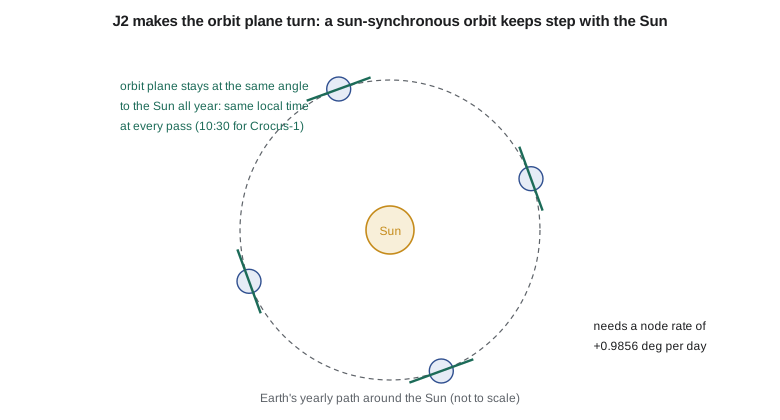
Sun-synchronous orbits are the standard choice for Earth observation because the lighting is consistent. Every image of a field in Kansas is taken with the Sun at a similar elevation and azimuth for a given season, so changes in the image reflect changes on the ground rather than changes in shadow. Dr. Benali chose a 10:30 descending node, a common choice: late enough for the Sun to be well up, early enough to beat the afternoon cumulus clouds that build over the prairies in summer. Landsat 8 and 9 use a similar time, which makes Crocus-1's images easier to compare with the long Landsat record.
# J2 perturbation: nodal regression, apsidal rotation and the sun-synchronous inclination for Crocus-1.
import math
MU = 398600.4418; RE = 6378.137; J2 = 1.08263e-3
SSO_RATE = 2*math.pi/(365.2422*86400)        # rad/s, one turn per tropical year
def rates(a, e, i_deg):
    i = math.radians(i_deg); n = math.sqrt(MU/a**3); p = a*(1 - e*e)
    k = 1.5*J2*(RE/p)**2*n
    return -k*math.cos(i), k*(2 - 2.5*math.sin(i)**2)
def sso_inclination(a, e=0.0):
    n = math.sqrt(MU/a**3); p = a*(1 - e*e)
    c = -SSO_RATE/(1.5*J2*(RE/p)**2*n)
    return math.degrees(math.acos(c))
for h in (400, 550, 700, 800):
    a = RE + h
    i = sso_inclination(a)
    print(f"{h} km: sun-synchronous inclination {i:.3f} deg")
a = RE + 550
for i in (51.6, 97.59, 98.0):
    dO, dw = rates(a, 0.0012, i)
    print(f"i = {i:6.2f} deg: node {math.degrees(dO)*86400:+.4f} deg/day, perigee {math.degrees(dw)*86400:+.4f} deg/day")
# Local time drift if the launch vehicle delivers 0.05 deg too little inclination
i_ok = sso_inclination(a); dO_ok = rates(a, 0, i_ok)[0]; dO_bad = rates(a, 0, i_ok - 0.05)[0]
drift = math.degrees(dO_bad - dO_ok)*86400*365.25
print(f"inclination error -0.05 deg: node drifts {drift:+.2f} deg/yr = {drift*4:+.1f} min of local time per year")400 km: sun-synchronous inclination 97.030 deg 550 km: sun-synchronous inclination 97.593 deg 700 km: sun-synchronous inclination 98.188 deg 800 km: sun-synchronous inclination 98.603 deg i = 51.60 deg: node -4.6334 deg/day, perigee +3.4654 deg/day i = 97.59 deg: node +0.9853 deg/day, perigee -3.4044 deg/day i = 98.00 deg: node +1.0382 deg/day, perigee -3.3685 deg/day inclination error -0.05 deg: node drifts -2.36 deg/yr = -9.4 min of local time per year
The code gives the sun-synchronous inclination as 97.03 degrees at 400 km, 97.59 at 550 km and 98.60 at 800 km. At 550 km and 97.59 degrees, Crocus-1's node advances by 0.9853 degrees a day, matching the Sun to within the rounding of the inclination. For comparison, a station-like orbit at 51.6 degrees regresses by 4.6 degrees a day. The last line explains why the inclination tolerance matters. If the launcher delivers an inclination 0.05 degrees too low, the node falls behind the Sun by 2.36 degrees a year, and the equator crossing time drifts by 9.4 minutes a year. Over a five-year mission that is 47 minutes, enough to move the 10:30 crossing to about 9:45 and lengthen every shadow in the images. The inclination trim budgeted in Lesson 5 prevents it.
Many missions accept and plan for drift instead. Some satellites are deliberately placed slightly off the sun-synchronous inclination so that their local time drifts slowly through a planned range, and others let it drift late in life when propellant is gone. For Crocus-1 Dr. Benali prefers a fixed time, and the trim is cheap.
Repeat ground tracks and frozen orbits
Perturbations also govern the ground track. Crocus-1 completes about 15.06 revolutions a day. If the number of revolutions over a whole number of days is a whole number, the ground track repeats exactly, and every field is revisited under the same viewing geometry. The calculation must use the nodal period, the time between equator crossings including the \(J_2\) effect on the mean anomaly and perigee, and the rotation of the Earth relative to the moving node. Dr. Benali's crop maps use a repeat cycle of a few days to a few weeks; the final altitude of 550 km was tuned within a few kilometers to give the repeat she wanted.
Lesson 2 introduced frozen orbits. The odd zonal harmonic \(J_3\) makes the eccentricity and argument of perigee oscillate, and a particular combination, an eccentricity of about 0.001 with perigee held near 90 degrees, keeps both nearly constant under the combined \(J_2\) and \(J_3\) effects. A frozen orbit gives the same altitude over each latitude on every pass, which keeps image scale and ground resolution consistent. The code's perigee rate of about minus 3.4 degrees a day is the \(J_2\) rate alone; the \(J_3\) term balances it at the frozen eccentricity.
Atmospheric drag
Below about 1000 km, the thin upper atmosphere slows satellites. The drag acceleration is
where \(\rho\) is the density, \(v\) the speed relative to the atmosphere, \(C_D\) a drag coefficient around 2.2 for satellites, \(A\) the cross-sectional area and \(m\) the mass. The ratio \(m/(C_D A)\) is the ballistic coefficient; a heavy, compact satellite resists drag better than a light one with large solar arrays. Drag removes energy, so the orbit shrinks; paradoxically the satellite speeds up as it descends, because a lower orbit is faster.
The difficulty is the density. At 550 km it is around \(10^{-13}\) to \(10^{-12}\) kg/m³, and it varies by a factor of ten or more with solar activity. When the Sun is active, extreme ultraviolet radiation heats and expands the thermosphere, raising the density at a given altitude. Geomagnetic storms add sharp increases over a day or two. In February 2022 a moderate geomagnetic storm caused 38 of 49 newly launched Starlink satellites, still in a low deployment orbit, to re-enter within days. Solar Cycle 25 peaked around 2024 and 2025, and the higher drag of this period shortened the lives of many small satellites in low orbits. Arjun uses a standard atmosphere model driven by forecasts of solar flux and geomagnetic indices, and he carries a margin for the uncertainty.
Drag also matters for operations long before re-entry. Because it changes the period, an uncertainty in drag becomes an uncertainty in where the satellite will be along its track, and that error grows with the square of time. A drag error of 10 percent at 550 km in an active solar period can amount to several kilometers along track after a week. This is the main reason the operations team refreshes the orbit from GNSS data daily, and it is also why collision warnings, discussed in Lesson 12, carry uncertainty ellipsoids that are longest in the along-track direction. For the propulsion budget, Arjun estimates drag make-up at 550 km at a few meters per second over five years, depending on the solar cycle, and Dr. Nakamura holds it inside the 32 m/s of remaining margin.
Third bodies and solar radiation pressure
The Sun and Moon perturb all orbits, but their effect grows with altitude. For a low orbit like Crocus-1's it is small compared with \(J_2\). For geostationary satellites the lunar and solar pull is the dominant perturbation: left alone, a geostationary orbit's inclination grows by about 0.75 to 0.95 degrees per year, and the satellite spends a large share of its propellant on north–south station-keeping to hold it near zero. The Earth's equatorial ellipticity, the harmonic \(J_{22}\), also makes geostationary satellites drift in longitude toward two stable points, near 75 degrees east and 105 degrees west, so east–west station-keeping is needed too.
Sunlight carries momentum. The pressure at the Earth's distance is about 4.56 micropascals on an absorbing surface and up to twice that on a mirror. It matters for spacecraft with large area for their mass, such as geostationary satellites with big arrays, and for solar sails, which use it for propulsion. For Crocus-1 it is a small effect on the orbit, but it produces a disturbing torque on the attitude, one of the terms Lesson 9 budgets.
| Perturbation | Main effect | Where it dominates |
|---|---|---|
| Oblateness, \(J_2\) | Node and perigee drift; enables sun-synchronous orbits | All low and medium orbits |
| Higher harmonics, \(J_3\) and beyond | Eccentricity oscillation; frozen orbits; geostationary longitude drift | Precision orbits, GEO |
| Atmospheric drag | Orbit decay; along-track uncertainty | Below about 1000 km |
| Sun and Moon | Inclination growth; long-period changes | GEO and high orbits |
| Solar radiation pressure | Eccentricity changes; attitude torques | High area-to-mass objects |
Worked problem
Node rate for the station
Estimate the nodal regression at 420 km and 51.6 degrees for a circular orbit.
Show solution
- \(a = 6798\) km, \(n = \sqrt{398600/6798^3} = 1.1355\times10^{-3}\) rad/s.
- \(\dot{\Omega} = -1.5(1.08263\times10^{-3})(6378/6798)^2(1.1355\times10^{-3})\cos 51.6^\circ = -1.0\times10^{-6}\) rad/s.
- Multiply by 86,400 s and convert: about \(-5.0\) degrees a day.
Answer: About 5 degrees a day westward.
Worked problem
Sun-synchronous inclination
Find the inclination for a sun-synchronous circular orbit at 550 km.
Show solution
- Required \(\dot{\Omega} = 2\pi/(365.2422 \times 86400) = 1.991\times10^{-7}\) rad/s.
- \(n = 1.0950\times10^{-3}\) rad/s; \(1.5 J_2 (R_E/a)^2 n = 1.5(1.08263\times10^{-3})(0.92060)^2(1.0950\times10^{-3}) = 1.507\times10^{-6}\) rad/s.
- \(\cos i = -1.991\times10^{-7}/1.507\times10^{-6} = -0.1321\), so \(i = 97.59^\circ\).
Answer: 97.59 degrees.
Worked problem
Local time drift
A node drift error of 2.36 degrees a year corresponds to what change in local time?
Show solution
- The Earth turns 360 degrees in 24 hours, so 1 degree is 4 minutes.
- \(2.36 \times 4 = 9.4\) minutes a year.
Answer: About 9.4 minutes a year.
Common mistakes
MistakeExpecting \(J_2\) to change the semi-major axis over time.
InsteadIts secular effects are on the angles; drag changes the size.
MistakeUsing a prograde inclination for a sun-synchronous orbit.
InsteadThe node must move eastward, which needs a retrograde inclination.
MistakeUsing a fixed atmospheric density for lifetime estimates.
InsteadDensity varies tenfold with solar activity; use forecasts and margins.
MistakeIgnoring lunar and solar effects for geostationary satellites.
InsteadThey drive the inclination growth that station-keeping must correct.
MistakeComputing ground track repeat with the two-body period.
InsteadUse the nodal period including \(J_2\).
Summary and key terms
- Perturbations change orbits slowly but steadily.
- The Earth's oblateness, through \(J_2\), turns the node and the perigee at predictable rates.
- A retrograde inclination of about 97.6 degrees at 550 km makes the node keep step with the Sun, giving Crocus-1 the same local time on every pass, and a small inclination error makes that time drift.
- Drag shrinks low orbits at a rate that depends strongly on solar activity.
- The Sun and Moon dominate perturbations at geostationary altitude, and solar radiation pressure matters for light, large structures.
- Perturbation
- Any force beyond the central inverse-square attraction.
- J2
- The coefficient of the Earth's oblateness in its gravity field.
- Nodal regression
- The drift of the ascending node caused by oblateness.
- Critical inclination
- The inclination, 63.4 or 116.6 degrees, at which perigee does not rotate.
- Sun-synchronous orbit
- An orbit whose node turns eastward once a year, keeping a fixed local time.
- Ballistic coefficient
- The ratio \(m/(C_D A)\) that measures resistance to drag.
- Station-keeping
- Maneuvers that hold a satellite in its assigned orbit.
- Solar radiation pressure
- The force of sunlight on a spacecraft.
Practice problems
Work each problem on paper first, then reveal the answer to check.
Which way does the node move for a retrograde orbit?
Show answer
Eastward.
What is the sun-synchronous inclination at 800 km?
Show answer
About 98.6 degrees.
Why did Dr. Benali choose a 10:30 crossing?
Show answer
Good Sun elevation before afternoon clouds, and compatibility with Landsat.
What happens to a satellite's speed as drag lowers it?
Show answer
It increases, because lower orbits are faster.
What dominates perturbations of a geostationary satellite?
Show answer
The Sun and Moon, plus the Earth's equatorial ellipticity for longitude.
At what inclinations does the perigee stay fixed?
Show answer
63.4 and 116.6 degrees.
Lesson quiz · 5 questions
Score 60% or more to complete this lesson.
Create a free account to save your progress, take quizzes and earn a certificate.