
AERO-340 · Lesson 9 of 12 · 27 min
Combustors
The combustor is where the cycle's heat is added, and it has the most difficult brief in the engine. It must burn fuel completely in a few milliseconds, in air moving at tens of meters per second, at pressures from a fraction of an atmosphere at high altitude to forty atmospheres at take-off. It must relight in flight after a flameout, deliver gas to the turbine with a carefully controlled temperature profile, lose as little pressure as possible, and emit as little nitrogen oxides, carbon monoxide, unburned hydrocarbons and soot as possible. Emissions are now as important as efficiency in combustor design, and Dr. Nakamura asks Arjun to prepare the Swift 900's emissions summary for certification planning, checked against the EPA aircraft engine emission standards in 40 CFR Part 87, which follow ICAO Annex 16 Volume II and are enforced by the FAA.
Combustor layout
Modern engines use annular combustors: a ring-shaped liner between the compressor and turbine, with fuel nozzles spaced around the front. Air leaving the compressor first passes through a diffuser that slows it, because no flame can survive at compressor exit speeds of 100 to 150 m/s. The air then divides. Part enters the front of the liner through swirlers around each fuel nozzle; the rest flows along the outside of the liner and enters through rows of holes along its length, and through small cooling holes or slots that keep the liner wall itself from melting.
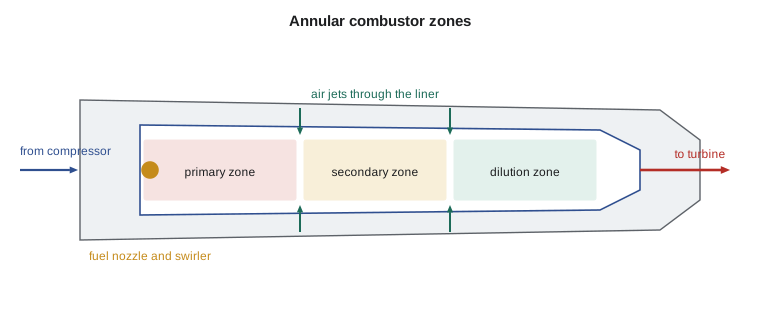
The liner is divided into zones. In the primary zone, near the fuel nozzle, the swirling flow creates a recirculation region where hot products mix back into the incoming mixture and keep the flame stable; the local mixture is near stoichiometric so it burns fast and hot. The secondary zone adds air to complete the burning of carbon monoxide and soot. The dilution zone adds the remaining air to cool the gas to the temperature the turbine can accept and to shape the radial temperature profile, hotter at mid-span where the blades are strongest and cooler at the root and tip.
Fuel-air ratio and equivalence ratio
The overall fuel-air ratio follows from an energy balance across the combustor. With combustion efficiency \(\eta_b\), the fuel needed to raise the gas from the compressor exit temperature \(T_{t3}\) to the turbine inlet temperature \(T_{t4}\) is
Comparing it with the stoichiometric ratio, about 1/14.7 for kerosene, gives the equivalence ratio \(\phi = f/f_{st}\). Overall equivalence ratios in aircraft combustors are low, around 0.3 to 0.4 at take-off, because most of the air is used for dilution and cooling. A flame cannot burn at such lean mixtures, which is exactly why the air is staged: the primary zone sees a much richer mixture.
# Combustor sizing checks for the Swift 900 core at take-off: fuel-air ratio for the required
# temperature rise, overall and primary-zone equivalence ratios, residence time, and CO2 and H2O
# produced per kg of kerosene (taken as C12H23).
LHV, cp_g = 43.2e6, 1180.0
f_st = 1 / 14.7                                  # stoichiometric fuel-air ratio for kerosene, approx.
T3, T4, eta_b = 790.0, 1600.0, 0.995             # compressor exit and turbine inlet at take-off, K
f = cp_g * (T4 - T3) / (eta_b * LHV - cp_g * T4)
phi = f / f_st
print(f"fuel-air ratio {f:.4f}, overall equivalence ratio {phi:.2f}")
share_primary = 0.30                             # fraction of combustor air entering the primary zone
print(f"primary zone with {100*share_primary:.0f} percent of the air: equivalence ratio {phi/share_primary:.2f} (rich-burn)")
print(f"primary zone with 60 percent of the air: equivalence ratio {phi/0.60:.2f} (lean-burn)")
# residence time from volume, mass flow and density
mdot, p3, V = 8.0, 2.4e6, 0.008                 # kg/s core air at take-off, Pa, m^3 combustor volume
rho = p3 / (287 * (T3 + T4) / 2)
t_res = rho * V / mdot
print(f"mean gas density {rho:.1f} kg/m3, residence time about {1000*t_res:.1f} ms")
# products: C12H23 + 17.75 O2 -> 12 CO2 + 11.5 H2O
M_fuel = 12 * 12.011 + 23 * 1.008
print(f"per kg of fuel: {12*44.01/M_fuel:.2f} kg CO2 and {11.5*18.015/M_fuel:.2f} kg H2O")
fuel_kgph = f * mdot * 3600
print(f"take-off fuel flow per engine {fuel_kgph:.0f} kg/h -> {fuel_kgph*3.16/1000:.2f} t CO2 per hour")
for EI in (8, 15, 25):
print(f"NOx emission index {EI:2d} g/kg -> {EI*fuel_kgph/1000:.1f} kg NOx per engine-hour at take-off")fuel-air ratio 0.0233, overall equivalence ratio 0.34 primary zone with 30 percent of the air: equivalence ratio 1.14 (rich-burn) primary zone with 60 percent of the air: equivalence ratio 0.57 (lean-burn) mean gas density 7.0 kg/m3, residence time about 7.0 ms per kg of fuel: 3.16 kg CO2 and 1.24 kg H2O take-off fuel flow per engine 670 kg/h -> 2.12 t CO2 per hour NOx emission index 8 g/kg -> 5.4 kg NOx per engine-hour at take-off NOx emission index 15 g/kg -> 10.0 kg NOx per engine-hour at take-off NOx emission index 25 g/kg -> 16.7 kg NOx per engine-hour at take-off
The program finds a fuel-air ratio of 0.0233 at take-off, an overall equivalence ratio of 0.34. If 30 percent of the air enters the primary zone, it burns slightly rich at 1.14; if 60 percent does, it burns lean at 0.57. These two numbers are the two families of low-emissions combustor described below. The mean residence time in a combustor of 8 liters is about 7 milliseconds, long enough for kerosene to burn completely at take-off pressure, but not by much; at high altitude, where the pressure is a tenth as high, reactions slow sharply, which is why relight at altitude is a certification test. Each kilogram of fuel gives 3.16 kg of CO₂ and 1.24 kg of water, figures used in every aviation emissions inventory, and one engine at take-off burns about 670 kg/h, producing 2.1 metric tons of CO₂ per hour.
Emissions and how combustors control them
Combustor emissions fall into two groups. CO₂ and water are set by the fuel burned and cannot be reduced by the combustor; only less fuel, or fuel from non-fossil carbon (Lesson 12), reduces them. Nitrogen oxides, carbon monoxide, unburned hydrocarbons and non-volatile particulate matter (soot) depend on how the fuel is burned, and here combustor design has a large effect.
Nitrogen oxides form mostly in the hottest parts of the flame, above about 1800 K, and their formation rate rises exponentially with temperature and with the time spent there. Higher engine pressure ratios, which raise compressor exit temperature and flame temperature, make NOx harder to control, so the efficiency gains of Lesson 3 come with an emissions challenge. Two main approaches are used. Rich-burn, quick-quench, lean-burn combustors burn rich in the primary zone, where there is too little oxygen for much NOx, then mix in air very quickly to jump past the stoichiometric peak temperature, and finish burning lean. Lean-burn combustors premix fuel and air and burn the whole primary zone lean, keeping the flame temperature low throughout; they give the lowest NOx but are harder to keep stable and need staging, with a separate pilot flame at low power.
Emissions are regulated at the engine level by ICAO standards, adopted nationally. Certification measures emission indices, grams of pollutant per kilogram of fuel, over a standard landing and take-off cycle of idle, take-off, climb and approach at set thrusts and times, and the limits depend on the engine's pressure ratio and thrust. Standards for non-volatile particulate mass and number, introduced in the last decade, now apply to new engine types; Canada and the United States have adopted them through the EPA aircraft engine emission standards in 40 CFR Part 87, which follow ICAO Annex 16 Volume II and are enforced by the FAA. Cruise emissions are not directly regulated, but they matter for climate: NOx at altitude affects ozone and methane, and soot and water vapor can form persistent contrails.
| Pollutant | Main cause | Main control |
|---|---|---|
| CO₂, H₂O | Carbon and hydrogen in the fuel | Burn less fuel or use non-fossil carbon |
| NOx | High flame temperature and time at it | Rich-quench-lean or lean premixed combustion |
| CO, unburned hydrocarbons | Incomplete burning, mainly at idle | Good atomization, primary zone design, staging |
| Soot (nvPM) | Rich, poorly mixed regions | Better mixing, lean burn, low-aromatic fuels |
Other combustor requirements
Pressure loss across the combustor, 3 to 6 percent of total pressure, comes partly from the diffuser and partly from the jets through the liner that create the mixing. Lower loss helps the cycle; more loss improves mixing. The temperature profile at the exit, described by the pattern factor (the peak exit temperature above the average, divided by the temperature rise), must be small and stable, because the turbine is designed for the average and a hot streak shortens blade life. Ignition at the ground and relight at altitude, stability at idle and during rapid throttle changes, and freedom from combustion instabilities, acoustic pressure oscillations that can damage the liner, are all certification items under the FAA engine airworthiness standards of 14 CFR Part 33.
Worked problem
Fuel-air ratio
A combustor takes air at 700 K to 1450 K with \(c_p = 1180\) J/(kg K), \(h_{PR} = 43.2\) MJ/kg and \(\eta_b = 0.99\). Find the fuel-air ratio and equivalence ratio.
Show solution
- \(f = 1180 \times 750/(0.99 \times 43.2\times10^6 - 1180 \times 1450) = 885\,000/(42.77\times10^6 - 1.71\times10^6) = 0.0216\).
- \(\phi = 0.0216 \times 14.7 = 0.32\).
Answer: A fuel-air ratio of 0.0216, equivalence ratio 0.32.
Worked problem
CO2 from a flight
A business jet burns 1500 kg of fuel on a flight. How much CO₂ does it emit?
Show solution
- \(1500 \times 3.16 = 4740\) kg.
Answer: About 4.7 metric tons of CO₂, whatever the combustor design.
Worked problem
Emission index
An engine at approach burns 0.10 kg/s of fuel with a NOx emission index of 10 g/kg for 4 minutes. How much NOx does it emit?
Show solution
- Fuel \(= 0.10 \times 240 = 24\) kg.
- NOx \(= 24 \times 10 = 240\) g.
Answer: 240 g of NOx during the approach phase.
Fuel injection and the fuel system
Kerosene must be broken into fine droplets that evaporate quickly. Pressure atomizers force fuel through a small swirling orifice at high pressure; airblast atomizers spread the fuel into a thin sheet and shatter it with fast-moving air, giving good atomization at high power and a more uniform spray. Many engines use dual-orifice or staged injectors so that atomization stays good from idle to take-off. Droplet sizes of 20 to 50 micrometers are typical; larger drops burn slowly and raise smoke and carbon monoxide.
The engine fuel system pumps fuel from the aircraft tanks, heats it with oil coolers so that ice crystals cannot block filters, meters it with the engine control, and supplies the nozzles. Modern engines use full-authority digital engine controls, which schedule fuel flow against spool speed, temperatures and pressures to give the thrust the pilot selects while keeping every limit: surge margin, turbine temperature, overspeed. Fuel also serves as the coolant for the engine oil and, in some designs, for electronics, which limits how hot the fuel may become.
Worked problem
Fuel flow from fuel-air ratio
A core flow of 8 kg/s at a fuel-air ratio of 0.0233 needs what fuel flow, in kg/h and liters per hour at 0.80 kg/L?
Show solution
- \(\dot m_f = 8 \times 0.0233 = 0.186\) kg/s = 671 kg/h.
- Volume \(= 671/0.80 = 839\) L/h.
Answer: About 671 kg/h or 840 liters per hour per engine at take-off (about 220 US gallons per hour).
Arjun's emissions summary for the Swift 900 lists the engine maker's certified emission indices at the four landing and take-off points, the characteristic values compared with the limits for the engine's pressure ratio, and the margin for each pollutant. It also notes the engine's particulate results, which matter for local air quality around airports. The margins are comfortable for carbon monoxide and hydrocarbons and narrower for NOx, as expected for a high pressure ratio core.
Common mistakes
MistakeThinking the combustor can reduce CO₂ per kilogram of fuel.
InsteadCO₂ depends only on the fuel's carbon; only less fuel or non-fossil carbon reduces it.
MistakeAssuming the overall equivalence ratio is where the flame burns.
InsteadAir is staged; the primary zone is much richer than the overall ratio.
MistakeRaising pressure ratio for efficiency without considering NOx.
InsteadHigher compressor exit and flame temperatures increase NOx formation.
MistakeIgnoring altitude relight.
InsteadLow pressure at altitude slows reactions; relight is a certification requirement.
Summary and key terms
- Annular combustors slow the compressor air in a diffuser, then burn fuel in stages: a recirculating primary zone holds the flame, a secondary zone completes burning and a dilution zone cools the gas and shapes the turbine inlet profile.
- The overall fuel-air ratio comes from an energy balance and is far leaner than stoichiometric.
- CO₂ and water depend only on the fuel burned; NOx, CO, hydrocarbons and soot depend on how it burns, and are controlled by rich-quench-lean or lean premixed designs.
- Emissions are certified over the landing and take-off cycle against ICAO-based standards.
- Annular combustor
- A ring-shaped combustor liner between compressor and turbine.
- Primary zone
- The recirculating flame-holding region at the front of the liner.
- Dilution zone
- The rear region where air is added to cool the gas to turbine temperature.
- Equivalence ratio
- Actual fuel-air ratio divided by the stoichiometric ratio.
- Emission index
- Grams of a pollutant emitted per kilogram of fuel burned.
- Pattern factor
- Peak combustor exit temperature above average, divided by the temperature rise.
- Landing and take-off cycle
- The standard idle, take-off, climb and approach test cycle for emissions certification.
Practice problems
Work each problem on paper first, then reveal the answer to check.
What is the equivalence ratio for a fuel-air ratio of 0.025?
Show answer
About 0.37.
In the program, raise the turbine inlet temperature to 1700 K. What happens to the fuel-air ratio?
Show answer
It rises to about 0.0262.
Why is the overall mixture so lean?
Show answer
Most of the air is used to cool the gas and the liner after the primary zone.
Which combustor type premixes fuel and air to keep the flame cool?
Show answer
Lean-burn (lean premixed).
How much CO₂ comes from 670 kg of fuel?
Show answer
About 2.12 metric tons.
Why must combustors pass an altitude relight test?
Show answer
To restart the engine in flight at low pressure after a flameout.
Lesson quiz · 5 questions
Score 60% or more to complete this lesson.
Create a free account to save your progress, take quizzes and earn a certificate.