
AERO-340 · Lesson 11 of 12 · 27 min
Rocket propulsion
A rocket carries everything it throws out. There is no incoming air, no ram drag and no dependence on the atmosphere, which is why rockets are the only propulsion that works in space and the only practical way to reach orbit. The physics is the same momentum balance as Lesson 1, with the incoming stream removed. This lesson treats rockets at the level of a standard textbook, for launch vehicles and spacecraft. Prairiewind Aerospace's involvement is small but real: the company makes composite fairing parts for a commercial small-satellite launcher, and the launcher's engineers have asked the company to review the performance figures quoted in a marketing brochure before a customer meeting. Dr. Nakamura gives Arjun the job, with the reminder that the review is about checking numbers, not designing an engine.
Thrust and specific impulse
For a rocket with propellant mass flow \(\dot m\), exhaust velocity \(V_e\), exit pressure \(p_e\) and nozzle exit area \(A_e\), the thrust is
with no ram drag term. It is convenient to combine the two terms into an effective exhaust velocity \(c = F/\dot m\). The standard performance measure is specific impulse, the thrust per unit weight flow of propellant, which has units of seconds:
where \(g_0 = 9.80665\) m/s². Specific impulse is to rockets what TSFC is to jet engines, but inverted: higher is better. Typical vacuum values are about 300 to 340 seconds for liquid oxygen with kerosene, 360 to 380 for liquid oxygen with methane, and 440 to 460 for liquid oxygen with liquid hydrogen. Solid rocket motors used as boosters are typically lower. Electric thrusters on spacecraft reach 1500 to 3000 seconds or more, but with thrusts of fractions of a newton, suitable only for long, gentle maneuvers in orbit.
Compare a jet engine. An air-breathing engine carries only its fuel and gets its oxidizer free from the air, so its equivalent specific impulse, thrust divided by fuel weight flow, is several thousand seconds: the Swift 900's turbofan at 16.7 mg/(N s) has an equivalent specific impulse of about 6100 s. Rockets are wasteful by that measure, and are used only where the air runs out or speeds are too high for air-breathing engines.
The rocket equation
As a rocket burns propellant, it gets lighter. Integrating Newton's second law in free space, with no gravity or drag, gives the ideal rocket equation, first published by Tsiolkovsky in 1903:
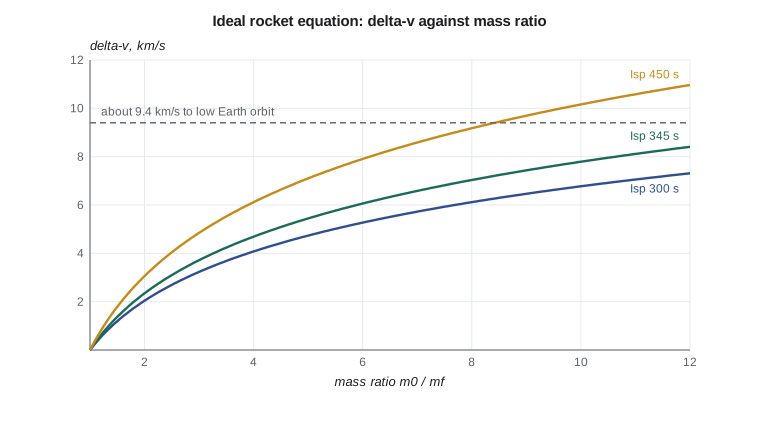
where \(m_0\) is the initial mass and \(m_f\) the final mass after the propellant is burned. The velocity change depends on specific impulse and the logarithm of the mass ratio. Logarithms grow slowly, so large velocity changes need very large mass ratios. Reaching low Earth orbit needs an orbital speed of about 7.8 km/s, plus about 1.5 to 2 km/s lost to gravity during the climb and to atmospheric drag, a total of about 9.3 to 9.8 km/s.
Staging
A single stage would need a mass ratio of about 25 at 300 seconds to reach orbit, meaning 96 percent of the lift-off mass would have to be propellant, leaving only 4 percent for tanks, engines, structure and payload. Staging solves the problem by discarding empty tanks and engines along the way, so that later stages do not have to accelerate dead weight. Each stage's velocity change is calculated with the rocket equation using its own masses, and the total is the sum.
# Rocket propulsion at textbook level: the ideal rocket equation for a two-stage small launcher,
# and the thrust coefficient of a nozzle from the isentropic relations.
import math
g0 = 9.80665
def stage(Isp, m0, mprop):
    return Isp * g0 * math.log(m0 / (m0 - mprop))
# two-stage vehicle, masses in kg; payload 300 kg
payload = 300.0
s2_dry, s2_prop, s2_isp = 1200.0, 6000.0, 345.0
s1_dry, s1_prop, s1_isp = 4200.0, 38000.0, 300.0
m_upper = payload + s2_dry + s2_prop
m0 = m_upper + s1_dry + s1_prop
dv1 = stage(s1_isp, m0, s1_prop); dv2 = stage(s2_isp, m_upper, s2_prop)
print(f"lift-off mass {m0/1000:.1f} t, payload fraction {100*payload/m0:.2f} percent")
print(f"stage 1 delta-v {dv1/1000:.2f} km/s, stage 2 {dv2/1000:.2f} km/s, total {(dv1+dv2)/1000:.2f} km/s")
print("low Earth orbit needs about 7.8 km/s of orbital speed plus roughly 1.5 to 2 km/s of gravity and drag losses")
single = stage(320.0, m0, s1_prop + s2_prop)
print(f"one stage with the same total propellant and dry mass, Isp 320 s: {single/1000:.2f} km/s")
# thrust coefficient of an ideal nozzle
def CF(gm, eps, pc, pa):
    # solve area ratio for exit pressure ratio by bisection
    def area(pr):
        M = math.sqrt(2 / (gm - 1) * (pr ** (-(gm - 1) / gm) - 1))
        return (1 / M) * ((2 / (gm + 1)) * (1 + (gm - 1) / 2 * M * M)) ** ((gm + 1) / (2 * (gm - 1)))
    lo, hi = 1e-6, 0.5
    for _ in range(80):
        mid = (lo + hi) / 2
        if area(mid) > eps: lo = mid
        else: hi = mid
    pe = mid * pc
    mom = math.sqrt(2 * gm**2 / (gm - 1) * (2 / (gm + 1)) ** ((gm + 1) / (gm - 1)) * (1 - (pe / pc) ** ((gm - 1) / gm)))
    return mom + (pe - pa) / pc * eps, pe
for eps, pa, where in ((16, 101325, "sea level"), (16, 0, "vacuum"), (80, 0, "vacuum, upper-stage nozzle")):
    c, pe = CF(1.22, eps, 7.0e6, pa)
print(f"area ratio {eps:3d}, {where:26s}: exit pressure {pe/1000:6.1f} kPa, thrust coefficient {c:.3f}")lift-off mass 49.7 t, payload fraction 0.60 percent stage 1 delta-v 4.26 km/s, stage 2 5.45 km/s, total 9.70 km/s low Earth orbit needs about 7.8 km/s of orbital speed plus roughly 1.5 to 2 km/s of gravity and drag losses one stage with the same total propellant and dry mass, Isp 320 s: 6.80 km/s area ratio 16, sea level : exit pressure 44.5 kPa, thrust coefficient 1.551 area ratio 16, vacuum : exit pressure 44.5 kPa, thrust coefficient 1.782 area ratio 80, vacuum, upper-stage nozzle: exit pressure 5.6 kPa, thrust coefficient 1.912
The program checks the brochure's two-stage vehicle. With a lift-off mass of 49.7 metric tons and a 300 kg payload, the first stage gives 4.26 km/s and the second 5.45 km/s, a total of 9.70 km/s, enough for low Earth orbit with a small margin, at a payload fraction of 0.60 percent. A single stage with the same propellant and dry mass, even at a better specific impulse of 320 seconds, reaches only 6.80 km/s. Arjun's review note confirms the brochure's figures are consistent with the rocket equation but points out that it quoted vacuum specific impulse for the first stage, which spends its first minute at sea-level pressure, where specific impulse is lower; the first-stage delta-v is therefore a little optimistic.
Nozzles and the thrust coefficient
Rocket nozzles are convergent-divergent, because the chamber pressure is far above ambient. The thrust coefficient \(C_F = F/(p_c A_t)\), where \(p_c\) is the chamber pressure and \(A_t\) the throat area, measures how well the nozzle turns chamber pressure into thrust. It depends on the area ratio \(A_e/A_t\), the gas properties and the ambient pressure. A nozzle that is too large for sea level overexpands the flow, giving an exit pressure below ambient and a negative pressure term; one that is too small underexpands it. First stages therefore use moderate area ratios, and upper stages, which fire in vacuum, use large ones.
The program shows this for a chamber at 7 MPa with a gas \(\gamma\) of 1.22. With an area ratio of 16, the exit pressure is 44.5 kPa and the thrust coefficient 1.55 at sea level and 1.78 in vacuum: the same engine gives 15 percent more thrust in space. An upper-stage nozzle with an area ratio of 80 expands to 5.6 kPa and reaches 1.91 in vacuum, which is why upper-stage engines have such large bells.
Civil space and regulation
Launches are licensed: in Canada through federal approvals in which Transport Canada plays the central role, and in the United States by the FAA's Office of Commercial Space Transportation under 14 CFR Part 450. Range safety, debris mitigation and the safe disposal of spent stages and satellites at the end of their lives are as much part of modern launch engineering as performance. This course deals only with performance at the textbook level; propellant formulation and engine design details belong to specialist courses and licensed organizations.
| Propulsion | Typical specific impulse, s | Typical use |
|---|---|---|
| Solid rocket motor | about 250 to 290 | Boosters, some small launchers |
| Liquid oxygen and kerosene | about 300 to 340 (vacuum) | First stages |
| Liquid oxygen and methane | about 360 to 380 (vacuum) | Newer reusable launchers |
| Liquid oxygen and hydrogen | about 440 to 460 (vacuum) | Upper stages |
| Electric propulsion | 1500 to 3000 or more | Satellite station keeping and orbit raising |
| Turbofan, for comparison | several thousand (equivalent) | Aircraft, using air as oxidizer |
Worked problem
Specific impulse
An engine gives 650 kN in vacuum with a propellant flow of 205 kg/s. Find its specific impulse.
Show solution
- \(c = 650\,000/205 = 3171\) m/s.
- \(I_{sp} = 3171/9.80665 = 323\) s.
Answer: 323 seconds, typical of an oxygen-kerosene engine in vacuum.
Worked problem
Rocket equation
An upper stage with specific impulse 345 s starts at 7500 kg and burns 6000 kg of propellant. Find its delta-v.
Show solution
- \(\Delta v = 345 \times 9.80665 \times \ln(7500/1500) = 3383 \times 1.609 = 5.45\) km/s.
Answer: 5.45 km/s, matching the program's second stage.
Worked problem
Mass ratio for a required delta-v
What mass ratio does a stage with specific impulse 300 s need to give 4.0 km/s?
Show solution
- \(\ln(m_0/m_f) = 4000/(300 \times 9.80665) = 1.360\).
- \(m_0/m_f = e^{1.360} = 3.90\).
Answer: A mass ratio of 3.9, so 74 percent of the stage's starting mass must be propellant.
Gravity and drag losses
The ideal rocket equation ignores gravity and drag. In a real ascent, the rocket must fight gravity while climbing, losing roughly \(g\) times the time spent climbing steeply, and must push through the dense lower atmosphere. Launch vehicles therefore climb vertically only briefly, then pitch over into a gravity turn in which the trajectory curves gradually toward horizontal. A high thrust-to-weight ratio at lift-off, typically 1.2 to 1.5, shortens the time spent fighting gravity, while a lower thrust reduces the engine mass. Typical losses for small launchers are 1.5 to 2 km/s, which is why the orbital requirement is about 9.4 km/s rather than 7.8.
Launching from a site closer to the equator adds the Earth's rotation, up to about 0.46 km/s eastward at the equator, and launching to a polar or sun-synchronous orbit, popular for Earth-observation satellites, gains nothing from it. These considerations decide where launch sites are built and which orbits a given vehicle can reach with a given payload.
Worked problem
Earth rotation benefit
The Earth's surface speed is about 465 m/s at the equator. Estimate the eastward boost at a latitude of 45 degrees.
Show solution
- \(465 \times \cos 45^\circ = 329\) m/s.
Answer: About 0.33 km/s, a few percent of the total requirement, which still matters for payload.
Reusable first stages, which fly back and land for refurbishment, have changed launch economics over the last decade. Reuse costs payload, because the stage must keep propellant for the return and carry legs and fins, but it saves building a new stage for every flight. The rocket equation still governs the trade: every kilogram of landing propellant reduces the mass ratio available for the ascent.
Common mistakes
MistakeAdding a ram drag term to rocket thrust.
InsteadA rocket takes in no air; its thrust has no ram drag.
MistakeUsing vacuum specific impulse for a stage that flies through the lower atmosphere.
InsteadSea-level specific impulse is lower because of the pressure term.
MistakeThinking delta-v grows in proportion to propellant mass.
InsteadIt grows with the logarithm of the mass ratio, so returns diminish.
MistakeComparing rockets and jets by specific impulse without noting the jet gets its oxidizer free.
InsteadAir-breathing engines carry only fuel, so their equivalent specific impulse is far higher.
Summary and key terms
- A rocket carries all its propellant, so its thrust has no ram drag.
- Specific impulse, thrust per unit weight flow of propellant, measures efficiency.
- The rocket equation gives delta-v from specific impulse and the logarithm of the mass ratio; reaching orbit needs about 9.4 km/s, which in practice requires staging.
- Convergent-divergent nozzles are sized for their operating pressure, and the thrust coefficient shows the gain in vacuum.
- Launches are licensed, and performance checks must use specific impulse appropriate to the altitude.
- Specific impulse
- Thrust divided by propellant weight flow, in seconds.
- Effective exhaust velocity
- Thrust divided by propellant mass flow.
- Mass ratio
- Initial mass divided by final mass of a stage or vehicle.
- Rocket equation
- Delta-v equals specific impulse times g0 times the natural log of the mass ratio.
- Staging
- Discarding spent parts of a vehicle so later stages accelerate less dead mass.
- Thrust coefficient
- Thrust divided by chamber pressure times throat area.
Practice problems
Work each problem on paper first, then reveal the answer to check.
What delta-v does a stage with Isp 450 s and mass ratio 4 give?
Show answer
About 6.1 km/s.
In the program, raise the second-stage dry mass to 1500 kg. What is the new total delta-v?
Show answer
About 9.16 km/s, short of what orbit needs with a margin.
What is the equivalent specific impulse of a jet with TSFC 20 mg/(N s)?
Show answer
About 5100 s.
Why do upper stages use larger nozzle area ratios?
Show answer
In vacuum, a larger expansion raises exhaust velocity without any overexpansion penalty.
Roughly what fraction of a small launcher's lift-off mass reaches orbit as payload?
Show answer
Under 1 percent.
Why does a single stage struggle to reach orbit?
Show answer
It must carry its empty tanks and engines all the way, needing an impractically high mass ratio.
Lesson quiz · 5 questions
Score 60% or more to complete this lesson.
Create a free account to save your progress, take quizzes and earn a certificate.