
AERO-340 · Lesson 12 of 12 · 27 min
Sustainable aviation fuels, hydrogen and electric propulsion
Aviation produces roughly 2 to 3 percent of global CO₂ emissions, and its share is growing as other sectors decarbonise faster. Engines are about as efficient as the physics of Lessons 3 to 5 easily allows, and each new generation saves perhaps 15 percent of fuel over the one before. Deeper cuts need a different energy carrier. This lesson compares the three options now being developed: sustainable aviation fuels that drop into today's engines, hydrogen burned or used in fuel cells, and batteries driving electric motors. The Tern itself is a hybrid of the old and new, and Prairiewind Aerospace's board has asked Dr. Nakamura's group for a one-page view of where each option fits, with numbers. Arjun's final task of the year is to produce it.
Energy per kilogram and per liter
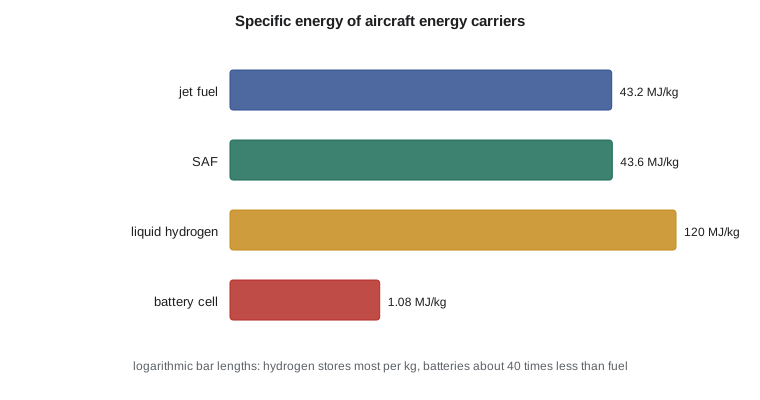
The first comparison is physical. Kerosene stores about 43 MJ/kg and 35 MJ/L. Liquid hydrogen stores about 120 MJ/kg, nearly three times as much by mass, but only about 8.5 MJ/L, a quarter as much by volume, and it must be kept at about 20 K (about −423 °F) in insulated tanks. Lithium-ion battery cells store about 0.9 to 1.1 MJ/kg (250 to 300 Wh/kg) today, roughly 40 times less than kerosene, and pack-level values are 15 to 30 percent lower again. Electric motors and fuel cells are more efficient than gas turbines, so the comparison of useful energy narrows the gap, but does not close it.
# Energy carriers for aircraft: stored energy per kg and per liter, the mass of each needed to
# deliver the same useful propulsive energy, and life-cycle CO2 for the Tern's 600 km mission.
# All life-cycle values are illustrative round numbers for comparison only.
need_kWh = 900.0                                 # propulsive (shaft) energy for the mission, kWh
carriers = {
    # name: (MJ/kg, MJ/L, efficiency fuel-or-battery to shaft, life-cycle g CO2e per MJ of carrier)
    'jet fuel (fossil)':          (43.2, 34.7, 0.32, 89),
    'SAF, waste-oil HEFA (50%)':  (43.6, 34.5, 0.32, 50),
    'liquid hydrogen, fuel cell': (120.0, 8.5, 0.50, 15),
    'battery, 300 Wh/kg cell':    (1.08, 2.5, 0.90, 30),
}
print("carrier                      kg needed   liters needed   life-cycle CO2e kg")
for name, (e_kg, e_L, eta, ci) in carriers.items():
    E_MJ = need_kWh * 3.6 / eta
    print(f"{name:28s} {E_MJ/e_kg:9.0f}      {E_MJ/e_L:9.0f}        {E_MJ*ci/1000:9.0f}")
print("\nhydrogen tank mass and battery packaging are not included; they change the picture a great deal")
pack = 1.08 * 0.833                               # cell to pack, illustrative
print(f"a pack at about 83 percent of cell specific energy stores {pack/3.6*1000:.0f} Wh/kg; the Tern's 600 kg battery holds about {600*pack/3.6:.0f} kWh")carrier kg needed liters needed life-cycle CO2e kg jet fuel (fossil) 234 292 901 SAF, waste-oil HEFA (50%) 232 293 506 liquid hydrogen, fuel cell 54 762 97 battery, 300 Wh/kg cell 3333 1440 108 hydrogen tank mass and battery packaging are not included; they change the picture a great deal a pack at about 83 percent of cell specific energy stores 250 Wh/kg; the Tern's 600 kg battery holds about 150 kWh
The program puts all four carriers on the same footing: the 900 kWh of shaft energy needed for a 600 km Tern trip. Fossil jet fuel needs 234 kg. A 50 percent blend of waste-oil SAF needs about the same mass and volume. Liquid hydrogen through a fuel cell needs only 54 kg of hydrogen, but 762 liters of it, two and a half times the volume of the kerosene, before counting the tank. A battery alone would need 3.3 metric tons of cells, more than half the Tern's maximum take-off mass. The life-cycle emissions, using illustrative round numbers, fall from about 900 kg of CO₂ equivalent for fossil fuel to about 500 for the blend and about 100 for hydrogen or batteries made with low-carbon electricity. The last line confirms the Tern's own battery: 600 kg of pack at about 250 Wh/kg holds 150 kWh, enough for take-off, climb and a short leg, but not a full trip.
Sustainable aviation fuels
Sustainable aviation fuels are kerosene-like hydrocarbons made from non-fossil carbon: waste fats and oils, agricultural and forestry residues, municipal waste, alcohols, or CO₂ captured from the air combined with hydrogen from electrolysis. Because they are chemically similar to jet fuel, they burn in today's engines and travel through today's pipelines. They are approved through ASTM D7566, which lists each production pathway in an annex and currently allows blends with conventional fuel of up to 50 percent; once blended and certified, the fuel is treated as standard jet fuel. The CO₂ from burning SAF is the same per kilogram as fossil fuel, 3.16 kg; the benefit comes from the carbon having been taken from the atmosphere recently, so life-cycle emissions can be 50 to 80 percent lower, depending on the feedstock and process. Work is under way, with engine and aircraft makers, to qualify 100 percent synthetic fuels, which need some aromatic content or seal changes because aromatics help certain fuel system seals swell.
The main limits are supply and cost. SAF was well under one percent of global jet fuel use in the mid-2020s and costs two to several times as much as fossil fuel. Policy is trying to change that: blending mandates in Europe, the ICAO CORSIA scheme for offsetting international emissions, and federal tax incentives and state low-carbon fuel programs. SAF also tends to have fewer aromatics, which cuts soot particles and may reduce contrail formation, a non-CO₂ benefit that may be significant.
Hydrogen
Hydrogen can be used in two ways. It can be burned in a modified gas turbine, giving water vapor and NOx but no CO₂; the combustor must be redesigned for hydrogen's much faster flame and wider flammability range, and lean premixed designs are being developed to keep NOx low. Or it can feed fuel cells, which convert it directly to electricity at efficiencies of about 50 to 60 percent, driving electric motors; this produces only water. Fuel cells suit small and regional aircraft; combustion suits larger ones, where the power needed would make fuel cells too heavy.
The difficulties are storage and supply. Liquid hydrogen tanks must be thick, insulated and roughly cylindrical or spherical to manage boil-off and pressure, so they cannot go in the wings; they take fuselage volume and add weight. Airports need liquefaction, storage and handling for a cryogenic fuel. And hydrogen is only clean if made cleanly, by electrolysis using low-carbon electricity rather than from natural gas without carbon capture. Hydrogen aircraft are being demonstrated at small scale, but large commercial hydrogen airliners are not expected before the mid-2030s at the earliest, and many programs have slipped.
Battery-electric and hybrid propulsion
Electric motors are light, efficient (95 percent or more), quiet and simple, and they make new configurations possible: distributed propellers along the wing, propellers at the wing tips that recover tip vortex energy, and motors that can produce short bursts of high power. The problem is the battery. At today's specific energy, battery-electric aircraft suit training, very short commuter routes and the new vertical take-off air taxis, with ranges of the order of 100 to 200 km. Each doubling of battery specific energy roughly doubles the useful range, so progress in cells matters directly. Batteries also bring thermal runaway risk, which requires careful cell selection, containment and monitoring, and certification standards for electric propulsion are still being developed by Transport Canada, the FAA and other authorities.
Hybrids, like the Tern, are the bridge. A battery supplies peak power for take-off and climb, allowing a smaller engine; the engine provides range; and the electric motors give the configuration freedom and quiet operation near airports. Lesson 6 showed the efficiency cost of the conversion chain. The Tern's case depends on the routes: on its longest routes its batteries cover take-off and climb, and on shorter hops they cover most of the trip.
| Option | Main strength | Main limit | Likely first use |
|---|---|---|---|
| SAF blends | Drops into existing engines and infrastructure | Supply and cost | All aircraft, now |
| Hydrogen combustion | No CO₂ at the aircraft, high specific energy | Tank volume and weight, airport supply | Regional and narrow-body, 2030s or later |
| Hydrogen fuel cells | Only water emitted, efficient | Fuel cell and tank mass, cooling | Small and regional aircraft |
| Battery-electric | Efficient, quiet, simple | Low specific energy | Trainers, air taxis, very short routes |
| Hybrid-electric | Smaller engine, quiet operations, new configurations | Conversion losses, complexity | Commuter aircraft like the Tern |
Arjun's one-page view
The note Arjun writes for the board is short. SAF is the only option that reduces emissions from the Swift 900 and the company's existing fleets in the next decade, and the company should certify all its products for the highest approved blends and press for supply at Wichita's airport. The Tern's hybrid design is right for its routes today and should be built to accept better batteries as they arrive, since each improvement extends its battery-only range. Hydrogen is worth watching for a future regional aircraft, but the airport supply question will decide its timing more than the aircraft engineering. Dr. Nakamura adds one sentence before it goes to the board: that every option should be judged on life-cycle emissions, measured honestly, not on what comes out of the tailpipe.
Worked problem
Hydrogen volume
A mission needs 180 kWh of fuel cell output. With a fuel cell efficiency of 0.50 and liquid hydrogen at 120 MJ/kg and 8.5 MJ/L, find the hydrogen mass and volume.
Show solution
- Hydrogen energy \(= 180 \times 3.6/0.50 = 1296\) MJ.
- Mass \(= 1296/120 = 10.8\) kg; volume \(= 1296/8.5 = 152\) L.
Answer: About 11 kg but 152 liters of liquid hydrogen, plus the tank.
Worked problem
SAF life-cycle saving
A flight burns 1500 kg of fuel. Fossil fuel has life-cycle emissions of 89 g CO₂e/MJ and a SAF 22 g CO₂e/MJ. What is the saving with a 50 percent blend at 43.2 MJ/kg?
Show solution
- Energy \(= 1500 \times 43.2 = 64\,800\) MJ.
- Fossil: \(64\,800 \times 0.089 = 5770\) kg; blend: \(64\,800 \times (0.5 \times 0.089 + 0.5 \times 0.022) = 3600\) kg.
Answer: About 2.2 metric tons of CO₂e saved, 38 percent.
Worked problem
Battery range scaling
An electric aircraft has 100 km of useful range with 250 Wh/kg packs. Roughly what range would 400 Wh/kg packs give at the same battery mass?
Show solution
- Range scales with stored energy: \(100 \times 400/250 = 160\) km.
Answer: About 160 km, before any weight savings in the rest of the aircraft are reinvested.
Non-CO₂ effects and operations
Aviation's climate effect is not only its CO₂. NOx emitted at cruise altitude forms ozone and destroys methane, and contrails that persist and spread into cirrus clouds trap heat at night. Studies suggest the total warming effect of aviation may be roughly two to three times that of its CO₂ alone, though the non-CO₂ part is much less certain. Contrails form only in cold, humid air layers that are often thin, so small changes in cruise altitude on a small fraction of flights could avoid many of them; trials of contrail avoidance with weather forecasts are under way.
Operations also save fuel. Single-engine taxi, continuous descent approaches, more direct routings and higher load factors all reduce fuel burn without any new technology. For the Tern, electric taxi and battery climb are built in; for the Swift 900, careful flight planning and engine washing to keep performance up are the everyday levers. None of these replaces new energy carriers, but together they can cut fuel use by several percent across a fleet.
Worked problem
Contrail avoidance trade
Diverting 3 percent of flights 600 m lower costs those flights about 1.5 percent more fuel. What is the fleet-wide fuel penalty?
Show solution
- \(0.03 \times 1.5 = 0.045\) percent of fleet fuel.
Answer: Less than a twentieth of a percent of fuel, against a possibly large reduction in contrail warming, which is why such trials are being pursued (illustrative numbers).
Common mistakes
MistakeThinking SAF produces less CO₂ at the engine.
InsteadIt produces the same CO₂ per kilogram; the saving is in the life cycle, from recently captured carbon.
MistakeComparing hydrogen only by energy per kilogram.
InsteadIts low energy per liter and heavy tanks dominate aircraft design.
MistakeAssuming batteries will soon match kerosene.
InsteadEven large improvements leave them many times below kerosene's specific energy.
MistakeJudging options by tailpipe emissions alone.
InsteadProduction of the fuel or electricity can dominate life-cycle emissions.
Summary and key terms
- Deeper cuts in aviation emissions need new energy carriers.
- SAF drops into existing engines through ASTM D7566 approved pathways, with blends up to 50 percent today, and cuts life-cycle emissions by roughly 50 to 80 percent, limited by supply and cost.
- Hydrogen has three times kerosene's energy per kilogram but a quarter per liter, needs cryogenic tanks and clean production, and can be burned or used in fuel cells.
- Batteries store about 40 times less energy per kilogram than kerosene and suit short routes and air taxis; hybrids like the Tern bridge the gap.
- Options must be judged on life-cycle emissions.
- Sustainable aviation fuel
- Jet fuel made from non-fossil carbon sources, approved for blending with conventional fuel.
- Drop-in fuel
- A fuel that can be used without changes to engines, aircraft or infrastructure.
- ASTM D7566
- The standard that approves synthetic fuel pathways for blending into jet fuel.
- CORSIA
- The ICAO carbon offsetting and reduction scheme for international aviation.
- Fuel cell
- A device that converts hydrogen and oxygen directly into electricity and water.
- Specific energy
- Energy stored per unit mass.
- Thermal runaway
- A self-heating failure of a battery cell that can spread to neighboring cells.
Practice problems
Work each problem on paper first, then reveal the answer to check.
How many times more energy per kilogram does liquid hydrogen store than kerosene?
Show answer
About 2.8 times.
In the program, raise the battery cell to 500 Wh/kg. How much battery mass does the mission need?
Show answer
About 2000 kg, still a third of the Tern's maximum take-off mass.
Why can't hydrogen tanks go in the wings?
Show answer
They must be thick, insulated and roughly cylindrical, and need more volume than the wings provide.
What blend limit applies to SAF under ASTM D7566 today?
Show answer
Up to 50 percent.
Why might SAF reduce contrails?
Show answer
Fewer aromatics means fewer soot particles for ice to form on.
What decides whether hydrogen is low-carbon?
Show answer
How it is produced, for example electrolysis with low-carbon electricity.
Lesson quiz · 5 questions
Score 60% or more to complete this lesson.
Create a free account to save your progress, take quizzes and earn a certificate.