
AERO-340 · Lesson 7 of 12 · 25 min
Inlets and nozzles
The inlet and the nozzle are the parts of an engine that touch the outside flow, and they are where the propulsion group and the aerodynamics group work most closely together. The inlet must deliver the air to the fan face at the speed and uniformity the fan wants, with as little loss of total pressure as possible, at every condition from a crosswind take-off to cruise. The nozzle must turn the energy left in the stream into thrust. Aerodynamics II already developed the compressible flow tools, isentropic area relations, normal shocks and nozzle choking; this lesson applies them to the Swift 900's nacelle. Dr. Watanabe and Arjun are checking the engine maker's inlet and nozzle figures against the airframe's own predictions.
What the inlet must do
A subsonic transport inlet is a short diffuser: the air enters through a rounded lip and slows as the duct widens toward the fan face. Fans work best when the axial Mach number at their face is about 0.5 to 0.6, whatever the flight speed. At cruise, Mach 0.80, the air must slow down; at take-off, nearly stationary, it must speed up. The inlet does neither job alone. The stream tube of air that will enter the engine adjusts its shape ahead of the lip: at cruise it is narrower than the inlet and the air slows before it arrives, and at take-off it is wider and the air accelerates into the lip.
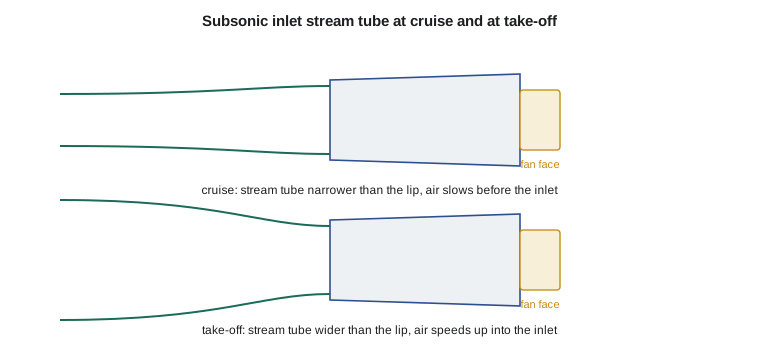
The quality of an inlet is measured by its total pressure recovery \(\pi_d = p_{t2}/p_{t0}\), and by distortion, the non-uniformity of total pressure across the fan face. Recovery of 0.99 or better is normal for a well-designed subsonic pod inlet at cruise. Each percent of lost recovery costs roughly 1 to 1.5 percent of thrust, more on high-bypass engines, so inlet designers fight for every tenth. Distortion matters even when the average is good, because a fan blade passing through a low-pressure region sees a sudden change in angle of attack that can provoke stall or vibration. Crosswinds, high angles of attack and engines mounted in the wake of a fuselage or wing all add distortion; rear-mounted business jet engines like the Swift 900's must be checked carefully for fuselage boundary layer and wing wake at high angles of attack.
The lip is a compromise. A thick, round lip handles the high flow angles of take-off and crosswinds without separating, but adds drag at cruise. A thin, sharp lip is good at cruise but separates at low speed. Most transport inlets are slightly drooped and scarfed to suit the angle of attack and the ground effect. Icing is a further consideration: the lip must be kept free of ice with hot bleed air or electric heating, and engines are tested in icing conditions before certification, at facilities such as specialized cold-weather and icing test centers such as the one GE operates in Winnipeg, Canada.
Supersonic inlets in brief
At supersonic speed a simple pitot inlet forms a normal shock ahead of the lip, and the loss through a normal shock grows quickly with Mach number: recovery is about 0.98 at Mach 1.3 but only about 0.72 at Mach 2.0. Supersonic inlets therefore use one or more oblique shocks from ramps or a center cone to slow the air in steps before a final weak normal shock, as Aerodynamics II showed. Variable geometry keeps the shocks in place as speed changes. These inlets are outside the scope of a business jet, but the same shock-loss reasoning explains why supersonic transports are so much harder to make efficient.
Nozzles
A nozzle accelerates the flow by converting pressure and temperature into velocity. If the total pressure at the nozzle entry is below the critical value \(p_t/p_0 = \big((\gamma+1)/2\big)^{\gamma/(\gamma-1)}\), about 1.89 for air and 1.85 for combustion gas, a convergent nozzle expands the flow fully and the exit pressure equals ambient. Above that ratio the nozzle chokes: the exit Mach number is one, the exit pressure is above ambient, and the remaining expansion happens outside the nozzle in a series of expansion and compression waves. The engine still gets the momentum thrust of the sonic jet plus a pressure thrust \((p_e - p_0)A_e\), but a little less in total than a convergent-divergent nozzle that expanded fully.
At subsonic cruise, nozzle pressure ratios are only slightly above critical, so convergent nozzles lose very little and are used almost everywhere on subsonic aircraft for their simplicity and low weight. Supersonic aircraft use convergent-divergent nozzles, often with variable area, because their nozzle pressure ratios are much higher. Nozzles also carry thrust reversers on most jets, cascade or clamshell doors that turn the bypass stream forward on landing, and noise-reduction features such as chevrons on the trailing edge, which mix the jet with the surrounding air more gently.
# Inlet and nozzle checks for the Swift 900 at cruise: the inlet capture ratio and recovery,
# and whether the convergent bypass and core nozzles are choked, with their pressure thrust.
import math
g, R = 1.4, 287.05
M0, T0, p0 = 0.80, 216.65, 17.9e3                 # 12 500 m
def ratio(M, gm=1.4): return 1 + (gm - 1) / 2 * M * M
Tt0 = T0 * ratio(M0); pt0 = p0 * ratio(M0) ** (g / (g - 1))
a0 = math.sqrt(g * R * T0); V0 = M0 * a0
# inlet: the fan face wants M 0.55; the free stream tube shrinks or grows to suit
def A_ratio(M):                                  # A / A* for isentropic flow
    return (1 / M) * ((2 / (g + 1)) * ratio(M)) ** ((g + 1) / (2 * (g - 1)))
mdot = 26.0                                      # kg/s, real engine air at cruise
rho0 = p0 / (R * T0); A0 = mdot / (rho0 * V0)
A_fan = A0 * A_ratio(0.55) / A_ratio(M0)
print(f"captured stream tube {A0:.3f} m2, fan face area needed for M 0.55: {A_fan:.3f} m2 (diameter {math.sqrt(4*A_fan/math.pi):.2f} m)")
for pi_d in (0.995, 0.98, 0.96):
    print(f"inlet recovery {pi_d}: fan-face total pressure {pt0*pi_d/1000:5.2f} kPa, about {100*(1-pi_d)*1.3:.1f} percent thrust lost")
# nozzles: total pressure and temperature at entry; choked if pt/p0 exceeds the critical ratio
crit = ratio(1.0) ** (g / (g - 1))
def nozzle(name, m, pt, Tt, gm, Rg=287.05):
    cr = ratio(1.0, gm) ** (gm / (gm - 1))
    if pt / p0 > cr:
        Te = Tt / ratio(1.0, gm); pe = pt / cr; Ve = math.sqrt(gm * Rg * Te)
    else:
        pe = p0; Me = math.sqrt(2 / (gm - 1) * ((pt / p0) ** ((gm - 1) / gm) - 1)); Te = Tt / ratio(Me, gm); Ve = Me * math.sqrt(gm * Rg * Te)
    Ae = m * Rg * Te / (pe * Ve)
    F_mom = m * Ve - m * V0; F_p = (pe - p0) * Ae
    print(f"{name}: pt/p0 {pt/p0:4.2f} (critical {cr:4.2f}) -> {'choked' if pt/p0 > cr else 'not choked'}, "
          f"Ve {Ve:4.0f} m/s, momentum thrust {F_mom/1000:5.2f} kN, pressure thrust {F_p/1000:4.2f} kN")
    return F_mom + F_p
Fb = nozzle("bypass nozzle", 21.0, pt0 * 0.99 * 1.50, Tt0 * 1.50 ** (0.4 / 1.4 / 0.88), 1.4)
Fc = nozzle("core nozzle  ", 5.0, pt0 * 0.99 * 1.35, 740.0, 1.33, 288.0)
print(f"total from the two streams {(Fb + Fc)/1000:.2f} kN (target 3.60 kN)")captured stream tube 0.383 m2, fan face area needed for M 0.55: 0.463 m2 (diameter 0.77 m) inlet recovery 0.995: fan-face total pressure 27.15 kPa, about 0.7 percent thrust lost inlet recovery 0.98: fan-face total pressure 26.74 kPa, about 2.6 percent thrust lost inlet recovery 0.96: fan-face total pressure 26.19 kPa, about 5.2 percent thrust lost bypass nozzle: pt/p0 2.26 (critical 1.89) -> choked, Ve 306 m/s, momentum thrust 1.46 kN, pressure thrust 0.75 kN core nozzle : pt/p0 2.04 (critical 1.85) -> choked, Ve 493 m/s, momentum thrust 1.29 kN, pressure thrust 0.17 kN total from the two streams 3.67 kN (target 3.60 kN)
The program finds a captured stream tube of 0.383 m² at cruise, smaller than the fan face of 0.463 m² that the air needs to reach Mach 0.55; the diffuser makes up the difference. The fan diameter of about 0.77 m matches the engine maker's drawing. Each percent of lost recovery costs about 1.3 percent of thrust in this simple estimate. Both nozzles are choked at cruise, the bypass nozzle at a pressure ratio of 2.26 against a critical 1.89 and the core nozzle at 2.04 against 1.85, so each gives a pressure thrust as well as momentum thrust. Together they give 3.67 kN, within 2 percent of the 3.60 kN cruise requirement, a satisfactory cross-check between the engine maker's data and the company's own model.
Arjun points out one thing the numbers hide. The bypass nozzle's pressure thrust is 0.75 kN, a third of its total, which means part of the bypass stream's expansion happens outside the nozzle, where it interacts with the rear fuselage. On a rear-mounted engine, that plume can change the pressure on the fuselage and the tail. The thrust and drag bookkeeping agreed in Lesson 1 must say who carries those effects, and the wind tunnel campaign in the aerodynamics plan includes powered nacelle tests to measure them.
| Item | Value at Swift 900 cruise | Comment |
|---|---|---|
| Captured stream tube area | 0.383 m² | smaller than the fan face: air slows ahead of the lip |
| Fan face area for Mach 0.55 | 0.463 m² | about 0.77 m diameter |
| Bypass nozzle pressure ratio | 2.26 (critical 1.89) | choked, 0.75 kN pressure thrust |
| Core nozzle pressure ratio | 2.04 (critical 1.85) | choked, 0.17 kN pressure thrust |
| Total thrust from both streams | 3.67 kN | target 3.60 kN |
Worked problem
Critical pressure ratio
Find the critical nozzle pressure ratio for air (\(\gamma = 1.4\)) and for combustion gas (\(\gamma = 1.33\)).
Show solution
- Air: \(1.2^{3.5} = 1.893\).
- Gas: \(1.165^{4.03} = 1.851\).
Answer: A convergent nozzle chokes when the total-to-ambient pressure ratio exceeds about 1.89 for air or 1.85 for hot gas.
Worked problem
Pressure thrust of a choked nozzle
A choked core nozzle has a total pressure of 37 kPa where the ambient pressure is 17.9 kPa and \(\gamma = 1.33\). The exit area is 0.050 m². Find the exit static pressure and pressure thrust.
Show solution
- \(p_e = p_t/1.851 = 37/1.851 = 20.0\) kPa.
- \((p_e - p_0)A_e = (20.0 - 17.9)\times 10^3 \times 0.050 = 105\) N.
Answer: About 0.1 kN of pressure thrust; small because the nozzle pressure ratio is only a little above critical.
Worked problem
Thrust lost to inlet recovery
An engine gives 3.60 kN with perfect recovery. Using the rule of about 1.3 percent thrust per percent of recovery, what does a recovery of 0.97 give?
Show solution
- Loss \(= 3 \times 1.3 = 3.9\) percent.
- \(F = 3.60 \times 0.961 = 3.46\) kN.
Answer: About 3.46 kN, a loss of 140 N that the aircraft would have to make up with extra fuel.
Nacelle drag and the integrated design
The nacelle's outer surface adds skin friction, and if the lip spills too much air at cruise the flow can accelerate around it and form shocks. Short, slim nacelles reduce weight and drag but leave less room for acoustic liners and thrust reversers. The final nacelle shape is a joint product of the engine maker and the airframe maker, refined in wind tunnel tests and computation.
Common mistakes
MistakeThinking the inlet alone slows the air at cruise.
InsteadMuch of the deceleration happens ahead of the lip, in the shape of the captured stream tube.
MistakeAssuming a choked nozzle wastes a lot of thrust.
InsteadAt subsonic cruise the loss compared with full expansion is small; pressure thrust recovers most of it.
MistakeLooking only at average inlet recovery.
InsteadDistortion across the fan face can cause stall or vibration even with good average recovery.
MistakeUsing air properties for the core nozzle.
InsteadHot gas has a lower gamma and a slightly lower critical pressure ratio.
Summary and key terms
- Subsonic inlets deliver air to the fan at about Mach 0.5 to 0.6 with high total pressure recovery and low distortion; the captured stream tube adapts ahead of the lip, and the lip shape is a compromise between take-off and cruise.
- Supersonic inlets use oblique shocks to limit losses.
- Convergent nozzles choke above a critical pressure ratio of about 1.85 to 1.89 and then give pressure thrust as well as momentum thrust; at subsonic cruise the loss compared with full expansion is small.
- Both inlets and nozzles interact with the airframe and must be handled in the thrust and drag bookkeeping.
- Total pressure recovery
- Total pressure at the fan face divided by free-stream total pressure.
- Distortion
- Non-uniformity of total pressure or swirl across the engine face.
- Captured stream tube
- The tube of free-stream air that ends up entering the engine.
- Choked nozzle
- A nozzle whose throat has reached Mach one, so further pressure rise does not raise exit Mach number.
- Critical pressure ratio
- The total-to-ambient pressure ratio at which a convergent nozzle chokes.
- Thrust reverser
- A device that turns part of the jet forward to help stop the aircraft on landing.
Practice problems
Work each problem on paper first, then reveal the answer to check.
A convergent nozzle has pt/p0 = 1.6 with air. Is it choked?
Show answer
No; 1.6 is below the critical 1.89.
In the program, lower the bypass nozzle's fan pressure factor from 1.50 to 1.20. Is it still choked?
Show answer
pt/p0 becomes about 1.81, below critical, so it is no longer choked and the pressure thrust disappears.
Why is a thick inlet lip used despite its cruise drag?
Show answer
It prevents flow separation at take-off and in crosswinds.
Why do supersonic inlets use oblique shocks?
Show answer
Several weak shocks lose less total pressure than one strong normal shock.
What does a fan-face Mach number of 0.55 imply about cruise and take-off flow?
Show answer
Air slows ahead of the lip at cruise and accelerates into it at take-off.
What is a chevron nozzle for?
Show answer
Reducing jet noise by mixing the jet more gently.
Lesson quiz · 5 questions
Score 60% or more to complete this lesson.
Create a free account to save your progress, take quizzes and earn a certificate.