
WRIT-101 · Lesson 9 of 12 · 20 min
Academic integrity and AI writing tools
▶ Video coming soon A video version of this lesson is on the way.
In the fifth week, Dr. Varga tells the class about a student she taught years ago, whom she calls Alex. Alex was a strong student who fell behind during a family crisis, found an essay online two nights before the deadline, changed some words and submitted it. The similarity report flagged it within minutes. Alex failed the course, lost a scholarship and had to explain the notation on a transcript to every program he later applied to. 'What I remember most,' Varga says, 'is that he told me he would have been fine with an extension. He never asked.' This lesson is about academic integrity: what it means, what counts as a breach, how to protect yourself, and how to use AI writing tools honestly.
What academic integrity means
Academic integrity is a commitment to honesty and responsibility in learning, teaching and research. The International Center for Academic Integrity describes it through six fundamental values: honesty, trust, fairness, respect, responsibility and courage. In practice, it means that the work you submit is your own, that you acknowledge the work of others, that you report data and results truthfully, and that you follow the rules your instructors set for each assignment.
Integrity matters for reasons beyond rules. A credential is a promise to employers and the public that you can do what it says. A nurse's diploma means the nurse learned pharmacology; an accounting diploma means the accountant can prepare financial statements; an engineering degree means the engineer can calculate loads. If the work behind a credential wasn't genuine, the promise is false, and the people who rely on it are put at risk. Integrity also protects the value of everyone else's work: when some students cheat, honest students' achievements are worth less.
Forms of academic misconduct
Colleges define misconduct in their own policies, and you should read yours, but most include the same core forms.
- Plagiarism: presenting someone else's words, ideas, data or images as your own, without proper acknowledgement.
- Fabrication: inventing data, sources, quotations or results.
- Falsification: altering data or results, such as dropping inconvenient measurements from a lab report without saying so.
- Contract cheating: having someone else complete work for you, whether a friend, a paid service or an online marketplace.
- Unauthorized collaboration: working with others on an assignment meant to be individual, or sharing answers.
- Unauthorized use of tools: using AI tools, translation software or other aids where the instructor has not permitted them.
- Self-plagiarism or duplicate submission: submitting work you produced for one course in another without permission.
Hana asks about falsification in lab reports. Varga explains that dropping an outlier is not misconduct if you report it and give a reason, such as a recorded equipment fault. It becomes misconduct when the measurement disappears silently because it spoiled the result. Honesty about what happened is the line.
Kinds of plagiarism
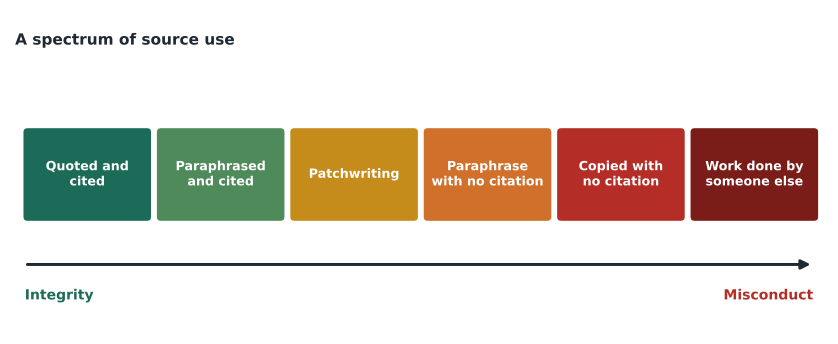
Plagiarism takes several forms, and most students who are found to have plagiarized did not set out to cheat. Direct plagiarism copies text word for word without quotation marks or citation. Mosaic plagiarism, or patchwriting, which Lesson 7 described, weaves a source's phrases into your own sentences without quotation marks. Paraphrase without citation restates someone's ideas in your own words without acknowledging them. Accidental plagiarism results from careless notes, when a phrase copied into your notes ends up in your draft as if it were yours. Each is treated as plagiarism regardless of intention, though intention usually affects the penalty.
How to protect yourself
The habits that prevent plagiarism are the habits of good research. Keep careful notes that mark quotations clearly, for example with quotation marks and the page number, and that separate the source's ideas from yours, as double-entry notes do. Record full citation details as you go. Paraphrase from memory, as Lesson 7 described. Start early, because most plagiarism happens under deadline pressure. And when you don't know whether something is allowed, such as discussing an assignment with a classmate or using a grammar checker, ask the instructor before you do it.
If you are struggling, ask for help early: an extension, a tutor, a counsellor, accessibility services. Instructors deal with these requests regularly, and very few would rather receive a plagiarized paper than a request for more time.
Similarity checkers
Many colleges use software such as Turnitin, which compares submitted work against a database of web pages, publications and previously submitted papers and produces a similarity report. The report does not decide whether a paper is plagiarized. It shows matching text, and an instructor reviews the matches: a properly quoted and cited passage is a match, but not a problem. A paper with a low similarity score can still be plagiarized, for example if it was written by someone else from scratch. The software is a tool for instructors, not a verdict.
AI writing tools
Generative AI tools such as chatbots can draft text, summarize articles, suggest outlines, rephrase sentences and answer questions. They raise new questions for academic integrity, and colleges and instructors have adopted different policies. Some courses prohibit AI tools entirely for graded work. Some permit specific uses, such as brainstorming or checking grammar, with disclosure. Some encourage their use as part of the assignment. Policies can differ between courses in the same program, and even between assignments in the same course.
The rule for this course, Varga says, is the rule she recommends everywhere: find out the policy for each assignment, follow it, and when AI use is permitted, disclose how you used it. Using an AI tool where it is not permitted is a form of unauthorized assistance. Submitting AI-generated text as your own writing, where that isn't permitted, is treated much like submitting work written by another person.
| Use | Often permitted? | Why it matters |
|---|---|---|
| Brainstorming topics or keywords | Often, with disclosure | Generates ideas you then develop yourself |
| Explaining a concept you are studying | Often | Like a tutor, but it can be wrong, so check |
| Checking grammar and spelling | Often | Similar to a grammar checker; check the course policy |
| Suggesting an outline | Sometimes | May substitute for planning you are meant to learn |
| Rewriting your paragraphs | Sometimes or rarely | The prose may no longer be your own writing |
| Drafting the paper | Rarely in writing courses | Replaces the skill the course is assessing |
| Finding sources | With great care | Tools can invent citations that do not exist |
Why AI tools need caution even when permitted
AI tools have specific weaknesses that matter in academic work. They can produce fluent, confident text that is wrong. They can invent sources, quotations and statistics, a problem often called hallucination. They may reproduce the views and gaps in the data they were trained on. They don't know your course readings or your instructor's expectations. And text they generate may closely resemble existing writing. Everything an AI tool tells you must be checked, and you remain responsible for every claim in work you submit.
Priya, whose program studies these systems, adds a point from her own courses: language models predict plausible text, they don't consult a database of facts. That is why a model can generate a citation with a real journal name, a plausible title and authors who exist but never wrote that article. Varga asks her to explain it to the class, and the explanation does more than any warning could.
There is also a learning cost. Writing is a way of thinking: when you work out how to explain an idea, you understand it better. If a tool does the drafting, you may finish the assignment without developing the skill it was designed to build. Varga tells the class that the essay they write in Lesson 12 will be assessed on their reasoning, which no tool can do for them.
Disclosing and citing AI use
When AI use is permitted, disclose it. Many instructors ask for a short statement at the end of the paper describing which tool you used, for what and how you checked the output. For example: 'I used an AI chatbot to brainstorm search keywords for my research. I did not use it to draft or revise any text. All sources were found and read in the library database.' If you quote or paraphrase AI-generated text, the major styles have published guidance on citing it. APA, for instance, treats the company that makes the tool as the author and includes the tool's name and version; MLA uses a description of the prompt. Because this guidance is new and still changing, check the current advice from the style's official website.
Don't rely on AI detectors to tell you whether your writing will be flagged. Research has found that such detectors produce frequent false positives, and that they are more likely to flag writing by people writing in a second language. Many colleges have cautioned instructors against relying on them. The best protection is a record of your own process: notes, outlines and saved drafts that show how your paper developed.
Copyright and fair use
Academic integrity is about honesty to your readers and instructors; copyright is about the legal rights of creators. They overlap but are not the same. In Canada, the Copyright Act's fair dealing provisions allow limited use of copyrighted works for purposes including research, private study, education, criticism, review and news reporting, provided the use is fair, which is why you can quote short passages in an essay. Citation does not make an excessive copy legal, and permission from a copyright holder does not remove the need to cite.
If you are accused
If an instructor raises a concern about your work, respond honestly and promptly. Read your college's policy, which will describe the process and your rights, usually including the right to see the evidence, to respond and to appeal. Bring your notes and drafts. Many colleges have student advocates or ombudspersons who can explain the process. A first, minor breach is often treated as a learning opportunity; dishonesty during the process is treated much more seriously.
Collaboration done right
Collaboration is valuable, and many assignments require it. The integrity question is not whether you worked with others but whether the work you submit reflects the kind of collaboration the assignment allows. For an individual paper, discussing the readings, testing ideas on a classmate and giving each other feedback on drafts are usually encouraged. Writing sentences together, sharing a draft for someone to copy, or dividing up an individual assignment are not. For a group project, the group shares responsibility for the whole, and each member should be able to explain any part of it.
Amir's construction management courses assign group reports. His group agrees at the start who will draft each section, sets an internal deadline for drafts, and has one member edit the whole report for consistency. They keep a short log of who did what, which they include as an appendix when the instructor asks. When one member pastes in a section copied from a contractor's website, the editor catches it, and the group rewrites it together with proper citations. Shared responsibility means checking each other's work, not only dividing it.
Peer review in writing courses has its own etiquette. Comment on what the draft does, ask questions, suggest changes, but don't rewrite your classmate's paragraphs for them. The writer must make the revisions in their own words.
Worked problem
Is this an integrity problem?
Consider four situations. First, Luis and a classmate discuss the assignment question over coffee, then write their papers separately. Second, Amir finds a perfect sentence in a trade magazine and pastes it into his draft with a citation but no quotation marks. Third, Brigid uses a grammar checker that rewrites two of her sentences, in a course whose policy permits grammar checkers. Fourth, Kofi asks a chatbot to write his conclusion in a course that prohibits AI drafting, then edits it.
Show solution
- Luis: discussion of ideas is usually permitted unless the assignment says otherwise; writing separately keeps the work his own. Check the policy, but this is normally fine.
- Amir: copying exact words without quotation marks is plagiarism even with a citation. He must add quotation marks or paraphrase properly.
- Brigid: permitted by the policy; she should review the changes to make sure the meaning is still hers.
- Kofi: prohibited AI drafting; editing the output does not make it his own writing. He should write his own conclusion.
Answer: Luis and Brigid are within the rules; Amir must fix his quotation; Kofi's use breaches the course policy.
Common mistakes
MistakePlagiarism only counts if you meant to do it.
InsteadPlagiarism is defined by what you submit; intention affects the penalty, not whether it occurred.
MistakeA low similarity score proves a paper is original.
InsteadSimilarity software only finds matching text; work written by someone else can score low.
MistakeIf an AI tool wrote it, there is no author to plagiarize.
InsteadSubmitting AI-generated text as your own writing where not permitted is a breach of integrity.
MistakeCiting a source makes copying its exact words acceptable.
InsteadExact words need quotation marks as well as a citation.
Summary and key terms
- Academic integrity rests on honesty, trust, fairness, respect, responsibility and courage.
- Misconduct includes plagiarism, fabrication, falsification, contract cheating, unauthorized collaboration and unauthorized tool use.
- Careful notes, early starts and asking when unsure prevent most plagiarism.
- AI policies vary by course and assignment; follow them, disclose permitted use and check everything a tool produces.
- Keep notes and drafts as a record of your process, and ask for help before a deadline becomes a crisis.
- Academic integrity
- A commitment to honesty and responsibility in academic work.
- Plagiarism
- Presenting others' words, ideas or work as your own without acknowledgement.
- Fabrication
- Inventing data, sources or results.
- Falsification
- Altering data or results.
- Contract cheating
- Having someone else complete academic work for you.
- Hallucination
- False information, such as invented citations, produced by an AI tool.
- Similarity report
- Software output showing text that matches other sources, reviewed by an instructor.
Practice problems
Work each problem on paper first, then reveal the answer to check.
Is it plagiarism to submit a paper you wrote for another course?
Show answer
Usually yes, as duplicate submission, unless both instructors permit it.
What should a disclosure statement about AI use include?
Show answer
Which tool, what it was used for, and how the output was checked.
Why can't a similarity report decide whether a paper is plagiarized?
Show answer
It shows matching text, which may be properly quoted, and can miss work written by someone else.
Name two habits that prevent accidental plagiarism.
Show answer
Marking quotations clearly in notes with page numbers, and paraphrasing from memory.
Lesson quiz · 5 questions
Score 60% or more to complete this lesson.
Create a free account to save your progress, take quizzes and earn a certificate.