
WRIT-101 · Lesson 1 of 12 · 21 min
The writing process: from assignment to final draft
▶ Video coming soon A video version of this lesson is on the way.
On the first day of WRIT-101 at Northgate College in Hamilton, Dr. Helen Varga asks her students to write down the last thing they wrote that someone else had to act on. Kofi Mensah, in the accounting program, writes 'an email to my landlord about a leaking pipe.' Hana Sato, in physics, writes 'a lab report that came back covered in red ink.' Luis Ortega, in computing science, writes 'a bug report.' Brigid Nolan, in cinematography, writes 'a pitch for a short film.' Amir Haddad, in construction project management, writes 'a daily site log.' Varga collects the cards and reads them aloud. 'Every one of these,' she says, 'is academic writing in the sense that matters for this course. Someone had a purpose, a reader and a situation, and the writing either worked or it didn't.'
This course is about writing that works: clear, well-supported essays, reports and summaries that a reader can follow, trust and act on. It is required in many Northgate programs, from accounting and mathematics to architecture and photography, because every one of those fields depends on people who can read carefully, think through a problem and explain their reasoning in writing. This first lesson is about the process behind good writing, because the most common reason student writing fails is not a lack of talent but a lack of process: the paper was started too late, written in one pass and handed in without being read again.
Writing is a process, not a performance
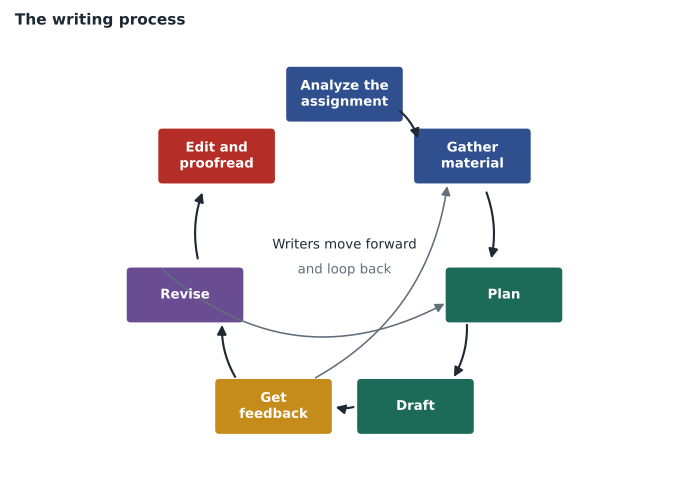
Many students imagine that good writers sit down and produce finished prose in one sitting. Almost no one works that way. Professional writers, researchers and engineers move through a series of overlapping activities: understanding the task, gathering material, planning, drafting, getting feedback, revising, editing and proofreading. They loop back constantly. A writer drafting a section may discover that the plan doesn't work and return to planning; a writer revising may realize that a key source is missing and return to research.
Varga draws the process as a loop rather than a straight line. Thinking of writing this way has a practical benefit: it lets you separate jobs that interfere with each other. When you draft, you are trying to get ideas down and see how they connect. When you edit, you are trying to make each sentence correct and clear. If you try to do both at once, polishing every sentence before you know what the paragraph is for, you write slowly and often throw the polished sentences away. Writing the first draft quickly and fixing it later is not careless. It is efficient.
Step one: analyze the assignment
Every piece of academic writing starts with a task, and many weak papers go wrong before a word is written because the writer misread it. Varga hands out a sample assignment from a second-year course and asks the class to take it apart.
'Write a 1,500-word report evaluating whether the college's switch to online course evaluations has improved response rates and the usefulness of feedback. Use at least four sources, including data from the Office of Institutional Research. Follow APA style. Due Friday, October 24.'
She asks four questions about any assignment, and the class works through them.
- What is the task word? Here it is evaluating, which means making a judgment about quality or effectiveness and supporting it with evidence. A report that only describes the new system has not done the task.
- What is the subject, and how narrow is it? Two things are to be judged: response rates and the usefulness of feedback. A report that discusses only response rates has done half the task.
- What are the requirements? Length, genre (a report, not an essay), number and type of sources (at least four, including institutional data), citation style (APA) and deadline.
- Who is the reader, and what do they expect? An instructor in an education or management course, reading as a professional who wants a clear judgment, organized headings and evidence they can check.
Task words matter because they set the kind of thinking the paper must show. Describe and summarize ask you to report what is there. Explain asks how or why something happens. Analyze asks you to break something into parts and show how they work together. Compare asks for similarities and differences, usually to reach a point. Evaluate, assess and argue ask you to take a position and support it. A student who is asked to evaluate and only explains has written a competent paper on the wrong task.
| Task word | What it asks you to do | A sign you have not done it |
|---|---|---|
| Summarize | Report the main points of a text accurately and briefly, in your own words | Your summary includes your opinions or minor details |
| Explain | Show how or why something happens or works | You describe what happens but never say why |
| Analyze | Break a subject into parts and show how the parts relate | You list parts without connecting them |
| Compare | Identify meaningful similarities and differences and draw a conclusion | You describe one thing, then the other, and stop |
| Evaluate or assess | Judge quality, value or effectiveness against stated criteria, with evidence | You never state a judgment |
| Argue | Take and defend a debatable position, answering objections | Your position is a fact no one disputes |
Step two: gather material
Before you can plan, you need something to plan with. For some assignments the material is a set of readings; for others it is research you must find; for a lab report it is your own data. Gathering is also thinking. Varga recommends that students write while they read: short notes on what a source says, what they think about it and how it might fit the paper. Notes written in your own words, with the source and page recorded, save hours later and are the single best protection against accidental plagiarism, which Lesson 9 covers in detail.
Freewriting is a useful early tool. Set a timer for ten minutes and write continuously about the topic without stopping to correct anything. Most of what you write will be unusable, but freewriting often surfaces the question that actually interests you. Luis tries it on the course-evaluation assignment and discovers that what he really wants to know is whether students who respond to online evaluations differ from those who don't, which turns a vague topic into a researchable question.
Step three: plan
A plan can be a formal outline with numbered headings or a rough list of points on the back of an envelope. What matters is that before drafting you know your main point, the reasons or sections that support it, and the order that will make sense to the reader. Lessons 3 and 4 return to planning in detail. For now, Varga gives a simple test: can you state the main point of the paper in one or two sentences? If not, you are not ready to draft the whole paper, though you may be ready to draft a section to find out what you think.
Step four: draft
A first draft is for you. Its job is to get the content down in roughly the right order. Begin wherever you can make progress; many writers draft the body before the introduction, because it is easier to introduce a paper once you know what it says. Leave notes to yourself in brackets, such as [need source for this] or [check figure], rather than stopping to look things up. Keep moving.
Hana says her problem is the opposite: she can't start because the first sentence never seems good enough. Varga tells her to start with the sentence 'The point of this report is' and finish it. She can delete it later. Getting past the blank page is a matter of lowering the stakes of the first sentence, not of waiting for inspiration.
Step five: get feedback
Writers cannot see their own drafts the way a reader does, because they already know what they meant. Feedback from a classmate, a tutor or the instructor shows where a reader gets lost, misunderstands or wants more evidence. Sam Achebe, a tutor at the Northgate writing centre, visits the class and explains how to use a session well: bring a draft, the assignment and two or three specific questions, such as 'Is my argument clear in the introduction?' or 'Does the second section support my thesis?' A session that starts with 'Can you fix my grammar?' usually wastes the most valuable thing a reader can give you, which is an account of how the paper reads.
Steps six and seven: revise, then edit and proofread
Revision means re-seeing: changing the content, structure and argument in response to what the draft and its readers have shown you. It may mean moving sections, cutting paragraphs that don't serve the point, adding evidence or rewriting the thesis because the draft argued something slightly different. Editing works at the level of sentences: clarity, concision, word choice, grammar. Proofreading is the final check for typos, formatting and citation details. Lesson 11 covers all three. The order matters. There is no point perfecting the commas in a paragraph you are about to cut.
Planning your time backward
The process takes time, so the most practical habit in this lesson is to plan backward from the deadline. Varga asks Kofi to schedule the course-evaluation report, due on a Friday three weeks away. Working back from the due date, he blocks out a day for proofreading and formatting, three days for revision including a writing centre appointment, four days for drafting, three days for planning and research notes, and the rest for gathering sources. The plan shows him that he needs to book the tutoring appointment for the second week, not the night before.
Luis, who likes numbers, turns the schedule into a small program that divides the available days among the stages in proportion to the effort each usually takes.
from datetime import date, timedelta
due = date(2026, 10, 24)
start = date(2026, 10, 3)
days = (due - start).days
stages = [("gather and read", 3), ("plan", 2), ("draft", 3), ("feedback and revise", 3), ("edit and proofread", 1)]
total = sum(w for _, w in stages)
d = start
for name, w in stages:
    n = round(days * w / total)
    print(f"{d.isoformat()}  {name}: {n} days")
    d += timedelta(days=n)
print("finish by", d.isoformat(), "| due", due.isoformat())2026-10-03 gather and read: 5 days 2026-10-08 plan: 4 days 2026-10-12 draft: 5 days 2026-10-17 feedback and revise: 5 days 2026-10-22 edit and proofread: 2 days finish by 2026-10-24 | due 2026-10-24
The schedule finishes on the due date with no slack, so Luis moves everything a day earlier. A schedule is a tool, not a contract; its value is that it shows conflicts early, such as a midterm in the same week as the draft.
Writing in different programs
WRIT-101 is taken by students in programs that write very differently. Accountants write memos and audit findings; physicists write lab reports and papers with equations; computing scientists write documentation and design documents; filmmakers write treatments and proposals; construction managers write reports, change orders and safety plans. The genres differ, but they share the habits this course teaches: understand the task and the reader, make a clear main point, support it with evidence, organize it so the reader can follow, acknowledge sources and revise.
Varga tells the class that the essay is the main form in this course not because they will all write essays for a living but because the essay is the most demanding general form. It requires you to define a question, take a position, organize an argument and use sources without the support of a template. A writer who can do that can learn the conventions of a lab report or a project proposal quickly. Lesson 10 covers summaries, reports and other genres directly.
Worked problem
Analyzing an assignment
Amir receives this assignment in his construction management program: 'In 800 to 1,000 words, compare two methods of scheduling a residential build and recommend one for a small contractor. Cite at least three sources in APA style.' What does the assignment require?
Show solution
- Identify the task words: compare and recommend. The paper must show similarities and differences and then take a position.
- Identify the subject: two scheduling methods, applied to a residential build, for a small contractor. A general history of scheduling would miss the target.
- List the requirements: 800 to 1,000 words, at least three sources, APA style.
- Identify the reader: an instructor who expects a professional recommendation a small contractor could act on, with criteria such as cost, ease of use and accuracy.
- Plan the shape: introduce the situation and the recommendation, compare the methods on stated criteria, recommend one and explain when the other might be better.
Answer: A comparison that ends in a supported recommendation for a small residential contractor, 800 to 1,000 words, with at least three APA citations.
Common mistakes
MistakeGood writers produce good first drafts.
InsteadGood writers produce rough first drafts and revise them; the quality comes from the process.
MistakeRevising means fixing grammar and spelling.
InsteadRevising means changing content, structure and argument; grammar and spelling belong to editing and proofreading.
MistakeYou must write the introduction first.
InsteadMany writers draft the body first and write the introduction once they know what the paper says.
MistakeA writing tutor's job is to correct your paper.
InsteadA tutor's most useful job is to show you how a reader experiences your draft, so you can revise it yourself.
Summary and key terms
- Writing is a loop of overlapping stages: analyzing the task, gathering material, planning, drafting, getting feedback, revising, and editing and proofreading.
- The task word in an assignment sets the kind of thinking required; describing when asked to evaluate is a common way to miss the task.
- Separate drafting from editing so you don't polish sentences you will later cut.
- Feedback is most useful when you bring specific questions about how the draft reads.
- Plan backward from the deadline so each stage, especially revision, gets real time.
- Writing process
- The overlapping stages a writer moves through, from understanding the task to proofreading the final draft.
- Task word
- The verb in an assignment, such as analyze or evaluate, that tells you what kind of thinking to show.
- Freewriting
- Writing continuously for a set time without stopping to correct, used to generate ideas.
- Revision
- Changing the content, structure or argument of a draft.
- Editing
- Improving sentences for clarity, concision, correctness and style.
- Proofreading
- A final check for typos, formatting and citation details.
Practice problems
Work each problem on paper first, then reveal the answer to check.
An assignment asks you to 'assess the effectiveness of a recycling program.' What must your paper contain that a description would not?
Show answer
A judgment about how effective the program is, measured against stated criteria and supported by evidence.
Why do many writers draft the introduction last?
Show answer
Because it is easier to introduce a paper accurately once you know what the body says.
Name two questions you could bring to a writing tutor about a draft.
Show answer
For example: is my main point clear in the introduction, and does each section support it?
You have twelve days for a paper. Which stage should you protect when time runs short, and why?
Show answer
Revision, because it is where the argument and structure improve; skipping it usually costs more than any other cut.
Lesson quiz · 5 questions
Score 60% or more to complete this lesson.
Create a free account to save your progress, take quizzes and earn a certificate.