
WRIT-101 · Lesson 8 of 12 · 20 min
Citing sources in APA, MLA and Chicago style
▶ Video coming soon A video version of this lesson is on the way.
Kofi's accounting instructor wants APA. Brigid's film instructor wants MLA. Jess's architectural history instructor wants Chicago. Luis asks the obvious question: why can't everyone agree on one system? Dr. Varga answers that each style grew up to serve a different kind of scholarship, and that once you understand what all of them are doing, switching between them is a matter of details. 'Every citation system answers the same two questions,' she says. 'Where did this come from, and how can the reader find it? The styles differ in where they put the answers.'
Why we cite
Citation does several jobs at once. It gives credit to the people whose ideas, words and data you use. It lets readers find and check your sources, which is what makes academic claims verifiable. It shows readers how your argument fits into existing work and how strong your evidence is. And it protects you: careful citation is the clearest evidence that you are using sources honestly. Lesson 9 discusses academic integrity; this lesson covers the mechanics.
What needs a citation? Any quotation, paraphrase or summary of a source; any data, statistics, images or figures you did not create; and any idea that is distinctively someone else's, even if you express it entirely in your own words. What does not need one? Common knowledge, meaning facts widely known and undisputed among your readers, such as the year a country was founded or that water boils at 100 degrees Celsius at sea level, and your own ideas, observations and analysis. When in doubt, cite.
Two parts of every citation system
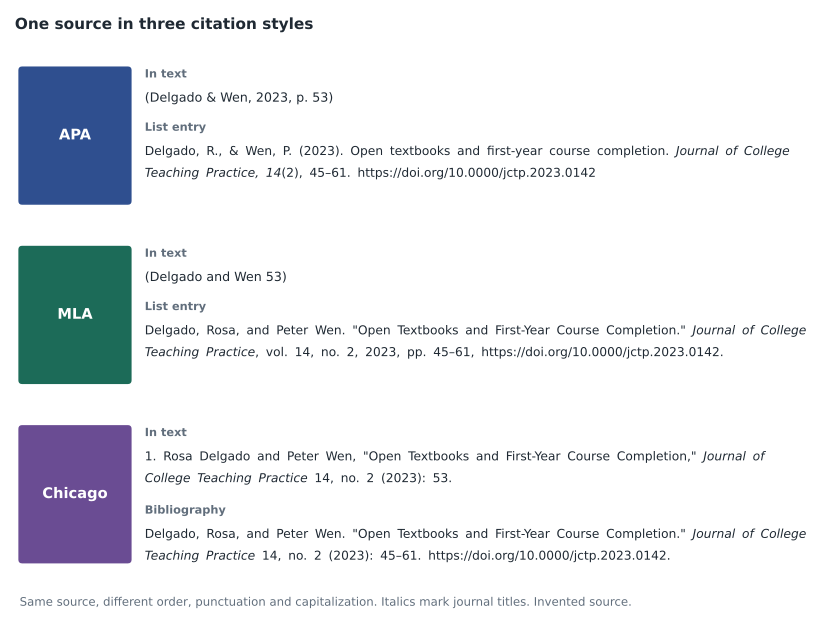
All the major styles have two linked parts: a brief citation in the text, at the point where you use the source, and a full entry in a list at the end (or, in Chicago's notes style, in a note). The in-text citation points the reader to the full entry; the full entry gives everything needed to find the source. If a reader sees (Delgado & Wen, 2023, p. 53) in your paragraph, they should be able to find Delgado in your alphabetical reference list and from there find the article.
The examples in this lesson use sources invented for this course, so you can practise without worrying about the details of real publications. The style rules are real. This lesson follows the seventh edition of the APA Publication Manual, the ninth edition of the MLA Handbook and the Chicago Manual of Style, whose eighteenth edition appeared in 2024. Style guides are revised every several years, so always check which edition your instructor requires, and use your library's citation guide or the official style websites for cases this lesson doesn't cover. A few formatting features, such as the italics used for journal and book titles, can't be shown in this lesson's text; they appear in the figures.
APA style: author and date
APA style, from the American Psychological Association, is used in psychology, education, business, nursing and many social sciences. It emphasizes the author and the date, because in these fields how recent the research is matters. In-text citations give the author's surname and the year, plus a page number for quotations. They can be parenthetical, (Delgado & Wen, 2023), or narrative, where the author's name is part of your sentence: Delgado and Wen (2023) found. Use an ampersand inside parentheses and the word and in narrative citations. For three or more authors, give the first author's name followed by et al. from the first citation.
The reference list, titled References, lists every cited source alphabetically by the first author's surname, with a hanging indent. Each entry has four main elements in a fixed order: author, date, title and source. For a journal article: Delgado, R., & Wen, P. (2023). Open textbooks and first-year course completion. Journal of College Teaching Practice, 14(2), 45–61. https://doi.org/10.0000/jctp.2023.0142. The journal name and volume number are italic; the article title is in sentence case, meaning only the first word, the first word after a colon and proper nouns are capitalized.
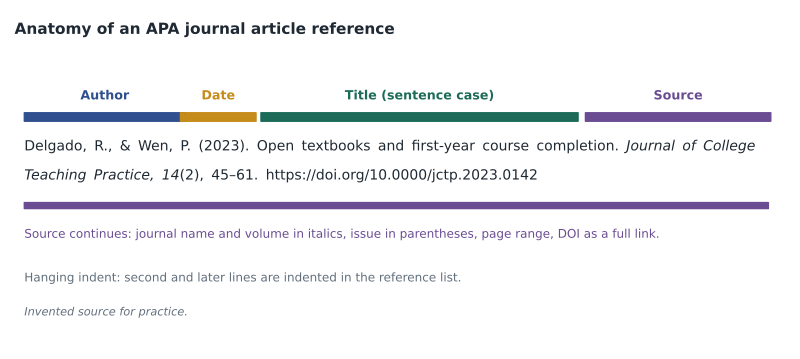
A DOI, or digital object identifier, is a permanent link assigned to many articles and books; include it as a full https://doi.org/ address when one exists. For a book: Ferris, M. (2021). The price of reading: Textbooks, access, and learning. Lakemont Press. The book title is italic. For a report by an organization, the organization is the author: Northgate College Office of Institutional Research. (2025). First-year textbook cost survey: Fall 2025 results. Northgate College. For a newspaper article online: Okoye, T. (2024, March 12). Free textbooks, hidden costs. The Northgate Ledger. https://ledger.example.org/2024/03/12/free-textbooks. For a web page with no date, write (n.d.) in place of the year.
MLA style: author and page
MLA style, from the Modern Language Association, is used in literature, languages, film and media studies and many humanities fields. It emphasizes the author and the page, because these fields often analyze specific passages. In-text citations give the author's surname and the page number, with no comma: (Delgado and Wen 53). If you name the author in your sentence, give only the page: Delgado and Wen observe that the benefit was largest where textbooks cost most (53). MLA uses the word and, not an ampersand, and for three or more authors gives the first author followed by et al.
The list at the end, titled Works Cited, is alphabetical with a hanging indent. MLA's ninth edition builds every entry from a set of core elements in order: author, title of source, title of container, other contributors, version, number, publisher, publication date and location. A container is the larger work that holds the source, such as a journal that holds an article or a website that holds a page. The journal article becomes: Delgado, Rosa, and Peter Wen. "Open Textbooks and First-Year Course Completion." Journal of College Teaching Practice, vol. 14, no. 2, 2023, pp. 45–61, https://doi.org/10.0000/jctp.2023.0142. MLA uses authors' full first names, title case for titles and quotation marks for the titles of shorter works; the journal name is italic.
For a film, the container model shows its flexibility. The film itself is the source; contributors such as the director follow the title; the studio is the publisher. Brigid's student film analysis cites a short film by a fictional director: Tremblay, Anouk, director. Kitchen Light. Lakemont Pictures, 2022. The film title is italic. MLA lets you begin with the person whose work you are discussing, so a paper about acting might begin the entry with an actor instead.
Chicago style: notes and bibliography
The Chicago Manual of Style, from the University of Chicago Press, offers two systems. The author-date system is similar to APA and used in some sciences and social sciences. The notes and bibliography system, described here, is used in history, art history, architecture and parts of the humanities. Instead of a parenthetical citation, you place a superscript number in the text, usually at the end of the sentence, and give the citation in a footnote at the bottom of the page or an endnote at the end of the paper.
The first time you cite a source, the note gives full details: 1. Rosa Delgado and Peter Wen, "Open Textbooks and First-Year Course Completion," Journal of College Teaching Practice 14, no. 2 (2023): 53, https://doi.org/10.0000/jctp.2023.0142. Later citations of the same source use a short form: 2. Delgado and Wen, "Open Textbooks," 53. Notes give authors' names in normal order and separate elements with commas. A bibliography at the end lists sources alphabetically with surnames first and elements separated by periods: Delgado, Rosa, and Peter Wen. "Open Textbooks and First-Year Course Completion." Journal of College Teaching Practice 14, no. 2 (2023): 45–61. https://doi.org/10.0000/jctp.2023.0142.
Notes have an advantage that historians value: they can carry commentary. A note can explain a disagreement among sources, give background that would interrupt the main text, or point readers to further reading. Jess uses a note in her paper on the railway station conversion to explain that two sources give different dates for the building's closure and why she follows one.
| Feature | APA | MLA | Chicago notes |
|---|---|---|---|
| Used in | Social sciences, education, business, health | Literature, languages, film and media | History, art, architecture, humanities |
| In-text form | (Author, year, p. page) | (Author page) | Superscript number and note |
| List title | References | Works Cited | Bibliography |
| Author names in list | Surname and initials | Full names | Full names |
| Article title case | Sentence case, no quotation marks | Title case in quotation marks | Title case in quotation marks |
| Date position | Right after author | Near the end | After the volume and issue |
Formatting the list
In all three styles, the list at the end is alphabetized by the first word of each entry, usually the first author's surname, and uses a hanging indent, in which the first line of each entry starts at the margin and later lines are indented. Every source cited in the text appears in the list, and every source in the list is cited in the text. Personal communications such as interviews you conducted are handled differently by each style; APA cites them only in the text, for example.
Citation tools
Reference managers such as Zotero, Mendeley and EndNote store your sources and generate citations and reference lists in any style. Library databases also offer a cite button. These tools save time, but they make predictable errors: wrong capitalization, missing DOIs, an organization's name split as if it were a person's, or an online article treated as a web page. Always check generated citations against the style rules. Luis runs a quick check on his reference list with a short program that flags entries missing a year or a DOI.
import re
refs = [
    "Delgado, R., & Wen, P. (2023). Open textbooks and first-year course completion. Journal of College Teaching Practice, 14(2), 45-61. https://doi.org/10.0000/jctp.2023.0142",
    "Ferris, M. (2021). The price of reading: Textbooks, access, and learning. Lakemont Press.",
    "Okoye, T. Free textbooks, hidden costs. The Northgate Ledger.",
]
for r in sorted(refs):
    author = r.split(",")[0]
    year = re.search(r"[(](\d{4}|n[.]d[.])", r)
    doi = "doi.org" in r
    problems = [] if year else ["no year"]
    if "Journal" in r and not doi:
        problems.append("journal article without DOI")
print(author, "->", "ok" if not problems else ", ".join(problems))Delgado -> ok Ferris -> ok Okoye -> no year
The script catches the Okoye entry, which is missing its date. It cannot catch everything, such as a wrong capitalization, which is why the final check is always a careful read.
Common errors
Varga lists the citation errors she sees most often. Citing a source in the text that is missing from the list, or the reverse. Using the date the article was accessed instead of its publication date. Putting the article title in italics instead of the journal name. Giving a database's name or a URL from a library search page instead of a DOI or stable link. Citing a secondary source as if you had read the original; if you read about a study only in another source, cite the source you read, and in APA note it as cited in. And mixing styles within one paper.
Citing as you write
The worst time to build a reference list is the night before the deadline, working backward from a draft full of half-remembered sources. Cite as you draft. Each time you use a source, put the in-text citation in immediately, even in rough form such as (Delgado 53), and add the full entry to your list or reference manager at the same time. When you revise, the citations move with the text. When you finish, the list is already complete, and the final job is only to check its format.
Varga also recommends keeping page numbers for everything, even when the style doesn't require them for paraphrases. APA, for example, encourages but does not require page numbers for paraphrases. Having them in your notes lets you check a paraphrase against the source later, and lets you answer quickly if an instructor asks where a point came from.
Worked problem
Converting a citation between styles
Kofi has this APA reference: Ferris, M. (2021). The price of reading: Textbooks, access, and learning. Lakemont Press. His philosophy elective requires MLA. Convert it, and give an MLA in-text citation for page 88. The author's full name is Mara Ferris.
Show solution
- Author: MLA uses the full first name: Ferris, Mara.
- Title: MLA uses title case for the book title, which stays italic: The Price of Reading: Textbooks, Access, and Learning.
- Publisher and date: MLA puts the publisher, then the year: Lakemont Press, 2021.
- Assemble with periods after the author and title and a comma between publisher and date.
- In-text: surname and page, no comma: (Ferris 88).
Answer: Ferris, Mara. The Price of Reading: Textbooks, Access, and Learning. Lakemont Press, 2021. In text: (Ferris 88).
Common mistakes
MistakeParaphrased ideas don't need citations.
InsteadParaphrases and summaries need citations just like quotations.
MistakeCitation generators are always correct.
InsteadThey make predictable errors; check every entry against the style rules.
MistakeYou can cite the original study you read about in a textbook.
InsteadCite the source you actually read; in APA, use 'as cited in' for the original.
MistakeAPA in-text citations use 'and' inside parentheses.
InsteadAPA uses an ampersand inside parentheses and 'and' in narrative citations.
Summary and key terms
- Citation credits sources, lets readers check claims and shows how your argument fits existing work.
- Cite quotations, paraphrases, summaries, data and distinctive ideas, but not common knowledge or your own analysis.
- APA uses author and date; MLA uses author and page; Chicago notes use numbered notes and a bibliography.
- Each style links a brief in-text citation to a full entry in an alphabetical list with hanging indents.
- Check which edition your instructor requires, and check every generated citation.
- In-text citation
- A brief citation at the point where a source is used.
- Reference list
- APA's alphabetical list of sources at the end of a paper.
- Works Cited
- MLA's alphabetical list of sources.
- Bibliography
- Chicago's alphabetical list of sources in the notes system.
- DOI
- A digital object identifier, a permanent link to a publication.
- Hanging indent
- A format in which every line of an entry after the first is indented.
- Common knowledge
- Facts widely known and undisputed among a paper's readers, which need no citation.
Practice problems
Work each problem on paper first, then reveal the answer to check.
Write an APA parenthetical citation for a quotation from page 12 of a 2024 article by Lee and Park.
Show answer
(Lee & Park, 2024, p. 12)
What is a container in MLA style?
Show answer
The larger work that holds the source, such as the journal holding an article.
In Chicago notes style, what does a short note include?
Show answer
The author's surname, a shortened title and the page number.
Does 'Ottawa is the capital of Canada' need a citation in a paper for Canadian readers?
Show answer
No; it is common knowledge.
Lesson quiz · 5 questions
Score 60% or more to complete this lesson.
Create a free account to save your progress, take quizzes and earn a certificate.