
WRIT-101 · Lesson 4 of 12 · 20 min
Structuring an essay: introductions, body and conclusions
▶ Video coming soon A video version of this lesson is on the way.
Jess Whitehorse, a first-year architecture student, brings a draft to class that she says has all the right ideas in the wrong order. Dr. Varga asks her to read only the first sentence of each paragraph aloud. The class hears a point about cost, then a point about history, then a point about cost again, then a definition that should have come first, then the thesis. 'Architects don't put the foundation on the roof,' Varga says. 'The ideas are good. The building isn't standing yet.' This lesson is about structure: how to arrange the parts of an essay so a reader can follow the argument from the first paragraph to the last.
Why structure matters
A reader cannot see your plan. They meet your essay one sentence at a time, and they need to know at each moment what you are claiming, why this paragraph comes now and how it connects to what came before. A clear structure does that work for them. It also does work for you: when you organize an essay deliberately, you often discover gaps in the argument, repeated points or a section that doesn't belong.
Most academic essays share a basic shape: an introduction that sets up the question and states the thesis, a body that develops the argument in a logical order, and a conclusion that draws the argument together and shows why it matters. That shape is a convention, not a law, but it exists because it serves readers. A reader who knows the thesis early can read every paragraph as support for it.
Outlining
An outline is a plan of the essay's structure. It can be formal, with numbered sections and subsections, or informal, a list of points in order. What matters is that it shows the thesis, the main sections and the order of evidence. Varga asks students to write a sentence outline rather than a topic outline: each item is a full sentence stating a claim, not a single word. 'Cost' tells you nothing about what the section argues. 'First-year students at Northgate spend more on required textbooks than students at comparable colleges' tells you exactly what the section must prove.
Kofi's sentence outline for his open textbook essay looks like this. Thesis: Northgate should require first-year courses to use open textbooks wherever an adequate one exists, with support for faculty, because the savings for students outweigh the costs. Section one: textbook costs prevent many first-year students from using required materials. Section two: open textbooks produce learning outcomes similar to commercial ones in introductory courses. Section three: the main costs, faculty time and missing course tools, can be managed with modest support. Section four: a policy limited to courses with adequate open texts avoids the strongest objections.
Introductions
An introduction has three jobs: to orient the reader to the topic and why it matters, to set up the specific question or problem the essay addresses, and to state the thesis. Many introductions also give a brief roadmap of how the essay will proceed, especially in longer papers. A common pattern is the funnel: begin with the broader context, narrow to the specific problem and end with the thesis.
Kofi's first draft begins: 'Since the dawn of time, people have used books to learn.' Varga circles it. Opening sentences that reach back to the beginning of history, or that define a common word from the dictionary, waste the reader's most attentive moment. Better openings begin close to the problem: a striking but accurate fact, a short concrete case, a question the essay will answer, or a brief description of a debate. Kofi revises: 'In the 2025 fall term, a Northgate survey found that a large share of first-year students had gone without at least one required textbook because of cost.' The reader is in the problem immediately.
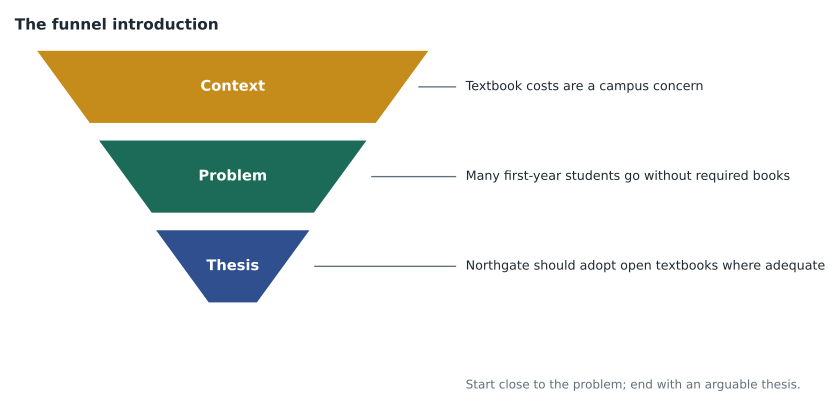
How long should an introduction be? In a 2,000-word essay, one paragraph of 150 to 250 words is usual. In longer papers, the introduction may take two or three paragraphs. If your introduction is longer than any body section, it is probably doing work that belongs in the body.
Organizing the body
The body is where the argument happens, and its order should follow the logic of the argument, not the order in which you found the sources. Several patterns are common.
- By reason: each section develops one reason for the thesis, usually in order of logical dependence or of increasing strength.
- Problem and solution: first establish that a problem exists and why it matters, then propose and defend a solution.
- Cause and effect: trace how one thing leads to another, or work backward from an effect to its causes.
- Chronological: follow events in time order, useful for history or case analysis but risky if it turns analysis into narrative.
- Comparison: examine two or more things against the same criteria, either one subject at a time or one criterion at a time.
Kofi's essay combines problem and solution with organization by reason. He first establishes the problem, then argues that the solution works, then answers the objections. That order matters. A reader who isn't convinced there is a problem will not care whether the solution works.
Comparison: block or point by point
Comparison essays have a structural choice of their own. In block organization, you discuss everything about subject A, then everything about subject B. In point-by-point organization, you take one criterion at a time and discuss both subjects under each. Block organization is simpler to write and works for short comparisons, but it can leave the reader to do the comparing. Point-by-point organization makes the comparison explicit and usually produces a sharper argument, at the cost of more careful transitions.
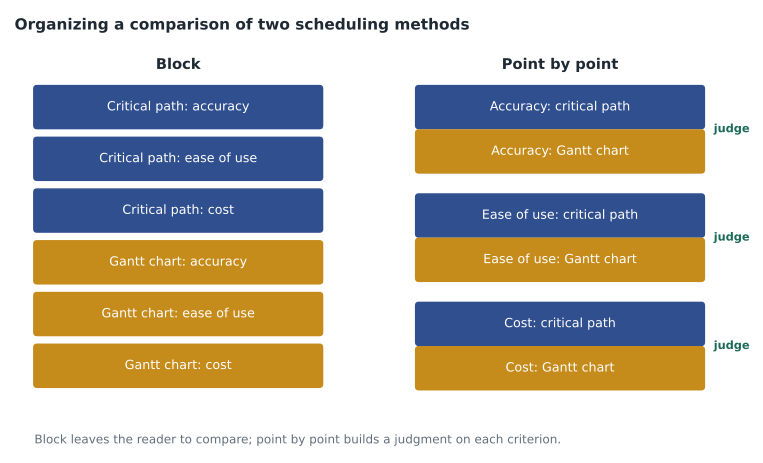
Amir is comparing two scheduling methods for a residential build. In block form, he describes the critical path method fully, then the Gantt-chart method fully. In point-by-point form, he compares both on accuracy, then both on ease of use, then both on cost. The point-by-point version leads naturally to his recommendation, because each section ends with a judgment.
Where to put the counterargument
There are three common places for counterarguments. You can address them near the beginning of the body, clearing away objections before building your case; this works when readers are likely to hold the objection strongly. You can address them where they arise, in the section they most directly challenge. Or you can gather them in a section near the end, after your case is made. Kofi chooses the third approach for his main objection, because his reader needs to understand the proposal before the objection makes sense, but he handles a smaller objection about student internet access in the section on costs, where it arises.
Transitions and signposts
Transitions are the words, phrases and sentences that show how one idea relates to the next. Signposts are statements that tell the reader where the essay is going. Both make structure visible. Simple transitions show relationships: however and in contrast show contrast; therefore and as a result show consequence; for example shows illustration; similarly shows comparison. But the strongest transitions are not single words. They are sentences that link the point just made to the point coming next.
Varga shows a weak and a strong transition between Kofi's first and second sections. Weak: 'Another point is that open textbooks are good.' Strong: 'If cost keeps students from using required materials, the obvious question is whether free alternatives can teach as well. The evidence suggests they can.' The strong version reminds the reader of the argument so far and sets up what comes next.
Conclusions
A conclusion should not simply repeat the introduction. By the end of the essay the reader knows more than they did at the start, and the conclusion should reflect that. Good conclusions do some combination of three things: synthesize the argument, showing how the parts fit together; restate the thesis in light of what has been shown, often more precisely than in the introduction; and show why it matters, by pointing to implications, next steps or questions that remain. A conclusion should not introduce major new evidence, which belongs in the body, or end with a sweeping claim the essay hasn't supported.
Kofi's draft conclusion repeats his introduction almost word for word. His revision begins by noting that the evidence shows cost is a real barrier and that open textbooks perform as well as commercial ones in most introductory courses, then acknowledges that the policy depends on faculty support, and ends by proposing that Northgate begin with the five largest first-year courses and evaluate the results after one year. The reader leaves with a concrete next step.
Titles and headings
A good title tells the reader what the essay is about and, ideally, what it argues. 'Textbooks' is too vague. 'Open Textbooks at Northgate: Why the Savings Outweigh the Costs' tells the reader the topic and the position. Many academic titles use a colon to combine a short phrase with a more precise description. Headings are standard in reports and long papers and less common in short essays, though some instructors permit them. Follow the assignment and the conventions of your discipline.
Reverse outlining
An outline written before drafting shows what you intended. A reverse outline, written after drafting, shows what you actually wrote. To make one, read each paragraph of your draft and write in the margin, in a single short sentence, what the paragraph says and what it does in the argument. 'Gives the survey result on skipped textbooks; supports reason 1.' 'Describes the history of open licences; background, may not be needed.' Then read the margin notes in order, as if they were an outline.
Reverse outlines reveal problems that are invisible when you reread the full draft. You may find two paragraphs making the same point in different sections, a paragraph that does nothing for the thesis, a reason that appears in the body but not in the thesis, or a jump in logic between two sections. Jess makes a reverse outline of her adaptive reuse draft and finds that three of her nine paragraphs are history that never connects to her argument. She cuts two and turns the third into a short case that supports her environmental reason.
Sam Achebe at the writing centre says reverse outlining is the single most useful revision technique he teaches, because it moves the writer from the sentence level, where most students try to revise, to the structural level, where the biggest improvements are made.
Proportion
Structure is also about proportion: how much of the essay each part takes. A useful starting guide for a 2,000-word argumentative essay is about ten to fifteen out of every hundred words for the introduction, a similar share for the conclusion, and the rest for the body, divided among the sections roughly by importance. If your background section is longer than your strongest reason, or your counterargument section is two sentences, the proportions are telling you something about the argument.
Kofi checks the proportions of his draft and finds that his section on the problem is twice as long as the section on whether open textbooks work. The problem section is easier to write because the evidence is vivid, but the second section is where a skeptical reader needs the most convincing. He trims the first and develops the second, adding a paragraph on how learning outcomes were measured in the studies he cites.
Proportion is a guide, not a formula. A policy essay may need a long section on feasibility; a comparison may need equal space for each criterion. The question to ask is whether the space each part receives matches the work it has to do.
Worked problem
Restructuring a draft
Jess's draft on adaptive reuse of old buildings has paragraphs in this order: a definition of adaptive reuse, the cost advantage, her thesis, a history of the Hamilton railway station conversion, the environmental advantage, a counterargument about safety codes, and a summary. How should she restructure it?
Show solution
- Move the thesis to the end of the introduction, after the definition, so the reader knows the argument before the evidence.
- Decide on an order for the reasons: environmental advantage first if it is the stronger reason, or cost first if her reader cares most about budgets.
- Use the station conversion as a case within the section it best supports, rather than as a separate narrative.
- Place the safety-code counterargument after the reasons, and respond by explaining how code compliance is managed in reuse projects.
- Rewrite the summary as a conclusion that draws out what the case shows for her city's planning policy.
Answer: Introduction with definition and thesis, two reason sections with the case study used as evidence, a counterargument section and a conclusion that states implications.
Common mistakes
MistakeThe introduction should start with a broad statement about history or humanity.
InsteadStart close to the problem with a specific fact, case or question.
MistakeThe body should present sources in the order you read them.
InsteadOrder the body by the logic of the argument.
MistakeA conclusion restates the introduction.
InsteadA conclusion synthesizes the argument and shows why it matters.
MistakeTransitions are single words like however and also.
InsteadThe strongest transitions are sentences that connect the previous point to the next.
Summary and key terms
- Structure lets readers follow an argument they cannot see in advance.
- A sentence outline states the claim of each section, not just its topic.
- Introductions orient the reader, set up the problem and state the thesis, often in a funnel.
- Order the body by reason, problem and solution, cause and effect, chronology or comparison, following the argument's logic.
- Conclusions synthesize, restate the thesis precisely and show implications without adding major new evidence.
- Outline
- A plan of an essay's structure.
- Sentence outline
- An outline in which each item is a full sentence stating a claim.
- Funnel introduction
- An introduction that moves from context to problem to thesis.
- Block organization
- A comparison that discusses each subject fully in turn.
- Point-by-point organization
- A comparison that discusses both subjects under each criterion in turn.
- Transition
- A word, phrase or sentence that shows how ideas relate.
- Signpost
- A statement that tells the reader where the essay is going.
Practice problems
Work each problem on paper first, then reveal the answer to check.
Turn this topic outline item into a sentence outline item: 'Costs'.
Show answer
For example: 'Required textbooks cost first-year Northgate students more per term than their course fees for labs.'
What is wrong with an introduction that begins 'Webster's dictionary defines writing as'?
Show answer
It wastes the opening on a definition the reader doesn't need instead of starting close to the problem.
When is point-by-point organization better than block organization?
Show answer
When the comparison should lead to a judgment, because it puts the two subjects side by side on each criterion.
Name two things a strong conclusion does.
Show answer
Synthesizes the argument and shows its implications or next steps.
Lesson quiz · 5 questions
Score 60% or more to complete this lesson.
Create a free account to save your progress, take quizzes and earn a certificate.