
WRIT-101 · Lesson 2 of 12 · 21 min
Reading critically
▶ Video coming soon A video version of this lesson is on the way.
Dr. Varga begins the second week with a short passage projected on the screen. It comes, she says, from an opinion column in a fictional student newspaper, The Northgate Ledger, written for this course.
'Textbook prices are out of control. Last year the average Northgate student spent more on books than on groceries, and one in three students admitted to skipping a required textbook because they couldn't afford it. Open textbooks, which are free online, solve this problem completely. Colleges that have switched report that students do just as well or better. The administration's refusal to act shows it simply doesn't care about students. It is time for Northgate to replace every commercial textbook with an open one by next fall.'
She asks the class whether they agree. Most hands go up. Then she asks a different question: what would you need to know before you could decide whether the argument is any good? The room goes quiet, then the questions start. Where does the grocery comparison come from? Who are the 'one in three', and how were they asked? Which colleges switched, and how was 'just as well' measured? Is free online the same as free? Does refusal to act mean the administration has said no, or that it hasn't decided? Varga smiles. 'That,' she says, 'is critical reading.'
What critical reading means
Critical reading does not mean reading with hostility or looking for things to dislike. It means reading actively: understanding what a text says, how it says it, why it says it and whether its claims are well supported. A critical reader can agree with a text and still see its weaknesses, or disagree with it and still see what it gets right. In academic writing, nearly every essay is a response to other texts, so the quality of your writing depends on the quality of your reading.
Varga describes three levels of reading. Reading for what the text says means understanding its main point, its supporting points and its evidence well enough to summarize them accurately. Reading for how it says it means noticing structure, word choice, tone and the kinds of evidence used. Reading for whether it works means evaluating the reasoning: are the claims supported, are the assumptions reasonable, is anything important left out? Most students stop at the first level. Academic writing asks for all three.
Before you read: preview
Reading an academic text from the first word to the last without any preparation is slow and often confusing. Previewing takes a few minutes and makes the reading faster and more accurate. Look at the title, the author and where it was published. Read the abstract or introduction and the conclusion. Skim the headings, figures and tables. Ask what you expect the text to argue and what you need from it. Previewing gives you a map, so that when you read the details you know where they fit.
Hana says this feels like cheating, reading the end first. Varga points out that academic texts are not mysteries. Researchers put their conclusions in the abstract precisely so readers can decide whether and how to read the rest. A physicist reading a journal article will often read the abstract, look at the figures, read the conclusion and only then decide whether to work through the methods.
The rhetorical situation
Every text is written by someone, for someone, for a reason, in a particular context. These four elements, often called the rhetorical situation, shape what a text says and how. The Ledger column was written by a student, for other students and perhaps for the administration, to persuade the college to act, in the context of rising costs and a campus debate. Knowing this helps explain its urgent tone and its sweeping claims. A report on the same topic written by the college's Office of Institutional Research for the board of governors would sound very different: cautious, full of qualifications and data tables, and focused on options rather than demands.
| Element | Question to ask | For the Ledger column |
|---|---|---|
| Author | Who wrote this, and what is their expertise or stake? | A student columnist with a personal stake in costs |
| Audience | Who is it written for, and what do they already believe? | Students, many already sympathetic, and the administration |
| Purpose | What does the author want readers to think or do? | Persuade the college to adopt open textbooks by next fall |
| Context | When, where and in response to what was it written? | A campus debate about textbook costs |
The rhetorical situation does not tell you whether a text is right, but it tells you what to look for. A writer with a strong stake may still be correct, but you should check their evidence with special care. A writer addressing an audience that already agrees may skip evidence that a skeptical reader would need.
Annotating as you read
Annotation means writing on or beside a text as you read: underlining main claims, marking evidence, noting questions, and writing short responses in the margin. Annotation forces active reading, and it gives you a record you can use when writing. Varga suggests a simple system: underline the main claim once, mark each piece of evidence with an E, put a question mark beside anything unclear or unsupported, and write a few words in the margin summarizing each paragraph. Digital tools work too; what matters is that you respond to the text rather than simply highlighting it.
Highlighting alone is a trap. Brigid admits that her textbooks are mostly yellow. Varga says that highlighting feels productive but often isn't, because it records what seemed important without recording why. A margin note such as 'key definition' or 'weak evidence, one survey' is worth far more than a yellow line.
Finding the claim, the reasons and the evidence
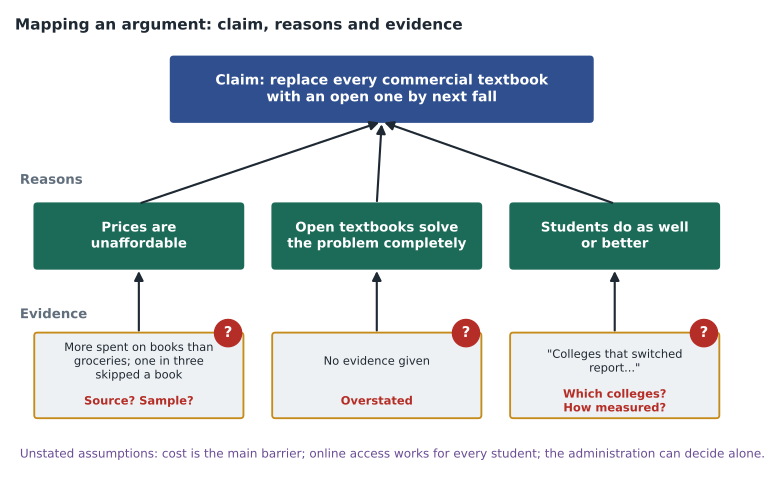
Most texts that make an argument have a main claim, reasons that support it and evidence that supports the reasons. Finding these is the core skill of critical reading. In the Ledger column, the main claim is that Northgate should replace every commercial textbook with an open one by next fall. The reasons are that textbook prices are unaffordable, that open textbooks solve the problem and that students do as well with them. The evidence is a spending comparison, a survey figure and a claim about other colleges.
Once you have laid out the structure, you can test each part. Is the evidence accurate and from a reliable source? Does it support the reason? Does the reason support the claim? The column's evidence is vague: we don't know where the figures come from. Some reasons go further than the evidence: 'solve this problem completely' is a much stronger claim than 'reduce costs.' And there are gaps: the column never considers what the switch would cost faculty in time or whether open textbooks exist for every course.
Assumptions
An assumption is a belief a text relies on but does not state. Every argument has them, and many disagreements turn on them. The Ledger column assumes that cost is the main barrier to students using textbooks, that free online access is equally usable for every student, and that the administration could make the switch on its own. Each assumption might be true, but each could be questioned: students without reliable internet or with some disabilities may find online texts harder to use, and in most colleges the choice of course materials belongs to faculty, not administrators. Identifying assumptions is one of the most valuable things a critical reader can do, because it shows where an argument would need more support to persuade someone who doesn't already agree.
Language and tone
Word choice is evidence too. The column says prices are 'out of control,' that open textbooks solve the problem 'completely,' and that the administration 'simply doesn't care.' These words are designed to provoke agreement, and they also reduce the column's credibility with careful readers, because they claim more than any evidence could show. Academic writing generally prefers precise, measured language: prices have risen by a stated amount, open textbooks reduced costs in a stated number of courses, the administration has not yet announced a decision. You will practise that style in Lessons 3 and 11. For now, notice how loaded language works on you as a reader.
Reading academic articles
Many of the sources you will use in this course and in your programs are research articles. Most follow a predictable structure, often called IMRaD: introduction, methods, results and discussion. The introduction states the problem and what is already known. The methods explain how the study was done. The results report what was found, often in tables and figures. The discussion interprets the results, notes limitations and suggests implications. Knowing this structure lets you read strategically: the introduction and discussion tell you the argument, the methods tell you how much to trust it, and the results tell you exactly what was found.
Luis notices that the abstract of an article on open textbooks says students 'performed as well or better,' while the results table shows a small improvement in one course, no difference in three others and a small decline in one. Varga calls this the summary gap: abstracts and conclusions often state findings more broadly than the data. A critical reader checks the results before repeating the abstract.
Reading numbers and graphs
Statistics and graphs are persuasive, which is exactly why they need careful reading. Ask what is being measured and how, how many people or cases are included, what the comparison is, and whether the graph's axes start at zero or are stretched to exaggerate a difference. 'One in three students admitted to skipping a required textbook' could come from a careful survey of a thousand randomly selected students or from an online poll answered by forty people who chose to respond. The number is the same; its meaning is not.
Double-entry notes
Varga recommends a note-taking format that keeps reading and thinking separate but side by side. Divide a page into two columns. In the left column, record what the text says: a short summary of each section or a key quotation, with the page number. In the right column, record your response: a question, a connection to another reading, a doubt about the evidence or an idea for your own paper. The left column keeps you honest about what the author actually wrote. The right column is where your argument begins.
Kofi tries it on a chapter about student finances. On the left he writes that the author reports that most students who skip textbooks do so in their first year. On the right he writes: is that because first-year courses use more expensive books, or because first-year students don't yet know about library copies? That question becomes a paragraph in his final essay. Double-entry notes also make it easy, later, to tell your own ideas from the source's, which matters for academic integrity.
Reading in your discipline
Every field reads in its own way. An accountant reading a financial statement starts with the notes, because that is where unusual items are explained. A physicist reading a paper checks whether the uncertainty in the results is large enough to swallow the claimed effect. A computing scientist reading documentation looks first for the example code and then for the edge cases. A film student reading a script reads for structure and pacing as much as for content. A construction manager reading a specification looks for the words shall and must, which mark requirements, and for the sections that say who is responsible.
Varga asks each student to bring a short text from their own program next week and explain how a skilled reader in their field approaches it. The point is that critical reading is not a single technique. It is a set of questions, and each discipline adds its own: what counts as evidence here, what the usual weaknesses are, and what an expert would check first. Learning to read like an expert in your field is a large part of becoming one.
Finally, slow down when it matters. Critical reading takes longer than skimming, and not every text deserves it. Skim to decide whether a source is relevant; read critically the ones you will rely on. A good working rule is to read critically any source you plan to quote, any source whose numbers you plan to use, and any source that disagrees with you.
Worked problem
Reading a claim critically
A brochure from a commercial publisher says: 'Students using our digital courseware score 12 points higher on final exams.' What questions should a critical reader ask before using this claim?
Show solution
- Rhetorical situation: the author is a company selling the product, so the claim needs independent support.
- Measurement: 12 points higher than what? Students in the same course without the courseware, or students in a different year?
- Sample: how many students, in which courses and colleges, and were they assigned randomly or did they choose the product?
- Alternative explanations: students who buy courseware may already be more motivated or have more money and time.
- Source: is there a published study, and has anyone without a financial stake checked it?
Answer: Treat the claim as an advertisement until independent evidence supports it, and do not repeat it as a fact.
Common mistakes
MistakeCritical reading means finding faults.
InsteadIt means understanding a text fully and judging its support fairly, including its strengths.
MistakeHighlighting is the same as annotating.
InsteadAnnotation records your response: what a passage is doing and what you think of it.
MistakeThe abstract tells you what the study found.
InsteadThe abstract tells you what the authors say they found; check the results.
MistakeA confident tone means strong evidence.
InsteadStrong language often signals weaker support; judge the evidence, not the tone.
Summary and key terms
- Critical reading means understanding what a text says, how it says it and whether its support is adequate.
- Preview before reading: title, author, venue, abstract, headings, figures and conclusion.
- The rhetorical situation (author, audience, purpose, context) shapes a text and tells you what to check.
- Map the argument into claim, reasons and evidence, then test each link and identify the assumptions.
- Read research articles strategically using the IMRaD structure, and check results against the abstract.
- Critical reading
- Active reading that understands, analyzes and evaluates a text.
- Rhetorical situation
- The author, audience, purpose and context of a text.
- Annotation
- Notes written on or beside a text that record its structure and your response.
- Assumption
- A belief an argument relies on without stating it.
- IMRaD
- The introduction, methods, results and discussion structure of many research articles.
- Loaded language
- Words chosen to provoke an emotional reaction rather than describe precisely.
Practice problems
Work each problem on paper first, then reveal the answer to check.
What is the difference between reading for what a text says and reading for whether it works?
Show answer
The first understands its content well enough to summarize it; the second evaluates whether its claims are supported.
Name one assumption in the claim 'Online courses are better because students can learn anytime.'
Show answer
That flexibility improves learning, or that all students have the time, equipment and self-direction to use it.
Why should you read the results section and not only the abstract?
Show answer
Because abstracts often state findings more broadly or more positively than the data show.
Rewrite 'Prices are out of control' in measured academic language.
Show answer
For example: 'The average cost of required textbooks at Northgate rose by a third between 2020 and 2025.'
Lesson quiz · 5 questions
Score 60% or more to complete this lesson.
Create a free account to save your progress, take quizzes and earn a certificate.