
SMW-210 · Lesson 6 of 12 · 19 min
Square-to-round transitions
The square-to-round is the classic fitting of the sheet metal trade. It joins a square or rectangular duct, fan outlet or air handler connection to a round duct, and it turns up on nearly every commercial job. It is also the fitting that every apprentice exam asks for, because it brings together everything in the last four lessons: plan and elevation, true lengths, the true-length diagram and triangulation in order. This lesson develops the on-centre square-to-round, the simplest and most common kind, in which the round end is centred over the square end, both by drawing and by calculation.
The Ashgrove air handler
The new air handler at Ashgrove discharged through a 600 mm square opening on its top. Lin's drawing called for a square-to-round, 450 mm high, taking the air from that opening into a 450 mm round main, specified to its outside diameter, in 0.85 mm galvanized steel. The round was centred over the square in both directions, which made it an on-centre transition. Aggie set Kai to develop it as the first full triangulation job of the term, and it became part of the capstone in Lesson 12.
How a square-to-round is made up
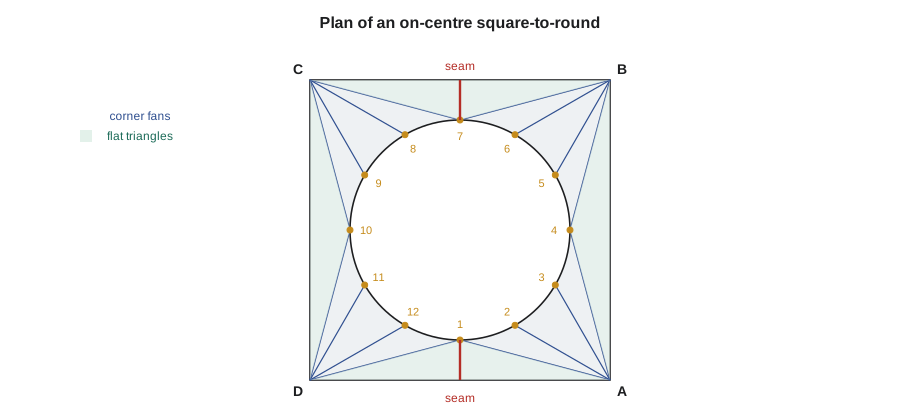
Look at a square-to-round from above and it divides into eight parts. At each of the four corners of the square, a fan of lines runs from the corner up to a quarter of the round, forming a curved conical surface, a piece of an oblique cone with its apex at the corner. Between each pair of corners, along each side of the square, a flat triangle runs from the side up to a single point on the round, the point directly over the middle of that side. The fitting is four curved corners and four flat triangles, alternating around it.
That structure decides how it is developed. The flat triangles are each one triangle, with their base the side of the square and their apex a point on the round. The curved corners are each divided into narrow triangles by the fan of lines from the corner to the divisions of the round. With the round divided into 12 equal spaces, each corner fan has four lines, from the corner to four points, and three narrow triangles between them.
Where the seam goes
A square-to-round is almost always made in two halves, with two seams, because a one-piece pattern is awkward to form and often too large for the sheet. The BCcampus pattern development textbook puts it flatly: a square-to-round can only be formed in halves. The seams usually run up the middle of two opposite flat triangles, from the middle of a side of the square to the round point above it. Putting the seam in a flat triangle keeps it straight, keeps it out of the curved corners where forming is hardest, and makes the two halves identical on an on-centre fitting, so one pattern serves for both.
Some shops, particularly on smaller fittings, put a single seam on one side and form the fitting in one piece with a corner bend left open. Others put the seams at two corners. Kai followed the Keelson practice, two halves with seams at the middle of the front and back flat triangles, which matched Lin's shop drawing.
The true lengths
On an on-centre square-to-round, the symmetry makes the work small. Every corner is the same as every other, and within each corner fan the lines come in mirror pairs. With 12 spaces, each corner has only two different true lengths: the outer lines, from the corner to the two points at the ends of its quarter, and the inner lines, from the corner to the two points in between. The seam line, from the middle of the side up to the round point above it, has a third length. That is all.
The plan lengths are measured in the plan, from each corner to each round point it fans to. The rise is the height of the fitting. In the true-length diagram, the vertical is the 450 mm height and the plan lengths are laid along the base. The script below finds the true lengths by calculation, builds the quarter of the pattern from the seam to the middle of the next side by triangulation, and checks the result. It works with the mean radius of the round, the outside diameter less one thickness, as all round work does.
# Square-to-round half pattern by calculated triangulation
import math
W, D, H, t = 600, 450, 450, 0.85   # mm           # square side, round outside diameter, height, thickness
r = (D - t) / 2               # mean radius
n = 12                        # spaces around the round
def tl(p, q): return math.dist(p, q)
def swing(P, Q, dp, dq, side):
    d = math.dist(P, Q); a = (dp*dp - dq*dq + d*d) / (2*d); h = math.sqrt(max(dp*dp - a*a, 0))
    ux, uy = (Q[0]-P[0]) / d, (Q[1]-P[1]) / d
    return (P[0] + a*ux - side*h*uy, P[1] + a*uy + side*h*ux)
# 3D model: square at z = 0, round at z = H; corner A at (+W/2, -W/2), B at (+W/2, +W/2)
rp = [(r*math.cos(math.radians(-90 + 30*k)), r*math.sin(math.radians(-90 + 30*k)), H) for k in range(7)]
A3, B3 = (W/2, -W/2, 0), (W/2, W/2, 0)
print("true lengths from corner A:", ", ".join(f"A-{k+1} {tl(A3, rp[k]):.1f}" for k in range(4)))
# pattern: lay A-B on the x axis, then swing each round point from its corner and its neighbour
A, B = (0.0, 0.0), (W, 0.0)
P = {}
P[4] = swing(A, B, tl(A3, rp[3]), tl(B3, rp[3]), 1)          # middle point, from both corners
for k in (2, 1, 0):                                          # back toward the seam at A's side
    P[k+1] = swing(A, P[k+2], tl(A3, rp[k]), tl(rp[k], rp[k+1]), 1)
M3 = (0, -W/2, 0)                                            # middle of the next side: the seam
P['M'] = swing(A, P[1], W/2, tl(M3, rp[0]), 1)
chord = tl(rp[0], rp[1])
print(f"round step-off (chord of {n} spaces) {chord:.1f} mm")
for k in [1, 2, 3, 4, 'M']:
    print(f"point {str(k):>2}: x {P[k][0]:>8.1f}  y {P[k][1]:>8.1f}")
arc = sum(math.dist(P[k], P[k+1]) for k in (1, 2, 3)) * 2
print(f"check: round edge of this side {arc:.1f} mm vs a quarter of pi x Dm {math.pi*2*r/4*2:.1f} mm (chords run slightly short)")true lengths from corner A: A-1 546.1, A-2 498.9, A-3 498.9, A-4 546.1 round step-off (chord of 12 spaces) 116.2 mm point 1: x -32.6 y 545.1 point 2: x 71.7 y 493.7 point 3: x 184.0 y 463.7 point 4: x 300.0 y 456.3 point M: x -260.1 y 149.6 check: round edge of this side 697.5 mm vs a quarter of pi x Dm 705.5 mm (chords run slightly short)
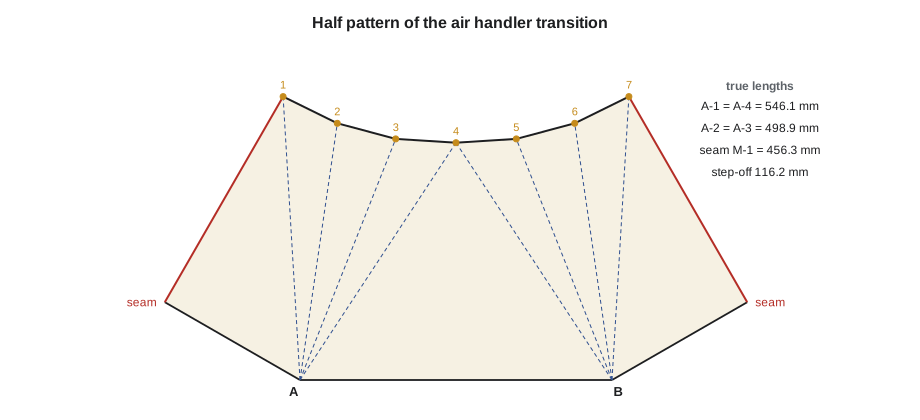
The two true lengths of the corner fan are about 546 mm for the outer lines and 499 mm for the inner lines. The plan positions of the points on the pattern, measured from corner A at the origin with side A-B along the base, come out as listed. The check line compares the curve through the round points, measured as straight chords between them, with half the mean circumference. The chords run about 1 percent short of the arc, which is exactly the shortfall Lesson 1 of SMW-120 predicted for 12 spaces, and it tells the pattern maker that the points are right and the curve drawn through them will be the right length.
Drawing the half pattern
On the bench, Kai drew the half pattern the way the BCcampus textbook sets it out, which is also the order the script follows.
- He drew the base line A-B, the full side of the square, at its true length, 600 mm.
- From A he swung the true length A-4 and from B the true length B-4. Where they crossed was point 4, the round point over the middle of side A-B. Triangle A-B-4 was the flat triangle on that side.
- From A he swung A-3, and from point 4 he swung the round step-off, the chord between round points, true in the plan. Where they crossed was point 3.
- He repeated the step for points 2 and 1, each from A by its true length and from the last point by the step-off. Points 1 to 4 completed corner A's fan.
- From point 1, the round point over the middle of the next side, he swung the seam line, the true length from the middle of the side up to point 1. From A he swung half the side, 300 mm. Where they crossed was the end of the seam.
- He worked the same way from B on the other side of the flat triangle, which gave the other corner fan and the other half-side to the second seam.
He then drew the edges. The square end was drawn as straight lines from the seam end to A, A to B, and B to the other seam end. The round end was drawn as a smooth curve through the seven round points with a flexible batten. The fan lines and the edges of the flat triangle were drawn lightly as bend lines.
The right-angle check
The BCcampus textbook gives one more check for the on-centre square-to-round, and Kai found it the most useful. The last triangle of each half, the one with the half-side of the square, the seam line and the corner fan's outer line, should make a right angle at the seam end. That follows from the fitting's geometry: on an on-centre square-to-round, the seam line rises straight up from the middle of the side, square to the side, and the pattern keeps that right angle when it unrolls. If the angle on the pattern is not 90 degrees, an error has crept in somewhere, and the right move is to go back and find it.
On his first attempt, Kai's angle was off by about two degrees. He had swung A-2 from point 4 instead of from A, a slip of the kind Lesson 5 warned about. He found it by checking each length on the pattern against his true-length table, corrected it, and the second attempt checked square.
Allowances and forming
With the net half pattern checked, Kai added the allowances. Along each seam line he added the Pittsburgh lock or a grooved seam, from SMW-130, pocket on one half and flange on the other, so the two identical halves would still mate; on Keelson's square-to-rounds, one half carried pockets on both seams and the other carried flanges on both. Along the square edge he added the allowance for the connection to the air handler, a flange in this case. Along the round edge he added the allowance for the round connection, a bead and slip or a flange, swung as a curve parallel to the round edge.
Forming a square-to-round is done on the brake and by hand. The flat triangles stay flat. The corner fans are formed to a smooth cone, either by bending lightly along each fan line on the brake, a few degrees at a time, or by working the corner over a stake by hand. Many shops brake the fan lines in small bumps and then smooth the corner with a mallet, which gives a clean conical shape. The bend at each edge of the flat triangle, where it meets a corner fan, is a sharp line on the outside of the fitting, and on a well-made square-to-round it runs straight from the square's corner to the round.
Once both halves are formed, they are joined at the seams, checked on a flat surface, and measured: the square end square on its diagonals, the round end round on two diameters at right angles, and the height correct. An on-centre square-to-round should sit on its square end with the round end level and centred.
Square-to-rounds for any size
The on-centre method works for any square and any round. If the round is large compared with the square, the corner fans are short and the flat triangles small; if the round is small, the fans are long and steep. Two special cases need care. When the round's diameter is the same as the square's side, the round touches the middle of each side, the flat triangles disappear, and the fitting is four corner fans only. When the round is larger than the square, the round overhangs the sides and the fitting becomes a round-to-square with its flat triangles sloping outward, which develops the same way but looks very different in the plan.
A rectangle-to-round, where the large end is a rectangle instead of a square, is developed the same way, except that the corner fans are no longer all the same, the flat triangles on the long sides differ from those on the short sides, and the true-length diagram has more lines. Lesson 10 develops one for a register boot, and Lesson 11 calculates one completely.
Common mistakes
MistakeSwinging a fan line from the last round point instead of from the corner.
InsteadEach fan line's true length is swung from its corner; only the step-off is swung from the last point.
MistakeUsing the outside diameter of the round for the round points.
InsteadDivide the mean circle, the outside diameter less one thickness.
MistakePutting the seam in a curved corner without a reason.
InsteadPut the seams in the middle of two opposite flat triangles so they stay straight and the halves match.
MistakeSkipping the right-angle check on an on-centre fitting.
InsteadThe last triangle should be square at the seam end; if not, go back.
MistakeGiving both halves the same allowances on the seams.
InsteadPut pockets on both seams of one half and flanges on both seams of the other, or otherwise make the halves mate.
Summary and key terms
- A square-to-round is four conical corner fans alternating with four flat triangles.
- With 12 spaces on the round, each corner fan has four lines; on an on-centre fitting there are only two different fan lengths and one seam length.
- The half pattern starts with the flat triangle on one side and works outward, each round point found from its corner by a true length and from the last point by the step-off.
- Seams usually run up the middle of two opposite flat triangles, so the two halves are identical.
- Check that the chords of the round edge run about 1 percent short of half the mean circumference, and that the last triangle is square at the seam.
- Corner fans are formed to a smooth cone; flat triangles stay flat.
- Square-to-round
- A transition fitting joining a square or rectangular end to a round end.
- On-centre
- Having the round end centred over the square end in both directions.
- Corner fan
- The group of lines from one corner of the square to its quarter of the round, forming a conical corner.
- Flat triangle
- The flat part of a square-to-round between two corner fans, running from a side of the square to one round point.
- Step-off
- The chord between adjacent division points on the round, true in the plan.
- Half pattern
- A pattern for one of two identical halves of a fitting.
Practice problems
Work each problem on paper first, then reveal the answer to check.
How many different true lengths does an on-centre square-to-round with 12 spaces need?
Show answer
Three: the outer fan line, the inner fan line and the seam line.
A square-to-round is 400 mm square to 300 mm round, 300 mm high. What is the seam line's true length?
Show answer
The plan length is 200 minus 150, 50 mm, so the true length is the square root of 50 squared plus 300 squared, about 304 mm.
Why are square-to-rounds usually made in halves?
Show answer
A half is easier to form and fits the sheet, and on an on-centre fitting the halves are identical.
What should the angle be at the seam end of the last triangle on an on-centre half pattern?
Show answer
90 degrees.
Lesson quiz · 5 questions
Score 60% or more to complete this lesson.
Create a free account to save your progress, take quizzes and earn a certificate.