
SMW-130 · Lesson 9 of 12 · 18 min
Brazing and hot work in sheet metal
Brazing sits between soldering and welding. Like soldering, it joins metals with a filler that flows into a close-fitting joint by capillary action without melting the parts. Like welding, it makes a strong joint that will stand heat and load. In sheet metal, brazing is used less often than soldering or welding, but it has an important place: joining copper and brass where solder is not strong enough or the joint will run hot, joining dissimilar metals, repairing thin and galvanized parts, and in braze welding, where the filler is laid in a bead like a weld. This lesson covers brazing and braze welding, then the hot work rules that apply to all the heat-based joining in this course.
Brazing and soldering compared
The dividing line is temperature. A process that uses a filler melting above 450 °C (840 °F) but below the melting point of the parts is brazing. Below that line it is soldering; above the melting point of the parts, it is welding. The line is a convention, set out in the standard definitions of the American Welding Society and used in Canada too, but it marks a real change. Brazing fillers are much stronger than solders, and a brazed joint in steel or copper can be as strong as the parent metal.
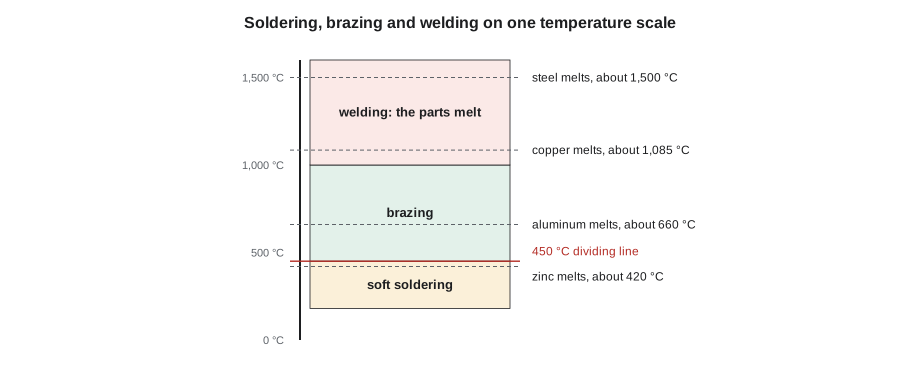
Higher temperature brings costs. Brazing burns off zinc from galvanized steel around the joint, it discolours and can distort thin sheet, it needs a torch or furnace rather than a copper, and it needs more care with fire and fumes. Where solder will do the job, it is usually the better choice in sheet metal. Where it will not, because the joint must be strong, must stand temperatures above about 150 °C (300 °F), or must join metals solder does not suit, brazing is the next step.
Brazing fillers and fluxes
- Copper-phosphorus fillers, sometimes with silver, are used to braze copper to copper. The phosphorus acts as a flux on copper, so no separate flux is needed for copper-to-copper joints. They are not suitable for steel or other iron-based metals, because the phosphorus forms brittle compounds.
- Silver brazing alloys, with silver, copper and zinc, flow at the lower end of brazing temperatures and are used for copper to brass, copper to steel, stainless and dissimilar metals. They need a flux.
- Bronze fillers, such as brass and silicon bronze, are used for braze welding steel, cast iron and galvanized steel.
Brazing fluxes are pastes or powders that become active at brazing temperatures, mostly based on borax and fluorides. They clean the metal and protect it while hot. Their residue is glassy and often corrosive and must be removed, usually with hot water and a brush. Some fluxes contain fluorides whose fumes are hazardous and need good ventilation.
Making a brazed joint
A brazed joint needs the same three things as a soldered joint: clean metal, the right fit and the right heat. The clearance between parts is critical: small enough for capillary action, usually about the thickness of a sheet of paper, but not so tight that the filler cannot enter. The parts are cleaned to bright metal, fluxed if needed, assembled and supported so they will not move, and then heated evenly with a torch until the joint reaches brazing temperature. The filler is touched to the joint, not to the flame. If the joint is hot enough, the filler melts on contact and flows into the gap. If the filler has to be melted by the flame, the joint is not hot enough and the filler will not flow in.
Even heating is the skill. The torch is moved over both parts so they reach temperature together; the heavier part needs more heat. Flux works as a thermometer: on silver brazing, the flux goes clear and runs like water at about the right temperature. Overheating burns the flux, oxidizes the metal and can melt thin sheet. After brazing, the joint is allowed to cool undisturbed, then cleaned of flux.
On the St. Brendan's job, Keelson brazed the copper brackets that held the new copper downspouts to the wall. The brackets carried the weight of the downspouts and ice in winter, and solder alone would have crept under that load. Aggie used a copper-phosphorus filler, no flux, and an air-acetylene torch, and Kai watched how she heated the heavy bracket strap more than the thin downspout band so they reached temperature together.
Braze welding
Braze welding uses a bronze filler laid as a bead, like a weld, into a groove or along a fillet, rather than drawn into a capillary gap. The parts are not melted, so it causes less distortion and less damage to coatings than fusion welding, and it can join dissimilar metals. In sheet metal, braze welding with silicon bronze is used to join and repair galvanized steel, because silicon bronze flows at a temperature low enough to leave much of the zinc in place. Gas metal arc brazing, or MIG brazing, uses a MIG welding machine with silicon bronze wire to do the same job faster, and is common on thin galvanized parts and in automotive body work. These processes overlap with welding and are covered with other thin-gauge welding in SMW-230.
Resistance to heat, and why it matters
Joints in some systems see heat in service. Kitchen exhaust duct carries hot, greasy air and, in a fire, very hot gases. Boiler breechings and flues carry flue gases. Dryer exhaust and some industrial exhaust runs warm. Solder softens and creeps at temperatures well below its melting point, so soldered joints are not used where heat is expected. Brazed and welded joints are. On Brine & Ember's grease duct, the code required continuously welded, liquid-tight joints because of the fire hazard; neither solder nor brazing would have been acceptable there.
The script below compares the working temperature of a joint with the solidus of a few filler metals, using a common rule that a soldered joint should not normally run above about half its solidus in absolute temperature under load. That rule of thumb, from the study of creep, is a guide for thinking about temperature limits, not a design rule; for real limits use the filler maker's data and the code for the system.
# Rough check: is a joint's service temperature well below the creep range of its filler?
fillers = {
    # name: solidus in °C
    "50/50 tin-lead solder":    183,
    "95/5 tin-antimony solder": 232,
    "silver braze":             620,
    "copper-phosphorus braze":  645,
}
service = 120     # joint service temperature, °C
for name, solidus in fillers.items():
    sol_k = solidus + 273.15
    svc_k = service + 273.15
    ratio = svc_k / sol_k
    flag = "fine" if ratio < 0.5 else "creep likely under load"
print(f"{name:25s} service/solidus = {ratio:.2f} (absolute) -> {flag}")50/50 tin-lead solder service/solidus = 0.86 (absolute) -> creep likely under load 95/5 tin-antimony solder service/solidus = 0.78 (absolute) -> creep likely under load silver braze service/solidus = 0.44 (absolute) -> fine copper-phosphorus braze service/solidus = 0.43 (absolute) -> fine
At 120 °C, both solders are well into the range where they creep under steady load, while the brazing alloys are nowhere near it. That is the reasoning behind brazing the St. Brendan's brackets and behind never soldering a joint that will run hot.
The absolute temperature is used because creep depends on how close the metal is to its own melting point, measured from absolute zero. In everyday temperatures the ratio makes the point clearly: a solder that starts to melt at a little under 200 °C is already soft enough to creep at roofing and duct temperatures under load, while a brazing alloy is not.
Hot work
Soldering, brazing, welding, torch cutting and grinding are all hot work: work that produces flame, sparks or enough heat to start a fire. More building fires start from hot work than most people expect, and roofs and ceilings, full of dust, insulation, wood and membranes, are among the worst places for it. Every sheet metal shop and every construction site has a hot work procedure, and on many sites a written hot work permit is required before any torch is lit.
In Nova Scotia, the occupational health and safety regulations require hot work to be controlled, and the National Fire Code of Canada, adopted in the province, sets requirements for hot work including fire watches. Most building owners and general contractors add their own permit systems. Keelson followed the general contractor's permit system on site and its own written procedure in the shop, which drew on NFPA 51B, the widely used standard for fire prevention during hot work.
A typical hot work permit, and the procedure behind it, cover the same points.
- Can the work be done another way, without heat, or moved to a safe area such as the shop? If so, do that instead.
- Combustibles within about 11 m (35 ft) of the work are moved away or covered with fire-resistant blankets, and openings in floors and walls that sparks could fall through are covered.
- Fire extinguishers suited to the hazard are at hand, and the fire watch knows how to use them.
- A fire watch stays with the work and for a period after it ends. NFPA 51B's 2019 edition calls for at least one hour of fire watch after hot work, followed by further monitoring; site rules may ask for more.
- Smoke and heat detectors near the work may be isolated only under the building's procedure, and are restored afterwards.
- The permit is signed by the person responsible for the area, posted at the work, and closed out when the fire watch ends.
On the church roof, Keelson's crew soldered with coppers rather than torches wherever they could, because a copper has no open flame. Where a torch was needed, for the brackets and some flashings, they wet down the wood decking around the work, covered the gaps into the roof space with fire blankets, kept an extinguisher at the torch, and Kai stayed on fire watch for the hour after each session, then checked the roof space from inside before leaving. Church roofs are notoriously hard to save once fire gets into them.
Fumes and ventilation
Brazing and braze welding produce fumes from fluxes, from the filler and from coatings. Zinc from galvanized steel and brass vaporizes and forms zinc oxide fume, which causes metal fume fever, a flu-like illness, in people who breathe it. Cadmium-bearing silver brazing alloys, now rare and to be avoided, give off very toxic fumes. Fluoride fluxes give off irritant fumes. The controls are the same as for soldering, only more so: local exhaust ventilation that captures the fumes at the source, good general ventilation, and respiratory protection where those are not enough. Never braze or weld galvanized steel in a confined space without ventilation and a hazard assessment.
Personal protection
Torch brazing needs eye protection with a shade suited to gas brazing, typically lighter than for arc welding but darker than clear safety glasses. Flame-resistant clothing, leather gloves and boots, and a cap or hood protect against sparks and hot metal. Synthetic clothing can melt onto skin and should not be worn for hot work. Compressed gas cylinders must be secured upright, with caps on when not in use, and fuel gas hoses and regulators inspected before each use; flashback arrestors are fitted on oxy-fuel equipment.
Planning hot work on a job
On a construction site, hot work is planned, not improvised. When the foreman plans a week's work, any task that needs soldering, brazing, cutting or welding is identified, the permit is arranged with the general contractor or owner in advance, and the fire watch is scheduled into the crew's time. The last hour of a shift is the worst time to start hot work, because the fire watch must stay after it ends and crews are tempted to cut the watch short. Keelson's rule on the church job was no new hot work in the last ninety minutes of the day.
Hot work also needs the right extinguisher. Water extinguishers or a charged hose suit wood and paper fires on a roof deck, while dry chemical extinguishers suit a wider range of fires and are the common choice on sites. The fire watch checks the extinguisher's gauge and tag before work starts, and knows where the nearest fire alarm pull station is.
Common mistakes
MistakeMelting brazing filler in the flame and dripping it onto a cold joint.
InsteadHeat the joint until the filler melts on contact and flows in.
MistakeUsing copper-phosphorus filler on steel.
InsteadUse it only on copper and some copper alloys; use silver or bronze fillers on steel.
MistakeSoldering a joint that will run hot or carry steady load.
InsteadBraze or weld joints that see heat or load; solder creeps.
MistakeStarting hot work without moving combustibles or posting a fire watch.
InsteadFollow the hot work permit: clear or cover combustibles, extinguisher at hand, fire watch during and after.
MistakeBrazing galvanized steel without fume control.
InsteadCapture zinc fume at the source and use respiratory protection where needed.
Summary and key terms
- Brazing uses a filler melting above 450 °C (840 °F) but below the parts, drawn into a close-fitting joint by capillary action.
- Copper-phosphorus fillers braze copper to copper without flux; silver alloys join dissimilar metals and need flux; bronze is used for braze welding.
- Heat the joint, not the filler; the filler should melt on contact with the hot joint.
- Solder creeps at moderate temperatures under load; joints that run hot or carry load are brazed or welded.
- Hot work needs a procedure or permit: alternatives considered, combustibles removed or covered, extinguisher ready, fire watch during and after.
- Control flux, zinc and filler fumes with local exhaust and protection.
- Brazing
- Joining with a filler that melts above the soldering range but below the melting point of the parts.
- Braze welding
- Laying a brazing filler as a bead into a groove or fillet without melting the parts.
- Hot work
- Any work producing flame, sparks or heat enough to start a fire.
- Fire watch
- A person assigned to watch for and put out fires during and after hot work.
- Metal fume fever
- A flu-like illness from breathing zinc oxide and other metal fumes.
- Clearance
- The gap between parts in a brazed or soldered joint.
Practice problems
Work each problem on paper first, then reveal the answer to check.
Why was the downspout bracket brazed instead of soldered?
Show answer
It carried steady load from the downspout and ice, and solder would creep under it.
What filler joins copper to copper without a separate flux?
Show answer
A copper-phosphorus filler.
How long does NFPA 51B's 2019 edition call for a fire watch after hot work?
Show answer
At least one hour, followed by further monitoring.
What illness can breathing zinc fume from galvanized steel cause?
Show answer
Metal fume fever.
Lesson quiz · 5 questions
Score 60% or more to complete this lesson.
Create a free account to save your progress, take quizzes and earn a certificate.