
SMW-130 · Lesson 5 of 12 · 18 min
Round and spiral duct joints
Round duct has fewer joints per metre than rectangular duct, needs less reinforcement for the same pressure, and leaks less, which is why engineers specify it wherever space allows. Its joints are different from rectangular joints, though, and so are the mistakes. The Ashgrove job used a great deal of round duct: 250 mm (10 in) branch ducts to the classroom diffusers, 600 mm (24 in) spiral mains in the gym, and a long run of exposed spiral in the new library that had to look as good as it worked. This lesson covers the longitudinal seams of round duct, the joints between sections and fittings, the couplings and flanges used on spiral duct, and how each is assembled and sealed.
Longitudinal seams of round duct
Round duct is made in two ways. Longitudinal-seam pipe is rolled from a flat sheet and closed with one seam along its length, nearly always a grooved seam on light gauge, as Lesson 2 described, or a welded seam on heavy gauge and stainless. Spiral duct is formed continuously on a spiral machine from a strip of coil, which is wound helically and locked with a spiral lock seam as it turns. The spiral seam is formed and closed by the machine in one operation, and it acts as a continuous stiffening rib around the pipe, which is one reason spiral duct is so rigid.
On longitudinal-seam pipe, the seam is the weakest and leakiest part of the section. It is grooved tightly and, where the seal class requires, sealed along its length. On spiral pipe, the lock seam is very consistent because the machine makes it, but it is still not airtight in every case. Many spiral machines can apply sealant into the seam as it forms, and specifications for higher pressure or tighter systems often call for factory-sealed spiral seams.
Crimped slip joints
The commonest joint between round sections and fittings in light gauge is the crimped slip joint. One end of the pipe is crimped on a crimping machine: a set of rolls forms small corrugations around the end, reducing its diameter slightly so it slides inside the plain end of the next piece. The crimped end, called the male end, goes inside the plain female end, and the joint is fastened with sheet metal screws around the circumference and then sealed.
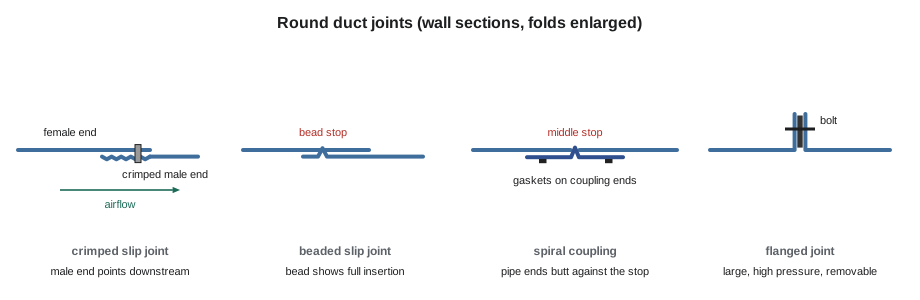
The direction matters. In supply duct, the crimped male end points downstream, in the direction of airflow, so that the air flows over the joint edge rather than into it. In exhaust duct carrying grease or moisture, the male end points so that any condensate or liquid runs over the joint rather than into it, which usually means male end down in a vertical riser. Keelson's shop rule was that every fitting left the shop with its airflow arrow marked, so the installer could orient it without thinking.
The insertion depth matters as much. A slip joint that is pushed together only a short way is weak and leaks. On Keelson's sections, the crimp was formed about 40 mm (1 1/2 in) long, and the joint was pushed home until the female end covered all of it. A bead rolled on the pipe just behind the crimp, a beaded slip joint, acts as a stop so the joint cannot be overinserted, and as a mark that shows when it is fully home.
Fastening and sealing slip joints
Slip joints are fastened with sheet metal screws, usually three on small pipe and more as the diameter grows, spaced evenly around the circumference. The duct standards and specifications set the minimum. Screws are placed close enough to the end of the female piece that they pass through both walls in the overlap, but not so close that they tear out. On Ashgrove the branch ducts took three screws per joint at 250 mm (10 in) diameter and the gym spiral took eight at 600 mm (24 in). Rivets are sometimes used instead of screws, especially on exposed duct where screw heads would be visible inside, or on stainless.
Sealing a slip joint is done in one of two ways. Sealant can be applied to the male end before it is inserted, so it is trapped inside the overlap, or applied around the outside of the joint after it is fastened, covering the edge of the female end and the screw heads. Many installers do both on higher pressure systems. Tape alone is not a substitute for sealant on a metal duct joint unless the specification allows it and the tape is listed for the purpose, a subject for Lesson 11.
Couplings for spiral duct
Spiral duct and its fittings are usually joined with couplings or by fitting a male fitting into the female end of the pipe. A spiral coupling is a short sleeve with a raised bead or stop around its middle. It slips inside the ends of two pipes, which butt against the stop, and is fastened with screws or rivets through each pipe into the sleeve. Fittings made to spiral sizes have male ends that slip into the pipe in the same way, with the bead on the fitting acting as the stop.
Gasketed couplings and fittings carry factory-fitted rubber or foam gaskets on their male ends. The gasket seals against the inside of the pipe as the joint is pushed home, so no sealant is needed if the system is allowed to rely on gaskets. Gasketed systems are fast to install and very tight, and many large commercial projects now specify them for that reason. They need clean, round, burr-free pipe ends, because a burr or a dent cuts or folds the gasket.
A practical rule of spiral work is that pipe is cut to length on site, and every cut end must be square, round and deburred before a coupling or fitting goes in. On the library run, Sean had Kai cut every piece with a saw guide to keep the cuts square, deburr the inside edge with a file, and check that each end was round by slipping a coupling in before fastening. A cut end that is out of round, from a careless cut or rough handling, will not seal on a gasket.
Flanged round joints
Large and higher pressure round duct, and duct that must be taken apart, is joined with flanges. Angle-ring flanges are steel rings formed from angle and welded or riveted to the duct ends, then bolted together with a gasket between them. Roll-formed round flanges and proprietary flange systems do the same job with lighter, faster components, often with a clamp or quick-release band instead of bolts. Van Stone joints, in which the duct end is flared over a loose flange ring, are used in some industrial systems and where the flange must be able to turn for alignment.
Draw bands are another option on round duct, especially on industrial and dust collection systems: a split band with a gasket lining is wrapped around two butted pipe ends, often with rolled beads or flanges on the pipe, and tightened with a lever or bolt. Draw bands and clamp couplings allow quick disassembly for cleaning, which matters in systems that carry dust, sawdust or grease.
Joints at fittings
Every elbow, tee, reducer and transition in a round system has joints at its ends and often seams within it. Gore elbows from SMW-120 have standing seams between their gores, made on an elbow machine, which must be sealed like any other seam. Adjustable elbows, which can be turned to any angle, have swivelling seams between gores; they are convenient but leaky, and many specifications restrict them to low pressure systems or require them to be sealed after setting. Tees and laterals have a seam where the branch meets the main, often a flanged or tabbed joint riveted or spot welded and then sealed.
On Ashgrove the gore elbows were made in the shop with standing seams, sealed inside the seam, and given crimped and beaded male ends for the slip joints. Lin chose fixed elbows over adjustable elbows for every supply branch because of the specification's seal class, and kept adjustable elbows only for low pressure exhaust.
How many screws?
The number of screws or rivets in a round slip joint, and their spacing around the circumference, is set by the standard or the specification. A common rule in practice is a minimum of three, with more added so that the spacing around the pipe does not exceed a set distance. The script below uses that rule to find the number of fasteners per joint and the total for a run. The maximum spacing in it is an illustrative Keelson value, not a quoted requirement.
# Fasteners per round slip joint: at least 3, spaced no more than a set distance apart
import math
max_spacing = 300        # illustrative maximum spacing around the pipe, mm
for d in [150, 250, 400, 600, 900]:
    circ = math.pi * d
    n = max(3, math.ceil(circ / max_spacing))
print(f"diameter {d} mm: circumference {circ:.0f} mm, {n} fasteners, spacing {circ / n:.0f} mm")diameter 150 mm: circumference 471 mm, 3 fasteners, spacing 157 mm diameter 250 mm: circumference 785 mm, 3 fasteners, spacing 262 mm diameter 400 mm: circumference 1257 mm, 5 fasteners, spacing 251 mm diameter 600 mm: circumference 1885 mm, 7 fasteners, spacing 269 mm diameter 900 mm: circumference 2827 mm, 10 fasteners, spacing 283 mm
At 600 mm the rule gives seven screws; Sean's crew used eight on the gym spiral, one more than the minimum, so they could set them at even 45-degree intervals. At 250 mm it gives three, which matched the classroom branches. Bigger pipe needs more fasteners, but the spacing stays about the same, because what the screws resist is the pull and racking at each point around the joint.
Screws in round duct carry one more concern: their points stick into the airstream inside the duct. In supply and return duct for offices and schools that does not matter much. In duct that will be cleaned with brushes, that carries lint or dust, or that is exposed and visible from below through grilles, the points catch debris or look poor, and rivets or short screws are used instead.
Leakage and round duct
Round duct leaks less than rectangular duct for three reasons: it has no corner seams, its walls do not flex as much under pressure, and its joints are short compared with the area of duct they serve. A well-sealed round system can be very tight indeed. The duct leakage test manuals reflect this by expecting tighter leakage classes from round duct than from rectangular duct of the same seal class. Lesson 11 takes up leakage classes and the arithmetic of allowable leakage.
That advantage is easily thrown away at the joints. A round system with crimped joints pushed half home, screws missing and sealant skipped can leak worse than good rectangular duct. On the library run, which was exposed, the architect wanted no visible sealant, so Lin specified gasketed spiral fittings throughout and had every joint checked for full insertion before the ceiling grid went in. The run passed its leakage test with room to spare.
Round joints at equipment and in the field
Round duct often ends at equipment: a fan inlet, a terminal unit, a diffuser neck or a louvre. These connections are usually slip joints onto a collar provided by the equipment maker, fastened and sealed in the same way as a duct joint, but the collar may be a different gauge or metal and may not be perfectly round. An installer checks the collar size before forming the duct end, uses a flexible connector where vibration from the equipment must be kept out of the duct, and never relies on the equipment collar to carry the weight of the duct.
Field cuts on round duct need the same care as shop work. A pipe cut with snips is rarely square or round, so Sean's crew cut spiral pipe with a saw and a guide, and longitudinal-seam pipe with a pipe cutter or a careful snip cut followed by trimming, then re-rounded the end on a stake before fitting it.
Common mistakes
MistakePointing a crimped male end upstream in supply duct.
InsteadPoint the male end in the direction of airflow so air flows over the joint edge.
MistakePushing a slip joint in only part way.
InsteadPush it fully home until the female end covers the crimp or meets the bead.
MistakeInstalling a gasketed fitting into a burred or out-of-round cut end.
InsteadCut square, deburr and check roundness before inserting a gasketed fitting.
MistakeUsing adjustable elbows on a system with a strict seal class.
InsteadUse fixed elbows, or seal adjustable elbows after setting, as the specification allows.
MistakeRelying on tape alone on a metal slip joint.
InsteadUse listed sealant, and tape only where the specification allows it.
Summary and key terms
- Round duct is closed by a grooved or welded longitudinal seam, or formed as spiral duct with a continuous lock seam.
- Crimped slip joints slide a crimped male end into a plain female end, with the male end pointing in the direction of flow.
- Slip joints must be fully inserted, fastened with enough screws or rivets around the pipe, and sealed.
- Spiral duct is joined with couplings and male-ended fittings; gasketed versions are fast and tight but need clean, round ends.
- Large, higher pressure or removable round duct is joined with flanges or draw bands.
- Round duct leaks less than rectangular duct when its joints are made properly.
- Crimped end
- A pipe end corrugated on a crimping machine so it slides inside the next piece.
- Beaded slip joint
- A slip joint with a rolled bead behind the crimp that acts as an insertion stop.
- Spiral lock seam
- The continuous helical seam formed and closed by a spiral duct machine.
- Coupling
- A short sleeve with a centre stop used to join two lengths of spiral duct.
- Gasketed fitting
- A fitting with a factory-fitted gasket on its male end that seals inside the pipe.
- Draw band
- A split band, often gasket-lined, tightened around two butted pipe ends.
Practice problems
Work each problem on paper first, then reveal the answer to check.
Which way does the crimped end point in a supply duct?
Show answer
Downstream, in the direction of airflow.
How many screws does Keelson's rule give for a 900 mm (36 in) round joint?
Show answer
Ten, at a spacing just under the maximum.
Why must spiral pipe be deburred before a gasketed coupling is inserted?
Show answer
A burr can cut or fold the gasket, so the joint leaks.
Name two reasons round duct leaks less than rectangular duct.
Show answer
It has no corner seams, and its walls flex less under pressure; its joints are also short relative to the area served.
Lesson quiz · 5 questions
Score 60% or more to complete this lesson.
Create a free account to save your progress, take quizzes and earn a certificate.