
SMW-110 · Lesson 8 of 12 · 18 min
Shears, notchers and the ironworker
The squaring shear sits near the front of Keelson's shop, where sheets come off the rack and go onto its bed. It is the first machine almost every piece of duct passes through, and Walt considers it the most important machine for an apprentice to learn properly, both because nearly every job depends on it and because it can amputate a finger without slowing down. Kai spent most of his third week at the shear, first watching, then cutting scrap under supervision, then cutting blanks for the Ashgrove duct with Aggie at his shoulder. This lesson covers the machines that cut sheet in the shop: squaring shears, rotary and throatless shears, notchers and the ironworker.
The squaring shear
A squaring shear cuts a sheet in a straight line across its width. It has a fixed lower blade along the front edge of the bed and an upper blade on a moving crosshead. The upper blade is set at a slight angle, called the rake, so it cuts progressively from one end to the other like a pair of scissors instead of hitting the whole width at once, which reduces the force needed. Before the blade comes down, hold-downs, a row of feet just behind the blade line, clamp the sheet so it cannot move during the cut. Foot shears are worked by a treadle; power shears are driven mechanically or hydraulically and are started by a foot switch.
Gauges set where the cut falls. The back gauge, a bar behind the blades that moves on screws or is set by a motor, sets the length of pieces that pass through the blade line and stop against it. Front gauges, extending forward over the bed, set cuts measured from the front. The squaring arm, a long straight bar at one end of the bed fixed exactly at right angles to the blade, gives the sheet a reference edge so every cut is square to it. A good operator checks the squaring arm and gauges with a square and a test cut at the start of each day, because every piece cut on a shear that is out of square is out of square too.
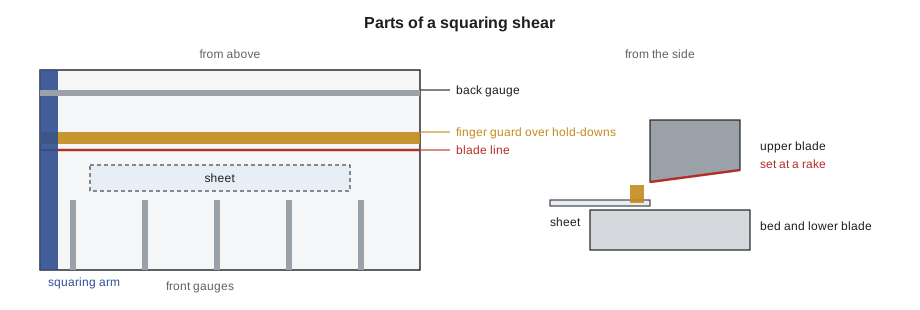
The finger guard is a bar or slotted guard in front of the hold-downs that keeps hands from reaching the blade line and the hold-downs, while still letting the sheet pass under it. It must never be raised, removed or reached under. The hold-downs themselves can crush fingers, which is why the guard covers them as well as the blade.
Shear capacity
Every shear has a rated capacity, usually given as a thickness of mild steel and a maximum length of cut, such as 2.0 mm mild steel by 2.5 m (14 gauge by 8 ft) for a mid-sized hydraulic shear. Stronger materials reduce the capacity, and because the force to shear a sheet at a given rake rises roughly with the square of its thickness, the reduction in thickness is smaller than the increase in strength. A common rule of thumb in shop manuals is that a shear handles stainless steel about two or three gauges lighter than its mild steel rating, and aluminum somewhat heavier, but the maker's chart for the machine is what counts.
Exceeding the capacity can crack the blades, damage the crosshead or stall the machine with the sheet clamped. It also produces a poor cut: a rough, torn edge with a large burr. Shears are also never used to cut rod, bar, wire, hardened steel or anything that is not flat sheet of the rated kind, which chips the blades, and short or narrow pieces that the hold-downs cannot clamp are cut another way.
# Equivalent shear capacity in other materials: force ~ shear strength x thickness^2 at a fixed rake
import math
rated_t = 2.0       # mm                       # mild steel rated capacity
rated_strength = 310      # N/mm^2                # mild steel shear strength used for the rating
materials = {"galvanized mild steel": 310, "aluminum 3003-H14": 100, "stainless 304": 520}                   # material: shear strength
for mat, strength in materials.items():
    t_max = rated_t * math.sqrt(rated_strength / strength)
    print(f"{mat:24s} up to about {t_max:.2f} mm")
jobs = [("stainless 304", 1.5), ("stainless 304", 1.6), ("aluminum 3003-H14", 3.0)]
for mat, t in jobs:
    t_max = rated_t * math.sqrt(rated_strength / materials[mat])
print(f"cut {t} mm {mat}: {'OK' if t <= t_max else 'over capacity: use the plasma table or send out'}")galvanized mild steel up to about 2.00 mm aluminum 3003-H14 up to about 3.52 mm stainless 304 up to about 1.54 mm cut 1.5 mm stainless 304: OK cut 1.6 mm stainless 304: over capacity: use the plasma table or send out cut 3.0 mm aluminum 3003-H14: OK
On this estimate, the shear rated for 2.0 mm mild steel cuts stainless up to about 1.5 mm, which is close to the shop chart's figure for the machine. The Brine & Ember hood panels, in 1.27 mm (18 gauge) stainless, were well within range; the 1.6 mm stainless bracket plates were not, and Lin put them on the plasma table.
Blade clearance, the small gap between upper and lower blades as they pass, is set for the thickness being cut. Too much clearance folds thin sheet into the gap and leaves a large burr; too little wears the blades quickly. Many shears have a lever or dial that sets clearance for the material. Dull blades produce the same rough edge as wrong clearance, and they are rotated or reground on a schedule.
Operating the shear safely
Keelson's shear procedure is posted on the machine. Before the first cut: check that guards are in place, the area is clear and the gauges are set; make a test cut on scrap and check it for length and square. For each cut: place the sheet against the squaring arm and the gauge, keep both hands on the sheet well in front of the finger guard, step on the pedal only when hands are clear, and take the foot off the pedal before reaching for the cut piece. Only one person operates the shear at a time, and a helper who supports a large sheet keeps their hands at the far edges and stays clear of the treadle.
Cut pieces fall behind the shear onto a table or into a bin, and nobody reaches behind the blade line to pick them up while the shear can cycle. When the back gauge has to be adjusted or a piece retrieved from behind the blade, the shear is stopped, and for any work inside the guarding, such as changing blades or clearing a jam, it is locked out as Lesson 2 described.
Long, narrow strips are a particular hazard because they are hard to hold and can whip as they are cut. Very narrow strips, narrower than the hold-downs can clamp, are not cut on the shear at all. Kai's first mistake at the shear was to stand a sheet at the squaring arm with his thumb curled over the edge in front of the guard; Aggie said nothing until he had taken his foot off the pedal, then showed him the gap between his thumb and the hold-downs. He never did it again.
Rotary, throatless and circle shears
Some cuts cannot be made on a squaring shear. A rotary shear, or rotary machine, uses two circular cutting wheels that turn against each other to cut a sheet along a line or curve as it is fed through, and it is used to trim cylinders and cut circles and curves in light sheet. A circle shear holds the sheet on a pivot and turns it against rotary cutters to cut discs and rings for round duct end caps and collars. A throatless shear has short blades and no throat, so the sheet can turn freely around the blade to cut irregular curves and shapes; it is hand-operated by a long lever and cuts heavier material than snips with less effort.
All of these machines have pinch points where the wheels or blades meet, and the sheet's edge passes close to the hands. They are used with gloves suited to the work, but with care: the rotating wheels of rotary and circle shears can catch a glove the same way a drill spindle can, so many shops require hands to stay at a set distance and use push blocks for the final part of a cut.
Notchers
A power notcher removes a V-shaped or square notch from the corner or edge of a sheet in one stroke. Its blades are set to an angle, usually 90 degrees, and adjustable stops set the depth of the notch. Notchers prepare corners of pans, plenum panels and duct sections where flanges are bent up and seams are formed, and they are much faster and more consistent than snips. The danger zone is small but severe, and notchers have guards and two-hand controls or foot switches that keep the operator's hands away from the blades. Corner notching is part of pattern work, so SMW-120 and SMW-130 come back to it.
The ironworker
An ironworker is a hydraulic machine with several work stations: a punch for holes in plate and angle, a shear for flat bar, a shear for angle, a notcher for angle and plate, and sometimes a bender. It is rated in tonnes or tons of punching force and in the thickness of flat bar and size of angle it can cut. In a sheet metal shop, the ironworker makes hanger brackets, angle-iron frames for duct reinforcement and equipment supports, and the curbs and frames the Brine & Ember hood would hang from.
Each station has its own guard and hold-down, and only one station is used at a time; on many machines, all stations move when the foot pedal is pressed, so an operator at one station can be injured by another person working at a second. Stripper plates hold the work down as the punch withdraws. Material is supported on the machine's tables and stops, not held by hand near the dies. The punching force needed is the same circumference times thickness times shear strength as in Lesson 6, which is why the ironworker can punch holes the hand punch cannot.
| Machine | What it cuts | Main hazard | Key control |
|---|---|---|---|
| Squaring shear | Straight cuts across sheet | Blade line and hold-downs | Finger guard; hands clear before the pedal |
| Rotary and circle shears | Curves, circles and trims in light sheet | Rotating wheel pinch points | Keep hands at a distance; push blocks |
| Throatless shear | Irregular curves in heavier sheet | Blade and lever | Lever control; feed hand away from blade |
| Power notcher | Corner and edge notches | Small, severe danger zone | Guards and two-hand or foot controls |
| Ironworker | Holes, flat bar, angle, notches | Several stations moving at once | One operator, one station; guards and strippers |
By the end of the week, Kai had cut all the blanks for the first phase of the Ashgrove ductwork. Walt checked a sample with a square and tape and found them all within 1 mm (1/32 in) and square. "Good," he said. "Now do it a thousand more times without ever putting your hand where your thumb was on Monday."
Where cutting is going
Many shops, Keelson among them, now cut much of their duct on a computer-controlled plasma table. The detailer draws the fittings in software that unfolds them into flat patterns, nests the patterns on a sheet to waste as little as possible, and sends the program to the table, which cuts every piece with a plasma torch, including the notches, in a few minutes. A coil line goes further and uncoils, flattens, notches, shears and forms straight duct sections automatically. SMW-420 covers both. Even in a shop with those machines, the squaring shear and notcher stay busy: for short runs, repairs, flashings, field changes and every piece the computer did not anticipate. And every operator still needs the skills of this lesson, because the plasma table's output has to be checked with a square and a tape just as a sheared blank does.
Plasma cutting brings its own hazards: intense light that requires shaded eye protection, fume from the metal and its coating that requires extraction, noise, and high voltage in the torch. Only trained operators run the table. Kai would spend time with Lin on it in his second year.
Common mistakes
MistakeReaching under or over the finger guard to straighten a sheet.
InsteadKeep hands in front of the guard; stop the machine to adjust the sheet.
MistakeCutting stainless steel at the mild steel rating.
InsteadUse the maker's chart; stainless capacity is about two or three gauges lighter.
MistakeCutting rod, wire or narrow strips on the squaring shear.
InsteadCut only flat sheet of the rated kind that the hold-downs can clamp.
MistakeTwo people operating one ironworker at different stations.
InsteadOne operator, one station; all stations may move together.
MistakeTrusting the squaring arm without checking it.
InsteadCheck it with a square and a test cut at the start of each day.
Summary and key terms
- The squaring shear cuts straight lines; the rake angle, hold-downs, gauges and squaring arm make cuts accurate.
- The finger guard and hold-downs are in front of the blade line and must never be bypassed.
- Capacity is given in mild steel; stainless reduces it by about two or three gauges, and the maker's chart governs.
- Blade clearance is set for the thickness; wrong clearance or dull blades leave rough, burred edges.
- Rotary, circle and throatless shears cut curves; notchers cut corners; the ironworker punches and cuts bar and angle.
- Lock out before changing blades, clearing jams or working inside guards.
- Rake
- The slight angle of a shear's upper blade, which makes it cut progressively along the sheet.
- Hold-down
- A foot that clamps the sheet to the shear bed before the blade cuts.
- Back gauge
- An adjustable stop behind the blades that sets the length of a sheared piece.
- Squaring arm
- A straight bar at right angles to the blade that gives the sheet a reference edge.
- Blade clearance
- The gap between the passing upper and lower blades of a shear.
- Ironworker
- A hydraulic machine with stations for punching, shearing and notching plate, bar and angle.
Practice problems
Work each problem on paper first, then reveal the answer to check.
A shear is rated for 2.0 mm mild steel. Roughly what stainless thickness can it cut, using the square-root rule with 310 and 520 N/mm²?
Show answer
2.0 × √(310/520) ≈ 1.54 mm.
Why is the upper blade of a shear raked?
Show answer
It cuts progressively along the sheet, reducing the force needed.
What should you do if a piece falls behind the blade line during a run?
Show answer
Stop the shear; lock it out if any part of the body will go inside the guarding.
What causes a large burr on sheared edges?
Show answer
Too much blade clearance or dull blades.
Lesson quiz · 5 questions
Score 60% or more to complete this lesson.
Create a free account to save your progress, take quizzes and earn a certificate.