
SMW-110 · Lesson 1 of 12 · 18 min
The sheet metal trade and your apprenticeship
Kai Ferreira's first morning at Keelson Sheet Metal started at 6:45 in the lunchroom, with a hard hat that still had the store sticker on it and a pair of steel-toed boots that had not yet been rained on. Keelson is a mid-sized sheet metal contractor in an industrial park on the edge of Halifax, Nova Scotia. It has a fabrication shop of about 1,900 square metres, three delivery trucks, and field crews that install ductwork, kitchen exhaust, architectural flashing and metal roofing across the region. Halima Noor, who owns the company, had hired Kai as a first-year apprentice after a summer as a shop helper. Walt Szymanski, the shop foreman, handed him a time card and a safety orientation binder. Aggie MacLeod, a journeyperson with twenty-two years in the trade, would be his mentor.
"You'll be in the shop for most of this year," Walt said. "The field crews will borrow you when they need hands. By the end of the year you'll know every machine in here, what every material is, and how not to get hurt doing any of it." This course follows Kai through that first year in the shop. It covers the tools, machines and materials of the trade and the safe work practices that go with them. Later courses in the program cover pattern development, seams and joints, duct fabrication, welding, field installation, architectural work, balancing, industrial ventilation and estimating. This first lesson describes the trade itself and how an apprenticeship in it works.
What sheet metal workers do
Sheet metal workers fabricate, assemble, install and maintain products made from thin metal: usually steel, aluminum, stainless steel and copper from about 0.4 mm (0.016 in) up to about 3 mm (1/8 in) thick, and sometimes thicker. The trade is defined by the material and by the skill of turning a flat sheet into a three-dimensional shape that fits. A worker lays out a pattern on a flat sheet, cuts it, bends and forms it, joins the pieces with seams, fasteners, solder or welds, and installs the finished product where it belongs.
Most of the work falls into a few broad areas. Heating, ventilating and air conditioning ductwork is the largest: rectangular, round and oval duct, fittings, dampers, plenums and the hangers that hold them up. Kitchen exhaust and industrial ventilation is a specialized branch: grease ducts and hoods, dust collection, fume exhaust. Architectural sheet metal covers flashing, gutters, roofing, wall cladding, copings and ornamental work. There is also a wide range of specialty fabrication, from stainless steel counters and equipment for food service and hospitals to machine guards, enclosures and custom parts. Some sheet metal workers specialize in testing, adjusting and balancing air systems, in shop drawings and estimating, or in running computer-controlled cutting and coil lines.
At Keelson, the work on the board on Kai's first day showed most of those areas at once. A crew was replacing the ductwork at Ashgrove Elementary School as part of an HVAC retrofit that would run through the summer. The shop was building a stainless steel kitchen exhaust hood and grease duct for Brine & Ember, a new restaurant downtown. The architectural crew was measuring the roof of St. Brendan's Church, a heritage building whose copper roof and flashings needed restoration. And the estimating office was working on the sheet metal package for the new wing at Eastgate Hospital, the largest job Keelson had bid in years. Those four jobs come up again and again in this program.
Shop and field
Sheet metal work happens in two places, and an apprentice needs to be comfortable in both. In the shop, material arrives in flat sheets and coils, and it is cut, formed and assembled on machines that are too large to take to a job site: squaring shears, brakes, roll formers, notchers, plasma tables and coil lines. Shop work is precise and repetitive, and it rewards care with layout and machines. In the field, the finished pieces are carried, lifted, hung, connected and sealed, often overhead, often around other trades, and often in weather. Field work rewards planning, communication and attention to the building as it really is rather than as the drawings say it is.
The two halves depend on each other. A fitting that is a quarter of a centimetre (quarter inch) out in the shop can cost an hour in the field, and a field measurement taken carelessly can waste a day of shop time. Walt's rule was that every apprentice should spend time on both sides so that shop workers understand what the field needs and field workers understand what the shop can do. Kai would spend most of his first year in the shop and help on field jobs when a crew needed an extra pair of hands.
How an apprenticeship works
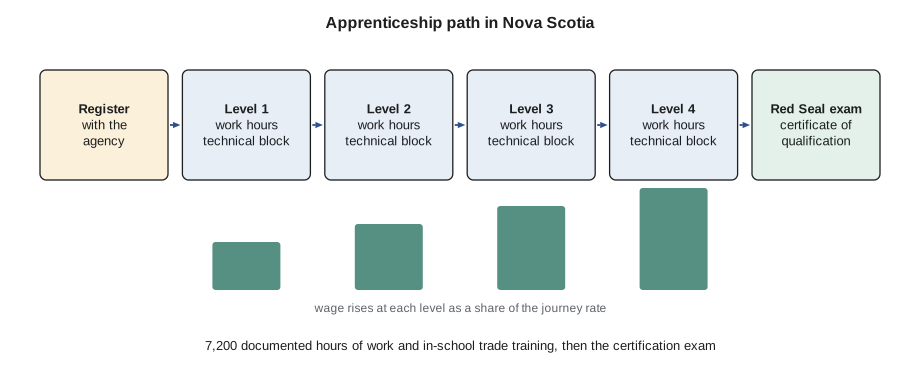
In Nova Scotia, sheet metal worker is a compulsory certified trade. That means anyone doing the work of the trade must either be a registered apprentice or hold a certificate of qualification, with a few exceptions for workers certified in other trades doing work within their own scope. The Nova Scotia Apprenticeship Agency registers apprentices, approves the training and issues certificates. The program, as the trade regulation sets it out, requires 7,200 documented hours of on-the-job experience and in-school trade training, the technical training the Agency approves, and a certification exam. A person who did not serve an apprenticeship can apply to challenge the exam with 10,800 hours of documented work in the trade. Halima registered Kai with the Agency in his first week, and from that day his hours counted.
The in-school training comes in blocks, usually several weeks at a time at a community college such as the Nova Scotia Community College, at levels that match the apprentice's progress. Each block ends with exams, and passing them is part of moving from one level to the next. At the end of the program the apprentice writes the certification exam. For sheet metal worker this is the interprovincial Red Seal exam, so passing it gives both the provincial certificate of qualification and the Red Seal endorsement, which is recognized across Canada. The last course in this program, SMW-430, prepares for that exam.
Pay rises as the apprentice progresses. An apprentice's wage is set as a percentage of a journeyperson's rate, and the percentage steps up at each level, so finishing the technical training on time and keeping the hours logged has a direct effect on the paycheque. The apprentice also has responsibilities: to work safely, to attend the technical training, to keep an accurate record of hours and skills, and to learn. The employer must provide supervision by qualified workers, a range of work that covers the trade, and the time to attend school.
The logbook
Aggie's first piece of advice was not about tools. "Write everything down. Hours, what you did, who you did it with. When you get to the end, nobody remembers what you did in your first year except you and your book." An apprentice's logbook records hours worked and the skills practised, and the employer signs it. The training standard for the trade lists the tasks an apprentice must be able to do, and the logbook shows when and where each was done. A gap in the log can delay a level change or the final exam, so Kai filled in his hours every Friday before he left the shop.
The script below is the kind of check Kai's training coordinator ran for every apprentice. It takes the program's required hours, the hours logged so far and a typical week, and estimates how long it will take to finish. It is a planning tool only; the real requirements are the ones the program sets.
# How long until the apprenticeship hours are complete?
required = 7200          # hours the program requires
logged = 410            # hours logged so far
week = 40             # hours worked in a typical week
weeks_per_year = 42    # weeks worked in a year, after school blocks and holidays
left = required - logged
weeks = left / week
years = weeks / weeks_per_year
print(f"hours still needed: {left}")
print(f"at {week} hours a week: {weeks:.0f} working weeks, about {years:.1f} years")
for share in (0.25, 0.50, 0.75):
print(f"{int(share * 100)} % of the hours is reached at {required * share:.0f} hours")hours still needed: 6790 at 40 hours a week: 170 working weeks, about 4.0 years 25 % of the hours is reached at 1800 hours 50 % of the hours is reached at 3600 hours 75 % of the hours is reached at 5400 hours
With 410 hours from his first summer and a 40-hour week, Kai had about four years of work ahead of him, which matched the program's design: four levels, each about a year. The real timetable would also depend on when his school blocks were scheduled.
Who's who on a sheet metal job
On a construction project, the sheet metal contractor is usually a subcontractor to a mechanical contractor or directly to the general contractor. The engineer designs the HVAC system and produces the drawings and specifications. The sheet metal contractor turns those drawings into shop drawings that show every piece of duct with its size, gauge and joints, fabricates the pieces, and installs them in coordination with the plumbers, pipefitters, electricians, sprinkler fitters and others who need the same ceiling space. On architectural work, the sheet metal contractor may work for the roofing contractor or the general contractor, and the details come from the architect.
Within Keelson, Halima runs the company and signs the contracts. The estimators price jobs before they are won. The detailer, Lin Zhao, draws shop drawings and programs the plasma table. Walt runs the shop, decides what gets built in what order and who builds it. In the field, Sean Doucette is the general foreman, and each job has a foreman or lead hand who runs the crew. Journeypersons do the skilled work and train apprentices. Apprentices learn by doing, under supervision, and gradually take on more.
| Role | What they do | Who Kai would see most |
|---|---|---|
| Owner or manager | Wins and signs contracts, sets company policy | Halima, at safety meetings |
| Estimator | Prices jobs from drawings before they are won | Rarely in the first year |
| Detailer | Draws shop drawings, programs cutting machines | Lin, when the plasma table needed feeding |
| Shop foreman | Runs fabrication, assigns work, enforces shop rules | Walt, every day |
| Field foreman | Runs a job site crew and coordinates with other trades | Sean, on loan days |
| Journeyperson | Does skilled work and trains apprentices | Aggie, every day |
| Apprentice | Learns the trade under supervision | Kai, and two other apprentices |
What the trade asks of you
Sheet metal work asks for a particular set of abilities. The first is spatial thinking: seeing how a flat pattern will fold into a shape, and how a fitting will sit in a building. The second is arithmetic and geometry, used every day for layout, allowances and quantities; the pattern development courses later in the program rely on it heavily. The third is hand skill with tools and machines, which comes only with practice. The fourth is physical: carrying sheets and duct, working on ladders and lifts, and standing at a bench for long hours. And the fifth, the one Aggie said mattered most, is care: measuring twice, keeping hands out of machines, and finishing work that someone else will have to live with.
The trade also changes. Duct is increasingly cut on plasma tables and formed on coil lines driven by software. Building codes keep tightening limits on duct leakage, which puts more weight on good seams and sealing. Kitchen exhaust and fire-rated assemblies require close attention to listings and codes. Architectural metal work has grown with metal roofing and cladding. A sheet metal worker who keeps learning has a long career with many directions: field foreman, shop foreman, detailer, estimator, project manager, balancing technician, inspector or instructor.
At the end of the first day, Aggie walked Kai around the shop once more, naming each machine and pointing out its guards and stop buttons. "You don't touch any of these until somebody has shown you," she said. "That's not because we think you're careless. It's because every one of them can take a finger in less time than it takes to say so." The next lesson is about exactly that.
Common mistakes
MistakeTreating the apprenticeship as a job only, and not keeping the logbook up to date.
InsteadRecord hours and skills weekly and have them signed; gaps delay level changes and the final exam.
MistakeAssuming shop and field are separate careers.
InsteadEvery apprentice needs both; shop work and field work depend on each other.
MistakeThinking sheet metal means only ductwork.
InsteadThe trade includes HVAC duct, exhaust, architectural metal and specialty fabrication.
MistakeRunning a machine before being trained on it.
InsteadWait for a qualified person to show you the machine, its guards and its stops.
MistakeIgnoring the arithmetic because the computer does layout now.
InsteadLayout, allowances and quantities still depend on the worker's geometry and arithmetic.
Summary and key terms
- In Nova Scotia, sheet metal worker is a compulsory certified trade; the apprenticeship requires 7,200 documented hours, technical training and the Red Seal exam.
- The trade covers HVAC ductwork, kitchen and industrial exhaust, architectural sheet metal and specialty fabrication.
- Work is split between the shop, where material is cut and formed on large machines, and the field, where it is installed.
- The logbook records hours and skills and must be kept up to date and signed.
- Spatial thinking, geometry, hand skill, physical fitness and care are the abilities the trade asks for.
- Apprentice
- A person learning a trade through paid work under supervision and in-school training, registered with the apprenticeship authority.
- Compulsory certified trade
- In Nova Scotia, a trade that may be practised only by registered apprentices or holders of a certificate of qualification.
- Certificate of qualification
- The provincial credential earned by passing the certification exam; for this trade it comes with the Red Seal endorsement.
- Red Seal
- The interprovincial standard; the Red Seal exam leads to a credential recognized across Canada.
- Journeyperson
- A fully qualified worker in the trade.
- Shop drawing
- A drawing that shows every piece to be fabricated, with sizes, gauges and joints.
Practice problems
Work each problem on paper first, then reveal the answer to check.
How many documented hours does the Nova Scotia sheet metal worker apprenticeship require?
Show answer
7,200 hours of on-the-job experience and in-school trade training.
A worker with 9,000 hours in the trade and no apprenticeship wants to write the exam. Is that enough?
Show answer
No; the regulation requires 10,800 hours for a challenge application.
Name the four broad areas of sheet metal work.
Show answer
HVAC ductwork, kitchen and industrial exhaust, architectural sheet metal, specialty fabrication.
Who draws the shop drawings at Keelson?
Show answer
Lin Zhao, the detailer.
Lesson quiz · 5 questions
Score 60% or more to complete this lesson.
Create a free account to save your progress, take quizzes and earn a certificate.