
SMW-110 · Lesson 10 of 12 · 18 min
Rolls and roll-forming machines
In the middle of Keelson's shop, along one wall, stands a line of machines that make noise all day: the slip roll, the Pittsburgh lock former, the snap-lock machine, the cleat former, the duct flange former and the beading machine. Each one forms sheet by passing it between shaped rolls, either curving it into a cylinder or folding its edge into a profile in a series of small steps. These are among the most productive machines in the shop and among the most dangerous, because a roll that grabs a sheet will grab anything else that goes in with it. This lesson covers the machines that roll and roll-form sheet metal. The seams and locks they make are the subject of SMW-130.
The slip roll
A slip roll forming machine curves flat sheet into cylinders and cones for round duct, collars, sleeves and tanks. It has three long rolls. Two front rolls, the upper and lower, grip the sheet and drive it through as the crank or motor turns them. The third, the rear or forming roll, sits behind them and can be raised; as the sheet passes over it, it is bent upward into a curve. The higher the rear roll is set, the tighter the curve. The upper roll is called a slip roll because one end of it can be released and lifted, so a finished cylinder can be slid off the end of the roll instead of being unrolled. Grooves at one end of the lower and rear rolls take wired edges, so a cylinder with a wire already rolled into its edge can pass through.
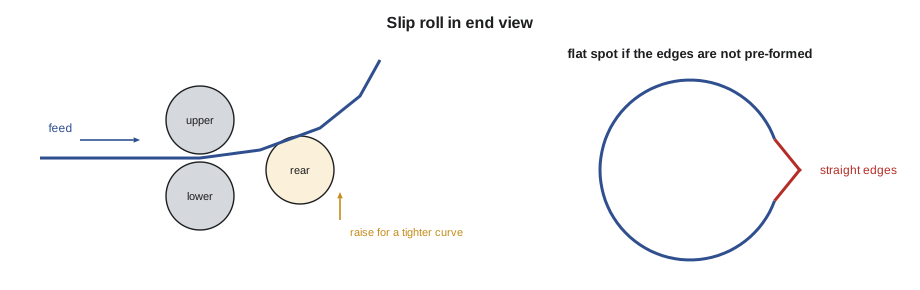
Rolling has one well-known problem. The first few millimetres (fractions of an inch) of the sheet's leading edge pass between the front rolls before they reach the rear roll, so they come out straight, and the same happens at the trailing edge. A cylinder rolled from a flat blank therefore has a flat spot at the seam. The fix is to pre-form the edges: start the sheet into the rolls, back it out, and bend the leading edge over the rear roll by lifting the sheet slightly, or pre-bend the edges on a brake or by hand over a stake, before rolling the whole sheet. On round duct with a lock seam, the formed lock edges also have to be fed with care so the rolls do not flatten them.
Rolling a cylinder is usually done in several passes, raising the rear roll a little each time until the diameter is right, because a single pass at full setting often overshoots and is hard to open up again. Springback opens the curve slightly when the sheet leaves the rolls, so the rear roll is set a little tighter than the final diameter. Cones are rolled by setting the rear roll at an angle to the front rolls and feeding the small end more slowly, a skill that takes practice and that SMW-210's cone patterns depend on.
Slip rolls are hand-cranked or powered. Power rolls run on a foot switch, often with a reverse, and have an emergency stop bar or cable along the front. The in-running nip between the front rolls is the danger: fingers, gloves, sleeves and hair can all be drawn in. The sheet is fed from its far edge, flat on the bed, with the hands kept well back from the rolls, and the machine is stopped before reaching anywhere near them. Gloves are not worn at power rolls in Keelson's shop, for the reason Lesson 2 gave, and Walt makes apprentices tie back long hair and remove rings and watches.
Roll-forming machines
A roll-forming machine folds a profile into the edge of a strip by passing it through a series of pairs of shaped rolls, called stations. Each station bends the edge a little further than the last, so a profile that would be impossible to make in one bend is made in eight or twelve gentle steps. The sheet is fed against a guide at the first station, the rolls grip it and pull it through, and the finished edge comes out of the last station at production speed, often many metres a minute. Most roll formers in a duct shop are dedicated to one profile, and many have two heads, one for each of two profiles, on the same machine.
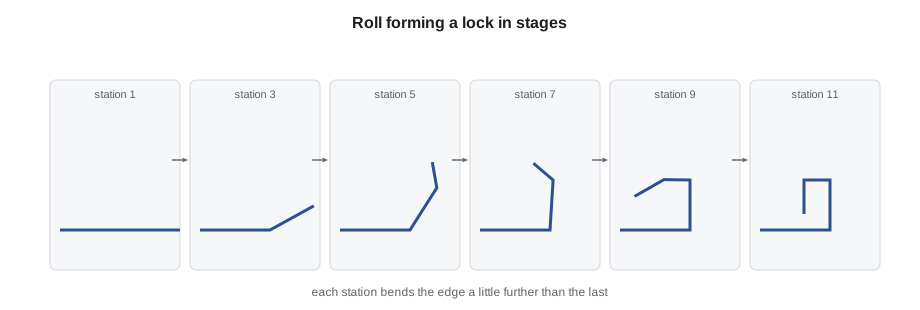
The Pittsburgh lock former makes the pocket half of the Pittsburgh lock, the most common longitudinal seam on rectangular duct: a deep folded pocket into which a single flange on the mating piece is inserted and the pocket edge then hammered closed. The snap-lock or button-punch machine forms a similar pocket with dimples that grip the mating flange when it is pushed in, so the seam snaps together without hammering. The flanged-edge or right-angle flange machine forms the single flange that goes into the pocket. Cleat formers make the S cleats and drive cleats that join the ends of duct sections. Transverse duct flange machines roll an integral flange onto the ends of duct for bolted connections. SMW-130 and SMW-220 describe each of these joints and where each is used; this lesson is about running the machines that make them.
Each machine has a capacity range, given as the thinnest and thickest gauges it forms, because the rolls are spaced for that range. Running material heavier than the range strains the machine and forms a poor profile; running material lighter than it may form loosely or buckle. Many machines have adjustable roll spacing or separate settings for light and heavy gauges, and the operator checks the setting against the work order before the first piece. The sheet's edge must be straight and square, because the guide steers from it, and the first piece of every run is checked for profile and fit with a mating piece.
Beading, crimping and rotary machines
A beading machine rolls a raised bead into a sheet to stiffen it. Beads across the panels of large rectangular duct reduce drumming and flexing; a bead around round duct near its end gives a stop for the next section. Cross-breaking, the old method of stiffening a duct panel by two shallow bends from corner to corner, does a similar job and is still used on some panels. A crimping machine crimps the ends of round duct and pipe so they slide into each other, as the hand crimper of Lesson 6 does on site.
Rotary machines are bench-mounted machines with a pair of shaped rolls on two shafts, turned by a crank or motor, and interchangeable roll sets for different jobs. The turning machine turns a flange or edge on round work; the burring machine turns a narrow flange on the end of a cylinder or a disc for a seam; the wiring machine rolls the edge of a cylinder around a wire to stiffen it; the beading machine adds beads; and the elbow edge or easy edger turns edges for round elbows. In a modern duct shop, most of this work is done on dedicated machines, but rotary machines are still used for short runs, repairs, and the copper and heritage work at the church.
Large shops also have spiral duct machines, which form round duct continuously by winding a strip helically and locking its edges into a spiral seam, and adjustable elbow machines that make round gored elbows. They are covered in SMW-220.
Calculating a round duct blank
Before any round duct goes into the slip roll, its blank has to be cut to the right stretchout. The stretchout is pi times the mean diameter, from Lesson 5, plus the allowance for the longitudinal seam that the shop's seam chart gives for the seam type and gauge. The blank's other dimension is the length of the section. Kai's job was a set of round branch ducts for the Ashgrove classrooms. The script works out the blank and how many blanks fit along a sheet.
# Round duct blank: stretchout on the mean diameter plus the seam allowance, and blanks per sheet
import math
D = 250          # mm                 # outside diameter of the finished duct
t = 0.55         # mm (26 gauge)                 # sheet thickness
seam = 22    # mm (example value for a grooved seam)           # allowance for the longitudinal seam, from the shop's seam chart
section = 1219   # mm         # length of each duct section
sheet_w, sheet_l = 1219, 2438   # mm
stretchout = math.pi * (D - t) + seam
print(f"stretchout {math.pi * (D - t):.1f} mm plus seam {seam} mm = blank width {stretchout:.1f} mm")
across = int(sheet_l // stretchout)     # blanks side by side along the sheet length
print(f"{across} blanks of {stretchout:.1f} by {section} mm fit along a {sheet_w} by {sheet_l} mm sheet")
waste = sheet_l - across * stretchout
print(f"offcut left: {waste:.1f} by {sheet_w} mm")stretchout 783.7 mm plus seam 22 mm = blank width 805.7 mm 3 blanks of 805.7 by 1219 mm fit along a 1219 by 2438 mm sheet offcut left: 21.0 by 1219 mm
Each blank was about 806 mm wide, so three fit along a 2,438 mm sheet with a strip of about 20 mm left over. Kai cut the blanks, pre-formed their edges and rolled them in three passes. The seam allowance in the script is an example; SMW-130 explains how each seam's allowance is worked out.
Running roll-forming machines safely
All roll-forming machines share the in-running nip between rolls at their infeed, where the sheet is drawn in, and many have exposed gears or chains. They are guarded so that hands cannot reach the rolls, with the infeed opening just large enough for the sheet. Material is fed flat and straight against the guide with the hands well back, and pushed in with the next piece or a push stick when it is short. Short pieces are not fed by hand at all. If a piece jams, the machine is stopped with the emergency stop, locked out and the jam cleared with tools, never by pulling the sheet back with the motor running. Long strips leaving the machine are supported on a table so they do not swing.
These machines are also loud, which is why they appeared in Kai's noise dose in Lesson 2, and their edges are sharp, especially on freshly formed locks. Formed pieces are stacked carefully and carried in pairs with the formed edge away from the body.
| Machine | What it makes | Check before running |
|---|---|---|
| Slip roll | Cylinders and cones | Roll setting for diameter; edges pre-formed; no gloves, rings or loose clothing |
| Pittsburgh lock former | Pocket half of the Pittsburgh lock | Gauge range; edge straight against the guide |
| Snap-lock machine | Snap-lock pocket with gripping dimples | Gauge range; first piece fit with its flange |
| Cleat former | S and drive cleats | Material width and gauge |
| Beading machine | Stiffening beads | Bead location; feed straight |
| Rotary machine | Turned, burred, wired and beaded edges on round work | Correct roll set; guard; crank speed |
By the end of the week, Kai had run all the Ashgrove branch duct blanks through the slip roll and fed several hundred feet of Pittsburgh pocket through the lock former. Walt let him run the snap-lock machine on his own on Friday afternoon, after watching him set it up, check the gauge and test-fit the first piece.
Looking after the roll machines
Roll machines are precise. A Pittsburgh lock former whose rolls have worn or whose spacing has drifted forms a pocket that is too tight for the flange or too loose to hold it, and every seam made from it is a problem in the field. Walt's maintenance schedule for the line called for cleaning the rolls of zinc flakes and oil every week, lubricating gears and bearings as the makers direct, checking the guide and roll settings with a test strip every Monday, and keeping a log of each machine's adjustments. Any machine that formed a bad profile was tagged out until it was set right. Zinc flaking off the rolls, Walt pointed out, was also a sign that the coating on the sheet was being damaged, and he would rather fix the rolls than send duct with scraped seams to a school.
Common mistakes
MistakeRolling a blank without pre-forming its edges.
InsteadPre-form the leading and trailing edges, or the cylinder will have a flat spot at the seam.
MistakeSetting the rear roll to the final diameter in one pass.
InsteadRoll in several passes and allow for springback.
MistakeWearing gloves or rings at power rolls.
InsteadRemove gloves, rings and loose clothing; the in-running nip can draw them in.
MistakeFeeding material outside the machine's gauge range.
InsteadCheck the range and settings against the work order before the first piece.
MistakePulling a jammed sheet back out of a running roll former.
InsteadStop, lock out, and clear the jam with tools.
Summary and key terms
- A slip roll curves sheet with two drive rolls and an adjustable rear forming roll; the upper roll releases to remove the cylinder.
- Pre-form edges to avoid flat spots, roll in several passes, and allow for springback.
- Roll formers bend a profile in stages through a series of roll stations.
- Pittsburgh lock formers, snap-lock machines, cleat formers and flange formers make the seams and joints of duct.
- Every roll former has a gauge range and must be fed straight against its guide.
- In-running nips are the main hazard: guard them, keep hands back, and lock out to clear jams.
- Slip roll
- A three-roll machine that curves sheet into cylinders and cones.
- Pre-forming
- Bending the leading and trailing edges of a blank before rolling so the cylinder has no flat spot.
- Roll forming
- Forming a profile progressively through a series of shaped roll stations.
- Pittsburgh lock
- A common longitudinal duct seam made of a pocket and a single flange.
- In-running nip
- The point where two rolls turn toward each other and can draw in material or body parts.
- Rotary machine
- A bench machine with interchangeable rolls for turning, burring, wiring and beading round work.
Practice problems
Work each problem on paper first, then reveal the answer to check.
A 300 mm outside-diameter duct is made from 0.70 mm sheet with a 22 mm seam allowance. What is the blank width?
Show answer
π × 299.3 + 22 ≈ 962.3 mm.
Why does a cylinder rolled from a flat blank have a flat spot?
Show answer
The leading and trailing edges pass the drive rolls before the forming roll reaches them.
Which machine makes the pocket half of a Pittsburgh lock?
Show answer
The Pittsburgh lock former.
What is the first step when a sheet jams in a roll former?
Show answer
Stop the machine with the emergency stop and lock it out.
Lesson quiz · 5 questions
Score 60% or more to complete this lesson.
Create a free account to save your progress, take quizzes and earn a certificate.