
SMW-110 · Lesson 2 of 12 · 17 min
Shop safety and hazard control
Kai's second day was a safety day. Walt ran the orientation himself, in the lunchroom first and then at every machine on the floor, because he had seen what sheet metal can do. "Thin metal is sharp metal," he said, holding up a strip of 0.55 mm (26 gauge) galvanized steel with an edge that looked harmless. "It cuts like a razor and it doesn't hurt until you see the blood. The machines are worse, because they don't stop when you yell." This lesson covers the hazards of a sheet metal shop and how they are controlled. It builds on the workers' rights and responsibilities covered in the safety orientation every new worker takes, and it applies them to this trade.
Your rights and the law that sets them
In Nova Scotia, the Occupational Health and Safety Act and its regulations, including the Occupational Safety General Regulations, set the rules for workplaces. Every worker has the right to know about the hazards of the work, the right to participate in health and safety through the joint committee or representative, and the right to refuse work that the worker reasonably believes is dangerous. The employer must provide training, supervision, equipment and safe procedures, and workers must use them. A sheet metal shop like Keelson's has a joint occupational health and safety committee, and its minutes are posted on the board by the time clock.
Walt was clear about the part that belonged to Kai. "If you don't know how to do something safely, you stop and ask. If something looks wrong, you tell me. Nobody here gets in trouble for asking, and nobody gets a medal for figuring it out alone."
The hierarchy of controls
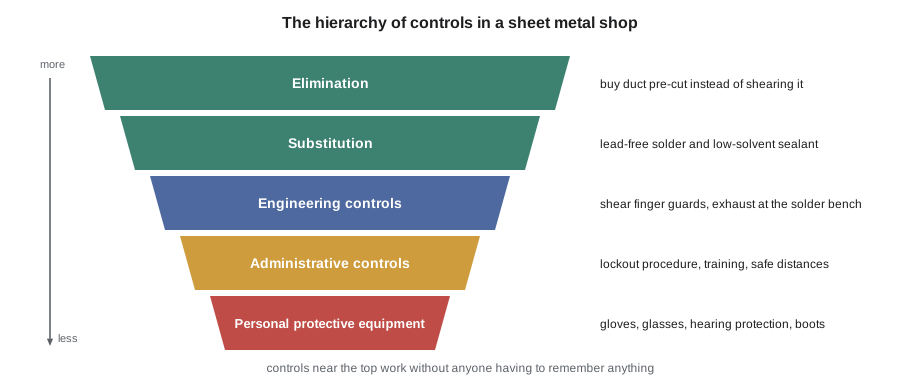
Every hazard in the shop is controlled in the same order of preference. The best control removes the hazard altogether, such as buying duct pre-cut by a supplier instead of shearing it. Next is substitution, replacing a hazard with a smaller one, such as using a lead-free solder. Then come engineering controls, which change the equipment or workplace so the hazard cannot reach the worker: guards on machines, local exhaust at the soldering bench, interlocks that stop a machine when its cover is opened. After that are administrative controls, which change how people work: procedures, training, signs, job rotation, keeping hands at a safe distance. Last is personal protective equipment, which protects the wearer but only if it is the right equipment, worn properly, every time.
The order matters because the controls near the top work without anyone having to remember anything. A guard protects a tired worker at the end of a shift; a procedure only protects a worker who follows it. Personal protective equipment is essential in sheet metal work, but it is the last line, not the first.
Cuts and sharp edges
Cuts are the most common injury in the trade. Every sheared, snipped or punched edge is sharp, and burrs and slivers stick out from it. Sheets are also heavy and flexible, so a sheet that slips can slice along its whole length. The controls are simple but must be habits. Wear cut-resistant gloves when handling sheet and cut pieces. Carry sheets by the edges with both hands, flat side vertical where possible, and never slide a hand along an edge. Deburr or hem edges that people will touch. Keep scrap off the floor and in the scrap bins, because a strip on the floor can cut through a boot sole or a pant leg. Store sheets flat in racks, not leaning against walls where they can fall.
Gloves for sheet metal work are rated for cut resistance. Products sold in Canada usually carry the EN 388 rating from the European standard, with a letter from A to F for cut resistance under the ISO test, and many also show the North American ANSI/ISEA 105 rating, from A1 to A9. Keelson issues gloves at about the middle of the range for general handling, with higher-rated gloves for handling stainless steel and freshly sheared coil, and thinner gloves with good grip for fine work. No glove is cut-proof, so gloves reduce injuries but do not replace careful handling.
There is one important exception. Gloves must not be worn near rotating parts that can catch them, such as a drill press spindle or the rolls of a slip roll, because a caught glove pulls the hand in. Lesson 7 and Lesson 10 return to this. Walt's shop has a sign at each such machine.
Eyes, ears and feet
Safety glasses with side shields are worn at all times on the shop floor. Shearing, punching and drilling throw small chips, and grinding throws hot particles at high speed. Glasses must meet the Canadian eye and face protection standard, CSA Z94.3, and a face shield is worn over them for grinding and cutting with abrasive wheels. Safety footwear protects against dropped sheets and coils and against punctures from scrap; in Canada it is certified to CSA Z195 and carries a green triangle patch for sole puncture protection with a toe cap.
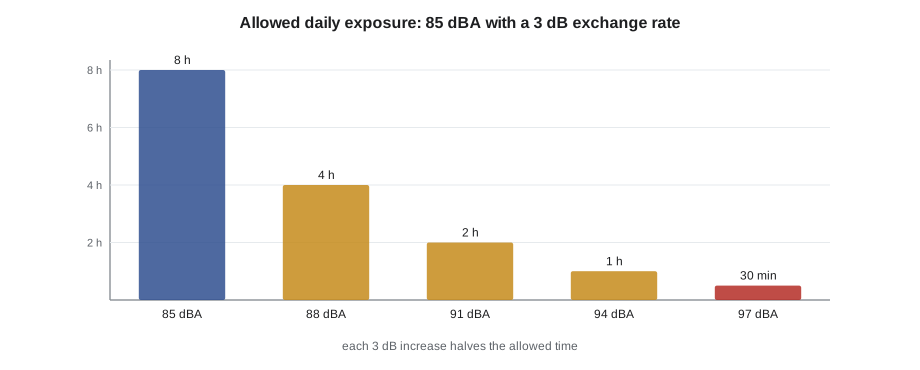
Noise is the hazard people notice least, because hearing loss from noise is painless and gradual. A sheet metal shop is loud: shears, brakes, hammers on sheet, grinders and roll formers. Hearing loss depends on both the level and the time, so a worker near a loud machine for a short time can receive the same dose as a worker near a quieter machine all day. The rule that sets the limit is the exposure limit for an eight-hour day, together with an exchange rate that says how much the allowed time shrinks when the level rises.
Nova Scotia applies a limit of 85 dBA over eight hours with a 3 dB exchange rate. Each 3 dB increase halves the allowed time, so 88 dBA is allowed for four hours and 91 dBA for two. Above the limit, the employer must reduce noise at the source where it can, provide hearing protection and run a hearing conservation program with hearing tests.
Walt had the shop surveyed with a sound level meter every year. The script works out the noise dose for one of Kai's days from the levels measured at the stations he worked at and the time spent at each.
# Daily noise dose from time spent at each shop station
limit, exchange = 85, 3        # dBA over 8 hours, and dB that halves the allowed time
stations = [  # (station, measured dBA, hours there)
    ("squaring shear and notcher", 88, 3.0),
    ("brake and bench work", 84, 3.5),
    ("grinding and cut-off saw", 95, 0.5),
    ("roll former and Pittsburgh machine", 91, 1.0)]
dose = 0.0
for name, level, hours in stations:
    allowed = 8 / 2 ** ((level - limit) / exchange)
    part = hours / allowed
    dose += part
    print(f"{name:36s} {level} dBA  {hours:3.1f} h  allowed {allowed:5.1f} h  dose {part * 100:5.1f} %")
print(f"total daily dose: {dose * 100:.0f} %")
print("over the limit: reduce exposure and wear hearing protection" if dose > 1 else "within the limit")squaring shear and notcher 88 dBA 3.0 h allowed 4.0 h dose 75.0 % brake and bench work 84 dBA 3.5 h allowed 10.1 h dose 34.7 % grinding and cut-off saw 95 dBA 0.5 h allowed 0.8 h dose 63.0 % roll former and Pittsburgh machine 91 dBA 1.0 h allowed 2.0 h dose 50.0 % total daily dose: 223 % over the limit: reduce exposure and wear hearing protection
Under Nova Scotia's 85 dBA and 3 dB criterion, Kai's day added up to well over the limit, mostly from the grinding and the roll former. That is why hearing protection is mandatory everywhere on Keelson's floor, not only at the loudest machines.
Machines: guarding and lockout
The machines in a sheet metal shop share a handful of hazards. The point of operation is where the work is done: the blade line of a shear, the closing gap of a brake, the die of a punch or notcher. Pinch points are where moving parts come together, such as the rolls of a roll former. Flywheels, belts and gears transmit power and can catch clothing or hair. Stored energy remains after a machine is switched off, in a raised shear blade, a counterweighted brake leaf or a hydraulic cylinder.
Nova Scotia's regulations require machines to be guarded so that workers cannot reach the point of operation or other dangerous parts during operation, and require that machines be locked out before anyone clears a jam, adjusts, cleans or repairs them. The national standard CSA Z432 describes how machine guarding is designed, and CSA Z460 describes how hazardous energy is controlled through lockout. Keelson's written lockout procedure lists, for each machine, every energy source and how to isolate it.
Lockout follows the same steps on every machine. Tell the people affected. Shut the machine down normally. Isolate every energy source: the electrical disconnect, the air supply, the hydraulic power unit. Apply your own personal lock and tag to each isolating device. Release or block stored energy: lower the blade or leaf, bleed air and hydraulic pressure, block anything that could fall. Then verify: try the start button, check that nothing moves, and only then begin the work. When the job is done, the person who applied each lock removes it, after checking that guards are back in place and everyone is clear.
Walt had Kai lock out the squaring shear on his second day, under supervision, and try the foot pedal to prove it was dead. "Your lock, your key, your fingers," Walt said. "Nobody else takes your lock off."
Fumes, dusts and chemicals
Sheet metal work produces a few airborne hazards. Heating galvanized steel by welding, cutting or brazing burns off zinc, which forms zinc oxide fume; breathing it can cause metal fume fever, a flu-like illness that comes on hours later. Soldering produces flux fumes that irritate the airways. Plasma cutting produces fume from the metal and its coating. Old roofing and flashing may contain lead, and old buildings may have asbestos in duct insulation, tapes and mastics, which must be identified before anyone disturbs it. The controls are local exhaust at the source, good general ventilation, choosing lead-free solders and flux, and respiratory protection fitted to the worker where the other controls are not enough.
Chemical products in the shop, from sealants and solvents to fluxes and cutting oils, come with safety data sheets and labels under WHMIS 2015. Kai had to find the safety data sheet binder and read the sheet for the duct sealant the shop used most before his first week was over.
Handling, housekeeping and fire
Strains and sprains are the second most common injury after cuts. A sheet of 1.2 by 2.4 m (4 by 8 ft) galvanized steel at 0.85 mm (22 gauge) weighs about 20 kg (42 lb), and it catches the wind like a sail. Coils weigh hundreds or thousands of kilograms (pounds) and are moved only with the shop's crane or forklift. Long or large pieces are carried by two people. Floors are kept clear of scrap, offcuts, cords and oil, and scrap goes into bins as it is made.
Grinding and cutting throw sparks, and a shop has cardboard, rags, solvents and sawdust from crating. Keep combustibles away from hot work, keep extinguishers charged and in place, and check the area half an hour after hot work stops. Hot work in the field, such as soldering a copper roof, usually needs a permit and a fire watch, a topic the later courses return to.
At the end of the safety day, Walt gave Kai a list of the five rules he wanted repeated without thinking: glasses and hearing protection on the floor, gloves for sheet but never near rotating parts, hands out of the point of operation, lock out before you reach in, and ask before you do anything you haven't been shown.
Common mistakes
MistakeWearing gloves at a drill press or slip roll.
InsteadGloves can be caught by rotating parts; remove them at those machines and use other ways to protect hands.
MistakeRelying on personal protective equipment first.
InsteadUse the hierarchy: eliminate, substitute, engineer and organize before relying on equipment worn by the worker.
MistakeTurning off a machine and reaching in to clear a jam.
InsteadLock out every energy source, release stored energy and verify before reaching in.
MistakeJudging noise by whether it seems loud.
InsteadExposure depends on level and time; follow the measured survey and wear hearing protection.
MistakeWelding or cutting galvanized steel without ventilation.
InsteadZinc fume causes metal fume fever; use local exhaust and respiratory protection where needed.
Summary and key terms
- Nova Scotia's OHS Act and regulations give workers the rights to know, participate and refuse, and require training, guarding and lockout.
- Controls follow the hierarchy: elimination, substitution, engineering, administrative, then personal protective equipment.
- Cuts are the most common injury; handle sheet with cut-resistant gloves and keep edges and scrap under control.
- Noise exposure is limited to 85 dBA over eight hours with a 3 dB exchange rate.
- Machines are guarded at the point of operation and locked out before jams are cleared or adjustments made.
- Zinc fume, flux fume, lead and asbestos are the main airborne hazards; control them at the source.
- Point of operation
- The place on a machine where the work is performed and where body parts are at risk.
- Lockout
- Isolating and locking every energy source of a machine, and releasing stored energy, before work on it.
- Exchange rate
- The increase in noise level that halves the allowed exposure time.
- Metal fume fever
- A short flu-like illness caused by breathing zinc oxide or other metal fume.
- Hierarchy of controls
- The order of preference for controlling hazards, from elimination to personal protective equipment.
Practice problems
Work each problem on paper first, then reveal the answer to check.
Under an 85 dBA, 3 dB criterion, how long may a worker be exposed to 91 dBA?
Show answer
Two hours.
Which national standard covers the control of hazardous energy in Canada?
Show answer
CSA Z460.
Name two hazards from welding galvanized steel.
Show answer
Zinc oxide fume, which causes metal fume fever, and burns or fire from sparks.
What must happen after the electrical disconnect is locked on a hydraulic brake?
Show answer
Release or block stored energy, such as lowering the ram and bleeding hydraulic pressure, and verify the machine cannot move.
Lesson quiz · 5 questions
Score 60% or more to complete this lesson.
Create a free account to save your progress, take quizzes and earn a certificate.