
SMW-110 · Lesson 7 of 12 · 18 min
Portable power tools
By his second week, Kai had used every hand tool in Aggie's box and was ready for the ones with batteries. Power tools do the same jobs as hand tools faster and with less fatigue, but they also do the wrong thing faster, and some of them can injure a worker in ways a hand tool cannot. Walt's shop rule was that no apprentice used a power tool on a job until a journeyperson had watched them use it on scrap. This lesson covers the portable power tools of the trade: drills and drivers, shears and nibblers, grinders and saws, and the batteries and cords that run them.
Drills and drivers
The cordless drill-driver is the most used power tool in the trade. It drills holes and drives screws, and its adjustable clutch slips when a screw reaches a set torque, so screws are driven tight without stripping the thin sheet they hold. A low speed setting gives more torque for large bits and screws; a high setting gives speed for small holes. An impact driver adds rapid rotary hammer blows when it meets resistance, which drives screws quickly and with little reaction on the wrist; it uses hexagonal-shank bits and nut setters, and it is the tool most field crews use for self-drilling sheet metal screws. Because it has no clutch, an impact driver can strip a screw in thin sheet or snap a small one, so it is used with care and a light trigger at the end.
Drilling sheet metal has its own technique. Mark the hole with a centre punch so the bit starts where it should. Clamp small pieces, or hold them in a vise, because a bit that grabs as it breaks through can spin an unclamped piece into the operator's hand; never hold small parts with the fingers. Support the sheet behind the hole with a block of wood so the bit does not push the thin metal into a dent. Use a sharp bit at the right speed and steady pressure, and ease off as the bit breaks through, which is when it is most likely to grab.
High-speed steel twist bits drill mild steel, galvanized steel and aluminum well. Cobalt bits keep their edge in stainless steel, which work-hardens if the bit rubs instead of cutting, so stainless is drilled at a slow speed with firm pressure and cutting fluid. Step drills, cone-shaped bits with a series of diameters, drill clean round holes of several sizes in thin sheet with one bit and leave little burr. Hole saws cut larger openings for pipes and conduit. The cutting speed of the tool's edge, not its rotation speed, is what decides whether a bit cuts cleanly or overheats, so a large bit must turn more slowly than a small one.
# Drill speed from cutting speed and bit diameter: larger bits turn slower
import math
cutting_speed = {  # approximate surface speed for high-speed steel bits, m/min
    "aluminum": 60, "mild and galvanized steel": 25, "stainless steel (cobalt bit)": 10}
bits = [3, 5, 8, 12]   # mm
for mat, v in cutting_speed.items():
    rpms = [1000 * v / (math.pi * d) for d in bits]
    print(f"{mat:30s} " + "  ".join(f"{d} mm: {r:5.0f}" for d, r in zip(bits, rpms)))
print("rpm values; hand drills are run at the nearest setting below these")aluminum 3 mm: 6366 5 mm: 3820 8 mm: 2387 12 mm: 1592 mild and galvanized steel 3 mm: 2653 5 mm: 1592 8 mm: 995 12 mm: 663 stainless steel (cobalt bit) 3 mm: 1061 5 mm: 637 8 mm: 398 12 mm: 265 rpm values; hand drills are run at the nearest setting below these
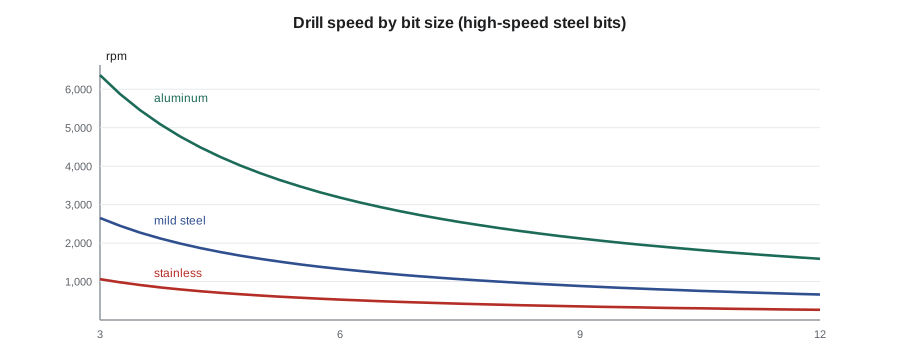
A 3 mm bit in mild steel runs at about 2,700 rpm, but a 12 mm bit in stainless steel should turn at only about 270 rpm. Running a large bit fast in stainless glazes the hole and ruins the bit within seconds.
Power shears, nibblers and electric snips
For long cuts in sheet, power cutting tools save hours of hand work. A power shear has a small reciprocating blade that moves against a fixed blade and cuts like a pair of snips that never tire. It leaves a clean edge but curls the waste strip, so it is used on lines where the waste can curl away. A nibbler punches out a series of small crescent-shaped bites with a punch and die and leaves a narrow kerf; it does not distort the sheet on either side, it can turn tight curves and start from a drilled hole in the middle of a sheet, but it throws a shower of tiny sharp crescents that must be swept up and kept away from eyes. Double-cut electric shears remove a narrow strip like double-cut hand snips and are the tool of choice for cutting into finished duct and into corrugated or ribbed panels.
These tools have ratings in thickness, as snips do, and the stainless rating is again much lower. They cut at the head of the tool, close to the hand guiding them, and the cut edge behind them is sharp, so the free hand stays behind the tool and away from the line. They are switched off and unplugged or have their battery removed before blades or punches are changed.
Grinders and saws
The angle grinder is one of the most dangerous tools in a sheet metal shop. It spins an abrasive wheel at very high speed, often 10,000 rpm or more on a 115 mm grinder, and is used with grinding wheels to smooth welds, with thin cut-off wheels to cut steel, and with flap discs to finish surfaces. If a wheel binds in a cut, the grinder can kick back toward the operator, and if a wheel breaks, its fragments leave at the speed of the rim. The rules are strict: the wheel's maximum safe speed must be at least the grinder's speed; the guard stays on and is set between the wheel and the operator; the side handle is used with both hands; the operator stands out of the line of the wheel and never cuts toward the body; a face shield is worn over safety glasses; and sparks are directed away from people and anything that can burn.
A cut-off wheel is never used for grinding with its side, because thin wheels are not made for side loads and can shatter. A wheel that has been dropped is checked and, if in doubt, discarded. The grinder is set down only after the wheel has stopped. Grinding galvanized steel produces zinc fume and dust, so it is done with local exhaust or outdoors, and grinding stainless steel needs wheels kept only for stainless, for the reason Lesson 3 explained.
Reciprocating saws with metal-cutting blades cut through installed duct, hangers and strut during demolition and alterations, such as the old ductwork at Ashgrove. Portable band saws cut strut, threaded rod and pipe cleanly with little noise and few sparks, and many field crews prefer them for cutting hanger rod. Abrasive chop saws cut angle and rod in the shop but throw sparks and produce noise and dust; cold-cutting metal saws with toothed blades are quieter and cleaner.
Batteries, cords and electrical safety
Most portable tools on Keelson's jobs run on lithium-ion batteries. They are powerful and convenient, but they store a lot of energy. A damaged, crushed or overheated battery can catch fire, and lithium-ion fires are hard to put out. Batteries are charged only on the maker's charger, not left charging unattended overnight on site, kept out of hot vehicles in summer, and taken out of service if they are swollen, cracked or have been dropped hard. Spare batteries are not carried loose in a pocket with nails and screws, which can short the terminals.
Corded tools are double-insulated or grounded, and their cords and plugs are checked before each use for cuts, crushed sections and missing ground pins. In Canada, electrical tools must be certified by an accredited body such as CSA or another recognized agency, and provincial rules require ground-fault protection for portable tools in wet locations and on construction sites. Keelson's field crews plug every corded tool into a ground-fault circuit interrupter, which cuts the power within a fraction of a second if current leaks to ground through a person.
Extension cords are rated for the current the tool draws and the length of the run, are kept out of water and away from sharp sheet metal edges that can cut them, and are never run through doorways where a door can pinch them.
Choosing the right tool
| Task | Best tool | Why |
|---|---|---|
| Drive many self-drilling screws in the field | Impact driver with a nut setter | Fast, little wrist reaction |
| Drive screws into thin sheet without stripping | Drill-driver on its clutch | The clutch stops at a set torque |
| Clean round holes of several sizes in thin sheet | Step drill | One bit, little burr |
| Long straight cut, waste can curl | Power shear | Fast and clean |
| Cut-out in the middle of a sheet or a tight curve | Nibbler | No distortion; starts from a drilled hole |
| Cut into finished duct or ribbed panels | Double-cut electric shear | Leaves both edges flat |
| Cut hanger rod and strut in the field | Portable band saw | Clean cut, few sparks |
| Grind a weld or cut steel angle | Angle grinder with the correct wheel and guard | High material removal; strict rules |
Aggie's rule for choosing a tool was the same as for hand tools: the right tool is the one that does the job cleanly with the least risk, not the one closest to hand. Kai's practical test that week was to cut a 300 mm (12 in) round opening in the side of a scrap duct section with a nibbler, drill and set twelve screws with the drill-driver on its clutch, and cut a length of threaded rod with the band saw, with Aggie watching. He passed on the second try. The first time, he held the duct section with one hand while drilling, and Aggie stopped him before the bit broke through.
Maintenance and storage
Power tools are kept clean, with vents free of dust so they do not overheat. Bits, blades and wheels are kept sharp and replaced when worn, because a dull bit or blade makes the tool work harder and the operator push harder, which is when accidents happen. Chucks are tightened with the key or the keyless sleeve and checked before starting. Tools are stored in their cases with batteries removed, and any tool that sparks, smokes, smells hot, has a damaged guard or a cracked housing is tagged out of service and reported. In the shop, Walt kept a log of the grinders and their wheels and inspected every guard monthly.
Fasteners driven by power tools
Most screws in duct work are self-drilling: their pointed tip is shaped like a small drill, so they make their own hole and tap their own thread in one action. The driver turns them at moderate speed with steady pressure until the tip breaks through, then the thread pulls the sheets together. Driving too fast burns the drill tip before it gets through; driving too slow or pushing too lightly lets the tip skate across the surface and scratch it. The right technique is to start square to the sheet, let the tip cut, and slow down as the head seats so the thread does not strip the thin metal. Lesson 11 covers how screws are chosen.
Battery-powered rivet tools set blind rivets quickly, and pneumatic and hydraulic tools set larger ones in the shop. Powder-actuated tools, which fire a fastener into concrete or steel with a cartridge, are used by field crews to fix hanger anchors and track, but only by workers trained and certified on the specific tool, because they are in effect a firearm. Kai would not use one in his first year.
Working with power tools overhead and on ladders
In the field, much drilling and screw driving is done overhead, from ladders and lifts. The tool's reaction, especially when a large bit grabs, can twist a worker off balance, and chips and swarf fall into the face. Field crews wear safety glasses with a good seal and often a face shield for overhead drilling, keep both feet and a stable stance on the platform, use a tool lanyard where dropped tools would endanger people below, and choose smaller bits and step drills to reduce the reaction. A worker on a ladder never reaches out past the rails to drill; the ladder is moved instead. SMW-310 covers working at heights in detail.
Kai noticed that the journeypersons on loan days did much of their drilling at waist height, before the duct went up: they pre-drilled hanger holes and connection holes on the ground and set the duct afterward. "Every hole you drill on the floor is a hole you don't drill over your head," Sean told him.
Common mistakes
MistakeHolding a small piece by hand while drilling it.
InsteadClamp it or hold it in a vise; a grabbing bit can spin the part.
MistakeRunning large bits fast in stainless steel.
InsteadUse slow speed, firm pressure, cutting fluid and cobalt bits; speed falls as diameter grows.
MistakeRemoving the guard from an angle grinder to fit a larger wheel.
InsteadNever remove the guard or use a wheel rated below the grinder's speed.
MistakeGrinding with the side of a thin cut-off wheel.
InsteadCut-off wheels are for cutting only; use a grinding wheel or flap disc for grinding.
MistakeLeaving damaged lithium-ion batteries in service.
InsteadTake swollen, cracked or dropped batteries out of service; they can catch fire.
Summary and key terms
- Drill-drivers have clutches that prevent stripping; impact drivers drive screws quickly but have no clutch.
- Centre punch, clamp, back up and ease off at breakthrough when drilling sheet metal.
- Drill speed is set by cutting speed and bit diameter; stainless steel needs slow speeds and cobalt bits.
- Power shears, nibblers and double-cut shears make long or awkward cuts; each has a thickness rating.
- Angle grinders demand correct wheels, guards, two hands, face protection and spark control.
- Batteries, cords and ground-fault protection are part of power tool safety.
- Clutch
- A drill-driver setting that slips at a chosen torque to avoid stripping screws.
- Impact driver
- A driver that adds rotary hammer blows, used for fast screw driving.
- Step drill
- A cone-shaped bit with steps of increasing diameter, used in thin sheet.
- Nibbler
- A power tool that cuts by punching out a series of small bites.
- Kickback
- A sudden reaction of a tool toward the operator when a wheel or blade binds.
- Ground-fault circuit interrupter
- A device that cuts power quickly when current leaks to ground.
Practice problems
Work each problem on paper first, then reveal the answer to check.
At what speed should a 10 mm bit drill mild steel at a cutting speed of 25 m/min?
Show answer
1,000 × 25 ÷ (π × 10) ≈ 800 rpm.
Which tool cuts a rectangular opening in the middle of a sheet without distorting it?
Show answer
A nibbler, starting from a drilled hole.
Name three rules for using an angle grinder.
Show answer
Wheel rated for the grinder's speed; guard on and positioned; both hands and a face shield over safety glasses.
What should be done with a swollen lithium-ion battery?
Show answer
Take it out of service and dispose of it as the maker directs.
Lesson quiz · 5 questions
Score 60% or more to complete this lesson.
Create a free account to save your progress, take quizzes and earn a certificate.