
RCDD-114 · Lesson 2 of 12 · 18 min
Cellular coverage and distributed antenna systems
▶ Video coming soon A video version of this lesson is on the way.
The clinic manager at Harbourview has a complaint before the building is even finished. Her staff toured the second-floor shell last week, and nobody's phone worked in the imaging wing or the basement parking. 'Our doctors use their phones for everything,' she tells Roz. 'Paging, secure messaging, calls to the hospital. If phones do not work in here, the building does not work.' Roz nods and turns to Daniel. 'Wi-Fi will not fix this. Phones need cellular coverage from the carriers, and the carriers only bring it inside when someone builds a system for it. That system is a distributed antenna system, and we need to plan space, pathways and power for one now.'
Cellular service is provided by licensed mobile network operators, often called carriers, from outdoor towers and rooftop sites. Their signals enter buildings through windows and walls. Modern construction is very good at stopping them: low-emissivity glass with metal coatings, foil-faced insulation, concrete, steel framing and below-grade levels can each remove tens of decibels. The result is that many large buildings have poor or no cellular coverage inside, even when service outside is excellent. An in-building system brings carrier signals inside and distributes them through antennas spread across the building.
What a distributed antenna system is
A distributed antenna system, or DAS, is a network of antennas connected to a common signal source that provides radio coverage throughout a building or campus. The signal source might be an off-air donor antenna on the roof that picks up a carrier's outdoor signal, or a base station installed in the building and connected to the carrier's network. The distribution network carries the signals from the source to antennas on each floor, usually in ceilings, using coaxial cable, fibre or balanced cabling depending on the architecture.
A DAS differs from a wireless LAN in several ways. It carries licensed carrier frequencies, so the carriers must approve and often control it. It usually serves several carriers and many frequency bands at once. Its antennas are passive or low-power radiating elements rather than access points with their own network intelligence. And its design is governed by carrier requirements and radio regulations rather than by the building owner's network team alone. The RCDD rarely designs the radio frequency aspects of a DAS, but must provide the infrastructure it needs and coordinate it with everything else.
Passive, active and hybrid systems
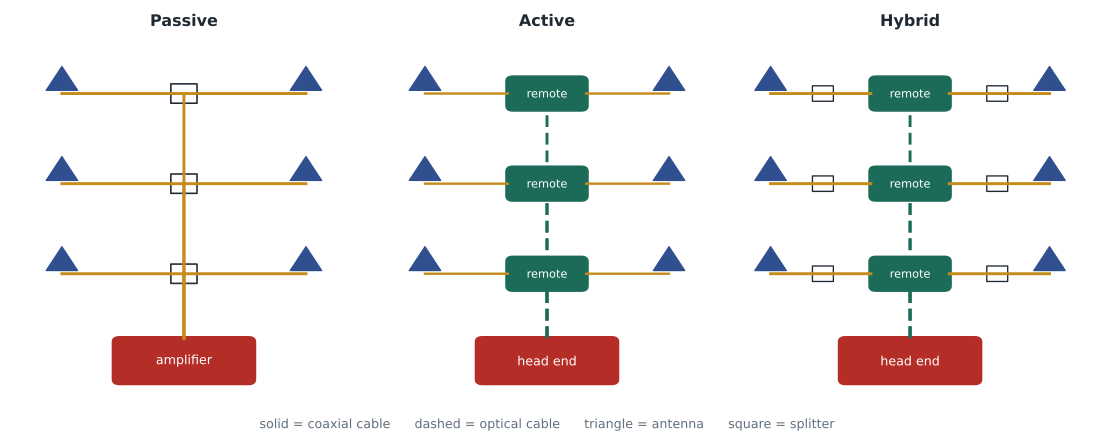
A passive DAS uses coaxial cable, splitters, couplers and antennas, with no powered equipment beyond the signal source and perhaps one amplifier. Passive systems are simple and need no power on each floor, but every splitter and every metre of coaxial cable reduces the signal. They suit small and medium buildings and are common for single-carrier coverage or public safety systems.
An active DAS converts the radio signals at a head end into optical signals that travel over fibre to remote units on each floor or zone. The remote units convert the signals back to radio frequency and drive nearby antennas through short coaxial runs. Active systems can serve large buildings and campuses with consistent performance and can be monitored remotely, but each remote unit needs power, space and often backup power. Some newer systems carry the signals over balanced cabling to remote radio units powered by PoE, which lets them share the building's structured cabling infrastructure.
A hybrid DAS uses fibre to carry signals between the head end and each floor, then passive coaxial distribution within the floor. It combines the long reach of fibre with the simplicity of passive distribution where distances are short. Many mid-sized commercial buildings, including the design Roz expects for Harbourview, use a hybrid approach.
| Architecture | Main media | Strengths | Infrastructure needs |
|---|---|---|---|
| Passive | Coaxial cable, splitters, couplers | Simple, no power on floors | Large coax pathways; loss limits reach |
| Active | Fibre to remote units; short coax to antennas | Scales to large buildings and campuses; monitored | Power, space and backup at each remote unit; singlemode fibre |
| Hybrid | Fibre between floors, coax on each floor | Balances reach and simplicity | Fibre riser plus coax pathways on each floor |
| Balanced-cable based | Category 6A to PoE-powered radio units | Shares structured cabling; easy to expand | Extra horizontal runs and PoE budget |
Signal sources: off-air and base station
An off-air DAS uses a donor antenna, usually on the roof, aimed at a carrier's nearest site. A bi-directional amplifier, sometimes called a signal booster, raises the received signal and feeds it into the distribution network. It also amplifies signals from phones inside the building on their way back out. Off-air systems are relatively inexpensive but can only distribute the capacity of the outdoor site they listen to, and they must be designed carefully so that they do not feed back on themselves or interfere with the carrier's network. Regulators require that boosters meet technical rules and that carriers consent to their use on licensed frequencies.
A base station DAS uses a small cell or full base station installed in the building, connected to the carrier's core network by fibre. It adds real capacity rather than just repeating outdoor signals, which matters in stadiums, hospitals, airports and large offices. Base station equipment needs a secure equipment room with power, cooling, backup power and fibre connections to the carriers. Many building owners now use a neutral host model, in which a third party builds and operates one DAS shared by several carriers, so that the building has one system instead of three or four.
Radio frequency budget through a passive network
Because a passive DAS loses signal at every splitter and along every cable, the designer keeps a budget from the source to each antenna. The budget starts with the power the amplifier delivers into the cable, subtracts cable loss and the loss of each splitter or coupler, and arrives at the power fed to each antenna. Antenna gain and the path to the user then decide the signal a phone will see. An ideal two-way splitter divides power in half, which is 3 dB, but real splitters lose a little more, typically around 3.3 to 3.5 dB. A three-way splitter loses close to 5 dB on each output.
Worked problem
A passive floor run
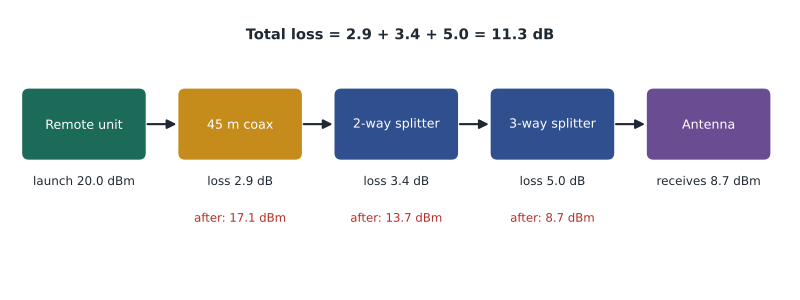
A hybrid DAS remote unit on the third floor delivers 20 dBm per band into a coaxial cable. The run to the farthest antenna is 45 m of cable rated at 6.5 dB per 100 m at the band of interest, and it passes through one two-way splitter (3.4 dB) and one three-way splitter (5.0 dB). What power reaches the antenna?
Show solution
- Cable loss: 45 × 6.5 ÷ 100 ≈ 2.9 dB.
- Splitter losses: 3.4 + 5.0 = 8.4 dB.
- Total loss: 2.9 + 8.4 = 11.3 dB.
- Power at the antenna: 20 − 11.3 = 8.7 dBm.
Answer: About 8.7 dBm per band at the antenna. The splitters cost almost three times as much signal as the cable, which is typical of passive distribution.
Budgets like this show why passive systems run out of reach in large buildings and why active and hybrid designs place remote units close to the antennas they serve. They also show that the coaxial cable grade matters. Thicker cables lose less per metre but are harder to route and need larger bend radii, so the DAS designer and the ICT designer must agree on pathways early.
Infrastructure the RCDD must provide
Whatever the architecture, a DAS needs things from the building that are much easier to provide during design than after construction. The list Roz gives Daniel for Harbourview includes the following.
- A head end or equipment room with space for carrier base stations or a bi-directional amplifier, racks, power, cooling and backup power, plus room for the carriers' fibre to enter.
- Roof access and a mounting location for donor antennas with a clear view toward carrier sites, plus a protected pathway from the roof to the head end and proper bonding of the antenna and its cable at the entrance to the building.
- Riser pathways for singlemode fibre or coaxial cable between floors, sized with spare capacity for additional carriers.
- Space on each floor for remote units, usually in or near the telecommunications room, with power and, if required, backup power.
- Horizontal pathways in ceilings for coaxial cable or balanced cabling to antenna locations, kept clear of sources of interference and respecting cable bend radius limits.
- Coordination with ceiling layouts, lighting and other services so that antennas can be mounted where the radio design needs them.
Daniel notices that several of these items overlap with spaces and pathways he has already designed. The riser sleeves, for example, were sized for ICT fibre and copper but not for coaxial cable or extra fibre for a DAS. He adds two sleeves per floor and records the assumption in the design basis so that the electrical engineer, Priya Raman, can confirm the firestopping details.
Carriers, regulations and ownership
Cellular systems are licensed. In Canada, Innovation, Science and Economic Development Canada (ISED) sets the technical rules for devices that transmit on licensed frequencies, including signal boosters. Carriers hold the licences and normally must consent to an in-building system that repeats their signals, and they often have their own design and acceptance requirements. A building owner who installs a booster without carrier agreement may cause interference to the carrier's network and may be required to shut the system down. For this reason DAS projects usually start with carrier engagement, which can take many months, and the infrastructure plan must allow for carriers who join later.
Ownership models vary. Some owners pay for a DAS as a building amenity, others lease space to a neutral host provider who recovers costs from carriers, and in some large venues carriers build and own their own systems. The RCDD should identify early which model applies, because it affects who designs the radio system, who approves it, who pays for the infrastructure and who maintains it. In the Harbourview project, the owner has chosen a neutral host provider for cellular service and a separate system for public safety radio, which is the subject of the next lesson.
When Wi-Fi calling is enough and when it is not
Some owners ask whether Wi-Fi calling on phones removes the need for a DAS. Wi-Fi calling can carry voice and messages over the building's wireless LAN when the phone and carrier support it, and it can be a reasonable solution for small offices with good Wi-Fi. It is not a substitute for cellular coverage in buildings where visitors use many different carriers and devices, where phones must hand over smoothly between indoors and outdoors, or where staff depend on cellular service for safety. Many hospitals require cellular coverage throughout the building for exactly these reasons. Wi-Fi calling also depends on the wireless LAN, so it fails when the LAN does.
Private cellular networks add another option. In some industrial sites, campuses and hospitals, owners deploy their own cellular network in shared or lightly licensed spectrum, where national spectrum rules allow it. Private networks use small cells connected over fibre or balanced cabling, often powered by PoE, and their infrastructure looks much like a wireless LAN. The RCDD treats them the same way: cabling to each radio location, power, switch capacity and space for the core equipment.
Common mistakes
MistakeAssuming the wireless LAN provides phone coverage.
InsteadWi-Fi and cellular are separate systems. Cellular coverage indoors needs a DAS, small cells or carrier equipment unless outdoor signals already penetrate well.
MistakeInstalling a booster without carrier involvement.
InsteadCarriers hold the licences and must normally consent. Uncoordinated boosters can interfere with the carrier network.
MistakeTreating coaxial cable like balanced cabling in pathway sizing.
InsteadDAS coax can be thick with large bend radii. Size pathways and bends for the cable the DAS designer specifies.
MistakeForgetting power and backup at remote units.
InsteadActive and hybrid systems need power at each remote unit, and many owners require backup power so that phones work during an outage.
Summary and key terms
- Modern construction blocks outdoor cellular signals, so many buildings need an in-building system to provide carrier coverage.
- A DAS distributes radio signals from a donor antenna or in-building base station to antennas throughout a building.
- Passive systems use coax and splitters; active systems use fibre to powered remote units; hybrid systems combine both.
- Each splitter and length of coax reduces signal, so passive budgets limit reach.
- The RCDD provides head end space, roof access, riser and horizontal pathways, power and coordination, while carriers and regulators govern the radio system.
- Distributed antenna system (DAS)
- A network of antennas fed from a common source to provide radio coverage throughout a building or campus.
- Donor antenna
- An outdoor antenna that receives a carrier signal for an off-air DAS.
- Bi-directional amplifier
- A device that amplifies signals in both directions between a donor antenna and the distribution network.
- Remote unit
- Powered equipment in an active DAS that converts optical signals to radio frequency for nearby antennas.
- Neutral host
- A third party that builds and operates one DAS shared by several carriers.
- Small cell
- A low-power base station that adds cellular capacity in a limited area.
Practice problems
Work each problem on paper first, then reveal the answer to check.
A two-way splitter loses 3.4 dB and a cable run loses 2.6 dB. What is the total loss?
Show answer
6.0 dB.
Why does a base station DAS add capacity while an off-air DAS does not?
Show answer
A base station connects to the carrier core and creates new capacity; an off-air system only repeats the capacity of the outdoor site.
Name three infrastructure items a DAS needs from the building.
Show answer
Head end space with power and cooling, riser pathways for fibre or coax, and space and power for remote units on each floor.
Lesson quiz · 5 questions
Score 60% or more to complete this lesson.
Create a free account to save your progress, take quizzes and earn a certificate.