
RCDD-101 · Lesson 8 of 12 · 23 min
Codes and authorities having jurisdiction
▶ Video coming soon A video version of this lesson is on the way.
Two weeks after the owner's standards arrive, Daniel goes with Roz to a meeting at Thunder Bay city hall with the building official and an electrical inspector. The agenda is the Harbourview Centre's fire separations, plenum spaces and the service entrance. On the way, Roz explains what she wants him to watch for. 'Standards tell you what good looks like,' she says. 'Codes tell you what's legal. And the inspector tells you what the code means on this job. You don't argue with the inspector in the meeting. You come prepared so you don't have to.' This lesson explains how codes differ from standards, how they become law, who enforces them and what an ICT designer must know about the codes that apply to communications infrastructure.
This lesson cites codes by number and subject only and describes them in general terms. Code editions and local amendments change, and the edition in force is set by each jurisdiction. Always confirm which code edition and amendments apply to a project.
Codes, standards and the law
A code is a set of minimum requirements, usually for safety, that a government has adopted into law. Model codes are written by bodies such as NFPA, the International Code Council, CSA Group and the National Research Council of Canada, and then adopted, often with amendments, by provinces, states or municipalities. Once adopted, a code is enforceable: work that does not comply can be refused a permit, failed at inspection or ordered removed.
Codes focus on safety rather than performance. An electrical code cares that communications cables do not spread fire through a plenum, that they are separated from power conductors, that they are protected against lightning and power contact at the building entrance and that their metallic parts are bonded. It generally does not care whether a cabling link supports 10 gigabit Ethernet. Performance is the domain of standards and specifications. A design that meets every standard but violates the code cannot be built; a design that meets the code but ignores the standards can be built but may not work.
| Document | Who writes it | How it becomes mandatory | Main concern |
|---|---|---|---|
| Model code | Code bodies such as NFPA, ICC, CSA Group, NRC | Adopted into law by a jurisdiction | Minimum safety |
| Adopted code | The jurisdiction, from a model code plus amendments | It is law | Minimum safety, locally adjusted |
| Standard | Standards developers such as TIA, ISO/IEC, CSA | Referenced by a code, contract or owner | Performance, interoperability, good practice |
| Reference manual | Associations such as BICSI | Not mandatory unless referenced | Explanation and good practice |
| Specification | The designer, for a project | Part of the contract | What this project must provide |
The electrical code and communications systems
In Canada, the Canadian Electrical Code, Part I, published by CSA Group as CSA C22.1, is the model electrical code. Each province and territory adopts it, usually with amendments; in Ontario, for example, it is adopted as the Ontario Electrical Safety Code and enforced by the Electrical Safety Authority. Communications systems are covered mainly in Section 60, with related rules for optical fibre cables, community antenna distribution and radio systems in other sections, and general bonding rules in Section 10. These sections address cable types and their fire ratings, installation in different building spaces, separation from power conductors, protection at the building entrance and bonding of communications systems.
Several code concepts recur across both countries. Cables are listed and marked according to their fire performance, and the code says which ratings may be used in which spaces, with the strictest ratings for air-handling spaces such as plenums and for vertical risers that could carry fire between floors. Abandoned cable that is no longer in use may have to be removed. Communications cables must be kept apart from power conductors unless barriers or other measures are used. At the building entrance, metallic cables exposed to lightning or accidental contact with power lines need primary protectors, and those protectors must be bonded to the building's grounding electrode system with conductors of adequate size and routed as directly as practical.
Building and fire codes
Building codes govern the construction of the building itself, and they matter to ICT design wherever communications infrastructure interacts with structure, fire separations and life safety. In Canada, the National Building Code of Canada, published by the National Research Council, is adopted by most provinces with amendments, and Ontario has its own Ontario Building Code. Fire codes govern the ongoing safety of buildings in use.
For an ICT designer, the most important building code issue is fire separation. When a pathway penetrates a fire-rated wall or floor, the opening must be sealed with a tested and listed firestop system that restores the rating. Canadian firestop systems are typically tested to CAN/ULC-S115. The designer must show penetrations clearly on drawings, specify firestop systems suitable for the cables and pathways used and leave room in sleeves for future cables to be added without destroying the seal. Building codes also affect accessible mounting heights for devices, the use of ceiling and floor spaces, emergency communications and the rooms that house ICT equipment.
Authorities having jurisdiction
The authority having jurisdiction, often shortened to AHJ, is the organization, office or individual responsible for enforcing a code or approving equipment, materials, installations or procedures. In practice, there may be several AHJs on one project. The building official enforces the building code. The electrical inspector enforces the electrical code. The fire marshal or fire department enforces the fire code and approves fire alarm and emergency communications systems. Other agencies may regulate healthcare facilities, elevators or radio systems. An insurer can act as an AHJ for its own requirements, and in some settings the owner's own standards office plays a similar role.
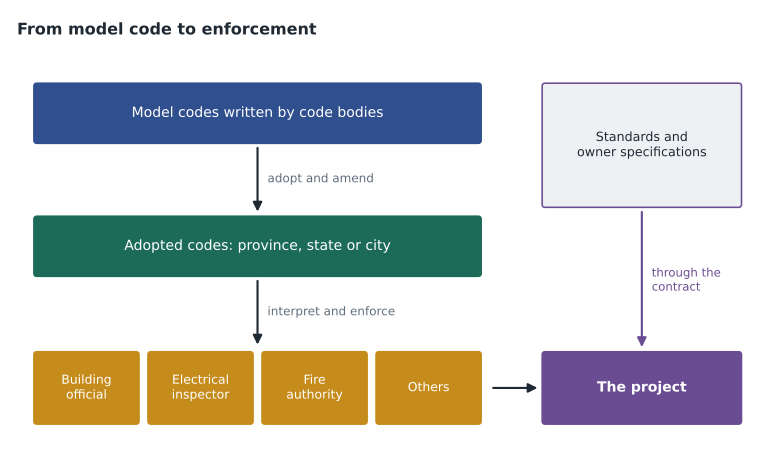
In Ontario, electrical work is inspected by the Electrical Safety Authority, while building permits and inspections are handled by the municipal building department. Other provinces have their own arrangements, sometimes with provincial inspectors and sometimes with municipal ones. The designer's first job is to find out who the AHJs are for each part of the project and which code editions and amendments they enforce.
The AHJ's interpretation of the code governs the project. Codes are written in general terms, and inspectors must interpret them for specific situations. When the interpretation matters to the design, the designer should seek it early, document it and, where possible, get it in writing. An interpretation that surprises everyone at final inspection can cost weeks and thousands of dollars.
A practical tip: keep a project code log. For each AHJ, record the name of the office and contact, the code editions and amendments in force, any interpretations given and the date. When questions arise during construction, the log saves time and settles disputes about what was agreed.
Codes also change on their own cycles. The Canadian Electrical Code is revised every three years, and provinces adopt each edition on their own schedules. A designer who works in several jurisdictions may be applying different editions on different projects at the same time, which is another reason to record the edition in force for each project at the start.
Worked problem
Preparing for the AHJ meeting
At the Harbourview meeting, the agenda includes the use of the second-floor ceiling as a return air plenum, the riser sleeves through the concrete floors and the service entrance from the street. What should Daniel have ready?
Show solution
- For the plenum: confirm from the mechanical engineer which ceiling spaces are air-handling, and list the cable types and listings that will run there.
- For the risers: show the number and size of sleeves through each rated floor, the firestop system intended for each and the spare capacity left for growth.
- For the service entrance: show the route of the provider's cables, the location of primary protectors and the bonding path to the building grounding electrode system.
- Bring the code sections he believes apply, by number, and questions for any point where the interpretation is unclear.
Answer: Daniel brings marked-up drawings, a list of cable listings by space, the firestop approach for each penetration and the entrance protection and bonding details, so that the officials can confirm or correct the approach before the design is finished.
Codes and the TDMM
The TDMM explains code requirements that affect ICT design, mostly in general terms, and points to the relevant codes in Canada, the United States and other countries. On the exam, questions about codes focus on widely applicable principles, such as cable fire ratings by space, separation from power, entrance protection and bonding, rather than on the amendments of one jurisdiction. In practice, an RCDD must go further and confirm the exact requirements locally.
A recurring exam theme is the order of precedence. Codes set the minimum; nothing in a standard, a specification or a manufacturer's instruction can reduce a code requirement. Standards and specifications can add requirements above the code minimum. When the TDMM, a standard and the code seem to conflict, the code governs safety, the contract governs performance, and the designer satisfies both.
Permits and inspections
Most ICT work in new buildings and major renovations requires permits, either as part of the electrical permit or as a separate low-voltage permit, depending on the jurisdiction. Inspections typically occur before walls and ceilings are closed, so that inspectors can see the cable types, supports, separation, firestopping and bonding, and again at completion. A designer helps by making the drawings clear about what goes where, by specifying listed products and tested firestop systems and by requiring the contractor to keep inspection records.
In Canada, electrical contractors and, in some provinces, communications installers must be licensed or registered, and some provinces allow certain low-voltage work without an electrical licence. Rules differ by province. The designer usually does not hold these licences, but should know whether the work requires a licensed contractor so that the bid documents say so.
Thinking like a designer about codes
The best designers treat codes as a design input from the first day, not as a hurdle at the end. They identify the AHJs, confirm editions, design pathways and spaces that make compliance straightforward and document their assumptions. They also understand that the code is a minimum. A design that merely complies may still be unsafe in practice if, for example, it leaves no room for future cables and invites installers to break firestop seals later. Designing for compliance throughout the building's life, not just on the day of inspection, is part of the RCDD's responsibility.
On the way back from the meeting, Daniel notes that the electrical inspector asked only two questions, both about the service entrance bonding, and that the building official spent twenty minutes on the riser sleeves. 'That tells you what they've seen go wrong before,' Roz says. 'Write it down. Next time you'll design for it before they ask.'
Common mistakes
MistakeTreating a standard as if it were a code.
InsteadCodes are law; standards apply through codes, contracts or owners.
MistakeAssuming the model code edition is the one in force.
InsteadConfirm the adopted edition and amendments with each AHJ.
MistakeLeaving code questions to final inspection.
InsteadSeek interpretations early and document them.
MistakeAllowing a specification to reduce a code requirement.
InsteadCodes set minimums that nothing else can lower.
MistakeIgnoring future firestop integrity.
InsteadProvide spare sleeve capacity and resealable systems so later work does not break seals.
Summary and key terms
- Codes are minimum safety requirements adopted into law; standards and specifications add performance requirements.
- The Canadian Electrical Code (CSA C22.1), adopted provincially, covers communications mainly in Section 60.
- Building codes govern fire separations, and penetrations need tested, listed firestop systems.
- The authority having jurisdiction enforces and interprets the code for a project; there may be several.
- Codes take precedence for safety; contracts govern performance; the design must satisfy both.
- Good designers treat codes as a design input from the start and design for compliance over the building's life.
- Code
- Minimum requirements adopted into law and enforced by an authority.
- Model code
- A code written by a code body for adoption by governments.
- Authority having jurisdiction (AHJ)
- The organization or person responsible for enforcing a code or approving installations.
- Plenum
- A space used for air handling, where cables need the strictest fire ratings.
- Riser
- A vertical pathway between floors, often through fire-rated floors.
- Firestop system
- A tested and listed assembly that restores the fire rating of a penetrated barrier.
- Primary protector
- A device at the building entrance that protects against lightning and power contact on metallic cables.
- Listed
- Tested and certified by a recognized laboratory for a specific use.
Practice problems
Work each problem on paper first, then reveal the answer to check.
What is the main concern of an electrical code with respect to communications cabling?
Show answer
Safety: fire spread, separation from power, entrance protection and bonding.
Who interprets the code for a specific project?
Show answer
The authority having jurisdiction.
Can a specification reduce a code requirement?
Show answer
No; codes set minimums.
Where are the strictest cable fire ratings usually required?
Show answer
In air-handling spaces such as plenums, and in risers.
What must happen when a pathway penetrates a fire-rated floor?
Show answer
It must be sealed with a tested and listed firestop system.
Name three possible AHJs on a project.
Show answer
Building official, electrical inspector, fire authority, insurer, healthcare regulator.
Why should code interpretations be sought early?
Show answer
To avoid costly surprises at inspection.
What does a primary protector do?
Show answer
Protects against lightning and accidental power contact on metallic cables entering a building.
Lesson quiz · 5 questions
Score 60% or more to complete this lesson.
Create a free account to save your progress, take quizzes and earn a certificate.