
RCDD-101 · Lesson 6 of 12 · 23 min
How the TDMM is organized and how to navigate it
▶ Video coming soon A video version of this lesson is on the way.
Daniel's copy of the TDMM arrives, and his first reaction is to put it on the shelf and look at it. It is a lot of manual. Roz takes it down and opens it to the table of contents. 'You won't read this cover to cover in order,' she says. 'Nobody does. You'll read it the way a designer works: start with the principles, then follow the infrastructure from the street to the outlet, then add the systems that ride on top, then the process that turns it into a building. Once you see that shape, the manual stops being a wall of pages.' This lesson describes the general organization of the TDMM, how its subject areas relate to the design process and practical ways to navigate it while studying.
This lesson describes the manual's structure in general terms. It does not reproduce BICSI's content, and chapter titles and order differ between editions. Use your own copy of the edition named in the current candidate handbook, and map what follows onto its actual table of contents.
What kind of document the TDMM is
The TDMM is a reference manual, not a textbook and not a standard. It explains principles and good practice across the whole field of ICT distribution design, drawing on the standards and codes discussed in lessons 7 and 8 and on the experience of BICSI's volunteer authors and reviewers. It tends to explain why as well as what: why a pathway should be sized for growth, why a bonding conductor should be as short and straight as practical, why outlets in a classroom differ from those in a hospital room. That makes it valuable long after the exam.
Because it is a reference, its chapters are written to be consulted individually. Each tends to begin with definitions and principles, move through design considerations and options, and end with specific recommendations, often in tables. Cross-references point to related chapters. Appendices and a glossary pull together terms and supporting material, and an index lets you find a topic quickly. Learning to use those navigation aids is part of learning the manual.
The shape of the manual
Although editions differ, the subject matter of the TDMM can be grouped into a handful of broad areas that follow the logic of design. Seeing those groups helps you place every chapter in context.
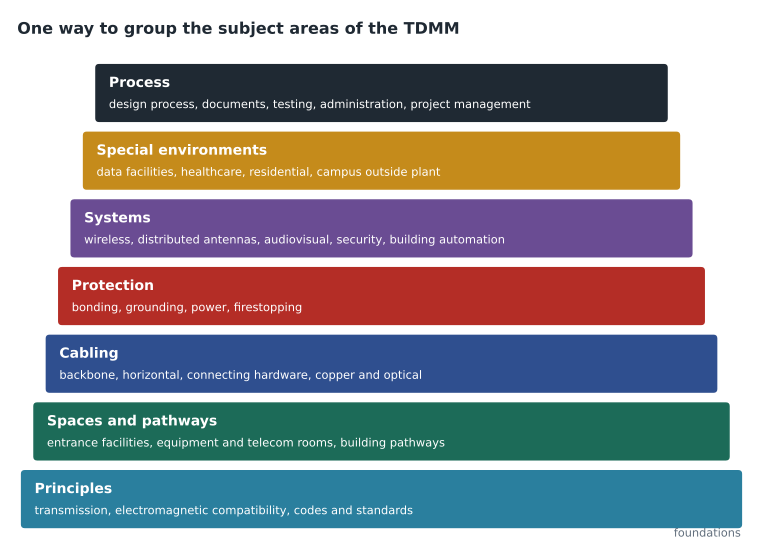
| Area | What it covers | Typical design questions |
|---|---|---|
| Principles | Transmission in copper, fibre and wireless; electromagnetic compatibility; how codes and standards work | Why does this cable category support this application? How far from a power source should this cable run? |
| Spaces and pathways | Entrance facilities, equipment rooms, telecommunications rooms and enclosures; conduit, tray, sleeves and other pathways | How big must the room be? How many sleeves through this floor? |
| Cabling | Backbone and horizontal cabling, media choices, topology, connecting hardware, open office options | Which media and topology meet the owner's needs within the limits? |
| Protection | Bonding and grounding, electrical protection, power for ICT, firestopping | How is this rack bonded? Where do protectors go? Which firestop system fits? |
| Systems | Wireless networks, distributed antenna systems, audiovisual, electronic safety and security, building automation | What does each system need from the infrastructure? |
| Special environments | Data centres, healthcare, education, residential and multi-tenant buildings, campus and outside plant | How do requirements change in this building type? |
| Process | Design process, drawings and specifications, testing, administration and labelling, project management | How is the design documented, built, tested and accepted? |
This program's courses follow a similar grouping. RCDD-110 covers principles of transmission and electromagnetic compatibility. RCDD-111 covers spaces and pathways. RCDD-112 covers backbone and horizontal cabling. RCDD-113 covers bonding, grounding, power and protection. RCDD-114 covers wireless and building systems. RCDD-115 covers data centres, campus and outside plant. RCDD-116 covers testing, administration and design project management. RCDD-160 then reviews everything for the exam.
Following the signal from the street to the desk
A powerful way to understand the manual is to follow a single service through a building, which is how many designers think about a project. Start where the service provider's cable enters the property, at the entrance facility, where it is protected against lightning and power faults and handed off at the demarcation point. Follow the backbone through the equipment room and up the risers to each telecommunications room. From there, follow the horizontal cabling through ceiling or floor pathways to the work area outlet, and on through the patch cord to the device. Along the way, every space needs power, cooling, lighting and bonding; every pathway needs fire protection where it crosses a rated barrier; every cable needs a label and a test result.
Building a personal index
Many candidates find it useful to keep a personal index alongside the manual: a short document, one or two pages per subject area, that lists the limits, rules of thumb and definitions they most need, each with a note of where to find it. Building the index is itself a form of active study, because it forces you to decide what matters and to put it in your own words. Reviewing it in the last weeks before the exam is far faster than rereading chapters.
A good personal index entry has three parts: the fact, the reason and the location. For example, an entry on horizontal cabling might record the maximum permanent link length, the reason it exists in terms of the channel performance the standards guarantee, and the chapter and table where the TDMM discusses it. An entry on telecommunications rooms might record the principle that rooms should stack vertically, the reason in terms of backbone pathways, and where the manual explains it. Facts without reasons are easy to forget and easy to misapply; reasons without facts cannot answer a calculation item.
Daniel starts his index on a single spreadsheet with one tab per subject area. By the end of his foundation phase it has about four hundred entries, and he notices that the act of writing the reason column has fixed many of them in his memory before he ever reviews them.
Edition changes
When a new edition of the TDMM appears, BICSI typically revises the RCDD exam to match after a transition period, and the candidate handbook names the edition in use. If you began studying from one edition and a new one is released before your exam, check the handbook immediately to see which edition your exam will use. Changes between editions can include new chapters on emerging topics, reorganized material and updated references to new standards, so a candidate who studies the wrong edition may be well prepared for an exam that no longer exists.
Worked problem
Mapping one connection to the manual
At the Harbourview Centre, a nurse's workstation in a second-floor clinic room connects to a cloud application. Daniel lists every part of the TDMM's subject matter he would consult to design that connection end to end.
Show solution
- Principles: cabling performance needed for the workstation and any power over Ethernet devices nearby; separation from medical equipment and power.
- Spaces: the entrance facility, the equipment room in the basement and the second-floor telecommunications room.
- Pathways: the service entrance conduits, the riser sleeves, the cable tray above the corridor and the box at the outlet.
- Cabling: the backbone fibre and copper from the equipment room, the horizontal copper link and the outlet hardware.
- Protection: protectors at the entrance, bonding of racks and the telecommunications bonding backbone, firestopping at each floor penetration.
- Special environment: healthcare requirements for outlet density and room types.
- Process: drawings, specification sections, labelling, testing and acceptance.
Answer: One ordinary connection touches every major area of the manual, which is why the exam treats the TDMM as a whole rather than as separate topics.
Navigating the manual efficiently
Study time is limited, so learn to find things quickly. The table of contents tells you where a subject lives. The index takes you to specific terms, often in several chapters. The glossary gives precise definitions, which matter on the exam because distractors often use a correct term with the wrong meaning. Cross-references inside chapters show how topics connect, and following them is one of the best ways to build the integrated understanding the exam rewards.
Many candidates find it helpful to mark their copy. Coloured tabs for each subject area, a highlighter for limits and requirements, and notes in the margin linking to related chapters make the manual faster to use and easier to review. If you prefer a digital edition, learn its search and bookmarking features. Either way, the aim is not decoration but speed: you want to be able to answer a practice question and then confirm the answer in the manual in under a minute.
| Navigation aid | Use it to |
|---|---|
| Table of contents | Find the chapter for a subject and see how the chapter is structured |
| Index | Find every place a specific term appears |
| Glossary | Check the exact meaning of a term |
| Cross-references | Follow connections between subjects, such as rooms and bonding |
| Tables and figures | Review limits, sizing guidance and design options at a glance |
| Your own tabs and notes | Return to key requirements quickly during study |
Reading a chapter actively
Passive reading of a large reference manual is slow and forgettable. Active reading turns each chapter into usable knowledge. Before reading a chapter, skim its headings and tables and ask what design decisions it supports. While reading, write down every requirement or limit in your own words, and note why it exists. After reading, close the book and explain the chapter's main points aloud or in writing, as if to a colleague, then check what you missed. Finally, answer practice questions on the chapter and confirm each answer in the text.
Roz suggests a further habit to Daniel: every time he reads a limit, he should picture where he has seen it applied, or ignored, on a real job. 'You've pulled more cable than most candidates,' she says. 'Use that. When the manual says leave slack in a certain place, think of the job where somebody didn't, and what it cost to fix.' Linking the manual to experience is one of the strongest memory aids there is.
Words that matter
Reference manuals and standards use certain words with precise meanings, and the TDMM is no exception. Standards typically distinguish between mandatory requirements, often expressed with shall, and recommendations, often expressed with should. Permissive statements use may. Codes have their own conventions. When the TDMM reports what a standard requires, notice whether the original is a requirement or a recommendation. Exam items sometimes turn on that difference: an option describing a recommendation as a requirement may be the wrong one.
| Word | Usual meaning in standards |
|---|---|
| Shall | A mandatory requirement for compliance |
| Should | A recommendation; good practice but not required for compliance |
| May | Permitted; an allowed option |
| Will | Often used for statements of fact or intention rather than requirements |
Using the manual after the exam
The TDMM is not just an exam book. Designers keep it on the desk and consult it throughout their careers, along with the standards and codes it references. Each new edition updates the content as standards and technology change, and RCDDs often buy each edition to stay current, which also supports the continuing education described in lesson 12. If you build good navigation habits now, the manual will serve you on every project.
Common mistakes
MistakeReading the manual cover to cover in page order.
InsteadRead by subject area and follow the design logic from principles to process.
MistakeStudying a chapter without asking what decisions it supports.
InsteadPreview headings and tables and link each to a design question.
MistakeIgnoring the glossary.
InsteadExact definitions matter because distractors often misuse correct terms.
MistakeTreating every statement as a requirement.
InsteadDistinguish shall, should and may.
MistakeTreating the manual as a standard.
InsteadThe TDMM is a reference manual that reports and explains standards and codes.
Summary and key terms
- The TDMM is a large reference manual explaining principles and practice across ICT distribution design.
- Its subject matter can be grouped into principles, spaces and pathways, cabling, protection, systems, special environments and process.
- Following a single connection from the entrance facility to the device touches every major area.
- The table of contents, index, glossary and cross-references are essential navigation aids.
- Active reading turns chapters into usable knowledge: preview, note limits and reasons, recall, then test.
- Standards language distinguishes requirements (shall) from recommendations (should) and permissions (may).
- Reference manual
- A document consulted by topic that explains principles and practice.
- Entrance facility
- The space where service provider and campus cabling enter a building.
- Demarcation point
- The point where the service provider's responsibility ends and the owner's begins.
- Riser
- A vertical pathway between floors.
- Work area outlet
- The outlet where horizontal cabling ends and the user's device connects.
- Shall
- Word used in standards for a mandatory requirement.
- Should
- Word used in standards for a recommendation.
- Cross-reference
- A pointer from one part of a document to a related part.
Practice problems
Work each problem on paper first, then reveal the answer to check.
Is the TDMM a standard?
Show answer
No; it is a reference manual that explains standards, codes and practice.
Name four broad subject areas of the TDMM.
Show answer
Any four of principles, spaces and pathways, cabling, protection, systems, special environments and process.
Where does a service provider's cable first enter a building?
Show answer
At the entrance facility.
What does the word shall usually indicate in a standard?
Show answer
A mandatory requirement.
What is the purpose of the glossary?
Show answer
To give the exact meaning of terms.
Name three steps of active reading.
Show answer
Preview, take notes in your own words, recall without the book, then test with questions.
Why link manual content to field experience?
Show answer
It strengthens memory and understanding.
Which course in this program covers bonding and grounding?
Show answer
RCDD-113.
Lesson quiz · 5 questions
Score 60% or more to complete this lesson.
Create a free account to save your progress, take quizzes and earn a certificate.