
RCDD-101 · Lesson 11 of 12 · 23 min
Building a study plan
▶ Video coming soon A video version of this lesson is on the way.
In August, before his application has even gone in, Daniel sits down with Roz to build a study plan. He brings a spreadsheet with every chapter of the TDMM in a column and a start date at the top. Roz looks at it for a minute and then turns the laptop around. 'This is a reading schedule,' she says. 'A study plan has to include the part where you find out what you don't know.' This lesson shows how to build a study plan for the RCDD that fits a working designer's life, uses time efficiently and includes the practice, review and testing that turn reading into knowledge.
How much time to plan for
BICSI's handbook gives a recommended number of study hours with the TDMM, differing by experience: at least 150 hours for a mid-career candidate and at least 125 hours for an advanced one. Those figures are a starting point. Candidates with narrower experience, or whose experience is mostly installation rather than design, often need more. Candidates who have worked across many building types and systems may need less, but should still plan seriously, because the exam covers areas few people meet in daily work.
Turn hours into weeks. A working designer can usually manage six to ten focused hours a week without burning out, for example an hour on four weeknights plus two or three hours at the weekend. At eight hours a week, 150 hours takes about nineteen weeks, or four and a half months. Add time for a preparation course if you take one, for full-length practice exams and for a final review, and a realistic plan for most candidates runs between four and nine months.
Study groups that work
A study group can be the best or the worst part of a plan. The best groups are small, usually three to five people, meet regularly for a fixed time and follow an agenda: each member prepares a topic in advance, explains it to the others in ten or fifteen minutes and brings a few practice questions. Members then work questions together and argue about the answers, always settling disputes by finding the explanation in the TDMM. The worst groups drift into general conversation, rely on one member to do all the preparation or spend their time swapping rumours about the exam.
Daniel's group meets online every second Wednesday for ninety minutes. Each member takes a turn leading, and the leader also writes ten practice questions for the others. Writing questions turns out to be one of the most effective study methods any of them have tried, because a good question requires a clear understanding of exactly what makes the right answer right and the wrong answers wrong.
Expect your plan to change. Some areas will take longer than you estimated, and others will turn out to be easier. A plan that is reviewed and adjusted every two weeks is far more useful than a perfect plan that is followed blindly or abandoned after a month.
Worked problem
Turning hours into a calendar
Daniel expects to need about 180 hours because his design experience is shorter than his installation experience. He can study about 8 hours a week from mid-August, will lose two weeks over the holidays and wants two weeks of final review before an exam in mid-April. Is his schedule realistic?
Show solution
- Weeks from mid-August to mid-April: about 34 weeks.
- Subtract two holiday weeks and two final review weeks: 34 − 2 − 2 = 30 study weeks.
- Hours available in those weeks: 30 × 8 = 240 hours, plus about 20 hours of final review.
- Compare with the 180 hours needed: he has about 60 hours of margin for slow weeks, illness or extra practice.
Answer: The plan is realistic, with roughly a third more time than his estimate. The margin matters: almost every candidate loses some weeks to work deadlines and life.
Start with a diagnostic
Before deciding how to divide the hours, find out where you stand. Take a diagnostic practice test covering the whole outline, or work through a set of practice questions from each major area of the TDMM, and record your results by area. Do it without studying first. The point is not to score well but to see where your knowledge is strong and where it is thin. Daniel's diagnostic shows strong results in cabling, testing and installation-related topics and weak results in bonding calculations, outside plant, audiovisual systems, healthcare facilities and the bid process.
| Area | Daniel's diagnostic | Weight in plan |
|---|---|---|
| Cabling, connecting hardware and testing | Strong | Light review |
| Spaces and pathways | Medium | Standard |
| Transmission and electromagnetic compatibility | Medium | Standard |
| Bonding, grounding and power | Weak | Extra time |
| Wireless, audiovisual, security and building systems | Weak | Extra time |
| Data centres, healthcare, residential and outside plant | Weak | Extra time |
| Design process, documents, bid and construction support | Weak | Extra time |
Weighting the plan
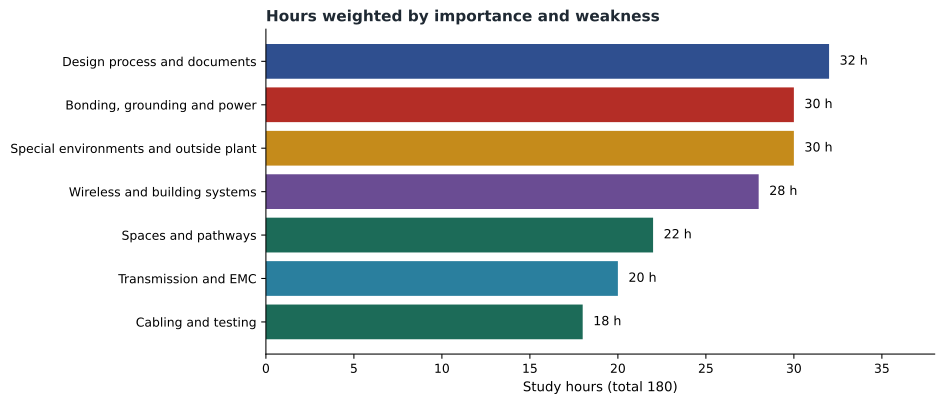
A good plan gives more time to areas that are both heavily weighted on the exam and weak for you, and less to areas you already know well. Because the largest domain, designing ICT solutions, draws on almost every part of the TDMM, the subject areas that feed it deserve the bulk of your time. Smaller domains, such as supporting the bid process, still need dedicated study, especially if, like Daniel, you have never written a specification.
One practical method is to score each area on two scales from one to three, importance and weakness, and multiply them. An area that is very important and very weak scores nine; an area of low importance that you already know scores one. Allocate hours roughly in proportion to the scores, then adjust by judgement. This avoids the common mistake of spending most of your time on subjects you enjoy, which are usually the ones you already know.
Phases of a plan
Most successful plans pass through four phases. The first is foundation: read each subject area of the TDMM actively, as described in lesson 6, and take notes in your own words. The second is application: work practice questions and calculations for each area, confirm answers in the manual, and keep an error log. The third is integration: take mixed practice sets that combine areas, and full-length timed practice exams. The fourth is final review: revisit your notes, error log and weakest areas, and rest before the exam.
| Phase | Share of time | Main activities |
|---|---|---|
| Foundation | About 45 in 100 hours | Active reading by subject area, notes, flash cards for key terms and limits |
| Application | About 30 in 100 hours | Practice questions by area, calculations, error log, confirming answers in the TDMM |
| Integration | About 15 in 100 hours | Mixed sets, two or three full timed practice exams, pacing practice |
| Final review | About 10 in 100 hours | Error log, summary notes, weak areas, rest |
The phases overlap. You do not need to finish reading the whole manual before doing practice questions; in fact, doing questions on each area soon after reading it improves retention. But the balance should shift from reading toward practice as the exam approaches.
Techniques that work
Research on learning gives some clear guidance that applies directly to RCDD preparation. Retrieval practice, which means testing yourself rather than rereading, produces stronger and longer-lasting memory. Spacing, which means returning to a topic several times over weeks rather than studying it once intensively, beats cramming. Interleaving, which means mixing different topics in one session once you know the basics, helps you learn to recognize which principle applies to which situation, exactly the skill the exam tests.
In practice, that means flash cards for terms and key limits, reviewed a few minutes a day; practice questions after every reading session; a weekly mixed set covering everything studied so far; and an error log. The error log is a simple list of every practice question you got wrong, the correct answer, the reason you missed it and where in the TDMM the answer is explained. Reviewing it weekly turns mistakes into the most efficient study material you have.
| Technique | What it means | Example |
|---|---|---|
| Retrieval practice | Recall from memory instead of rereading | Close the book and list the components of the bonding infrastructure |
| Spacing | Return to topics over weeks | Review the fill rules on day 1, day 4, day 11 and day 30 |
| Interleaving | Mix topics within a session | A practice set mixing pathways, bonding and wireless items |
| Error log | Record and analyze every mistake | Note that you confused a recommendation with a requirement |
| Teaching | Explain a topic to someone else | Explain loss budgets to a colleague in five minutes |
Choosing study resources
The TDMM is essential. Beyond it, candidates choose from BICSI's own courses, including its instructor-led design course and self-study test preparation, independent courses and practice question banks, study groups and mentoring. Each has a place. Instructor-led courses give structure and expert explanation but are costly and short. Practice question banks give volume but vary in quality, and none can reproduce the real exam. Study groups give motivation and the chance to explain topics to others. A mentor who is already an RCDD can answer questions and review your reasoning.
Judge any resource by whether it is based on the current TDMM edition, whether its explanations refer you back to the manual, and whether it helps you practise reasoning rather than memorizing answers. Be wary of anything that promises real exam questions; as lesson 10 explained, such material breaches exam confidentiality and is usually inaccurate. Daniel decides to take BICSI's instructor-led course in February, after his foundation phase, and to use one practice question bank plus a study group of three colleagues from other firms that meets online every second week.
Studying while working
Most candidates study while working full time, and the job can be both a help and a hindrance. It helps when you can connect study to real projects. When Daniel reads about telecommunications room sizing, he checks the Harbourview drawings. When he studies firestopping, he asks Tomasz Wiercinski, the cabling foreman, to show him the systems used on site. When he studies the bid process, he asks to sit in on Lakehead Signal's next bid review. Connecting study to work makes it memorable.
Work hinders when deadlines take over. Protect your study time as you would protect a meeting: put it in your calendar, tell colleagues and family when it is, and keep it short and regular rather than long and occasional. If a week is lost, do not try to double the next one; adjust the plan and use your margin. Burnout is a bigger risk to passing than any single difficult topic.
Tracking progress
Review your plan every two weeks. Compare hours studied with the plan, look at practice results by area and update the error log. If an area remains weak after its scheduled time, add a short block for it later rather than pushing on regardless. About six weeks before the exam, take a full-length timed practice exam under realistic conditions; repeat two or three weeks later. Use the results to plan the final review, not to predict your exact score, since practice exams vary in difficulty.
By March, Daniel's practice results in bonding, healthcare and the bid process have risen from weak to medium, and his pacing on full-length practice exams is comfortable. He still finds outside plant calculations slow. He adds two short sessions a week on them and keeps everything else on review. 'That's a study plan,' Roz says. 'It changed because you learned something.'
Common mistakes
MistakeBuilding a reading schedule instead of a study plan.
InsteadInclude diagnostics, practice, error logs, mixed sets and full practice exams.
MistakeSpending most time on favourite topics.
InsteadWeight time by exam importance and personal weakness.
MistakeRereading instead of testing yourself.
InsteadUse retrieval practice, spacing and interleaving.
MistakeTrying to make up lost weeks by doubling hours.
InsteadBuild margin into the plan and adjust calmly.
MistakeRelying on materials that claim to have real exam items.
InsteadUse legitimate resources tied to the current TDMM.
Summary and key terms
- Plan for the study hours BICSI recommends, adjusted for your experience, and convert them into weeks with margin.
- Start with a diagnostic and weight time by importance and weakness.
- Move through foundation, application, integration and final review phases.
- Use retrieval practice, spacing, interleaving and an error log.
- Choose resources based on the current TDMM that teach reasoning.
- Connect study to real projects, protect regular study time and review progress every two weeks.
- Diagnostic test
- An early practice test used to identify strengths and weaknesses.
- Retrieval practice
- Learning by recalling information from memory.
- Spacing
- Spreading study of a topic over time.
- Interleaving
- Mixing different topics within a study session.
- Error log
- A record of practice mistakes, their causes and where the answers are explained.
- Full-length practice exam
- A timed practice test that simulates the real exam's length and pacing.
Practice problems
Work each problem on paper first, then reveal the answer to check.
How many TDMM study hours does the handbook recommend for a mid-career candidate?
Show answer
At least 150 hours.
At 8 hours a week, roughly how many weeks does 160 hours take?
Show answer
About 20 weeks.
Why start with a diagnostic?
Show answer
To find strengths and weaknesses before dividing study time.
Name the four phases of a study plan.
Show answer
Foundation, application, integration and final review.
What is retrieval practice?
Show answer
Testing yourself from memory instead of rereading.
What goes into an error log?
Show answer
The question, the correct answer, why you missed it and where the TDMM explains it.
How often should you review your plan?
Show answer
About every two weeks.
Why are full-length practice exams useful?
Show answer
They build pacing and stamina and reveal weak areas.
Lesson quiz · 5 questions
Score 60% or more to complete this lesson.
Create a free account to save your progress, take quizzes and earn a certificate.