
RCDD-101 · Lesson 12 of 12 · 27 min
After the exam: continuing education and renewal
▶ Video coming soon A video version of this lesson is on the way.
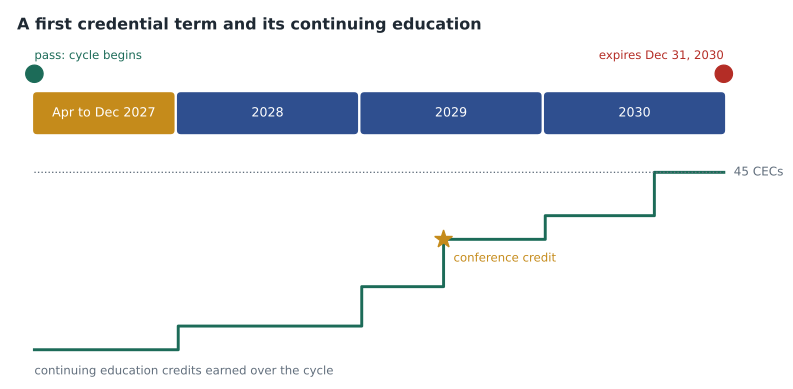
On April 15, 2027, a little after noon, Daniel walks out of the test centre and calls Roz from the parking lot. He has passed. Three days later his electronic certificate arrives, and Roz takes the whole studio to lunch. Over coffee she hands him a sheet of paper with a single line on it: December 31, 2030. 'That's when your first cycle ends,' she says. 'Everything between now and then decides whether you get to keep the letters.' This lesson explains what happens after the exam: when the credential term runs, what continuing education is required, how renewal and its fees work, what happens if you miss a deadline, and the ethical obligations every RCDD accepts.
The rules in this lesson are those in BICSI's current RCDD certification handbook. Renewal requirements and fees change from time to time, so confirm them in the current handbook and in your BICSI account well before your expiry date.
When the credential term runs
Under the current handbook, an RCDD credential is valid for the rest of the calendar year in which you first passed plus three more years, and it always expires on December 31. The handbook's own example is a candidate who passed on September 20, 2021, whose credential expired on December 31, 2024. The certification cycle, which is the period in which continuing education counts, begins on the day you pass.
This rule means that the length of a first cycle depends on when in the year you pass. Someone who passes in January gets nearly four years; someone who passes in December gets just over three. After the first renewal, each cycle runs three years to the next December 31.
Some RCDDs keep a simple running record for each cycle: a spreadsheet with the date, activity, provider, CECs earned and where the certificate is saved. It takes a minute after each course and saves hours at renewal or audit.
It is good practice to set two reminders in your calendar for each cycle: one about eighteen months before expiry to check your CEC total and plan the rest, and one about six months before expiry to recertify. Firms that employ several RCDDs often keep a shared register of expiry dates so that no proposal names a designer whose credential has lapsed. A lapse discovered during a bid can cost a firm the work, even if the designer renews a week later.
Worked problem
Working out an expiry date
Daniel passed on April 15, 2027. His colleague Aisha passed on November 30, 2027. When does each credential expire, and how long is each first cycle?
Show solution
- Both passed in 2027, so each credential runs for the rest of 2027 plus three years.
- Both expire on December 31, 2030.
- Daniel's first cycle runs from April 15, 2027 to December 31, 2030, about three years and eight and a half months.
- Aisha's first cycle runs from November 30, 2027 to December 31, 2030, about three years and one month.
Answer: Both credentials expire on December 31, 2030. Daniel has about seven and a half months longer than Aisha to earn his continuing education credits in the first cycle.
Continuing education credits
To renew, an RCDD must earn continuing education credits, known as CECs, during each cycle. The current handbook requires 45 approved CECs in each three-year cycle, including at least one qualifying conference credit. Credits earned at the conference count toward the 45; the conference requirement is part of the total, not in addition to it.
CECs are earned through activities BICSI approves, such as BICSI courses and conferences, approved courses from other providers, and other professional activities listed in the handbook. The handbook and BICSI's website explain which activities qualify, how many credits each earns and how to record them. Some activities need to be approved in advance or carry a BICSI course number; others may be submitted with documentation. Read the current rules rather than assuming that any training counts.
| Activity type | Notes |
|---|---|
| BICSI conferences and events | Attending a qualifying BICSI conference meets the conference credit requirement and earns CECs toward the 45 |
| BICSI courses and webinars | Usually carry assigned CEC values |
| Approved courses from other providers | Check that the course is approved for BICSI CECs |
| Other professional activities | The handbook lists further qualifying activities and how they are credited |
Plan CECs across the cycle rather than leaving them to the last year. Forty-five credits over three years is about fifteen a year, a manageable pace if you attend one conference during the cycle and take a few courses or webinars each year. Leaving everything to the final months is stressful and expensive, and can mean choosing whatever is available rather than what is useful.
Worked problem
Planning CECs across a cycle
Daniel wants to finish his CECs comfortably before December 31, 2030. He plans to attend a BICSI conference in 2029, which he expects to earn about 12 CECs, and to take courses and webinars in the other years. How many CECs does he need from other activities, and what pace is that?
Show solution
- Total required: 45 CECs, including the conference credit.
- From the conference: about 12 CECs, which also satisfies the conference requirement.
- Remaining: 45 − 12 = 33 CECs from other activities.
- Spread over about three and a half years, that is roughly 9 or 10 CECs a year.
Answer: Daniel needs about 33 CECs from courses and other activities, roughly 9 or 10 a year, plus the conference. Finishing by mid-2030 leaves time to fix any record problems before the deadline. (The conference CEC value is an assumption for planning; check the actual value for the event.)
Recording CECs and audits
CECs are recorded through your BICSI account. Keep your own records too: certificates of completion, agendas, receipts and any confirmation of credits. The current handbook says recertification records are subject to random audit within 30 days after recertifying and that records should be kept for six months. An audit asks you to provide proof of the activities you claimed. A simple folder for each cycle, digital or paper, makes an audit painless.
Renewing and the fees
When you have earned the required CECs, you apply to recertify through your BICSI account and pay the recertification fee. The current handbook lists 225 US dollars for BICSI members and 385 US dollars for non-members. Recertify before the expiry date to avoid late fees.
| Situation | Rule or fee in the current handbook |
|---|---|
| Recertification on time | 225 US dollars for members, 385 US dollars for non-members |
| Grace period after expiry | 90 days |
| After the grace period | Credential automatically suspended; suspension lasts until one year after the original expiration date |
| Late recertification, six months to one year after expiry | Late fee of 175 US dollars in addition to the recertification fee |
| More than one year after expiry | Credential expires; reinstatement may be possible |
| Reinstatement | Fee of 300 US dollars; allowed once, for lapses of no more than two terms past the original expiration; later lapses require retesting |
The details of grace, suspension and reinstatement are worth knowing because they determine what you may call yourself. During a suspension, you may not represent yourself as a current RCDD. If a proposal, bid or set of drawings lists you as an RCDD while your credential is suspended or expired, that misrepresentation is an ethics breach and may also breach the contract. Many firms track their staff's expiry dates for exactly this reason.
The code of ethics
Every RCDD agrees to follow BICSI's code of ethics, which sets out a list of professional obligations; the current handbook describes twelve and states that adherence is mandatory. In general terms, they require credential holders to act with integrity and professionalism, to protect the reputation of BICSI and the credential, to represent their credentials and qualifications accurately, to follow applicable codes and standards, to respect the confidentiality of clients and employers, and to avoid conduct that harms the public or the profession. Read the full code in the handbook; this summary does not replace it.
Ethical questions in ICT design are often practical. A designer may be asked to specify a product from a supplier who has offered a gift. A contractor may ask a designer to approve test results that do not meet the specification to avoid delay. An owner may ask for a design that saves money by ignoring a code requirement. A colleague may use the RCDD title before passing. In each case, the code points toward the same answers: disclose conflicts, do not misrepresent results, do not compromise safety or compliance, and represent credentials truthfully.
Worked problem
An ethics question on the job
Near the end of the Harbourview project, the cabling contractor's foreman tells Daniel that twelve links failed certification because of a batch of faulty outlets. The general contractor is behind schedule and asks Daniel to accept the results "for now" and let the contractor fix them after the owner moves in. What should Daniel do?
Show solution
- Identify the obligations: accurate representation of results, the owner's interests and the specification's acceptance requirements.
- Recognize the risk: accepting failed results would misrepresent the system's condition to the owner.
- Consider honest options: report the failures, propose a schedule for replacement and retesting, and let the owner decide whether to accept partial occupancy with the defects documented.
- Document the decision and communicate it to all parties in writing.
Answer: Daniel should not accept the failed results as compliant. He should report them accurately, propose a remedy and let the owner make an informed decision, with everything documented.
Keeping the credential meaningful
Renewal is more than paperwork. The ICT field changes quickly, and the continuing education requirement exists so that RCDDs stay current with new standards, new cable types, higher power delivery, new wireless technologies and evolving building types. The most valuable CECs are those that improve your work, not those that are quickest to collect. Many RCDDs use each cycle to deepen a specialty, such as data centres, outside plant, wireless or healthcare facilities, and some go on to earn BICSI's specialty credentials or to teach, write or serve on standards committees.
New editions of the TDMM also matter after the exam. Each edition reflects changes in standards and practice, and RCDDs who design to an outdated understanding risk specifying the wrong thing. Reading the new edition when it appears, or taking a course on what changed, is a sensible part of every cycle.
Looking ahead
With the credential in hand, Daniel's work changes. Roz begins giving him projects of his own, starting with a small clinic renovation. His name now appears on proposals with RCDD after it, and he finds that contractors and engineers listen differently when he speaks in meetings. He also notices that the exam was the beginning of his learning, not the end. Every new project raises questions the manual answered only in general terms, and he keeps the TDMM, now dense with his own notes, on the corner of his desk.
The rest of this program follows the same project and the same people through the design knowledge itself. RCDD-110 begins with the principles of transmission and electromagnetic compatibility, the foundation on which every other design decision rests.
Common mistakes
MistakeLeaving CECs to the last months of the cycle.
InsteadPlan about fifteen CECs a year and attend a conference during the cycle.
MistakeAssuming any training counts.
InsteadCheck that activities are approved for BICSI CECs and record them.
MistakeDiscarding records after renewing.
InsteadKeep records in case of a random audit.
MistakeUsing the RCDD title while suspended or expired.
InsteadRepresent your credentials accurately at all times.
MistakeTreating the code of ethics as a formality.
InsteadApply it to real decisions about results, conflicts and safety.
Summary and key terms
- The credential runs for the rest of the calendar year of passing plus three years and expires on December 31.
- Each three-year cycle requires 45 approved CECs, including one qualifying conference credit.
- Recertification records are subject to random audit; keep evidence of every activity.
- Recertification fees are lower for BICSI members; late, suspension and reinstatement rules apply after expiry.
- Every RCDD agrees to BICSI's code of ethics, whose professional obligations are mandatory.
- Continuing education keeps the credential meaningful in a fast-changing field.
- Credential term
- The period for which the credential is valid before renewal.
- Certification cycle
- The period in which continuing education counts toward renewal, beginning on the day you pass.
- CEC
- Continuing education credit approved by BICSI.
- Conference credit
- A credit for attending a qualifying BICSI conference, required once each cycle.
- Recertification
- Renewing the credential for a new cycle.
- Grace period
- A short period after expiry during which you may still recertify before suspension.
- Suspension
- A status in which you may not represent yourself as a current RCDD.
- Reinstatement
- Restoring a lapsed credential under the handbook rules.
Practice problems
Work each problem on paper first, then reveal the answer to check.
A candidate passes on March 3, 2028. When does the credential expire?
Show answer
December 31, 2031.
How many CECs are required in each cycle?
Show answer
45, including one qualifying conference credit.
Do conference CECs count toward the 45?
Show answer
Yes.
How long is the grace period after expiry?
Show answer
90 days.
What happens after the grace period?
Show answer
The credential is automatically suspended.
How long should recertification records be kept for audit?
Show answer
At least six months after recertifying.
Name three obligations in the code of ethics, in general terms.
Show answer
Act with integrity, represent credentials accurately, follow codes and standards, respect confidentiality.
Why does the RCDD require continuing education?
Show answer
To keep holders current in a fast-changing field.
Lesson quiz · 5 questions
Score 60% or more to complete this lesson.
Create a free account to save your progress, take quizzes and earn a certificate.