
RCDD-101 · Lesson 3 of 12 · 23 min
Eligibility: experience, education and other credentials
▶ Video coming soon A video version of this lesson is on the way.
Before Daniel buys a single study guide, Roz asks him to prove to her that he can apply. 'I've seen people study for six months and then discover their experience doesn't count the way they thought,' she says. 'Read the handbook rules first, map your own history against them and only then plan the year.' This lesson explains the eligibility rules BICSI publishes for the RCDD, how experience and education are assessed and how to document your own history so that the application in lesson 4 goes smoothly.
The rules described here are those in BICSI's RCDD certification handbook for the current version of the program, published in 2024. BICSI revises its handbook when it updates the credential, so always read the current edition before you apply. If anything in this lesson differs from the handbook you are reading, the handbook wins.
Why eligibility rules exist
The RCDD is meant to certify designers who can apply knowledge in real projects, not just people who can memorize a manual. Eligibility rules are how a credentialing body links its exam to practice. They also protect the value of the credential for everyone who already holds it. When an owner sees RCDD after a name, they assume the holder has spent meaningful time doing ICT design work. If anyone could sit the exam with no experience, that assumption would weaken.
Eligibility rules are also part of what credentialing bodies call a defensible program. A credential based on a job task analysis, with clear prerequisites, a properly developed exam and ongoing maintenance, can withstand challenges from candidates and is more readily accepted by employers and governments. You will see this logic again in lessons 5 and 10.
The three eligibility options
Under the current handbook, a candidate qualifies by meeting one of three options. Each combines verifiable ICT experience with something else, or requires a longer period of experience on its own.
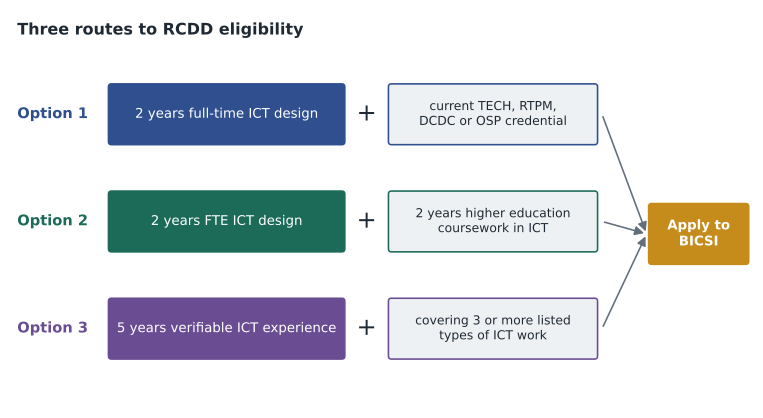
| Option | Experience | Plus |
|---|---|---|
| 1 | Two years of verifiable full-time work experience in ICT design | A current BICSI credential: TECH, RTPM, DCDC or OSP |
| 2 | Two years of verifiable full-time equivalent work experience in ICT design | Two years of higher education coursework in ICT |
| 3 | Five years of verifiable ICT experience | Experience that includes at least three of the ICT work types listed by BICSI |
There are two differences between the options. Options 1 and 2 require experience specifically in ICT design, and they shorten the period to two years because the candidate brings either another BICSI credential or formal education. Option 3 accepts a broader range of ICT experience but requires five years, and that experience must cover several different kinds of ICT work rather than one narrow task. Each option reflects the same idea: a candidate should have enough breadth to make sense of a broad exam.
What counts as ICT design experience
ICT design experience means work in which you planned, designed or specified ICT infrastructure, not only installed it. Typical examples include producing cabling layouts and riser diagrams, sizing telecommunications rooms and pathways, writing or editing specifications, preparing bills of materials, carrying out site surveys and needs analyses, reviewing contractor submittals, designing wireless coverage or distributed antenna systems, and preparing record documentation. Work done as part of a design team counts if you can describe your own role in it.
For option 3, BICSI's handbook lists categories of ICT work and asks that a candidate's five years include at least three of them. The list is meant to show breadth across the field rather than depth in one task, so a candidate whose five years were spent entirely on one activity may not qualify under this option. Read the current list in the handbook and map your own experience against it, job by job, noting which listed type each role covers.
What usually does not count is work that is only loosely related to infrastructure, such as configuring software applications, selling products without technical design involvement or managing an IT help desk with no infrastructure role. If you are unsure, describe the work honestly and let BICSI assess it, rather than leaving it out or stretching it.
Full-time equivalent experience
Options 1 and 2 refer to full-time or full-time equivalent experience. Full-time equivalent means that part-time work is added up and converted into the equivalent amount of full-time work. A common way to do this is to treat a standard working year as about 2,000 hours, or 40 hours a week for 50 weeks, and convert accordingly. The handbook does not ask you to calculate it this way, so check how BICSI wants part-time work described, but the principle is the same: two years at half-time is not two years of experience.
A last point about the calculation: be conservative. If your records show a range, such as six to ten hours a week, use the lower figure. An application that claims exactly the minimum on generous estimates invites questions, while one with a comfortable margin on cautious estimates is easy to approve.
Worked problem
Converting part-time design work
Before joining Lakehead Signal, Daniel spent eighteen months as a technician who also prepared cabling layouts for his employer about one day a week, roughly 8 hours of design work in a 40-hour week. Since joining the firm fourteen months ago, he has done design work full time. How much full-time equivalent design experience can he claim?
Show solution
- Part-time period: 8 of 40 hours is one fifth of full time, so eighteen months at one fifth equals 18 ÷ 5 = 3.6 months.
- Full-time period: fourteen months at full time equals 14 months.
- Total: 3.6 + 14 = 17.6 months of full-time equivalent design experience.
- Compare with options 1 and 2: two years is 24 months, so he is about 6.4 months short today.
Answer: Daniel has about 17.6 months of full-time equivalent design experience. He will reach 24 months in a little over six months of full-time design work, which fits his plan to apply in the summer and sit the exam the following spring.
Daniel's calculation shows why the order of steps matters. He also has more than five years of broader ICT experience, mostly installation and testing, with some design and some project coordination. Roz asks him to check whether option 3 might already apply. If his five years cover at least three of the listed work types, he may qualify now under option 3 rather than waiting for option 1 or 2. Working through every option before deciding is good practice.
Higher education coursework in ICT
Option 2 combines two years of design experience with two years of higher education coursework in ICT. The handbook describes qualifying coursework broadly. It can include science, technology, engineering and mathematics programs, trade school, a two-year degree or diploma, ICT or industry programs, apprenticeships, industry certifications and military training of an equivalent level. Degrees are evaluated for their relevance to the job task analysis behind the exam.
In Canada, relevant examples might include a two-year college diploma in electronics engineering technology, network or telecommunications technology, a completed electrical apprenticeship or a degree in electrical or computer engineering. A three-year advanced diploma or a four-year degree clearly covers the two-year requirement if the subject is relevant. A general business degree or an unrelated subject is unlikely to count, although individual courses in a relevant area might. You will need to provide evidence such as diplomas, certificates or transcripts, so gather them early.
Using another BICSI credential
Option 1 combines two years of ICT design experience with a current BICSI credential: Technician (TECH), Registered Telecommunications Project Manager (RTPM), Data Center Design Consultant (DCDC) or Outside Plant Designer (OSP). The word current matters. If your credential has expired, it does not count until you renew it. For many people coming from the cabling trade, the Technician credential is the natural route, because it builds on installation experience and shows a level of technical depth that complements design work.
Holding another credential does more than shorten the experience requirement. Preparing for it builds knowledge that overlaps with the RCDD, especially in cabling, testing and project practices. But it also adds cost and time, and it carries its own renewal obligations. If you already qualify under option 3, there is no need to earn a second credential just for eligibility.
Documenting your experience
BICSI verifies the experience candidates claim and may ask for additional proof. Good documentation saves time and avoids rejected applications. The simplest approach is to build an experience log before you apply.
| For each role, record | Why it matters |
|---|---|
| Employer, job title and dates (month and year) | Lets BICSI verify the period and calculate total experience |
| Hours per week in ICT design and in other ICT work | Needed to calculate full-time equivalent experience |
| Specific design tasks and deliverables | Shows the work was design, not only installation |
| Examples of projects, with your role on each | Gives concrete evidence that can be checked |
| A supervisor or colleague who can confirm the work | Supports verification if BICSI asks |
| Which of BICSI's ICT work types each role covers | Needed to show breadth for option 3 |
Write descriptions in concrete terms. 'Designed horizontal cabling for a 5,600-square-metre clinic, including outlet layouts, telecommunications room elevations and the specification section for copper cabling' is much more useful than 'worked on cabling projects'. Use the vocabulary of the field, which you will be learning anyway, and avoid exaggeration. A claim that cannot be verified does more harm than a modest claim that can.
Daniel's log for his time with a Thunder Bay cabling contractor shows the hours he spent on layouts and the projects involved, with the name of the estimator who reviewed his drawings. For Lakehead Signal, Roz agrees to confirm his work on the Harbourview project and two smaller jobs. Because he also has six years of installation, testing and project coordination work, his log may show three or more of BICSI's listed work types, in which case he could apply under option 3. Roz tells him to check each role against the handbook list rather than assume.
Common eligibility questions
Does experience have to be recent? The handbook asks for verifiable experience, so older work can count, but it becomes harder to verify as employers close or colleagues move on. Can experience from outside Canada and the United States count? Yes; the RCDD is an international credential, and BICSI accepts experience from many countries. Can unpaid or volunteer work count? Check the handbook; credentialing bodies usually want verifiable professional work, and internships may count if they involve real design tasks. Can you count two jobs held at the same time twice? No. Experience is measured in time worked, so overlapping roles add hours, not calendar years.
What if you do not yet qualify? Keep studying. Nothing stops you from reading the TDMM, taking courses or earning another credential while you build experience. The study plan in lesson 11 can start long before the application, and many candidates find that design work makes more sense once they have studied the principles behind it.
Common mistakes
MistakePlanning study before checking eligibility.
InsteadMap your experience against all three options first.
MistakeCounting installation work as design experience.
InsteadOptions 1 and 2 need ICT design experience; installation counts under option 3 as one of several work types.
MistakeTreating part-time work as full time.
InsteadConvert part-time hours to full-time equivalent.
MistakeRelying on an expired BICSI credential.
InsteadOnly a current credential counts for option 1.
MistakeWriting vague role descriptions.
InsteadDescribe specific design tasks, projects and deliverables that can be verified.
Summary and key terms
- Eligibility rules link the RCDD exam to real practice and protect the value of the credential.
- Option 1: two years of full-time ICT design experience plus a current TECH, RTPM, DCDC or OSP credential.
- Option 2: two years of full-time equivalent ICT design experience plus two years of higher education coursework in ICT.
- Option 3: five years of verifiable ICT experience covering at least three listed types of ICT work.
- Part-time work is converted to full-time equivalent; overlapping roles do not double count.
- A detailed experience log with dates, hours, tasks, projects and references makes verification straightforward.
- Eligibility
- The conditions a candidate must meet before BICSI approves them to sit the exam.
- ICT design experience
- Work planning, designing or specifying ICT infrastructure.
- Full-time equivalent
- Part-time work converted into the equivalent amount of full-time work.
- Verifiable
- Able to be confirmed by BICSI through documents or contacts.
- Current credential
- A credential that has not expired.
- Experience log
- A record of roles, dates, hours, tasks and references used to support an application.
- Job task analysis
- A study of what practitioners do, used to define the exam and judge relevant education.
Practice problems
Work each problem on paper first, then reveal the answer to check.
How many years of ICT design experience does option 1 require?
Show answer
Two years of full-time experience, plus a current BICSI credential.
Which BICSI credentials qualify for option 1?
Show answer
TECH, RTPM, DCDC or OSP.
How many years of ICT experience does option 3 require?
Show answer
Five years, covering at least three listed types of ICT work.
A candidate worked 20 hours a week in design for 12 months. How many full-time equivalent months is that?
Show answer
Six months.
Name two kinds of evidence for higher education coursework.
Show answer
Diplomas, certificates, transcripts or registrar letters.
Can two jobs held at the same time count as twice the experience?
Show answer
No; experience is measured in time worked.
Why describe design tasks in concrete terms?
Show answer
So BICSI can verify that the work was design and assess it accurately.
Where should you check the current eligibility rules?
Show answer
In BICSI's current RCDD certification handbook.
Lesson quiz · 5 questions
Score 60% or more to complete this lesson.
Create a free account to save your progress, take quizzes and earn a certificate.