
RAC-220 · Lesson 9 of 12 · 17 min
Charging methods: weight, superheat and subcooling
With the clinic's new indoor coil evacuated, Theo had a full system and an empty one at the same time: 6.8 kg (15 lb) of R-410A had been recovered from the rooftop unit, and the nameplate charge was printed on the unit's label. The question was how to put it back. Raj's answer was the same one he gave on every job. "Weigh it in first. Then check it with the method the manufacturer tells you to use. If the two don't agree, something else is wrong, and it's not the scale." Later that week Theo met the other side of the question at the Bauer house, where a homeowner's twenty-year-old air conditioner with a fixed piston had been topped up by someone else three times in five years.
Charging puts the correct amount of refrigerant into a system and confirms that the system is running as designed. Manufacturers specify the charge and how to check it. This lesson covers the four basic methods, weighing in, charging by superheat for fixed metering devices, charging by subcooling for valve systems, and using the manufacturer's charging charts, together with line set adjustments, the order of work and the safety rules that apply to every charge. Lesson 10 covers blends with glide, low ambient charging and inverter systems; lesson 11 adds the extra steps for A2L refrigerants.
Before any charge
- Confirm the refrigerant on the nameplate and on the cylinder, and check the cylinder's colour code is not the only identification; read the label.
- Make sure the airflow is right: clean filter, clean coils, correct fan speed. Charging against bad airflow puts in the wrong amount.
- Use an accurate electronic scale, zeroed with the cylinder on it, and digital or calibrated gauges set to the correct refrigerant.
- Wear safety glasses and gloves; liquid refrigerant causes frostbite, and a hose released under pressure can whip.
- Purge air from the hoses with a small amount of refrigerant from the cylinder, or use evacuated hoses, so no air enters the system.
- Know where liquid and vapour leave the cylinder. Single-component refrigerants and near-azeotropes can be charged as vapour or liquid; blends with glide must be removed from the cylinder as liquid, as lesson 10 explains.
Weighing in
Weighing in is the most accurate method when the system is empty and the total charge is known. The nameplate charge covers the system as shipped, which for split systems includes a stated length of line set. For a longer or shorter line set, the installation instructions give an adjustment per metre or foot of liquid line, based on its diameter.
- Place the cylinder on the scale, connect and purge the hose, zero the scale or note the starting weight.
- Into an evacuated system, charge liquid into the high side with the compressor off, until the scale shows the required amount or the pressures equalize. Never charge liquid into the suction side of a running compressor, except as a slow, metered feed as lesson 10 describes for blends.
- If the full charge will not enter with the system off, start the system and finish the charge slowly into the suction side as vapour, or as liquid metered through a restrictor for blends.
- Record the weight added.
# Line set adjustment for a split system (typical values; always use the installation instructions)
factory_length_m = 4.6        # line length covered by the factory charge
adjust_g_per_m = 56           # g per metre of 9.5 mm liquid line, R-410A (typical)
nameplate_kg = 2.38           # charge for the factory line length

for actual in [3.0, 4.6, 9.0, 15.0, 22.0]:
    extra_m = actual - factory_length_m
    total = nameplate_kg + extra_m * adjust_g_per_m / 1000
    sign = "add" if extra_m > 0 else ("remove" if extra_m < 0 else "no change")
print(f"line set {actual:5.1f} m: {sign} {abs(extra_m * adjust_g_per_m):5.0f} g -> total charge {total:.2f} kg")line set 3.0 m: remove 90 g -> total charge 2.29 kg line set 4.6 m: no change 0 g -> total charge 2.38 kg line set 9.0 m: add 246 g -> total charge 2.63 kg line set 15.0 m: add 582 g -> total charge 2.96 kg line set 22.0 m: add 974 g -> total charge 3.35 kg
Weighing in sets the amount, but it does not prove the system is working. A wrong piston, a kinked line, a dirty coil or a weak compressor will still give the wrong superheat or subcooling with the right weight. That is why the charge is always checked against the manufacturer's method once the system is running at stable conditions.
Charging fixed-orifice systems by superheat
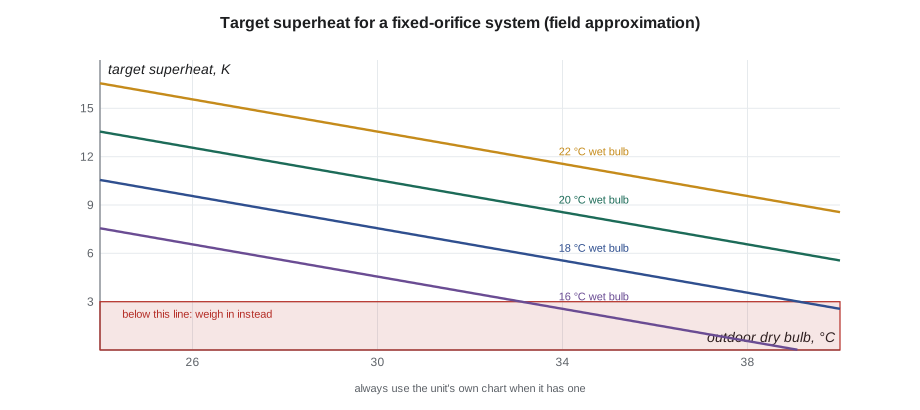
On a system with a capillary tube or piston, the superheat depends on the charge and on the conditions: the heat load on the indoor coil and the head pressure, which depends on the outdoor temperature. So a fixed-orifice system has no single target; it has a target superheat for the current indoor wet bulb and outdoor dry bulb temperatures. Manufacturers print a target superheat chart on the unit's service panel or in the installation instructions. Where no chart is available, many technicians use a well-known field approximation of the same charts, in Fahrenheit: target superheat equals three times the indoor wet bulb, minus 80, minus the outdoor dry bulb, all divided by two. It gives results close to typical manufacturers' charts within their range, but the unit's own chart always takes priority.
# Target superheat for a fixed-orifice system from the field approximation (computed in F, shown in K)
def target_sh_k(indoor_wb_c, outdoor_db_c):
    wb_f = indoor_wb_c * 1.8 + 32
    db_f = outdoor_db_c * 1.8 + 32
    sh_f = (3 * wb_f - 80 - db_f) / 2
    return sh_f / 1.8

for wb, db in [(19, 27), (19, 35), (17, 35), (21, 29), (16, 38)]:
    t = target_sh_k(wb, db)
    if t < 2.8:
        note = "below about 3 K: do not charge by superheat; check airflow and conditions, or weigh in"
    else:
        note = f"charge to about {t:.0f} K, within the manufacturer's tolerance"
print(f"indoor wet bulb {wb} C, outdoor {db} C -> target superheat {t:4.1f} K: {note}")indoor wet bulb 19 C, outdoor 27 C -> target superheat 10.6 K: charge to about 11 K, within the manufacturer's tolerance indoor wet bulb 19 C, outdoor 35 C -> target superheat 6.6 K: charge to about 7 K, within the manufacturer's tolerance indoor wet bulb 17 C, outdoor 35 C -> target superheat 3.6 K: charge to about 4 K, within the manufacturer's tolerance indoor wet bulb 21 C, outdoor 29 C -> target superheat 12.6 K: charge to about 13 K, within the manufacturer's tolerance indoor wet bulb 16 C, outdoor 38 C -> target superheat 0.6 K: below about 3 K: do not charge by superheat; check airflow and conditions, or weigh in
The pattern matters. A higher indoor wet bulb means more heat and moisture on the coil, so the evaporator boils off its liquid sooner and the target superheat rises. A higher outdoor temperature raises the head pressure, which pushes more refrigerant through the fixed device, so the target superheat falls. On a hot day with a dry indoor coil, the target can fall below a few degrees, where superheat charging becomes unreliable and the risk of floodback rises; manufacturers say not to charge by superheat in that range, and to weigh in instead or come back at better conditions.
To charge by superheat, measure the indoor wet bulb at the return, the outdoor dry bulb at the condenser inlet, find the target, then measure the actual superheat at the outdoor unit's suction service valve. If the actual is higher than the target, add refrigerant slowly, a small amount at a time, waiting several minutes for the system to settle; if it is lower, recover some. Adjust until the actual superheat is within the manufacturer's tolerance, often a few degrees, of the target.
Charging valve systems by subcooling
On a system with a TXV or an EEV, the valve holds the superheat near its setting, so the superheat says little about the charge. Instead, the charge is checked by subcooling at the outdoor unit's liquid service valve. The manufacturer gives a target subcooling, printed on the nameplate or service panel, often with a tolerance. Adding refrigerant backs more liquid up in the condenser and raises the subcooling; recovering lowers it.
- Run the system at stable conditions with the outdoor temperature in the manufacturer's range for subcooling charging, often above about 18 °C (65 °F).
- Measure liquid pressure and liquid line temperature at the service valve; use the bubble point for blends.
- Compare with the target. Add refrigerant slowly to raise subcooling, or recover to lower it, and wait several minutes between changes.
- Confirm that the superheat is reasonable at the same time. A valve system with correct subcooling but very high superheat has a restriction or a valve problem; one with very low superheat may have an airflow problem or an overfeeding valve.
Systems with receivers need different care. Because the receiver holds varying amounts of liquid, subcooling at the condenser outlet can be near zero even with a correct charge. Commercial refrigeration with receivers is commonly charged by weight, then checked by the liquid level in the receiver or a clear sight glass at full load, together with superheat and the liquid line temperature, according to the manufacturer's instructions.
Approach charging and manufacturer charts
Some manufacturers specify other methods: an approach method, comparing the liquid line temperature with the outdoor air temperature against a target; charging charts that plot liquid pressure against suction pressure or outdoor temperature; or, for many inverter and ductless systems, charging only by weight with a test-run mode that sets fixed compressor and fan speeds. The method in the manufacturer's instructions is the one to use, because it reflects how that equipment was rated and tested.
The clinic and the Bauer house
At the clinic, Theo weighed in the full 6.8 kg (15 lb) into the evacuated system as liquid through the liquid service valve with the unit off; about 6.2 kg (13.7 lb) went in before the pressures equalized, and he finished the rest as vapour into the suction side with the unit running. After fifteen minutes, the subcooling at the liquid valve read 5 K (9 °F) against a target of 5.5 ± 1 K (10 ± 2 °F), and the superheat at the evaporator outlet was close to the valve's setting. No adjustment was needed, which confirmed the coil, valve and charge were right.
At the Bauer house, the piston system was a different story. With a clean filter and coil, the indoor wet bulb was 19 °C (66 °F) and the outdoor temperature 32 °C (90 °F), giving a target superheat of about 8 K (14 °F), but the actual superheat was under 1 K (2 °F), the suction line was sweating all the way to the compressor and the head pressure was high. The repeated top-ups had overcharged the system. Theo recovered refrigerant in small amounts until the superheat matched the target, then asked about the original leak. The homeowner showed him where an oily stain had been wiped off a flare connection at the indoor coil each year; the shop booked a return visit to repair the flare and weigh in a fresh charge.
Charging records for every method
Whatever the method, write down the conditions and the result: outdoor and indoor temperatures, wet bulb if used, the target and the measured superheat or subcooling, and the weight added or removed. A target is meaningless without the conditions it was calculated for, and the next technician can only judge the charge if they know what it was set against. On fixed-orifice systems, note whether the charge was weighed in or set by superheat, because a charge set by superheat on a hot, dry day may need checking under milder conditions.
Common mistakes
MistakeCharging by superheat on a TXV or EEV system.
InsteadUse subcooling or the manufacturer's method; the valve holds superheat.
MistakeCharging by subcooling on a fixed-orifice system.
InsteadUse the manufacturer's target superheat chart.
MistakeIgnoring the line set length when weighing in.
InsteadAdjust the charge for the actual line length using the installation instructions.
MistakeCharging with a dirty filter or coil.
InsteadFix the airflow first.
MistakeAdding refrigerant quickly and reading immediately.
InsteadAdd small amounts and wait several minutes for the system to settle.
Summary and key terms
- Weighing in is the most accurate way to set the charge in an evacuated system; adjust for line set length.
- Every charge is then checked by the manufacturer's method at stable conditions.
- Fixed-orifice systems are checked by a target superheat that depends on indoor wet bulb and outdoor dry bulb.
- Valve systems are checked by target subcooling, with superheat as a cross-check.
- Receiver systems are commonly charged by weight and checked by level, sight glass and superheat.
- Inverter and ductless systems usually require weighing in and a manufacturer test mode.
- Weighing in
- Charging a measured mass of refrigerant from a cylinder on a scale.
- Target superheat
- The superheat a fixed-orifice system should run at under the current conditions.
- Target subcooling
- The subcooling a valve system should run at with a correct charge.
- Line set adjustment
- The change in charge for a line set longer or shorter than the factory charge covers.
- Wet bulb temperature
- The temperature read by a thermometer with a wetted wick in moving air, reflecting humidity.
- Approach method
- A charging check comparing liquid line temperature with outdoor air temperature.
Practice problems
Work each problem on paper first, then reveal the answer to check.
Indoor wet bulb 19 °C and outdoor 35 °C. Using the field approximation, what is the target superheat?
Show answer
About 6.5 K: 19 °C is about 66 °F and 35 °C is 95 °F, so (3 × 66 − 80 − 95) ÷ 2 ≈ 12 °F, which is about 6.5 K.
A 15 m line set is used where the factory charge covers 4.6 m, with an adjustment of 56 g per metre. How much refrigerant is added?
Show answer
About 580 g.
A TXV system shows subcooling of 2 K against a target of 5.5 K. What do you do?
Show answer
Add refrigerant slowly, waiting between additions, until the subcooling reaches the target.
Why should you not charge a piston system by superheat when the target is below about 3 K?
Show answer
The method is unreliable there and the risk of liquid return is high; weigh in instead.
Lesson quiz · 5 questions
Score 60% or more to complete this lesson.
Create a free account to save your progress, take quizzes and earn a certificate.