
RAC-220 · Lesson 2 of 12 · 17 min
Capillary tubes and fixed orifices
The restaurant's reach-in cooler was back on the schedule. It had a new suction reed from last year, and it had been running well until the kitchen manager noticed the cabinet creeping up to 7 °C (45 °F) in the afternoons. Theo found the suction pressure low and the superheat at the compressor high, but the condenser was clean and the subcooling at the condenser outlet was normal, even a little high. He traced the liquid line back from the condenser to the drier, then to the point where a hair-thin copper capillary tube left the drier and coiled away behind the cabinet. At a tight bend behind the compressor, the capillary tube was cold and sweating. "That's a restriction inside the restriction," Dana said over the phone. "The tube got bent when someone pushed the unit back against the wall. Capillary tubes are simple, but they can't tell you what's wrong. You have to read the system around them."
Capillary tubes and fixed orifices are the simplest metering devices, and they are still found in a huge number of systems: domestic refrigerators and freezers, reach-in coolers, ice machines, window and through-the-wall units, dehumidifiers and many residential split air conditioners and heat pumps. This lesson explains how they meter, how they are sized and matched, why the charge in these systems is critical, and how they fail.
How a capillary tube meters
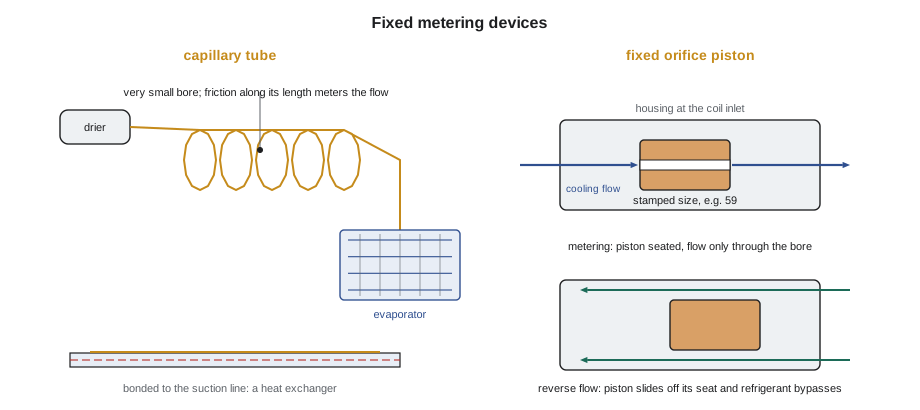
A capillary tube is a long copper tube with a very small inside diameter, typically around half a millimetre to two millimetres, and a length from under a metre to several metres. Its resistance to flow comes from friction along its length. Liquid enters at the condensing pressure. Along the first part of the tube, the pressure falls with little change of state; at the point where the pressure falls below the saturation pressure for the liquid's temperature, the liquid begins to flash, and from there on the mixture accelerates and the pressure falls faster. By the outlet, the refrigerant is a cold, two-phase mixture at roughly the evaporator pressure.
Because flashing starts where the pressure meets saturation, a capillary tube passes more refrigerant when the liquid entering it is well subcooled: the flashing point moves further along the tube, more of the tube carries dense liquid and the flow rises. Many designs solder the capillary tube alongside the suction line for part of its length, forming a heat exchanger that cools the liquid in the tube and warms the suction gas. This increases capacity and keeps the suction line from sweating.
- Diameter matters most. Flow through a capillary tube rises steeply with its bore, roughly with the bore raised to a power between two and three for a given length, so a small change in diameter changes the flow far more than the same percentage change in length.
- Length matters less. A longer tube passes less refrigerant, roughly in proportion to the inverse square root of length for liquid flow, so lengthening a tube by a third reduces flow by about an eighth.
- Capillary tubes cannot be adjusted in the field. A replacement must match the original bore and length, or the manufacturer's replacement chart, and must be the same tube type.
Fixed orifices and pistons
A fixed orifice is a short, precisely drilled hole in a brass fitting, used mostly in residential split air conditioners and heat pumps. The most common form is a piston, sometimes called by a brand name: a small brass cylinder with a central bore, sitting in a housing at the inlet of the indoor coil or in the outdoor unit. The bore size is stamped on the piston, often as a number such as 0.059 or 59, meaning a bore of 0.059 inch. Unlike a capillary tube, whose resistance is friction along its length, an orifice's resistance comes from the contraction and acceleration of the liquid through a short hole.
In heat pumps, each coil has its own piston in a housing that lets it slide. In the metering direction, the piston is pushed onto its seat and the refrigerant must pass through the bore. In the reverse direction, the piston is pushed off its seat and refrigerant flows freely around it through flutes on its sides. So a heat pump with pistons has one piston for cooling, at the indoor coil, and one for heating, at the outdoor coil, and each is sized for its mode.
# Flow through a fixed orifice: m = Cd * A * sqrt(2 * rho * dP)
import math
Cd = 0.65          # discharge coefficient, typical for a sharp orifice (approximate)
rho = 1000.0       # kg/m3, liquid R-410A density near 35 C (approximate)

def flow(bore_mm, dP_kPa):
    A = math.pi * (bore_mm / 1000) ** 2 / 4
    return Cd * A * math.sqrt(2 * rho * dP_kPa * 1000)      # kg/s

print("bore   dP=1500 kPa   dP=1900 kPa   dP=2300 kPa  (kg/min)")
for bore in [1.40, 1.50, 1.60, 1.70]:
    row = [flow(bore, dp) * 60 for dp in (1500, 1900, 2300)]
    print(f"{bore:.2f} mm   " + "   ".join(f"{r:9.2f}" for r in row))

# a cold day lowers the pressure difference from 1900 to 1500 kPa
drop = 1 - math.sqrt(1500 / 1900)
print(f"\nflow falls by about {drop*100:.0f} % for the same piston on a cold day")bore dP=1500 kPa dP=1900 kPa dP=2300 kPa (kg/min) 1.40 mm 3.29 3.70 4.07 1.50 mm 3.77 4.25 4.67 1.60 mm 4.29 4.83 5.32 1.70 mm 4.85 5.46 6.00 flow falls by about 11 % for the same piston on a cold day
The program uses the standard orifice equation with an approximate discharge coefficient, so its absolute numbers are only estimates, but two lessons stand out. First, flow scales with the bore's area, the square of its diameter, so a piston only a few thousandths of an inch larger passes noticeably more refrigerant. Second, flow rises with the square root of the pressure difference, so when the head pressure drops on a mild day, the piston passes less refrigerant and the evaporator becomes starved, raising superheat. That is exactly why fixed-orifice systems are charged by a target superheat that depends on the outdoor and indoor conditions.
Matching and sizing
Fixed devices are sized by the manufacturer for a particular combination of compressor, condenser, evaporator and refrigerant. In split systems, the indoor coil often ships with a piston that suits a common outdoor unit, and the outdoor unit's installation instructions list the piston that must be installed for each matched indoor coil. Using the wrong piston is a common and expensive mistake: too large a bore overfeeds and floods the evaporator, with low superheat and high suction, risking liquid return; too small a bore starves the evaporator, with high superheat, low suction and poor capacity. Some indoor coils allow a TXV kit to replace the piston, which the outdoor unit's documentation may require for high-efficiency combinations.
- Read the stamped size with a magnifier and compare it with the outdoor unit's chart before closing the coil.
- Never drill out a piston or swap one from stock without the chart; a few thousandths of an inch is a real change.
- When replacing a capillary tube, follow the equipment manufacturer's replacement data or a capillary tube selection chart for the refrigerant and capacity, and keep the heat exchange arrangement with the suction line if there was one.
Critical charge
Systems with capillary tubes or fixed orifices usually have no receiver. The refrigerant charge is set by the manufacturer for the system as built, and any extra refrigerant has nowhere to go but into the condenser or the evaporator. Because flow through a fixed device depends on the liquid reaching it, the charge directly sets how the device behaves. An overcharge backs liquid up in the condenser, raises the head pressure and subcooling, and pushes more refrigerant through the device, so the evaporator floods and superheat falls. An undercharge leaves too little liquid to seal the device's inlet, so vapour enters the tube or orifice with the liquid, flow falls, and the evaporator starves.
Small appliances such as domestic refrigerators may hold only a few tens of grams of refrigerant; an error of a few grams changes how they run. Such systems are charged by weight to the nameplate amount, never by gauges alone, and many technicians avoid attaching gauges at all unless a fault is suspected, because each hose connection removes a little refrigerant and adds a leak path.
How fixed devices fail
- Restriction by debris, sludge, wax or moisture. The small bore of a capillary tube or orifice catches particles that pass a drier, and in low-temperature systems moisture can freeze at the outlet, stopping flow until the device warms up. A moisture freeze-up shows as a system that runs well after an off cycle and then starves again; a properly sized drier and a good evacuation prevent it.
- Kinks and crushed tubes. A capillary tube that is bent tighter than its minimum radius or crushed under a cabinet restricts flow at that point; the tube is cold or frosted right after the kink.
- Wrong piston or a piston in backward. A piston installed upside down, or the wrong one for the outdoor unit, overfeeds or starves the coil.
- A stuck heat pump piston. If a piston sticks off its seat, it cannot meter in its mode, so the coil floods; if debris holds it on its seat in the bypass direction, flow in the other mode is restricted.
- Restrictions at the drier or strainer just before the device, which show as a temperature drop across the drier, as in RAC-210.
A restricted fixed device and a low charge both starve the evaporator, so both give high superheat and low suction pressure. The difference is in the subcooling. With a restriction, liquid backs up behind it in the condenser, so the subcooling is normal or high and the head pressure may be normal. With a low charge, there is not enough liquid to back up anywhere, so the subcooling is low. Lesson 7 builds this into a full table.
Fixing the reach-in
Theo confirmed his suspicion with a careful look at the capillary tube. The sweating spot started exactly at the kink, and the tube was warm a few centimetres upstream. Straightening a kinked capillary tube rarely restores its bore, so the shop replaced it. He recovered the charge, cut out the old tube and the drier, and installed a new capillary tube of the same bore and length from the manufacturer's replacement data, brazing it into the evaporator inlet and fitting a new drier sized for capillary systems with a nitrogen flow through the tubing. He routed the new tube away from the compressor and secured it so it could not be pushed against the wall again, then pressure-tested, evacuated and weighed in the nameplate charge. The suction pressure came up, the superheat at the evaporator outlet fell into the manufacturer's range and the cabinet held 3 °C (37 °F) through the next afternoon rush.
Ice machines and other capillary systems
Ice machines, reach-in freezers and domestic refrigerators often use a capillary tube bonded to the suction line, and many go through regular cycles of freezing and harvesting or defrosting. Their pressures and superheat change throughout each cycle, so a single reading means little. Manufacturers' service manuals give expected suction pressures at points in the freeze cycle, harvest times and the water or ice temperatures that confirm the system is working. Read these against the manual rather than against general air conditioning targets.
Common mistakes
MistakeAdding refrigerant to a starved capillary system without checking subcooling.
InsteadHigh subcooling with high superheat points to a restriction, not a low charge.
MistakeReplacing a capillary tube with any tube of similar length.
InsteadMatch the bore and length from the manufacturer's data; bore matters far more than length.
MistakeCharging a small appliance by gauge pressure.
InsteadWeigh in the nameplate charge.
MistakeLeaving the factory piston in an indoor coil without checking the outdoor unit's chart.
InsteadInstall the piston the matched outdoor unit specifies, or the required TXV kit.
MistakeBending a capillary tube tightly to tidy a cabinet.
InsteadKeep bends gentle and secure the tube away from moving parts and walls.
Summary and key terms
- A capillary tube meters by friction along its length; flashing begins where the pressure meets saturation.
- Bore matters much more than length; capillary tubes are replaced only to the manufacturer's data.
- A fixed orifice or piston meters through a short drilled bore; heat pumps use a piston for each mode.
- Flow through a fixed device rises with the square root of the pressure difference and with subcooling.
- Fixed-device systems have a critical charge; small appliances are charged by weight.
- Restrictions show high superheat with normal or high subcooling; a low charge shows high superheat with low subcooling.
- Capillary tube
- A long, small-bore tube that meters refrigerant by friction.
- Fixed orifice
- A short, drilled restriction that meters refrigerant; often a piston.
- Piston
- A floating brass orifice in a housing that meters in one direction and bypasses in the other.
- Critical charge
- A charge that must be held to the manufacturer's amount because the system has no receiver.
- Suction line heat exchanger
- A section where the capillary tube is bonded to the suction line, subcooling the liquid.
- Moisture freeze-up
- Ice forming at a metering device outlet from water in the refrigerant.
- Discharge coefficient
- A factor that relates the actual flow through an orifice to the ideal flow.
Practice problems
Work each problem on paper first, then reveal the answer to check.
A piston with a 1.50 mm bore is replaced by one with a 1.60 mm bore. By roughly what percentage does flow change at the same pressures?
Show answer
Flow scales with area: (1.60/1.50)² ≈ 1.14, about 14 % more.
Why does a capillary system run better after an off cycle and then starve again?
Show answer
Moisture freezing at the tube outlet; it thaws when the system stops.
A capillary system shows superheat of 20 K and subcooling of 10 K. Restriction or low charge?
Show answer
Restriction: liquid is backing up, so subcooling is high.
Why are domestic refrigerators charged by weight?
Show answer
Their charge is so small that a few grams change how they run, and gauges remove refrigerant.
Lesson quiz · 5 questions
Score 60% or more to complete this lesson.
Create a free account to save your progress, take quizzes and earn a certificate.