
RAC-220 · Lesson 5 of 12 · 17 min
Electronic expansion valves
The attic ductless heat pump at the Haddad house had been one of Theo's first calls in RAC-110: an R-410A inverter system rated 3.42 kW (11,700 Btu/h) with a 1.1 kg (2.4 lb) charge. This time Mrs. Haddad reported that it cooled for a while, then blew warm air, then cooled again, and the outdoor unit's display was flashing a code. The service manual listed the code as an expansion valve fault. Theo found the outdoor unit's EEV coil connector green with corrosion where water from a leaking gutter had dripped onto the unit's top. "This one's not a refrigerant problem at all," Dana said when she saw the photo. "But you'd be amazed how many people would have hooked up gauges and started adding refrigerant."
Electronic expansion valves are now standard in inverter-driven heat pumps and air conditioners, ductless systems, supermarket display cases, chillers and many rooftop units. They meter refrigerant the same way any valve does, with a variable opening, but the decision about how far to open comes from a controller reading sensors rather than from a bulb and spring. This lesson covers how EEVs are built and driven, how their controllers decide, what sensors they rely on, and how to check them in the field.
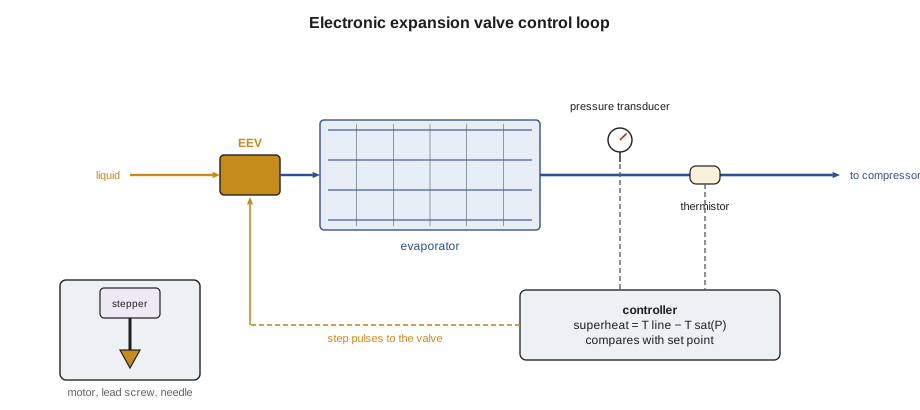
Types of EEV
- Stepper motor valves. A small stepper motor turns a lead screw that moves a needle in and out of the port. The controller sends pulses; each pulse moves the motor one step, and the valve's full travel is a fixed number of steps, often several hundred to a few thousand depending on the design. The controller tracks the position by counting steps, and drives the valve fully closed at start-up or periodically to reset its count, which is the clicking or ratcheting sound often heard from ductless outdoor units.
- Pulse-width-modulated (PWM) valves. A solenoid valve opens and closes rapidly, every few seconds, and the controller sets the fraction of each cycle that the valve is open. The average flow follows that fraction. PWM valves are common in supermarket display cases and some commercial refrigeration.
- Other designs include thermally driven and analogue-actuated valves on some equipment; the service literature describes them.
Stepper valves usually keep their last position if power is lost, so many systems also have a liquid line solenoid or a pump-down routine to stop flow during the off cycle. PWM valves close when de-energized, so they double as a shut-off.
How the controller decides
Most EEV controllers hold a superheat set point, just as a TXV does, but they can do it more precisely and over a wider range. The controller reads the evaporator outlet pressure with a pressure transducer and converts it to saturation temperature using the refrigerant's properties stored in its memory; it reads the suction line temperature with a thermistor; it subtracts to get superheat; and it moves the valve to bring the superheat to the set point, usually with a proportional-integral control algorithm. Some systems, especially ductless and residential inverter units, have no pressure transducer and instead use temperature sensors on the coil to estimate the saturation temperature, or they control on compressor discharge temperature, which rises when the evaporator is starved.
Because the controller knows the compressor speed, the fan speeds and the outdoor temperature, it can also anticipate changes: opening the valve before the compressor speeds up, setting a pre-positioned opening at start-up, and lowering the superheat target at low load to use more of the coil. In a heat pump, the same valve meters in heating and cooling, and the controller changes its targets and sensors with the mode and during defrost.
# A simple proportional-integral superheat controller driving a stepper EEV (simulation)
steps_max = 480
position = 120                      # steps open at start
setpoint = 5.0                      # K superheat target
kp, ki = 6.0, 0.8                   # controller gains (illustrative)
integral = 0.0

def superheat_for(position, load):
    # crude evaporator model: more opening feeds more refrigerant, lowering superheat
    feed = position / steps_max
    return max(0.0, 18.0 * load - 30.0 * feed)

load = 1.0
for t in range(0, 26):
    if t == 12:
        load = 0.7                  # load falls when the room cools down
    sh = superheat_for(position, load)
    error = sh - setpoint           # positive error: too much superheat, open the valve
    integral += error
    position = int(min(steps_max, max(0, position + kp * error + ki * integral * 0.1)))
    if t % 3 == 0 or t == 12:
print(f"t={t*10:3d} s load {load:.1f} superheat {sh:4.1f} K valve {position:3d} steps ({position/steps_max*100:3.0f} %)")t= 0 s load 1.0 superheat 10.5 K valve 153 steps ( 32 %) t= 30 s load 1.0 superheat 6.3 K valve 195 steps ( 41 %) t= 60 s load 1.0 superheat 5.2 K valve 206 steps ( 43 %) t= 90 s load 1.0 superheat 5.0 K valve 209 steps ( 44 %) t=120 s load 0.7 superheat 0.0 K valve 179 steps ( 37 %) t=150 s load 0.7 superheat 3.7 K valve 135 steps ( 28 %) t=180 s load 0.7 superheat 4.7 K valve 124 steps ( 26 %) t=210 s load 0.7 superheat 5.0 K valve 121 steps ( 25 %) t=240 s load 0.7 superheat 5.0 K valve 121 steps ( 25 %)
The simulation is deliberately simple, but it shows what a controller does: it opens the valve while the superheat is above the set point, and when the load falls, it closes the valve until the superheat returns to target. Real controllers add limits, rate changes and protection routines, and their gains are tuned by the manufacturer.
The sensors are part of the valve
An EEV is only as good as the information it receives. A TXV's bulb is mechanical; an EEV's sensors are electrical, and they fail in electrical ways:
- Thermistors change resistance with temperature. A thermistor that has come loose from its pipe reads air temperature; one with a damaged lead reads open or shorted, which most controllers flag as a fault. Service manuals give a resistance-temperature table, so a thermistor can be checked with an ohmmeter at a known temperature, typically disconnected from the board.
- Pressure transducers send a voltage or current proportional to pressure, often from a five-volt supply. They can drift, so a transducer's reading should be compared with a gauge on the same access point.
- The valve coil can be checked for resistance between its windings, against the manufacturer's values, with the connector unplugged. A stepper coil with an open winding cannot move the valve.
- Connectors and wiring are a frequent cause of trouble, especially outdoors, where water and corrosion attack them.
Because the controller calculates superheat from these sensors, a sensor error becomes a feeding error. A suction thermistor that reads 3 K (5 °F) too warm makes the controller think the superheat is higher than it is, so it opens the valve further and the evaporator runs wetter than intended. A transducer that reads low makes the controller calculate too high a superheat, with the same result.
Checking an EEV in the field
- Read the fault codes and the controller's live data if the unit offers them: valve position, superheat, sensor readings and set points. Many systems display these on the board, a remote controller or a service tool.
- Compare the controller's sensor readings with your own: a gauge on the access port and a clamp thermometer next to the thermistor.
- Listen and feel at start-up. A stepper valve usually drives closed and then opens to a start position; you may hear it ratchet. No sound and no change in the refrigerant flow can mean a dead coil or a failed driver.
- Check the coil's resistance and the connector. Many manufacturers also sell a test magnet or a handheld driver that can move a stepper valve independently of the board, to separate a stuck valve from a failed board.
- Follow the service manual's procedure for evacuating and charging systems with EEVs. Because many stepper valves hold their last position, some manuals call for a special service mode or for removing the coil and turning the valve open with a magnet, so the whole system can be evacuated and the charge can reach both sides.
| Symptom | Possible EEV-related cause | Check |
|---|---|---|
| Fault code for the valve or coil | Open coil, failed connector or driver | Coil resistance, connector, board output |
| High superheat, valve shows fully open | Low charge or restriction; valve cannot feed more | Subcooling, sight glass or charge check, drier |
| Low superheat, valve shows nearly closed | Valve stuck open or leaking through | Valve test with magnet or driver; replace valve body |
| Superheat wrong but controller shows target met | Sensor error | Compare thermistor and transducer with your own readings |
The second row is important. An EEV controller shows how far the valve is open; if it shows the valve fully open and the superheat still high, the valve is doing its best and the problem is upstream, usually a low charge or a restriction. If it shows the valve nearly closed and the superheat still low, the valve may be leaking through or stuck, or the controller may be fooled by a sensor.
Valves in larger systems
In supermarkets, each display case or walk-in often has its own EEV and case controller, linked to a supervisory system that logs superheat, valve opening, case temperature and defrost status. A technician can see trends from the office before going to the store: a case whose valve has crept to fully open over several weeks is probably losing refrigerant, while one whose superheat has started hunting may have a loose sensor. Chillers use larger motor-driven valves that are positioned to hold a liquid level, a superheat or a condenser subcooling, depending on the design.
The Haddads' heat pump
Theo switched off the power, unplugged the corroded connector and measured the EEV coil's windings: one winding read open. The service manual's flow chart called for checking the coil first and then the valve body; with the coil replaced, the board's start-up routine drove the valve closed and reopened it with the familiar clicking, and the fault code cleared. Live data showed the valve settling at about a third open, the superheat near the controller's target, and the indoor air leaving the head about 12 K (22 °F) cooler than the room. Theo sealed the new connector with the manufacturer's recommended boot, redirected the gutter downpipe with Mrs. Haddad's permission, and noted in the record that no refrigerant had been added or removed.
Start-up, protection and defrost routines
An EEV controller does more than hold superheat. At start-up, most controllers open the valve to a preset position for a short time before handing over to superheat control, so the evaporator fills quickly without flooding the compressor. Many add a minimum superheat limit, closing the valve hard if the superheat falls toward zero, and a maximum operating pressure function like a MOP bulb, limiting the opening during pull-down to protect the compressor motor. On heat pumps, the controller may watch discharge temperature as well, opening the valve to cool an overheating compressor or closing it to raise a discharge temperature that is too low, which suggests liquid is returning.
During defrost, the valve's job changes. In a heat pump defrost, the outdoor coil becomes the condenser and the indoor coil the evaporator for a few minutes; the controller drives the valve to a defrost position chosen by the manufacturer, then returns it to its heating position after defrost ends. In supermarket cases with electric or hot gas defrost, the case controller closes the valve during defrost and holds it closed for a drip period afterward. A technician who reads the valve position during these routines should not mistake a scheduled change for a fault. The service manual's sequence of operation describes what the valve should be doing at each stage, and many controllers show the current routine in their live data.
Common mistakes
MistakeAdding refrigerant to clear an EEV fault code.
InsteadRead the code and check the coil, connector, driver and sensors first.
MistakeTrusting the controller's sensor readings without checking them.
InsteadCompare thermistors and transducers with your own instruments.
MistakeEvacuating a system with a closed stepper valve.
InsteadFollow the manual's procedure to open the valve so the whole system is evacuated.
MistakeReplacing a valve body when the coil or board has failed.
InsteadTest the coil resistance and use the manufacturer's test tool or magnet to separate valve, coil and board faults.
MistakeLeaving an outdoor connector unsealed after repair.
InsteadProtect connectors from water as the manufacturer specifies.
Summary and key terms
- EEVs meter with a variable opening positioned by a controller, usually to hold a superheat set point.
- Stepper valves count steps and hold their position; PWM valves pulse open and closed and shut when de-energized.
- Controllers calculate superheat from a pressure transducer and thermistor, or estimate it from temperatures.
- Sensor errors become feeding errors; compare sensors with your own readings.
- Coil resistance, connectors, live data and manufacturer test tools separate valve, coil, board and sensor faults.
- A valve that reads fully open with high superheat points to a problem upstream, such as a low charge.
- Electronic expansion valve
- A metering valve positioned electrically by a controller.
- Stepper motor
- A motor that moves in fixed steps for each pulse it receives.
- Pulse-width modulation
- Controlling average flow by varying how long a valve is open in each cycle.
- Thermistor
- A temperature sensor whose resistance changes with temperature.
- Pressure transducer
- A sensor that converts pressure into an electrical signal.
- PI control
- A control method using the present error and its accumulated history to set the output.
- Live data
- Real-time readings and valve position shown by the controller.
Practice problems
Work each problem on paper first, then reveal the answer to check.
A stepper EEV controller shows 100 % open and superheat well above target. What should you check?
Show answer
The charge, subcooling and any liquid line restriction; the valve cannot feed more.
Why might a suction thermistor that has come loose from its pipe cause floodback?
Show answer
It reads the warmer air, so the controller thinks superheat is high and opens the valve too far.
How can you tell a failed EEV coil from a stuck valve body?
Show answer
Measure the coil resistance; if it is good, move the valve with the manufacturer's magnet or driver to see if it responds.
Why does a ductless outdoor unit click at start-up?
Show answer
The stepper EEV drives fully closed to reset its position count and then opens to its start position.
Lesson quiz · 5 questions
Score 60% or more to complete this lesson.
Create a free account to save your progress, take quizzes and earn a certificate.