
RAC-220 · Lesson 6 of 12 · 17 min
Automatic expansion valves and float metering
The arena's maintenance manager had a question when Raj and Theo came to look at the snack bar ice machine: why did the plant room's big ammonia system have a tank with a float on it, when the little ice machine and every walk-in Theo had worked on used valves with bulbs? Raj walked Theo past the ice plant's surge drum and its level control on the way out. "Different jobs," he said. "A TXV wants a dry coil outlet. A flooded evaporator wants to stay full of liquid, so you meter by level. And there's one more valve you'll see now and then that doesn't care about superheat or level at all. It just holds the pressure."
Besides fixed devices, TXVs and EEVs, two other families of metering device are found in the field: automatic expansion valves, which hold a constant evaporator pressure, and float valves, which hold a liquid level. Neither is common in new comfort cooling equipment, but technicians meet them in older equipment, small specialty units, water coolers, flooded chillers and industrial refrigeration. Understanding how they behave also makes the strengths of the superheat-controlling valves clearer.
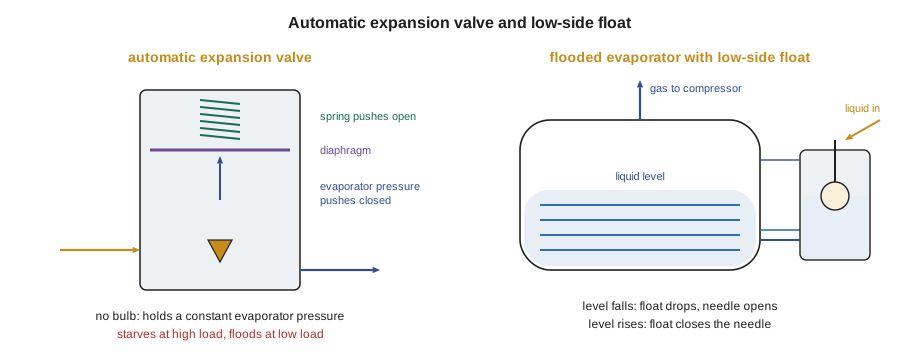
Automatic expansion valves
An automatic expansion valve (AXV), sometimes called a constant-pressure expansion valve, has a diaphragm with an adjustable spring on one side pushing the valve open and the evaporator pressure on the other side pushing it closed. It has no bulb. If the evaporator pressure falls below the setting, the spring opens the valve and feeds more refrigerant, raising the pressure; if the evaporator pressure rises above the setting, the valve closes. The result is a nearly constant evaporating pressure, and therefore a nearly constant evaporating temperature, regardless of load.
That sounds useful, but it has an odd consequence. When the load on the evaporator rises, the refrigerant boils faster and the evaporator pressure tends to rise; the AXV responds by closing to hold the pressure down, so it feeds less refrigerant just when more is needed, and the superheat rises. When the load falls, the evaporator pressure tends to fall, and the AXV opens, feeding more refrigerant just when less is needed; at very low load it can flood the coil. In other words, an AXV responds to load in the opposite direction to a TXV.
# Automatic expansion valve: feed versus load at a fixed evaporator pressure setting (illustrative model)
capacity_full = 2.6        # kW evaporator capacity at design load
for load_fraction in [1.3, 1.0, 0.8, 0.6, 0.4, 0.2]:
    heat_in = capacity_full * load_fraction
    # The valve holds the pressure, so the boiling rate is set by the coil's surface at that pressure.
    # If the heat arriving exceeds what the wetted coil can take, liquid boils off early (more superheat);
    # if it is less, liquid runs further along the coil (less superheat).
    wet_fraction = max(0.0, min(1.2, 1.0 / max(load_fraction, 0.01) * 0.85))
    if wet_fraction >= 1.0:
        status = "liquid reaching the outlet: flood risk"
    elif wet_fraction > 0.8:
        status = "near design superheat"
    else:
        status = "starved: high superheat"
print(f"load {load_fraction*100:4.0f} % ({heat_in:4.2f} kW) coil wetted about {min(wet_fraction,1.0)*100:4.0f} % -> {status}")load 130 % (3.38 kW) coil wetted about 65 % -> starved: high superheat load 100 % (2.60 kW) coil wetted about 85 % -> near design superheat load 80 % (2.08 kW) coil wetted about 100 % -> liquid reaching the outlet: flood risk load 60 % (1.56 kW) coil wetted about 100 % -> liquid reaching the outlet: flood risk load 40 % (1.04 kW) coil wetted about 100 % -> liquid reaching the outlet: flood risk load 20 % (0.52 kW) coil wetted about 100 % -> liquid reaching the outlet: flood risk
The model is only qualitative, but it captures the AXV's behaviour: starved at high load and flooding at low load. Because of this, AXVs suit only applications with a steady, predictable load, such as small water coolers, some ice cream and drink dispensers and a few specialty machines, or applications where holding the evaporator temperature exactly is more important than full use of the coil, such as preventing a coil from freezing. They are not used on systems with large load changes, and they are not used with multiple evaporators on one compressor.
- An AXV is adjusted by its spring: turning it to increase spring force raises the evaporator pressure the valve holds.
- A system with an AXV usually cycles on temperature with a thermostat or a low-pressure control set below the valve's pressure, so when the box is cold and the compressor stops, the valve closes as the pressure rises.
- Because the valve opens when the suction pressure falls, a system with an AXV must not be pumped down below its setting; the valve would open and feed the liquid into the evaporator.
Float valves
In a flooded evaporator, the refrigerant boils in a shell or drum around tubes or plates that carry the fluid being cooled, such as water or brine, and the shell is kept partly full of liquid. Vapour leaves from the top. Superheat at the outlet is near zero by design, so a superheat-controlling valve has nothing to work with. Instead, the refrigerant is metered by level, with a float.
- A low-side float sits in a chamber connected to the evaporator, or in the evaporator itself. As liquid boils away and the level falls, the float drops and opens a needle valve, admitting liquid from the high side. When the level rises to the set point, the float closes the valve. The evaporator stays at a steady level regardless of load.
- A high-side float sits in a chamber on the high side, after the condenser. As liquid condenses and the level rises, the float opens and passes the liquid to the low side. The high side holds almost no liquid, and the charge sits mostly in the evaporator, so a high-side float system has a critical charge: an overcharge can flood the evaporator and send liquid to the compressor.
Modern flooded chillers and industrial systems often use level sensors and motor-driven valves rather than mechanical floats, with a controller holding the level in the evaporator, a condenser, a receiver or a separator vessel. Large industrial refrigeration systems, such as ammonia plants for arenas, cold stores and food processing, use pumped or gravity recirculation with surge drums or low-pressure receivers, in which a level control keeps a pool of liquid that is pumped or drained through the evaporators. These systems are covered in RAC-420; here the point is the principle: in a flooded design, the metering device holds a level, not a superheat.
Liquid level and the flooded chiller
The seniors' residence's screw chiller, which Theo had helped service in RAC-210, has a flooded evaporator with a motor-driven valve. The chiller's controller holds a level in the evaporator shell, read by a level sensor, and it also watches the evaporator approach temperature, the difference between the leaving chilled water and the refrigerant's saturation temperature. If the level falls, the tubes near the top of the bundle are no longer covered, the approach widens and the chiller loses capacity. If the level is too high, liquid droplets can be carried into the compressor suction. The controller displays the level and the valve position, and the service manual gives the expected approach for a clean, properly charged machine.
For a technician, the diagnostic rule follows from the principle. On a flooded evaporator, superheat tells you little. Instead, read the level or the valve position, the evaporator approach and the sight glasses on the shell if fitted, and compare them with the manufacturer's values. A wide approach with a low level points to a low charge or a level control fault; a wide approach with a normal level points to fouled tubes, oil in the evaporator or non-condensables in the system.
Other low-side devices worth recognizing
- Hand expansion valves are manually adjusted needle valves, used mainly in industrial systems as a fixed bypass, a backup to a control valve or to set the flow from a recirculation pump.
- Evaporator pressure regulators and other pressure-regulating valves are not metering devices but are found nearby; they keep an evaporator above a minimum pressure when several evaporators share a compressor. They are covered with commercial systems in a later course.
- Thermostatic valves for special purposes, such as hot gas bypass and liquid injection valves, look like TXVs but control compressor protection, not the evaporator feed.
The ice machine and the arena tour
Back at the snack bar, the ice machine, a self-contained R-404A unit with a capillary tube, was making thin, hollow cubes. Theo checked the obvious items first: the water supply, the condenser and the harvest cycle all checked out. The suction pressure during the freeze cycle fell too slowly, and the evaporator plate frosted only on its lower half. The capillary tube had been replaced after the burnout the year before, and Raj suspected the replacement was too small, or partly blocked by debris from the old burnout. The suction filter-drier's pressure drop was normal, so the cleanup was holding. They recovered the charge, cut the capillary tube at the drier and found a small slug of debris lodged in its inlet. With a new tube and drier and the nameplate charge weighed back in, the plate frosted evenly and the cubes filled out. On the way out, the maintenance manager had his answer about the float: "Your ice plant's evaporator is meant to be full of liquid. The ice machine's plate isn't."
Float and level faults in the field
Mechanical floats have few parts, but they fail in characteristic ways. A float ball that has developed a pinhole fills with liquid and sinks, so a low-side float stays open and floods the evaporator, while a high-side float stays closed and backs liquid up into the condenser, starving the evaporator. A needle and seat worn by years of flow, or held open by debris, passes refrigerant even when the float has closed. A float chamber whose equalizing lines are blocked reads a false level. Level sensors and motor-driven valves replace these faults with electrical ones: a level probe coated with oil or sludge reads wrongly, a transmitter drifts, or a valve actuator fails.
The diagnostic approach is the same as for any metering device. Compare what the level control believes with independent evidence: sight glasses on the vessel, frost lines on uninsulated parts, the approach temperature, the suction superheat at the compressor, and on large machines the operating log. A level control that shows a normal level while the approach widens and the compressor's suction superheat climbs is reading wrongly. One that shows a high level while liquid reaches the compressor suction is probably right, and the cause is more likely an overcharge or a control set too high.
Old equipment with automatic expansion valves
Technicians still meet AXVs on older drinking fountains, small display cases and some specialty machines. When such a unit is repaired, the AXV is usually reset to the manufacturer's evaporator pressure or replaced with the same type, because the unit's controls and charge were designed around it. Converting an AXV unit to a TXV or capillary tube changes how the charge, pump-down and controls behave, and is normally done only when the equipment manufacturer provides a kit and instructions. A unit that is worn out is often better replaced with modern equipment than converted.
Common mistakes
MistakeExpecting an AXV to respond to load like a TXV.
InsteadAn AXV holds pressure; it starves at high load and floods at low load.
MistakeUsing superheat to judge a flooded evaporator.
InsteadRead the level, valve position and approach temperature instead.
MistakeOvercharging a high-side float system.
InsteadThe charge sits in the evaporator; follow the manufacturer's charge and level guidance.
MistakePumping down an AXV system below its setting.
InsteadThe valve opens as pressure falls and feeds liquid into the evaporator.
MistakeConfusing hot gas bypass or liquid injection valves with metering devices.
InsteadIdentify each valve's purpose from its label and the piping.
Summary and key terms
- An automatic expansion valve holds a constant evaporator pressure with a spring and diaphragm, without a bulb.
- AXVs respond to load opposite to a TXV, so they suit only steady-load applications.
- Flooded evaporators are metered by level, using low-side or high-side floats or level-controlled valves.
- High-side float systems have a critical charge held mostly in the evaporator.
- On flooded evaporators, judge the feed by level, valve position and approach temperature, not superheat.
- Hand expansion valves, pressure regulators and compressor protection valves are related devices with other jobs.
- Automatic expansion valve
- A valve that holds a constant evaporator pressure, without sensing superheat.
- Flooded evaporator
- An evaporator kept partly full of liquid refrigerant, metered by level.
- Low-side float
- A float valve that admits liquid to an evaporator when its level falls.
- High-side float
- A float valve on the high side that passes liquid to the low side as it condenses.
- Approach temperature
- The difference between the leaving fluid temperature and the refrigerant saturation temperature in a heat exchanger.
- Surge drum
- A vessel in industrial systems that holds liquid refrigerant at evaporator pressure and separates vapour.
- Hand expansion valve
- A manually adjusted needle valve used to meter or bypass refrigerant.
Practice problems
Work each problem on paper first, then reveal the answer to check.
An AXV system's superheat rises sharply when the box door is left open. Why?
Show answer
The higher load raises the evaporator pressure and the valve closes to hold its setting, starving the coil.
A flooded chiller's leaving water is 7 °C and the saturation temperature is 4 °C; the clean value is 1 K. Level is normal. What do you suspect?
Show answer
Fouled tubes, oil logging or non-condensables; the level control is not the cause.
Why does a high-side float system have a critical charge?
Show answer
The high side holds little liquid, so extra refrigerant goes to the evaporator and can flood it.
Which reading should you use instead of superheat to judge a flooded evaporator's feed?
Show answer
The level or valve position, and the approach temperature.
Lesson quiz · 5 questions
Score 60% or more to complete this lesson.
Create a free account to save your progress, take quizzes and earn a certificate.