
RAC-220 · Lesson 12 of 12 · 17 min
Charge troubleshooting, documentation and the capstone
At the end of Theo's second-year block, Dana handed him three work orders for one Thursday and told him he would run them himself, with Raj available by phone. The first was the seniors' residence's kitchen walk-in cooler, a TXV system on R-448A that was not holding temperature. The second was a homeowner's fixed-piston air conditioner that a big-box store technician had "recharged" a week earlier and that now froze its suction line. The third was a follow-up at the Lindqvists', where the new R-454B heat pump had displayed a refrigerant detection fault at three in the morning. "Bring me the readings, the cause and the record," Dana said. "In that order."
This lesson pulls the course together. It starts with a method for any charge-related complaint, then covers the documentation that every charge and repair requires, and ends with the three capstone calls, each worked through from readings to repair to record.
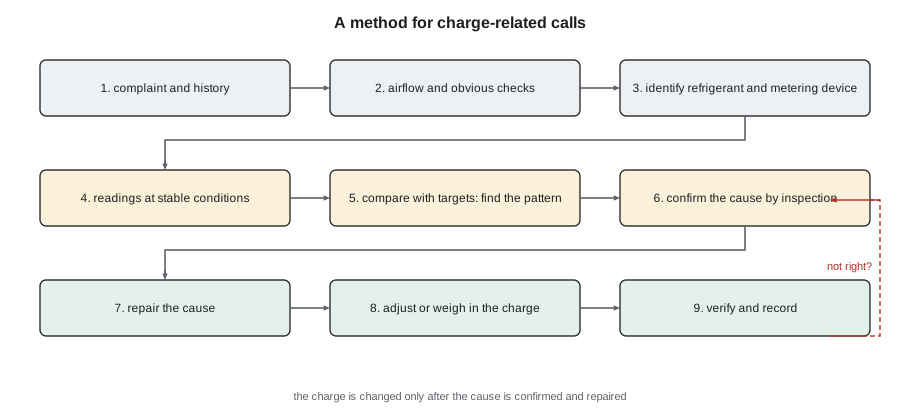
A method for charge-related complaints
- Listen to the complaint and look at the history. Recent top-ups, repairs or installations matter. A system that has needed refrigerant before has a leak until proven otherwise.
- Check the airflow and the obvious first: filters, coils, fans, belts, ice, blocked returns, thermostat settings and fault codes.
- Identify the metering device and the refrigerant from the nameplate and the equipment. The device decides which charging method applies.
- Take the full set of readings from lesson 7 at stable conditions, and use the correct P-T columns for the refrigerant.
- Compare with the manufacturer's targets for the current conditions and look for the pattern: low charge, overcharge, restriction, airflow, condenser, compressor or metering device.
- Confirm the cause by inspection: a temperature drop at a restriction, a leak found with a detector or bubbles, a loose bulb, a failed sensor.
- Repair the cause before adjusting the charge. If the system was leaking, find and repair the leak, then pressure-test, evacuate and weigh in, as RAC-120 and lessons 8 and 9 require.
- Verify the result with the manufacturer's method, and record everything.
Documentation
Every time refrigerant is added, removed or recovered, the work must be recorded. The regulations in RAC-120 set minimum records for many systems; customers, manufacturers' warranties and good practice require more. A useful service record includes:
- The equipment's identity: customer, location, make, model, serial number, refrigerant type and nameplate charge.
- The complaint, the readings taken with conditions (outdoor and indoor temperatures, wet bulb where relevant), and the targets used.
- The cause found and the repair made, including the location of any leak and how it was verified.
- The amounts of refrigerant recovered, added and removed, by weight, with the cylinder used, and the total charge now in the system.
- Evacuation results: final vacuum and decay test values.
- For A2L systems, the total charge written on the label and the results of the refrigerant detection system test.
- The technician's name and certification, the date, and any recommendations or follow-up.
Records do more than satisfy rules. They show patterns over time: a system that needs refrigerant every spring has a leak that someone has not found; a valve that has been adjusted three times is probably not the problem. For systems covered by leak-rate rules, the record of refrigerant added is the basis for calculating the leak rate, as RAC-120 showed for the seniors' residence's chiller.
# Build a short service record and check the charge history (kg)
record = {
    "site": "Seniors' residence, kitchen walk-in", "refrigerant": "R-448A", "nameplate_kg": 5.4,
    "metering": "TXV, external equalizer",
    "readings": {"suction_kPa_g": 170, "dew_C": -11.9, "suction_line_C": 1.0, "liquid_kPa_g": 1450, "bubble_C": 35.5, "liquid_line_C": 34.9},
}
history = [("2025-06-12", 0.8), ("2026-01-20", 0.9), ("2026-11-05", 0.0)]   # date, refrigerant added in kg

r = record["readings"]
superheat = r["suction_line_C"] - r["dew_C"]
subcool = r["bubble_C"] - r["liquid_line_C"]
print(f"{record['site']} | {record['refrigerant']} | {record['metering']}")
print(f"superheat {superheat:.1f} K, subcooling {subcool:.1f} K")
added = sum(kg for _, kg in history)
print(f"refrigerant added in the past 17 months: {added:.1f} kg ({added / record['nameplate_kg'] * 100:.0f} % of the nameplate charge)")
if added > 0 and superheat > 10 and subcool < 2:
print("pattern: low charge with repeated top-ups -> find and repair the leak before charging")Seniors' residence, kitchen walk-in | R-448A | TXV, external equalizer superheat 12.9 K, subcooling 0.6 K refrigerant added in the past 17 months: 1.7 kg (31 % of the nameplate charge) pattern: low charge with repeated top-ups -> find and repair the leak before charging
Capstone call 1: the residence walk-in
The walk-in was at 7 °C (45 °F) against a set point of 3 °C (37 °F). The evaporator coil and fans were clean and running, the door gaskets sealed and the condenser was clean. Theo's readings, shown in the program above, gave a superheat at the bulb of about 13 K (23 °F) and a subcooling of under 1 K (2 °F), with bubbles in the sight glass and a hissing sound at the TXV. The pattern was a starved evaporator with almost no subcooling: low charge. The record showed two top-ups in the past seventeen months by another contractor, together about 1.7 kg (3.8 lb), with no leak recorded.
Rather than add refrigerant, Theo leak-checked the system with an electronic detector and then bubble solution. He found a leak at a flare connection on the liquid line solenoid, which had been vibrating against a bracket. The residence's maintenance manager agreed to the repair. Theo recovered the charge, replaced the flare with a brazed connection using a nitrogen purge, installed a new filter-drier, pressure-tested with nitrogen, evacuated to 53 Pa (400 microns) with a decay test that held, and weighed in the nameplate charge of 5.4 kg (12 lb) as liquid. At stable conditions, the superheat at the bulb was about 5 K (9 °F), the sight glass was clear and the box pulled down to set point within the hour. The record listed the leak location, the repair, the charge recovered and added, the evacuation results and a recommendation to check the bracket on the next maintenance visit.
Capstone call 2: the frozen suction line
The homeowner's air conditioner had a fixed piston, R-410A and a nameplate showing 2.95 kg (6.5 lb) for 4.6 m (15 ft) of line set. It was running with frost on the suction line back to the outdoor unit. Theo checked the filter: it was clogged, and the indoor coil was partly iced. He shut the system off in cooling and ran the indoor fan to thaw the coil, replaced the filter and waited until the coil was clear before taking readings. With the airflow corrected, the indoor wet bulb was 18 °C (64 °F) and the outdoor dry bulb 30 °C (86 °F), for a target superheat of about 8 K (13 °F). The actual superheat was under 2 K (4 °F), and the subcooling and head pressure were high.
So the earlier "recharge" had overcharged the system, probably because it had been done with a blocked filter that made the superheat look high. The low airflow had been the real problem. Theo recovered refrigerant in small amounts, weighing what he removed, until the superheat came up to the target and the subcooling fell. He removed about 0.45 kg (1 lb). Because the homeowner reported no history of refrigerant problems before the filter clogged, there was no evidence of a leak, but he leak-checked the accessible joints anyway and found none. The record explained the filter, the overcharge and the amount removed, and recommended a filter change schedule.
Capstone call 3: the detection fault
At the Lindqvists', the indoor unit's board showed a fault code for the refrigerant detection sensor, logged at three in the morning, and the blower had run until the homeowner reset the system. The service manual's chart listed three possibilities: refrigerant detected, sensor fault and communication fault. Theo checked the area with his A2L-rated detector before opening the cabinet and found no refrigerant. The board's data showed the sensor reporting a fault rather than a concentration. The sensor's connector had been pinched under a panel edge during the installation and its wire had chafed. With the power off, Theo replaced the sensor harness as the manual described, ran the RDS test, confirmed that the blower started and the compressor stopped, and cleared the test. He leak-checked the indoor coil and line set joints with the detector to be certain, finding nothing, and noted in the record that no refrigerant had been added or removed and that the RDS had been tested after the repair.
| Call | Key readings | Cause found | Action | Charge change |
|---|---|---|---|---|
| Residence walk-in (TXV, R-448A) | High superheat, near-zero subcooling, bubbles | Leak at liquid line solenoid flare | Brazed repair, new drier, evacuate, weigh in | Full charge recovered and weighed in |
| Home air conditioner (piston, R-410A) | Low superheat, high subcooling after airflow fixed | Overcharge from earlier top-up with a clogged filter | New filter, recover to target superheat | About 0.45 kg (1 lb) removed |
| Lindqvist heat pump (R-454B) | No refrigerant detected; sensor fault reported | Chafed sensor harness | Harness replaced, RDS tested | None |
Reporting back
Back at the shop, Dana went through each record. She asked Theo why he had not added refrigerant at the walk-in to get the residence through the weekend. "Because it had already been topped up twice," he said, "and every top-up just lets the leak keep going." She asked why he had removed refrigerant from the home system instead of starting again with a full recovery and weigh-in, and he pointed out that the system had no leak, the nameplate charge was known and the superheat method with corrected airflow had given a clear target; a full recovery would have been more accurate but would have cost the homeowner more for little gain. She agreed, and added that if the target superheat had been near the bottom of the chart, she would have weighed in. On the third call, she asked what he would have done if his detector had found refrigerant. Theo answered from lesson 11: ventilate, keep ignition sources away, find the leak, recover with A2L-rated equipment, purge with nitrogen and only then repair.
"That's the course," Dana said. "Metering device, readings, cause, charge, record. Next year, we put it together with the controls."
Explaining the work to the customer
A customer who reads a service record should understand what was wrong, what was done and what they need to do next, without having to decode technical shorthand. Good technicians write a short plain-language summary at the top of the record and keep the readings and refrigerant amounts below it. For the residence's walk-in, Theo's summary said that the cooler had been losing refrigerant through a loose fitting that had been vibrating, that the fitting had been replaced with a brazed joint, that the system had been refilled with the correct amount and that the bracket should be checked on the next visit. For the homeowner, it said that a clogged filter had made the system look short of refrigerant, that too much had been added as a result, that the extra had been removed and that the filter should be changed every few months.
Plain summaries protect everyone. They show the customer that the cause was found, not just the symptom treated. They give the next technician a starting point. And when a dispute arises, such as a customer asking why refrigerant was added and the system still leaks, a clear record of the readings, the leak search and the recommendations shows what was known and done at the time. Photos of nameplates, gauge readings, leak locations and labels, attached to the electronic record, are now common practice at many contractors, including Northfield.
- Write what was found and done in plain words first, then the technical details.
- State refrigerant amounts by weight and the final total charge.
- List any recommendations, and whether the customer accepted or declined them.
- Attach photos where the contractor's system allows it.
Common mistakes
MistakeTopping up a system that has needed refrigerant before.
InsteadFind and repair the leak, then weigh in the charge.
MistakeCharging with an airflow problem present.
InsteadFix filters, coils and fans first, then read the system.
MistakeRecording only the refrigerant added.
InsteadRecord readings, conditions, cause, repair, all amounts by weight, evacuation results and the final charge.
MistakeClearing an A2L detection fault without checking for refrigerant.
InsteadCheck the area with an A2L-rated detector before anything else.
MistakeAdjusting a valve or charge to compensate for a fault elsewhere.
InsteadRepair the cause; then adjust only what the manufacturer's method calls for.
Summary and key terms
- Follow a method: history, airflow, identify, read, compare, confirm, repair, charge, verify, record.
- Repeated top-ups mean a leak; find and repair it before charging.
- Low airflow can make an overcharge look like an undercharge; fix airflow first.
- A2L detection faults are treated as a leak until a detector shows otherwise.
- Records include equipment, readings, cause, repair, refrigerant amounts by weight, evacuation and the final charge.
- Records show patterns over time and support leak-rate calculations.
- Service record
- A written record of a service call, including readings, repairs and refrigerant amounts.
- Top-up
- Adding refrigerant to a system without recovering the existing charge.
- Leak check
- A search for leaks using detectors, bubble solution or pressure tests.
- Verification
- Confirming after a repair that the system runs to the manufacturer's targets.
- Charge history
- The record of refrigerant added and removed over the life of a system.
Practice problems
Work each problem on paper first, then reveal the answer to check.
A cooler has needed 0.8 kg and 0.9 kg in two visits. What is the first step on the third visit?
Show answer
Leak-check and repair before charging.
A piston system has a blocked filter and high superheat. What should be done before charging?
Show answer
Replace the filter and clear any ice, then take new readings.
What should a record show for an A2L system after a charge?
Show answer
The total charge on the label, all amounts by weight, evacuation results and the RDS test.
Why remove refrigerant in small amounts when correcting an overcharge?
Show answer
So the superheat can settle and the target is approached without removing too much.
Lesson quiz · 5 questions
Score 60% or more to complete this lesson.
Create a free account to save your progress, take quizzes and earn a certificate.