
RAC-210 · Lesson 9 of 12 · 19 min
System accessories: driers, receivers, accumulators and separators
A few weeks after the clinic's rooftop unit had its phase rotation corrected, the clinic manager called again: the unit was cooling, but not as well as before, and the cooling coil had frost on its bottom rows on a hot afternoon. Theo connected his gauges and temperature clamps. The suction pressure was low, the superheat high and the subcooling at the condenser outlet normal. He worked his way along the liquid line with a clamp thermometer and stopped at the filter-drier. The liquid line was 39 °C (102 °F) entering the drier and 31 °C (88 °F) leaving it, and the drier's outlet was sweating. "There's your restriction," Dana said when he called. "A drier that drops eight degrees is flashing the liquid. Something has been loading it up, maybe debris from when the compressor was replaced years ago. Change it, and pull an oil sample while you're in there."
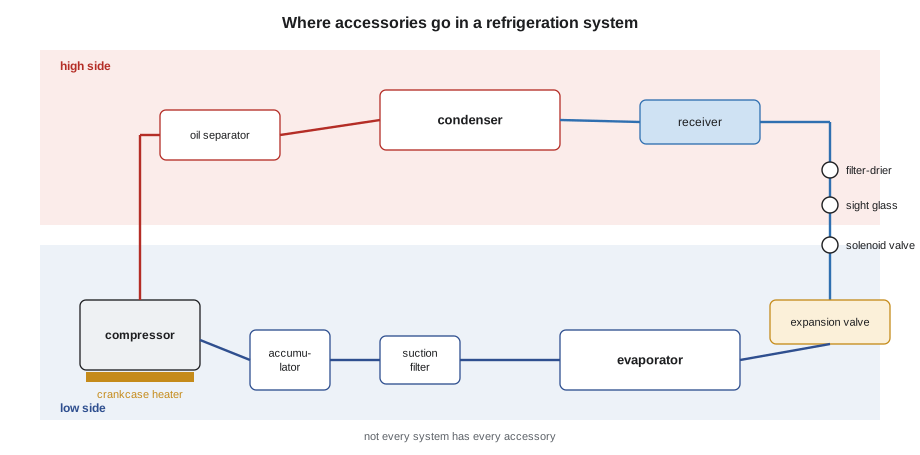
Between the compressor, condenser, metering device and evaporator, most refrigeration systems have a set of accessories that protect the system, store refrigerant, control flow and give the technician information. This lesson covers filter-driers and moisture-indicating sight glasses, receivers and accumulators, oil separators, solenoid and check valves, service valves, crankcase pressure and suction pressure regulating devices in outline, vibration eliminators, mufflers and heat exchangers: what each does, where it goes and how it fails.
Filter-driers
A filter-drier is a shell containing a desiccant core, usually a molded block of molecular sieve, activated alumina or both, held between screens. It removes moisture, acid and solid particles from the refrigerant. Moisture in a system causes ice at the metering device in low-temperature systems, forms acids with oil and refrigerant, and attacks motor insulation. Molecular sieve adsorbs water strongly; activated alumina also captures acids.
- Liquid line filter-driers are installed in the liquid line ahead of the metering device and the sight glass. Every system should have one, and it should be replaced whenever the system is opened for repair, because a drier that has been exposed to air has absorbed moisture and a drier that has worked for years may be near its capacity.
- Suction line filter-driers or filters are installed temporarily, or permanently in some systems, ahead of the compressor, mainly during burnout cleanups. They have high acid capacity and catch debris before it reaches the new compressor. Because a restriction in the suction line reduces capacity and raises superheat, they are fitted with pressure taps so the pressure drop can be measured, and removed or replaced when the cleanup is complete or the drop is too high.
- Bi-flow filter-driers are used in heat pumps, where the liquid line flows in both directions between heating and cooling. They contain check valves so the flow always passes through the core in the filtering direction.
- Replaceable-core driers have a bolted shell with removable cores, common on larger commercial systems and in burnout cleanups.
Driers are sized for the system's capacity and the refrigerant, using the manufacturer's tables. An undersized drier restricts flow and fills quickly; an oversized one is wasteful but harmless. A drier must be installed in the direction of the arrow on its shell, and brazed quickly with a wet rag or heat sink on its body so the desiccant and any internal seals are not overheated.
Recognizing a restricted drier
A filter-drier that has caught enough debris, sludge or wax restricts the liquid line. The pressure drop across it lowers the liquid's pressure, and if the pressure falls below the saturation pressure for the liquid's temperature, some liquid flashes to vapour inside or just after the drier. The evaporator is then fed with a mixture of liquid and flash gas, so it is starved: suction pressure and capacity fall and superheat rises. Because flashing absorbs heat, the drier's outlet is colder than its inlet, sometimes cold enough to sweat or frost.
- A temperature drop of more than about 1 to 2 K (2 to 3 °F) across a liquid line drier, measured with clamp thermometers on the copper on each side, is a common field sign of a restriction.
- Where the drier has access ports on both sides, the pressure drop can be measured directly and compared with the manufacturer's allowable drop.
- Bubbles in the sight glass immediately after the drier, with a full sight glass ahead of it, also suggest flashing in the drier, although bubbles can have other causes.
# Is the liquid flashing after the filter-drier? (R-410A, approximate saturation table)
import math
table = [(-10, 573), (0, 799), (10, 1088), (20, 1445), (30, 1883), (40, 2416), (50, 3054), (60, 3800)]  # C, kPa abs
P_ATM = 101.3

def sat_temp(p_abs):
    for (t1, p1), (t2, p2) in zip(table, table[1:]):
        if p1 <= p_abs <= p2:
            f = (math.log(p_abs) - math.log(p1)) / (math.log(p2) - math.log(p1))
            return t1 + f * (t2 - t1)
    raise ValueError("outside table")

liquid_temp_in = 39.0         # C, liquid entering the drier
p_in = 2700                   # kPa gauge, entering the drier
for drop in [20, 100, 250, 600]:       # kPa pressure drop across the drier
    t_sat_out = sat_temp(p_in - drop + P_ATM)
    subcool_out = t_sat_out - liquid_temp_in
    state = "still subcooled" if subcool_out > 0 else "FLASHING: liquid at its boiling point, part turns to vapour"
    shown = liquid_temp_in if subcool_out > 0 else t_sat_out
print(f"drop {drop:4d} kPa: saturation after drier {t_sat_out:5.1f} C, liquid about {shown:4.1f} C -> {state}")drop 20 kPa: saturation after drier 46.0 C, liquid about 39.0 C -> still subcooled drop 100 kPa: saturation after drier 44.8 C, liquid about 39.0 C -> still subcooled drop 250 kPa: saturation after drier 42.3 C, liquid about 39.0 C -> still subcooled drop 600 kPa: saturation after drier 36.3 C, liquid about 36.3 C -> FLASHING: liquid at its boiling point, part turns to vapour
The program shows the link between pressure drop and flashing. A small drop leaves the liquid subcooled and does no harm. A large drop lowers the saturation temperature below the liquid's temperature, so the liquid boils until it cools to the new saturation temperature, which is exactly the temperature drop Theo measured with his clamps. The subcooling that the condenser provided is used up in the drier instead of protecting the liquid on its way to the metering device.
Sight glasses and moisture indicators
A sight glass in the liquid line lets the technician see the refrigerant. A clear, full glass shows solid liquid; bubbles show vapour mixed with the liquid. Bubbles can mean a low charge, a restriction upstream such as a plugged drier, too little subcooling, or simply a transient condition after start-up or when a fan cycles. With some blends with glide, and at low loads, a few bubbles can appear even with a correct charge. A sight glass is therefore a clue, never the only basis for adding refrigerant; charging methods based on superheat, subcooling and the manufacturer's charts are covered in RAC-220.
Most sight glasses also contain a moisture-indicating element, a chemical spot that changes colour with the moisture content of the refrigerant, for example from green for dry to yellow for wet. The element must be read with the system running and stable, and it can take hours to respond after a change. A wet indication means the drier is saturated or the system has a leak or a contamination problem, and the drier must be changed and the cause found.
Receivers
A receiver is a storage tank in the liquid line after the condenser. Systems with thermostatic or electronic expansion valves, whose refrigerant needs vary with load and outdoor temperature, use receivers to hold the extra refrigerant when it is not needed, for example in summer on a system with condenser flooding head pressure control. Receivers also hold the charge during pump-down and give a place to store the whole charge for service. They have a dip tube or bottom outlet so only liquid leaves, and usually a relief valve and service valves. Because liquid in the receiver is at saturation, the liquid leaving it has no subcooling until it loses heat in the liquid line or a subcooler.
Systems with fixed metering devices such as capillary tubes or fixed orifices, and most residential air conditioners, do not use receivers; their charge is critical and is set by the manufacturer.
Suction accumulators
A suction accumulator is a vessel in the suction line ahead of the compressor that catches liquid refrigerant and oil returning from the evaporator, for example during start-up, defrost or a heat pump's change of mode. Liquid collects at the bottom; vapour leaves through a U-shaped outlet tube at the top. A small hole, the oil return orifice, at the bottom of the U-tube meters liquid and oil back slowly into the suction gas, so oil returns without a slug of liquid. Heat pumps and many rotary and scroll compressors rely on accumulators.
If the oil return orifice plugs, oil is trapped in the accumulator and the compressor runs short of oil. An accumulator that is undersized or full of liquid cannot protect the compressor. A heavily sweating or frosted accumulator during steady running, rather than briefly after a defrost, suggests liquid is returning continuously and the cause, such as overcharge, low airflow or an overfeeding metering device, must be found.
Oil separators
An oil separator in the discharge line removes most of the oil from the discharge gas before it reaches the condenser, and returns it to the compressor crankcase or to an oil management system. Separators use changes of direction, centrifugal action, baffles, screens or coalescing filter elements. A float valve returns collected oil to the compressor. Oil separators are standard on screw compressors, supermarket racks, low-temperature systems and systems with long or complex piping, where oil return through the system is difficult. They do not remove all the oil, so good piping practice is still needed.
On a multi-compressor rack, an oil management system returns oil from the separator to an oil reservoir and then to each compressor through oil level regulators that keep each crankcase at the right level. A float that sticks closed starves a compressor of oil; one that sticks open can pass hot discharge gas into the crankcase or flood it with oil.
Solenoid valves and check valves
- A solenoid valve is an electrically operated valve. The most common in refrigeration is the liquid line solenoid, normally closed, which opens when its coil is energized by the thermostat or controller. It is the heart of a pump-down system, and it isolates evaporators in multi-evaporator systems and during defrost. Solenoids must be installed in the flow direction shown on the body. A coil that has burnt out, a valve that sticks open or a valve that leaks through when closed are common faults; a closed solenoid that leaks lets the low side refill during the off cycle, so a pump-down compressor short-cycles on its low-pressure control.
- A check valve allows flow in one direction only. Check valves are used in heat pumps, in parallel compressor discharge lines, in hot gas defrost piping and in bi-flow driers. A check valve stuck open or closed can cause odd pressure behaviour that looks like other faults.
Service valves, access fittings and other accessories
- Schrader-type access fittings, like tire valves, give access for gauges. Their cores can leak and should be capped; core removal tools speed evacuation and recovery.
- Compressor service valves on semi-hermetic compressors and condensing units have a back seat, a front seat and a mid position. Back-seated, the gauge port is closed; front-seated, the line is closed; cracked off the back seat, the gauge port reads the pressure. Ball valves are also common on modern equipment.
- Vibration eliminators, flexible braided hoses in the suction and discharge lines near the compressor, stop vibration from cracking piping.
- Discharge mufflers reduce gas pulsation noise from reciprocating compressors.
- Suction-liquid heat exchangers transfer heat from the warm liquid line to the cold suction line, subcooling the liquid and adding superheat to the suction gas, which helps some refrigerants and some low-temperature systems but can overheat compressors if overused.
- Pressure regulating valves such as evaporator pressure regulators, which keep an evaporator above a minimum pressure, and crankcase pressure regulators, which limit the suction pressure the compressor sees after defrost or start-up, are used in commercial refrigeration and are covered with commercial systems in a later course.
Changing the drier on the rooftop unit
Back at the clinic, Theo locked out the unit and recovered the R-410A into a recovery cylinder, following the procedures from RAC-120. He cut out the old drier and set it aside for inspection, then brazed in a new drier of the correct size and flow direction with a dry nitrogen flow through the piping and a wet rag around the drier's body. He took an oil sample from the compressor's oil port with the unit's service kit and ran an acid test: the oil was clear and the test showed it below the acid threshold. After a nitrogen pressure test and evacuation, the topics of lessons 11 and 12, he weighed the charge back in. The liquid line temperature drop across the new drier was under 1 K (2 °F), the suction pressure and superheat returned to normal and the coil frost disappeared. When he cut open the old drier in the shop, its inlet screen was coated with fine black debris, which Dana suspected was carbon from an old compressor burnout that had never been fully cleaned up.
Common mistakes
MistakeReusing a filter-drier after opening a system.
InsteadReplace the liquid line drier whenever the system is opened.
MistakeAdding refrigerant because of bubbles in the sight glass alone.
InsteadCheck for restrictions, subcooling and the charging method first; bubbles have several causes.
MistakeInstalling a solenoid valve or drier backward.
InsteadFollow the flow arrows on the body.
MistakeLeaving a suction filter-drier in permanently after a cleanup without checking its pressure drop.
InsteadMeasure the drop, change cores as needed and remove or replace it as the instructions require.
MistakeOverheating a drier while brazing it in.
InsteadUse a wet rag or heat sink on the body and braze quickly.
Summary and key terms
- Liquid line filter-driers remove moisture, acid and solids; replace them whenever the system is opened.
- A restricted drier causes flashing: a temperature drop across it, a starved evaporator and high superheat.
- Sight glasses show liquid or bubbles; moisture indicators show whether the refrigerant is dry.
- Receivers store liquid in systems with expansion valves; accumulators protect compressors from liquid in the suction line.
- Oil separators return oil from the discharge line; solenoid valves and check valves control flow.
- Service valves, access fittings, vibration eliminators, mufflers and heat exchangers each have their own checks.
- Filter-drier
- A device that removes moisture, acid and particles from refrigerant.
- Molecular sieve
- A desiccant that strongly adsorbs water molecules.
- Bi-flow drier
- A filter-drier for heat pumps that filters in both flow directions.
- Flash gas
- Vapour formed when liquid refrigerant's pressure falls below its saturation pressure.
- Sight glass
- A window in the liquid line showing whether the refrigerant is solid liquid.
- Moisture indicator
- A colour-changing element in a sight glass that shows refrigerant moisture.
- Receiver
- A tank that stores liquid refrigerant after the condenser.
- Suction accumulator
- A vessel that traps liquid in the suction line and meters it back with oil.
- Oil separator
- A device that removes oil from discharge gas and returns it to the compressor.
- Liquid line solenoid
- An electrically operated valve that opens or closes the liquid line.
Practice problems
Work each problem on paper first, then reveal the answer to check.
Liquid enters a drier at 38 °C and leaves at 34 °C. What does this suggest?
Show answer
A restriction causing flashing; a drop over about 1 to 2 K is a common sign.
Why does a heat pump use a bi-flow drier?
Show answer
The liquid line flows both ways; the drier filters in both directions.
A pump-down cooler short-cycles on its low-pressure control during the off cycle. What accessory should you suspect?
Show answer
A liquid line solenoid leaking through when closed.
What does a yellow moisture indicator mean?
Show answer
Wet refrigerant; change the drier and find the source of moisture.
Lesson quiz · 5 questions
Score 60% or more to complete this lesson.
Create a free account to save your progress, take quizzes and earn a certificate.