
RAC-210 · Lesson 6 of 12 · 20 min
Air-cooled condensers and head pressure control
In January, with the outdoor temperature at −22 °C (−8 °F), Priya at the brewery called about the walk-in cooler again. This time it was not warm; it was cycling strangely, and the low-pressure control kept tripping the condensing unit off before the room reached temperature. Theo and Dana found the head pressure very low, the liquid line sight glass full of bubbles, and the evaporator starved. The condensing unit's head pressure control valve, which should hold the condensing pressure up in cold weather by backing liquid into the condenser, had a cracked dome and had lost its charge. "In summer the problem is getting heat out of the condenser," Dana said. "In a Kitchener winter, the problem is that the condenser gets rid of heat too easily."
The condenser is where the heat absorbed in the evaporator, plus the heat of compression, leaves the system. Most refrigeration and air conditioning condensers in small and medium systems are cooled by outdoor air. This lesson explains the three zones of a condenser, the condenser temperature difference and how it is used for diagnosis, how condenser capacity and heat rejection are calculated, how condensers are maintained, and how head pressure is controlled in cold weather so that metering devices and systems keep working.
Three jobs in one coil
Hot, superheated discharge gas enters the top of the condenser. As it flows through the tubes, it gives up heat to the air crossing the fins, in three stages.
- Desuperheating. The gas first cools from the discharge temperature down to the saturation, or condensing, temperature. This takes a fairly small part of the coil, although the temperature drop is large.
- Condensing. At the condensing temperature, the vapour changes to liquid while giving up its latent heat. This takes most of the coil and removes most of the heat, all at a nearly constant temperature for a single-component refrigerant or a near-azeotrope.
- Subcooling. Once all the vapour has condensed, the liquid cools a few degrees below the condensing temperature in the last passes of the coil. Subcooling ensures the liquid reaching the metering device is fully liquid, and adds a little capacity.
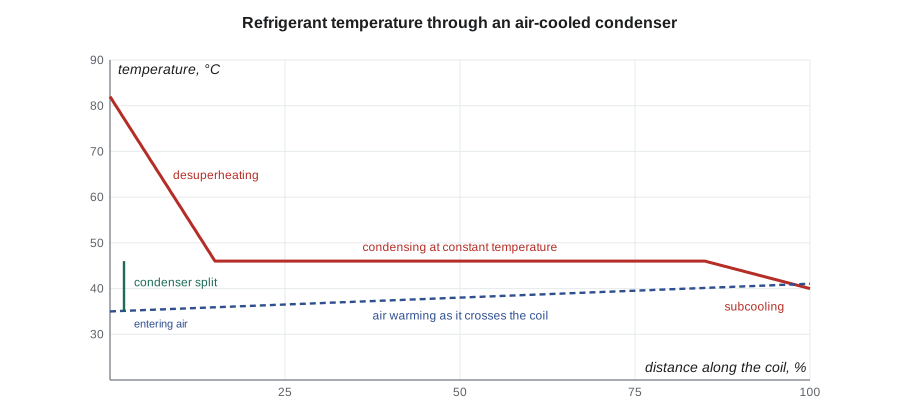
The condensing temperature is found from the high-side pressure with a pressure-temperature chart, as in level one. For blends with glide, such as R-448A or R-407C, the dew point is used for the condensing temperature when calculating superheat at the condenser inlet, and the bubble point when calculating liquid subcooling, following the manufacturer's practice.
Condenser temperature difference
The temperature difference between the condensing temperature and the air entering the condenser is called the condenser TD, or condenser split. It is set by the condenser's size and design and the amount of heat it must reject. Because heat flow through a coil is roughly proportional to the temperature difference, a given condenser at a given load runs with a fairly predictable TD, whatever the outdoor temperature.
| Equipment | Typical design condenser TD |
|---|---|
| Older standard-efficiency air conditioners | About 15 to 17 K (27 to 30 °F) |
| Higher-efficiency air conditioners and heat pumps | About 8 to 12 K (15 to 22 °F) |
| Medium-temperature refrigeration condensing units | About 8 to 14 K (15 to 25 °F) |
| Low-temperature refrigeration condensing units | About 6 to 8 K (10 to 15 °F) |
The TD is one of the most useful diagnostic numbers in the trade. If a condenser that normally runs with a 10 K (18 °F) split is running with a 20 K (36 °F) split at a normal load, something is stopping it from rejecting heat: dirt on the coil, a failed or slow fan, recirculation of hot discharge air back into the inlet, or non-condensable gases such as air in the system. If the split is much lower than normal, the system may be low on charge, the compressor may not be pumping, or the load may be very light.
Worked problem
Reading the condenser split at the brewery
In August, the brewery's walk-in condensing unit runs with entering air at 32 °C (90 °F) and a condensing temperature, read from the high-side pressure, of 53 °C (127 °F). The unit's design split is 11 K (20 °F). What does the reading suggest?
Show solution
- TD = 53 − 32 = 21 K, almost twice the design split of 11 K
Answer: The condenser is not rejecting heat as it should. Before checking the charge, Theo should look at the obvious causes: the coil, which at a brewery collects grain dust and yeast; the fan, which should be at full speed with clean blades; and the surroundings, where hot air from a nearby unit might be recirculating. Cleaning the coil is the usual fix, and the split should come back near design.
Heat rejection
The heat a condenser must reject is the evaporator's capacity plus the heat of compression. Manufacturers often express this as a heat of rejection factor, the ratio of total heat rejected to the refrigerating capacity. For a hermetic compressor cooled by suction gas, the motor's losses also go into the refrigerant and out at the condenser. Factors are commonly about 1.2 to 1.3 for air conditioning and medium-temperature refrigeration, and higher, about 1.4 to 1.6 or more, for low-temperature refrigeration, where the compressor does more work per unit of cooling.
On the air side, the heat rejected warms the air flowing through the coil. The air temperature rise across the condenser can be estimated from the airflow:
# Condenser heat rejection and air temperature rise
cases = [  # (name, evaporator capacity kW, compressor input kW, condenser airflow L/s, entering air C, condensing C)
    ("brewery walk-in, design",   2.6, 1.10, 650, 32.0, 43.0),
    ("brewery walk-in, dirty",    2.3, 1.30, 420, 32.0, 53.0),
    ("clinic rooftop unit",      10.5, 3.20, 1600, 30.0, 45.0),
]
for name, qe, w, flow, t_air, t_cond in cases:
    qc = qe + w
    rise = qc * 1000 / (1.23 * flow)
    leaving = t_air + rise
    print(f"{name:26s}: rejects {qc:5.2f} kW (factor {qc / qe:.2f}); air rises {rise:4.1f} K "
f"to {leaving:4.1f} C; condenser TD {t_cond - t_air:4.1f} K")brewery walk-in, design : rejects 3.70 kW (factor 1.42); air rises 4.6 K to 36.6 C; condenser TD 11.0 K brewery walk-in, dirty : rejects 3.60 kW (factor 1.57); air rises 7.0 K to 39.0 C; condenser TD 21.0 K clinic rooftop unit : rejects 13.70 kW (factor 1.30); air rises 7.0 K to 37.0 C; condenser TD 15.0 K
The dirty-condenser case shows the chain of effects: with airflow cut by a plugged coil, the same heat must be rejected with less air, so the air leaving the coil is hotter, and the condensing temperature has to rise until the larger split forces the heat out. The compressor then works harder, its input rises, the factor rises and the evaporator capacity falls. Cleaning one coil fixes all of these at once.
Keeping air-cooled condensers working
- Clean coils. Dust, cottonwood seeds, grease from restaurant exhausts and grain dust plug fins from the air inlet side. Coils are cleaned with the power locked out, using a coil cleaner approved for the coil material and water at low pressure, flushing from the clean side outward, opposite to the airflow. Microchannel aluminium coils, common on newer equipment, need gentler cleaning and only cleaners approved by the manufacturer, because they corrode easily.
- Fans. Check that blades are clean, undamaged and turning in the right direction at full speed, and that motor current is within its nameplate.
- Clearances. The unit needs the manufacturer's minimum clearances on all sides and above it. Walls, fences, shrubs, snow and nearby units can cause hot discharge air to recirculate into the inlet.
- Fins. Bent fins block airflow and can be straightened with a fin comb.
- Non-condensables. Air or nitrogen trapped in the system collects at the top of the condenser and raises head pressure. A high split with a clean coil and good airflow, and a condensing pressure well above the saturation pressure for the liquid's temperature after the unit has been off and has reached ambient temperature, suggest non-condensables. The fix is to recover the charge, evacuate and recharge.
Why head pressure must be controlled in cold weather
A refrigeration condenser outdoors in a cold winter can condense the refrigerant at a very low temperature. That sounds efficient, but the metering device needs a minimum pressure difference across it to feed the evaporator properly. A thermostatic expansion valve sized for a summer pressure difference cannot pass enough liquid when the head pressure falls to a fraction of its summer value, so the evaporator starves, the suction pressure falls and the low-pressure control trips, exactly what Priya's walk-in was doing. Hot gas defrost systems and heat reclaim systems also need a minimum head pressure. Air conditioning systems that run in cold weather, such as those cooling server rooms or interior zones of large buildings, need the same protection.
Head pressure control keeps the condensing pressure above a minimum by reducing the condenser's ability to reject heat in cold weather. Methods include:
- Fan cycling. A pressure or temperature control switches condenser fans off as the head pressure falls. On multi-fan condensers, fans are cycled in steps. Fan cycling is simple but causes the head pressure to swing.
- Fan speed control. A variable-speed fan motor or a fan speed controller slows the fan as the head pressure falls, giving smoother control.
- Dampers. Motorized louvres reduce airflow through the coil.
- Condenser flooding. A head pressure control valve, often combined with a receiver, backs liquid refrigerant up into the condenser in cold weather. Liquid-filled tubes have little effect on heat rejection, so the active condensing surface shrinks and the head pressure rises. Discharge gas is bypassed directly to the receiver to keep its pressure up. The system needs enough extra refrigerant to flood the condenser at the lowest design outdoor temperature, which is why such systems have a receiver and a larger charge.
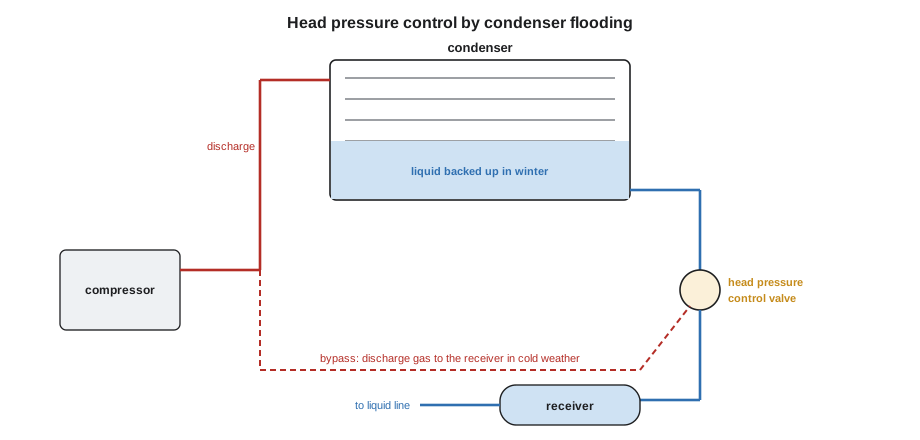
On the brewery walk-in, the head pressure control valve's dome contained a charge that set its control pressure. When the dome cracked and lost its charge, the valve opened fully to the condenser and stopped flooding it, so in the deep cold the head pressure collapsed. Replacing the valve restored control. Dana also checked the receiver level and the sight glass after the system settled, because a flooding system short of charge in winter shows the same bubbles and starving evaporator. In summer, with the condenser not flooded, the extra refrigerant sits in the receiver.
Heat reclaim and the condenser as a heat source
The heat leaving a condenser is not always wasted. Because a condenser rejects the evaporator's heat plus the heat of compression, it is a steady source of low-grade heat whenever the system runs. Supermarkets often route discharge gas through a heat reclaim coil in the store's air handler before it reaches the outdoor condenser, warming the sales floor in winter. Some restaurants and breweries use a desuperheater, a small water-cooled heat exchanger in the discharge line, to preheat domestic hot water with the hottest part of the discharge gas. The brewery's head brewer, Priya, had already asked Dana whether the glycol chiller's heat could warm the wash-down water.
Heat reclaim adds valves, controls and refrigerant volume, and it interacts with head pressure control: a reclaim coil works best at a raised condensing pressure, which costs compressor energy, so designers balance the heat recovered against the extra power. For a technician, the practical points are to know which way the discharge gas is routed in each mode, to check that the reclaim valve opens and closes fully, and to remember that a system with reclaim may carry extra charge that sits in the receiver or the idle coil. A reclaim coil that is left with liquid trapped in it during summer can also hide refrigerant from the charge, so the receiver level in each mode should be noted in the service record.
Heat pumps take the idea further: in heating mode, the indoor coil becomes the condenser, and the whole purpose of the system is to deliver the condenser's heat. Everything in this lesson about desuperheating, condensing, subcooling and the condenser split applies to the indoor coil of a heat pump in heating, with the indoor air as the cooling medium. The air temperature rise across a heat pump's indoor coil, and its high-side pressure, are read the same way.
Common mistakes
MistakeAdding refrigerant to a winter system with low head pressure and bubbles in the sight glass.
InsteadCheck the head pressure control first; a failed valve or fan control gives the same symptoms.
MistakeCleaning a condenser coil from the outside with high-pressure water.
InsteadLock out, use an approved cleaner and low pressure, and flush opposite to the airflow.
MistakeJudging condenser performance from head pressure alone.
InsteadCompare the condenser split with the design value at the actual entering air temperature.
MistakeIgnoring clearances around a condensing unit.
InsteadRecirculating hot air raises the entering temperature and the head pressure.
MistakeUsing a harsh coil cleaner on a microchannel coil.
InsteadUse only cleaners and methods approved by the coil's manufacturer.
Summary and key terms
- An air-cooled condenser desuperheats, condenses and subcools the refrigerant.
- The condenser split is the condensing temperature minus the entering air temperature; compare it with the design value.
- A high split points to dirt, fan problems, recirculation or non-condensables; a low split to low charge, a weak compressor or light load.
- Heat rejected = evaporator capacity + compressor heat, commonly a factor of about 1.2 to 1.3 for air conditioning and coolers and higher for freezers.
- Air temperature rise across a coil: Q = 1.23 × L/s × ΔT in watts (Q = 1.08 × cfm × ΔT in Btu/h).
- Cold-weather head pressure control uses fan cycling, fan speed control, dampers or condenser flooding with a receiver.
- Desuperheating
- Cooling superheated discharge gas to its saturation temperature.
- Condensing temperature
- The saturation temperature at the condenser pressure.
- Subcooling
- Cooling liquid below its saturation temperature.
- Condenser split
- Condensing temperature minus entering air temperature; also called condenser TD.
- Heat of rejection factor
- Total condenser heat divided by refrigerating capacity.
- Non-condensables
- Gases such as air or nitrogen in the system that do not condense and raise head pressure.
- Recirculation
- Hot air leaving a condenser and re-entering its inlet.
- Head pressure control
- Methods that keep condensing pressure above a minimum in cold weather.
- Condenser flooding
- Backing liquid into a condenser to reduce its active surface and raise head pressure.
- Microchannel coil
- An all-aluminium coil with flat multi-port tubes and louvred fins.
Practice problems
Work each problem on paper first, then reveal the answer to check.
A condenser has 35 °C entering air and a 46 °C condensing temperature. What is the split?
Show answer
11 K.
A walk-in's evaporator capacity is 3.0 kW and its heat of rejection factor 1.35. How much heat does the condenser reject?
Show answer
4.05 kW.
A condenser with 800 L/s of air rejects 5.0 kW. What is the air temperature rise?
Show answer
5,000 ÷ (1.23 × 800) ≈ 5.1 K.
Why does a TXV system starve in very cold weather without head pressure control?
Show answer
The pressure difference across the valve becomes too small for it to feed enough liquid.
Lesson quiz · 5 questions
Score 60% or more to complete this lesson.
Create a free account to save your progress, take quizzes and earn a certificate.