
RAC-210 · Lesson 3 of 12 · 21 min
Scroll compressors and capacity control
The dental clinic's rooftop unit had been off for a morning while the power utility replaced a transformer on the street. When the power came back, the unit started, but the clinic manager called within the hour: the air from the vents was warm, and the unit on the roof was making a loud, rattling hum. Theo and Dana found the compressor running, drawing about half its usual current, with suction and discharge pressures almost equal. The compressor shell was quiet at the bottom and noisy at the top. Dana locked out the unit and checked the phase rotation at the disconnect with a rotation meter. The utility had rolled two phases. "A scroll only pumps one way," she said. "Run it backward on three-phase and it just churns." With the power off, she swapped two supply leads at the disconnect, and the unit pulled down normally. The clinic's maintenance log already noted the scroll had run backward for under an hour, short enough that it was unlikely to be harmed, but Dana wrote a note to check it again at the next visit.
The scroll compressor has become the most common compressor in residential and light commercial air conditioning, heat pumps and many refrigeration condensing units. This lesson explains how a scroll compresses, why it is quiet and efficient, its compliance mechanisms and tolerance to liquid, the special precautions it needs, and the ways capacity is controlled: staged and modulated scrolls, multiple compressors, and variable-speed inverter drives, which are now common in heat pumps and ductless systems such as the one in the attic of the house on Northfield's service list.
How a scroll compresses
A scroll compressor has two spiral-shaped scrolls, one fixed and one orbiting. The orbiting scroll does not rotate; it is driven by an eccentric crank on the motor shaft so that it moves in a small circle, with an anti-rotation coupling keeping it from turning. As it orbits, the two spirals touch at several points along their flanks and form crescent-shaped pockets of gas. Suction vapour enters at the outside edge. With each orbit, the pockets move toward the centre and shrink, compressing the gas, until they reach the discharge port at the centre of the fixed scroll.
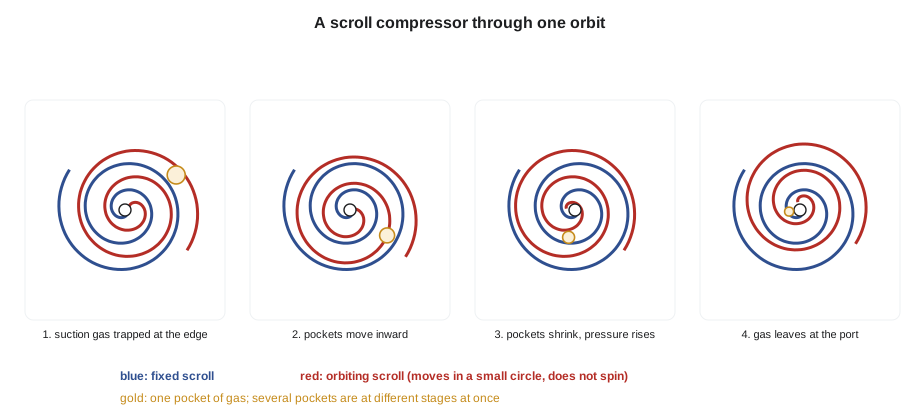
Several pairs of pockets are being compressed at once, each at a different stage, so the flow of gas is nearly continuous. There are no suction or discharge reed valves of the reciprocating kind, and no clearance volume that re-expands, so volumetric efficiency stays high across a wide range of conditions. These features make scrolls quiet, smooth and efficient, with few moving parts.
A scroll has a fixed built-in volume ratio set by the geometry of its spirals. If the system's actual pressure ratio is close to the built-in ratio, the scroll is very efficient. If the system's ratio is much higher, the gas is still below discharge pressure when it reaches the port and is pushed back by the discharge gas; if it is much lower, the gas is over-compressed. Both waste energy. This is one reason scroll designs differ for air conditioning, heat pump and refrigeration duty.
Most scroll compressors have a check valve, often a disc or floating valve, at or near the discharge port. It stops the high-pressure gas in the discharge line from flowing back through the scrolls when the compressor stops, which would spin the scroll backward briefly and cause a short noise at shutdown. A small reverse run at shutdown is normal on some models; a long backward run, or noise during operation, is not.
Compliance and liquid tolerance
The scroll flanks and tips must seal against each other closely to hold pressure. Scroll compressors use compliance, controlled flexibility, to keep the seal while allowing the scrolls to separate when something gets between them.
- Axial compliance lets the scrolls move apart slightly along the shaft axis. In many designs, intermediate-pressure gas pushes the scrolls together; if liquid or debris enters, they can separate a little to let it pass.
- Radial compliance lets the orbiting scroll move slightly away from the fixed scroll's flanks, so that a slug of liquid or a particle can pass through without breaking the scroll.
Because of compliance, scrolls tolerate a little liquid much better than reciprocating compressors. But tolerance is not immunity. Repeated floodback still dilutes the oil and wears bearings, and severe flooding can damage the scrolls. The same rules about returning only vapour to the compressor apply.
Special precautions with scrolls
- Phase rotation. Three-phase scrolls must run in the correct direction. Running backward, they make a loud noise, draw reduced current and do not pump. A short reverse run is usually harmless, but prolonged reverse running overheats the compressor until its internal protector trips, and repeated reverse running can damage it. On a new installation or after any electrical work, a phase rotation meter or a check of pressures at start-up confirms the direction. Swapping any two supply leads, with the power locked out, reverses it.
- Deep vacuum. A scroll must never be run, even briefly, to pull the system into a deep vacuum. With very little gas inside the shell, the electrical insulation between the motor terminals can break down, causing arcing at the terminal pins, and the scrolls run without the gas that normally cools and seals them. Manufacturers forbid starting a scroll under vacuum or using it to pump down below a small positive pressure; evacuation is the job of a vacuum pump.
- Short cycling. Like all hermetic compressors, scrolls need enough run time to return oil and enough off time for pressures and the motor to recover. Controls often enforce minimum run and off times.
- Low charge and high superheat. Scrolls are cooled by suction gas. High superheat from a low charge or a restriction raises the discharge temperature. Many larger scrolls have a discharge temperature sensor or thermostat that stops the compressor before damage occurs.
Scrolls are often described as having no internal pressure relief to protect against a blocked condenser. Some models have an internal relief or bypass between the high and low sides; others rely entirely on the external high-pressure control. A technician must never bypass a high-pressure control to keep a unit running, whatever the compressor type.
Capacity control with scrolls
A building's cooling or heating load changes all day and all year. A single-speed compressor matches it only by cycling on and off. Cycling wastes energy at each start, lets humidity rise because the coil warms between cycles, and causes temperature swings. Scroll systems use several ways to match capacity more closely to load.
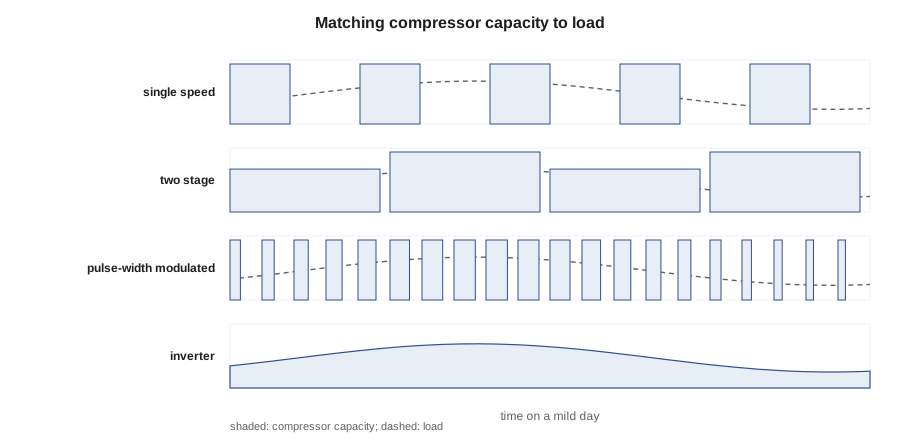
- Staged scrolls. Some scrolls have bypass ports in the fixed scroll that can be opened by a solenoid, unloading part of the compression and giving two capacity steps, commonly around two thirds and full capacity. Two-stage residential air conditioners and heat pumps often use this design.
- Pulse-width modulated scrolls. In one design, the fixed scroll can be lifted slightly away from the orbiting scroll by a solenoid valve. When it is lifted, the scrolls stop compressing although the motor keeps running. By loading and unloading in a cycle of a few seconds, the average capacity can be set anywhere from a low fraction up to full capacity. These are used in some commercial air conditioning and refrigeration systems.
- Tandem and trio compressors. Two or three scrolls are piped in parallel on a common suction and discharge, with an oil equalization arrangement, and switched on and off in steps. Many rooftop units and condensing units use tandems.
- Variable-speed scrolls. An inverter drive changes the frequency and voltage supplied to the compressor motor, usually a permanent magnet motor, so the compressor runs faster or slower. Speed range is wide, and capacity follows speed closely.
Inverter-driven compressors
Variable-speed compressors are now standard in ductless mini-splits, many heat pumps, including the cold-climate heat pumps covered in a later course, and growing numbers of commercial systems. The compressor in the attic ductless heat pump on Northfield's list is an inverter-driven rotary, and many larger heat pumps use inverter scrolls; the principles are the same.
The drive first rectifies the incoming AC to a DC bus, then switches it rapidly with transistors to create a variable-frequency output for the compressor motor. The motor is often a brushless permanent magnet motor, which is more efficient than an induction motor, especially at low speeds. The outdoor unit's control board decides the speed from the indoor temperature, the suction and discharge temperatures, the outdoor temperature and the unit's protection limits.
Running slower at part load has several advantages. With the compressor slowed, the heat exchangers, sized for full capacity, are oversized for the smaller flow. The evaporator runs warmer and the condenser cooler, the compression ratio falls, and the energy needed per unit of cooling falls considerably. Long, steady run times at low speed also improve comfort and dehumidification and reduce the number of starts.
# An inverter compressor at part load: capacity, power and COP as speed changes
# Simple illustrative model: capacity roughly proportional to speed, and the
# compression ratio falls at low speed because the heat exchangers are oversized.
rated_kw, rated_cop = 3.42, 3.8      # attic ductless heat pump, cooling, full speed

def run(speed_frac):
    capacity = rated_kw * speed_frac
    # condensing temperature falls and evaporating temperature rises at low speed:
    lift = 34 * (0.55 + 0.45 * speed_frac)      # K between evaporating and condensing
    cop = rated_cop * 34 / lift                 # COP improves as the lift falls
    cop *= 1 - 0.08 * (1 - speed_frac) ** 2     # small drive and motor losses at low speed
    return capacity, capacity / cop, cop, lift

print("speed  capacity  power   COP   lift")
for s in [1.0, 0.8, 0.6, 0.4, 0.25]:
    q, p, cop, lift = run(s)
print(f"{s:4.0%} {q:5.2f} kW {p:5.2f} kW {cop:4.1f} {lift:4.1f} K")speed capacity power COP lift 100% 3.42 kW 0.90 kW 3.8 34.0 K 80% 2.74 kW 0.66 kW 4.2 30.9 K 60% 2.05 kW 0.45 kW 4.6 27.9 K 40% 1.37 kW 0.27 kW 5.1 24.8 K 25% 0.85 kW 0.16 kW 5.5 22.5 K
The model is deliberately simple, and real performance comes from the manufacturer's data, but the trend it shows is real: an inverter heat pump at low speed can deliver cooling or heat for much less energy per unit than at full speed. That is why seasonal efficiency ratings of variable-speed equipment are much higher than those of single-speed equipment, and why a variable-speed system that runs almost continuously in mild weather is working as intended, not failing.
Inverter compressors bring their own service issues. The compressor cannot be started across the line; it must be run from its drive. Its windings are tested with the drive disconnected and the power locked out, using the same resistance and insulation tests as any compressor, but with lower and balanced resistances on three terminals typical of a three-phase permanent magnet motor. Many faults show up as error codes from the outdoor board, such as overcurrent, high discharge temperature or a failure to start, and the manufacturer's service manual is essential. The drive's DC bus capacitors can stay charged after the power is removed, so the bus voltage must be measured and confirmed discharged before touching the drive, as RAC-130 explained.
Checking a scroll in the field
Scrolls do not have the valves of a reciprocating compressor, so they fail differently. Common faults include worn or damaged scroll tips, which reduce pumping, failed bearings, electrical failures of the motor and failed internal protectors or discharge check valves. A scroll that is not pumping shows suction and discharge pressures closer together than normal and low current. Before condemning one, a technician checks for the external causes that look similar: reversed rotation on three-phase models, an unloaded staging solenoid stuck open, a pulse-width modulated scroll stuck unloaded, or an open internal bypass. On two-stage scrolls, the staging solenoid's voltage and coil resistance are checked before concluding the compressor itself has failed.
Worked problem
Is the rooftop scroll pumping?
After the leads were swapped, the clinic's R-410A rooftop unit runs with suction 830 kPa gauge (120 psig) and discharge 2,700 kPa gauge (390 psig) on a 30 °C (86 °F) day, drawing 11.8 A, within the range the manufacturer's chart shows for these conditions. Before the swap, the readings were 1,450 kPa gauge (210 psig) and 1,600 kPa gauge (232 psig) at 6.1 A. What do the two sets of readings show?
Show solution
- \[\text{after: } \frac{2700 + 101}{830 + 101} \approx 3.0 \qquad \text{before: } \frac{1600 + 101}{1450 + 101} \approx 1.1\]
Answer: Running backward, the scroll produced almost no pressure difference and drew about half its current. After the swap it produces a normal ratio of about 3 and current that matches the chart, so the compressor is pumping normally. Because it ran backward for less than an hour, it was not condemned, but its current and pressures are recorded for comparison at the next visit.
Common mistakes
MistakeStarting a scroll compressor to finish pulling a vacuum.
InsteadNever run a scroll under vacuum; use a vacuum pump and keep the compressor off.
MistakeAssuming a noisy, non-pumping three-phase scroll has failed.
InsteadCheck phase rotation first; swap two supply leads with the power locked out if it is reversed.
MistakeWorrying that a variable-speed heat pump runs almost all the time.
InsteadLong low-speed runs are normal and efficient; check performance, not just run time.
MistakeTesting an inverter compressor's windings with the drive still connected.
InsteadLock out, confirm the DC bus is discharged, disconnect the compressor leads and then test.
MistakeCondemning a two-stage scroll without checking its unloader solenoid.
InsteadMeasure the solenoid's voltage and coil resistance first.
Summary and key terms
- A scroll compresses gas in pockets formed between an orbiting and a fixed spiral, moving inward to a central discharge port.
- Scrolls have no clearance re-expansion and few moving parts, so they are quiet, smooth and efficient.
- Axial and radial compliance let scrolls tolerate small amounts of liquid or debris, but floodback still harms them.
- Three-phase scrolls must run in the right direction; scrolls must never run under deep vacuum.
- Capacity control: staging, pulse-width modulation, tandems and variable-speed inverter drives.
- Inverter compressors run slower at part load with a smaller lift and much better efficiency.
- Scroll compressor
- A rotary positive displacement compressor using an orbiting and a fixed spiral.
- Orbiting scroll
- The scroll that moves in a small circle without rotating.
- Compliance
- Controlled flexibility that lets scrolls separate slightly to pass liquid or debris.
- Built-in volume ratio
- The fixed ratio of suction to discharge pocket volume set by a scroll's geometry.
- Discharge check valve
- A valve that stops discharge gas flowing back through the scrolls at shutdown.
- Phase rotation
- The order in which the three phases of a supply reach their peaks.
- Staged scroll
- A scroll with ports that can be opened to reduce its capacity in steps.
- Pulse-width modulation
- Controlling average capacity by alternating loaded and unloaded periods.
- Inverter drive
- An electronic drive that varies a compressor motor's speed by changing frequency and voltage.
- Tandem compressors
- Two compressors piped in parallel and staged together.
Practice problems
Work each problem on paper first, then reveal the answer to check.
A three-phase scroll is noisy, draws low current and shows equal pressures. What do you check first?
Show answer
Phase rotation; reverse two leads with the power locked out if needed.
Why must a scroll not be used to pull a vacuum?
Show answer
With little gas inside, the motor terminals can arc and the scrolls run without cooling or sealing gas.
Name two advantages of running an inverter compressor at low speed.
Show answer
Better efficiency from a smaller lift, and better comfort and dehumidification from long steady runs.
How does a two-stage scroll reduce its capacity?
Show answer
A solenoid opens bypass ports that unload part of the compression.
Lesson quiz · 5 questions
Score 60% or more to complete this lesson.
Create a free account to save your progress, take quizzes and earn a certificate.