
RAC-210 · Lesson 1 of 12 · 23 min
Compressors: what they do and how they are built
Theo Martel started his second year at Northfield Mechanical in the back corner of the shop, where Dana Okafor kept what she called the boneyard: a shelf of failed compressors that had been cut open with a band saw. There was a small hermetic reciprocating compressor from a reach-in cooler, its piston and connecting rod frozen in a mess of black oil. There was a scroll compressor from a heat pump, with the two spiral scrolls exposed like a fossil. There was a rolling-piston rotary from a ductless unit, a semi-hermetic compressor from the grocery rack that Northfield had decommissioned the year before, and the twin rotors of a small screw compressor that a chiller dealer had given her for training. "Level one was about how the cycle works," Dana said. "Level two is about the machines that make it work, and how they die. Every one of these failed for a reason, and most of the reasons were outside the compressor."
This lesson begins the study of the three main heat-transfer and pumping components of a refrigeration system: the compressor, the condenser and the evaporator. It explains what the compressor actually does in the cycle, the families of compressors and how their construction differs, how compressors are rated and what the nameplate tells a technician, why compression ratio matters, and how the compressor's job connects to the condenser and evaporator that the rest of the course covers.
What the compressor does
In the vapour-compression cycle studied in level one, the evaporator absorbs heat by boiling refrigerant at a low pressure and temperature, and the condenser rejects that heat by condensing the refrigerant at a high pressure and temperature. The compressor is the component that connects the two. It draws in low-pressure vapour from the evaporator, through the suction line, and discharges it at a higher pressure into the condenser, through the discharge line, or hot gas line. In doing so it does two jobs at once.
- It moves refrigerant around the circuit. The mass of refrigerant the compressor pumps each second, multiplied by the refrigerating effect per kilogram or pound, is the system's capacity. A compressor that pumps less, because of worn valves, a low suction pressure or a slowed motor, gives less capacity.
- It raises the pressure, and with it the saturation temperature, of the refrigerant. The condenser can reject heat only if the refrigerant inside it condenses at a temperature above the air or water that cools it. Raising the pressure lifts the condensing temperature above the outdoor air on a hot day.
Raising the pressure takes energy. The compressor motor converts electrical energy into work on the refrigerant, and almost all of that work ends up as heat in the discharge gas. That is why the discharge line is hot, sometimes too hot to touch, and why the condenser must reject more heat than the evaporator absorbs. The heat rejected at the condenser equals the heat absorbed at the evaporator plus the heat of compression, a relationship that the condenser lessons use to size and check condensers.
The compressor cannot pump liquid. Liquid is nearly incompressible, so a slug of liquid arriving at a reciprocating compressor's cylinder, or a large amount of liquid arriving at any compressor, can break valves, bend connecting rods, wash the oil off bearings or damage scroll tips. Much of good system design and service is about making sure that only vapour, with a margin of superheat, reaches the compressor, and that the oil the compressor needs comes back to it.
Families of compressors
Compressors are grouped first by how they compress the gas. Positive displacement compressors trap a fixed volume of vapour and reduce that volume mechanically, which raises the pressure. Dynamic compressors give the vapour velocity with a spinning impeller and then convert the velocity into pressure in a diffuser. Most refrigeration and air conditioning compressors are positive displacement machines; dynamic, or centrifugal, compressors are used in large water chillers.
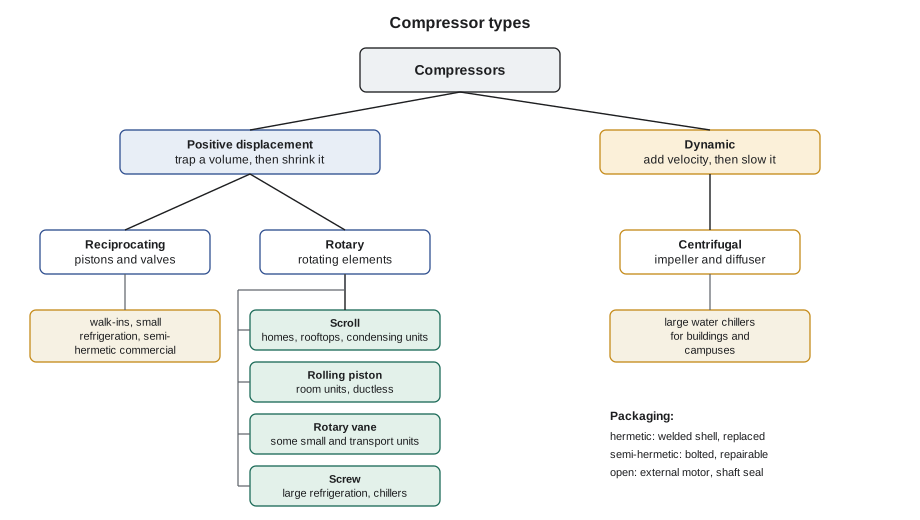
| Type | How it compresses | Typical applications |
|---|---|---|
| Reciprocating | A piston moving in a cylinder, with suction and discharge valves | Small refrigeration, walk-ins, older air conditioners, semi-hermetic commercial refrigeration |
| Scroll | An orbiting spiral moving against a fixed spiral, forming shrinking pockets | Residential and light commercial air conditioners and heat pumps, many refrigeration condensing units |
| Rolling piston rotary | An eccentric roller rolling around a cylinder, with a sliding vane | Room air conditioners, ductless mini-splits, small heat pumps |
| Rotary vane | Vanes sliding in slots of an off-centre rotor | Some small and transport units; less common in stationary HVAC-R |
| Screw | Two meshing helical rotors, or one rotor with gate rotors, trapping gas along the threads | Large commercial refrigeration, process chillers, industrial ammonia plants |
| Centrifugal | A high-speed impeller adding velocity, converted to pressure in a diffuser | Large water chillers for buildings and campuses |
A technician does not need to memorize size limits, which shift as products change, but should be able to recognize each type and know its typical strengths and weaknesses. A reciprocating compressor tolerates high compression ratios but is noisy and has many moving parts. A scroll is quiet, efficient and tolerant of a little liquid, but it cannot pull a deep vacuum and it can run backward on three-phase power. A rotary is compact and suited to small inverter-driven systems. A screw is rugged, handles large capacities and oil-flooded operation well. A centrifugal moves enormous volumes of gas efficiently but has limits on the pressure lift it can produce.
How compressors are built: hermetic, semi-hermetic and open
Compressors are also grouped by how the motor and the compressor are packaged, which decides how they are serviced.
- A hermetic compressor, often called a sealed or welded hermetic, has its motor and compressor sealed inside a welded steel shell. The motor windings sit in the refrigerant vapour, usually suction gas, which cools them. There are no shaft seals to leak, which makes hermetics reliable and cheap, but they cannot be opened for repair. When a hermetic fails, it is replaced. Almost all residential and light commercial compressors are hermetic.
- A semi-hermetic compressor, also called an accessible hermetic or serviceable hermetic, has its motor and compressor in a bolted cast-iron housing. The heads, valve plates, oil pump, bottom plate and sometimes the motor can be removed and serviced. Semi-hermetic reciprocating and screw compressors are common in supermarket racks, large walk-ins and industrial systems, where rebuilding a valve plate is cheaper than replacing a compressor.
- An open compressor has its motor outside the refrigerant circuit, connected to the compressor shaft by a coupling or belt. The shaft passes through a seal that must be maintained. Open compressors are used where the refrigerant must not touch motor windings, notably in ammonia systems, because ammonia attacks copper, and in some large chillers and transport systems.
The packaging affects how the motor is protected and how a failure spreads. In a hermetic or semi-hermetic compressor, a motor burnout breaks down the insulation and the oil, producing acids and carbon that contaminate the whole system. That is why lesson 11 spends a good deal of time on burnout cleanup. In an open compressor, a motor failure stays outside the refrigerant circuit, but a leaking shaft seal is a constant maintenance concern.
The nameplate
The compressor nameplate, and the matching data on the equipment's data plate, is the first thing to read on any compressor call. A typical hermetic compressor nameplate includes:
- Model and serial numbers, which identify the exact compressor and its manufacture date, and are needed to order an exact replacement or check warranty.
- Refrigerant or refrigerants it is approved for, and sometimes the oil type and charge.
- Voltage, phase and frequency, for example 208/230 V single-phase 60 Hz or 575 V three-phase.
- Rated load amperes (RLA), a figure used for sizing the circuit and contactor. RLA is not the current the compressor should normally draw; it is a design rating, and a compressor running correctly usually draws less, depending on load and conditions.
- Locked rotor amperes (LRA), the current the motor draws at the instant of starting or when its rotor is stalled. LRA is typically several times RLA.
- Sometimes the motor protection type, such as an internal line-break overload, and the terminal arrangement.
Theo picked up the semi-hermetic from the grocery rack and read the plate aloud: model, serial, R-22 and its replacements, 208/230 volts three-phase, RLA 31.4, LRA 198. "So it should run at 31 amps," he said. "It should never run above it for long," Dana corrected. "On a mild day with a low load it might draw 20. You compare what it draws with what the manufacturer's performance data say it should draw at those pressures. RLA is a ceiling for the circuit, not a target."
Capacity ratings and operating envelopes
A compressor's capacity is not a single number. It depends strongly on the evaporating and condensing temperatures. Lower evaporating temperatures mean less dense suction vapour, so each stroke or revolution pumps less mass and the capacity falls. Higher condensing temperatures increase the work per kilogram or pound and reduce the refrigerating effect, because the liquid arrives at the metering device hotter. Manufacturers publish capacity, power and current at standard rating points and in tables or polynomial equations covering the whole range.
Each compressor also has an operating envelope: the range of evaporating and condensing temperatures, and of return gas superheat, within which it can run reliably. Running outside the envelope, for example with a very low suction pressure and a high condensing pressure, raises the discharge temperature and can break down the oil, or overloads the motor. Low-temperature compressors for freezers are built for low suction pressures; air conditioning compressors are built for higher suction pressures and would overheat if used on a freezer.
Because capacity depends so much on conditions, a compressor is matched to its application by rating point and duty, not by horsepower. Older habits of describing compressors by horsepower, such as a three-horsepower walk-in compressor, give only a rough idea of size. Technicians should use the published capacity at the actual conditions, in kilowatts or Btu per hour, when selecting a replacement.
Compression ratio
Compression ratio is the absolute discharge pressure divided by the absolute suction pressure. It must be calculated from absolute pressures, never from gauge pressures, because gauge pressures read zero at atmospheric pressure and give nonsense ratios at low suction pressures.
The ratio matters for three reasons. First, the higher the ratio, the more work each kilogram or pound of refrigerant needs, so efficiency falls. Second, in a reciprocating compressor, the high-pressure gas left in the cylinder at the end of each stroke must re-expand before new gas can enter, so a high ratio reduces the volume of new gas pumped per stroke, a property called volumetric efficiency, studied in lesson 2. Third, the discharge temperature rises with ratio, which threatens the oil and the valves.
Typical ratios are roughly 2.5 to 3.5 for air conditioning and heat pumps in cooling, around 4 to 6 for medium-temperature refrigeration such as coolers, and 8 to 12 or more for low-temperature freezers. Very high ratios are one reason low-temperature systems may use two-stage compression, booster compressors or compressors with vapour injection. A ratio well above the usual range for an application tells the technician to look for a cause: low suction pressure from a restriction, low charge or an iced evaporator, or high head pressure from a dirty condenser or non-condensables.
Worked problem
Compression ratio on the glycol chiller
The brewery's R-134a glycol chiller is running with an evaporating temperature of −10 °C (14 °F) and a condensing temperature of 40 °C (104 °F). Use the course table to find the compression ratio.
Show solution
- From the table: P_suction = 201 kPa abs, P_discharge = 1,017 kPa abs
- \[\text{CR} = \frac{1017}{201} \approx 5.1\]
Answer: The compression ratio is about 5.1, normal for a medium-temperature application. If a dirty condenser raised the condensing temperature to 50 °C (122 °F), the ratio would rise to about 1,318 ÷ 201 ≈ 6.6 (191 ÷ 29.1 ≈ 6.6), with more power, less capacity and a hotter discharge.
# Compression ratio from gauge readings: always convert to absolute first
P_ATM = 101.3   # kPa, near sea level; Kitchener is a little lower, about 97.5 kPa

def ratio(suction_gauge, discharge_gauge, p_atm=P_ATM):
    ps = suction_gauge + p_atm
    pd = discharge_gauge + p_atm
    return pd / ps

cases = [  # (description, suction kPa gauge, discharge kPa gauge)
    ("ductless heat pump, cooling (R-410A)", 820, 2600),
    ("glycol chiller (R-134a)",              100, 916),
    ("same chiller, dirty condenser",        100, 1217),
    ("restaurant freezer (R-448A)",           65, 1650),
]
for name, s, d in cases:
    wrong = d / s if s > 0 else float('inf')
    print(f"{name:38s}: ratio {ratio(s, d):4.1f}   (gauge-only 'ratio' would be {wrong:5.1f})")
print("at Kitchener's air pressure:", round(ratio(65, 1650, 97.5), 1), "for the freezer")ductless heat pump, cooling (R-410A) : ratio 2.9 (gauge-only 'ratio' would be 3.2) glycol chiller (R-134a) : ratio 5.1 (gauge-only 'ratio' would be 9.2) same chiller, dirty condenser : ratio 6.5 (gauge-only 'ratio' would be 12.2) restaurant freezer (R-448A) : ratio 10.5 (gauge-only 'ratio' would be 25.4) at Kitchener's air pressure: 10.8 for the freezer
The output shows how badly gauge-only arithmetic misleads at low suction pressures. The freezer's true ratio is around 10, typical of low-temperature work; dividing gauge readings would suggest a ratio more than twice as high. On a system in a vacuum on the low side, the gauge-only ratio becomes meaningless or negative.
The compressor, the condenser and the evaporator as one system
Although this course takes the components one at a time, they never work alone. The compressor's pumping rate sets how fast refrigerant is removed from the evaporator, which helps set the suction pressure. The evaporator's load and airflow set how fast refrigerant boils, which also helps set the suction pressure. The condenser's size, cleanliness and the outdoor temperature set how fast heat leaves, which sets the head pressure. When one component changes, the balance point of the whole system moves.
- If the evaporator's airflow falls because of a dirty filter, less heat is absorbed, less refrigerant boils, and the suction pressure drops until the compressor's pumping rate matches the reduced boiling. The compressor then pumps less mass and the capacity falls further.
- If the condenser fouls, the head pressure rises until the smaller temperature difference across a dirty coil is enough to reject the heat. The compressor works harder, draws more current and runs hotter.
- If the compressor's valves wear, it pumps less. The suction pressure rises and the head pressure falls, a pattern lesson 10 uses to recognize an inefficient compressor.
Dana's rule for the boneyard was that every cut-open compressor came with a tag saying what killed it. Most tags named something outside the compressor: floodback from a failed evaporator fan, overheating from a dirty condenser, a burnout after repeated short cycling, oil loss from a badly piped suction riser. Replacing the compressor without fixing that cause, she told Theo, is how a contractor ends up with a second compressor on the shelf.
Safety around compressors
Compressors combine high pressure, high temperature, heavy weight and high-current electricity. Discharge lines and compressor heads can exceed 100 °C (212 °F) and cause burns. The shell and lines hold refrigerant and oil at pressure; never loosen a fitting, cut a line or remove a service valve core while the system is under pressure. Compressors are heavy, and a semi-hermetic can weigh well over 100 kg (200 lb), so lifting needs the right equipment and help. Terminal covers must stay in place when the compressor is energized, because a failed terminal can blow out of the shell, releasing hot oil and refrigerant and sometimes igniting the oil. Always lock out the electrical supply before removing a terminal cover, and treat any compressor that has been tripping or burning as a possible terminal failure.
Common mistakes
MistakeCalculating compression ratio from gauge pressures.
InsteadAdd atmospheric pressure to both readings first; ratios use absolute pressures.
MistakeTreating RLA as the current a compressor should draw.
InsteadRLA is a rating for circuit sizing; compare actual current with the manufacturer's data at the measured pressures.
MistakeChoosing a replacement compressor by horsepower.
InsteadMatch the model, or match capacity, refrigerant, voltage and envelope at the actual operating conditions.
MistakeReplacing a failed compressor without finding why it failed.
InsteadLook for floodback, overheating, oil loss or electrical causes before and after the change.
MistakeRemoving a compressor terminal cover with the power on.
InsteadLock out first; a failed terminal can eject hot oil and refrigerant.
Summary and key terms
- The compressor moves refrigerant around the circuit and raises its pressure so the condenser can reject heat.
- Heat rejected at the condenser equals heat absorbed at the evaporator plus the heat of compression.
- Positive displacement compressors (reciprocating, scroll, rotary, screw) trap and squeeze gas; centrifugal compressors use velocity.
- Hermetic compressors are sealed and replaced; semi-hermetic compressors can be opened and repaired; open compressors have a shaft seal and an external motor.
- Capacity depends on evaporating and condensing temperatures; every compressor has an operating envelope.
- Compression ratio uses absolute pressures and is typically about 3 for air conditioning, 4 to 6 for coolers and 8 to 12 or more for freezers.
- Positive displacement compressor
- A compressor that traps a volume of gas and reduces it mechanically to raise the pressure.
- Centrifugal compressor
- A dynamic compressor that adds velocity with an impeller and converts it to pressure.
- Hermetic compressor
- A compressor and motor sealed in a welded shell.
- Semi-hermetic compressor
- A compressor and motor in a bolted, serviceable housing.
- Open compressor
- A compressor driven by an external motor through a shaft seal.
- RLA
- Rated load amperes, a compressor current rating used for circuit and contactor sizing.
- LRA
- Locked rotor amperes, the current drawn at starting or with a stalled rotor.
- Compression ratio
- Absolute discharge pressure divided by absolute suction pressure.
- Operating envelope
- The range of evaporating, condensing and return gas conditions a compressor is approved to run in.
- Heat of compression
- The energy added to the refrigerant by the compressor, rejected at the condenser.
Practice problems
Work each problem on paper first, then reveal the answer to check.
Suction is 300 kPa gauge and discharge 1,500 kPa gauge at 101 kPa atmospheric pressure. What is the compression ratio?
Show answer
(1,500 + 101) ÷ (300 + 101) ≈ 4.0.
Which compressor type is most likely in a residential central air conditioner?
Show answer
A hermetic scroll.
Why are ammonia compressors usually open-drive?
Show answer
Ammonia attacks copper, so the motor windings are kept out of the refrigerant.
A freezer's ratio has risen from 9 to 13 since last month. Name two possible causes.
Show answer
Low suction pressure (iced coil, restriction, low charge) or high head pressure (dirty condenser, non-condensables).
Lesson quiz · 5 questions
Score 60% or more to complete this lesson.
Create a free account to save your progress, take quizzes and earn a certificate.