
RAC-210 · Lesson 12 of 12 · 23 min
Brazing, pressure testing and the capstone repair
Theo's last job of the course came from the brewery again. The R-134a glycol chiller that had appeared in so many of his lessons had lost part of its charge: the glycol was running warm on brewing days, and Priya had seen an oily patch on the bottom of the chiller's air-cooled condenser coil. Dana gave Theo the job from start to finish, with herself as the helper and inspector. "You've learned how each part works and how it fails," she said. "Now do the whole thing: find it, fix it, prove it, and write it up. And do the brazing and the pressure test the way the code and the manufacturer want, not the way somebody did it on a roof twenty years ago."
Almost every repair in this course ends with the same steps: making joints in copper and brass, then proving the system is tight before refrigerant goes back in. This lesson covers brazing for refrigeration, including alloys, flux and joint preparation; flowing nitrogen while brazing and why it matters; the hot work and personal safety rules around brazing; pressure testing with dry nitrogen, including the test pressures and the temperature correction needed to interpret a standing test; and finally the capstone repair that ties the course together.
Brazing and soldering
Brazing joins metals with a filler metal that melts above about 450 °C (840 °F) but below the melting point of the base metals. The filler flows into the close-fitting gap between a tube and a fitting by capillary action and bonds to both surfaces. Soldering uses fillers that melt below that temperature. In refrigeration, high-pressure joints in copper and brass are brazed, because brazed joints are much stronger and resist vibration and temperature changes better than soft-soldered joints. Soft solder is still used for some drain and water connections, but not for refrigerant piping.
| Filler family | Common uses | Flux needed |
|---|---|---|
| Copper-phosphorus (BCuP), 0 % silver | Copper to copper where the joint is not highly stressed | No, on copper to copper |
| Copper-phosphorus-silver (BCuP), about 5 to 15 % silver | Copper to copper and to wrought copper fittings; more ductile, better for vibration and gaps | No, on copper to copper; yes on brass |
| Silver brazing alloys (BAg), higher silver | Copper to brass, bronze or steel, such as valves, driers and compressor connections | Yes, a suitable brazing flux |
| Copper-phosphorus on steel | Not used: phosphorus makes brittle joints on steel and iron | Not applicable |
The phosphorus in BCuP alloys acts as a flux on copper, so copper-to-copper joints need no added flux. On brass, a flux is needed with BCuP, and on steel, copper-plated steel or stainless steel, a silver alloy with flux is used. Flux residue is corrosive, so it is applied sparingly to the outside of the tube only, kept out of the system, and washed off after brazing.
Making a good joint
- Cut tubes square with a tubing cutter, then ream the inside edge to remove the burr, holding the tube end down so chips fall out rather than into the pipe.
- Clean the outside of the tube and the inside of the fitting with an abrasive pad or brush until bright. Do not touch cleaned surfaces with oily fingers.
- Assemble with the tube fully inserted, square and supported, with a close, even gap. Capillary action works only in a narrow gap.
- Heat the tube first, then the fitting, moving the flame to bring the whole joint evenly to brazing temperature, judged by the colour of the copper and, with flux, the flux becoming clear and fluid. Apply the filler to the joint opposite the flame, letting the heat of the joint, not the flame, melt it and draw it in.
- Do not overheat. Overheating burns the filler, oxidizes the copper, damages nearby components and makes porous joints. Protect valves, driers, sight glasses, sensors and compressor terminals with wet rags or heat-absorbing paste.
- Let the joint cool naturally before disturbing it; quenching a joint in water while it is very hot can crack it.
Flowing nitrogen while brazing
When copper is heated in air, the inside surface oxidizes and forms a black scale of copper oxide. In a refrigeration system, this scale flakes off and travels with the refrigerant and oil, plugging screens, metering devices, capillary tubes and filter-driers, and damaging compressors. Flowing a small amount of dry nitrogen through the piping while brazing keeps oxygen out and prevents the scale from forming. Compressor and equipment manufacturers require it, and many warranty claims are refused when oxide scale is found.
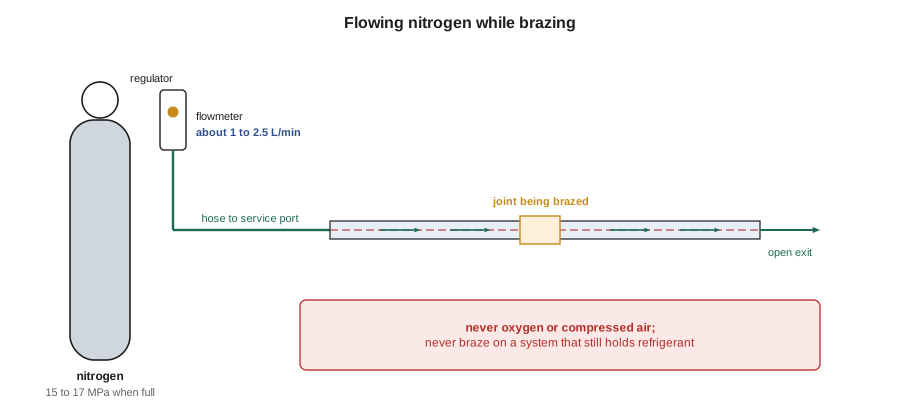
- Use only dry nitrogen, from a cylinder with a pressure regulator. A full nitrogen cylinder holds very high pressure, roughly 15 to 17 MPa (2,200 to 2,500 psi), and must never be connected to a system or hose without a regulator.
- Set a low flow with a flowmeter, commonly about 1 to 2.5 L/min (2 to 5 scfh), enough to sweep the air out and keep it out, but not enough to pressurize the joint and blow the filler out.
- Give the nitrogen an exit: an open end, a removed valve core or a loosened fitting downstream, so the piping is not pressurized while hot.
- Purge the line for a short time before heating to displace the air, keep the flow on while brazing, and continue until the joint has cooled enough not to oxidize.
- Never use oxygen or compressed air in place of nitrogen. Oxygen with oil in the system can explode. Compressed air brings moisture and oxygen into the system.
Safety and hot work
Brazing uses an oxy-acetylene, air-acetylene, air-propane or similar torch. The hazards are burns, fire, compressed gas, fumes and, around refrigerant, decomposition products.
- Never braze on a system that contains refrigerant. Recover it first and purge the section with nitrogen. Refrigerants that pass over a flame decompose into toxic and corrosive gases, and A2L and A3 refrigerants are flammable.
- Store and transport gas cylinders upright and secured, with valve caps on when not in use. Use regulators and hoses rated for the gas, check for leaks, and use flashback arrestors and check valves on oxy-fuel equipment.
- Follow the employer's hot work procedure and the site's permit system. Ontario's Fire Code and occupational health and safety rules require precautions against fire during hot work: removing or shielding combustibles, having a suitable fire extinguisher at hand, and keeping a fire watch during and after the work for the period the site's procedure sets.
- Wear safety glasses or brazing goggles with the right shade lens, gloves and clothing that will not melt. Work with good ventilation; cadmium-free fillers are standard now, and flux fumes and copper oxide fumes are still irritants.
- Watch for hidden combustibles behind walls, ceilings, roofing membranes and insulation, and use a heat shield. Roofs and attics are high-risk locations.
Pressure testing with nitrogen
After brazing and before evacuation, the system, or the section that was opened, is pressure-tested with dry nitrogen to prove that every joint holds. Pressure testing finds leaks while the system is empty, when they are cheap to fix, instead of after a new charge has been lost.
- Test pressures are set by the mechanical refrigeration code, CSA B52, which TSSA adopted in its 2023 edition for Ontario in 2024, and by the equipment maker. Factory-built equipment has its high-side and low-side test pressures on the nameplate. Field piping is tested to the code's requirements. The test pressure must never exceed the rating of the lowest-rated component in the section being tested; a low-side test pressure applied to a high-side gauge is fine, but a high-side test pressure applied to the low side can damage it.
- Use a nitrogen regulator set to the test pressure and, preferably, a relief valve on the test rig set just above it, so a regulator failure cannot overpressurize the system.
- Isolate components that cannot take the test pressure, such as some pressure controls and transducers, or test below their limits.
- Raise the pressure in stages, checking for gross leaks at a low pressure first, then raising to the test pressure.
- Check every joint with leak detection solution or an electronic method suitable for nitrogen, as covered in RAC-120. Bubbles at a joint mean a leak to be repaired, which means releasing the pressure, re-brazing and testing again.
- Hold the pressure for the time set by the code, the manufacturer or the company's procedure, recording the pressure and the temperature at the start and end.
- Release the test nitrogen to the outdoors or a ventilated area before evacuating. Nitrogen is not a regulated refrigerant, but in a small room a large release can displace oxygen.
Some technicians add a small trace amount of refrigerant to the nitrogen so that an electronic refrigerant detector can be used. Whether this is allowed depends on the refrigerant rules, as RAC-120 explained, and it is not permitted where the trace gas would later be vented. Many leak detectors now work with nitrogen and hydrogen mixtures used for the same purpose.
Temperature correction in a standing test
A standing pressure test is read at the start and end of the hold period. If the temperature of the gas in the piping changes, the pressure changes even without a leak. For an ideal gas in a fixed volume, absolute pressure is proportional to absolute temperature:
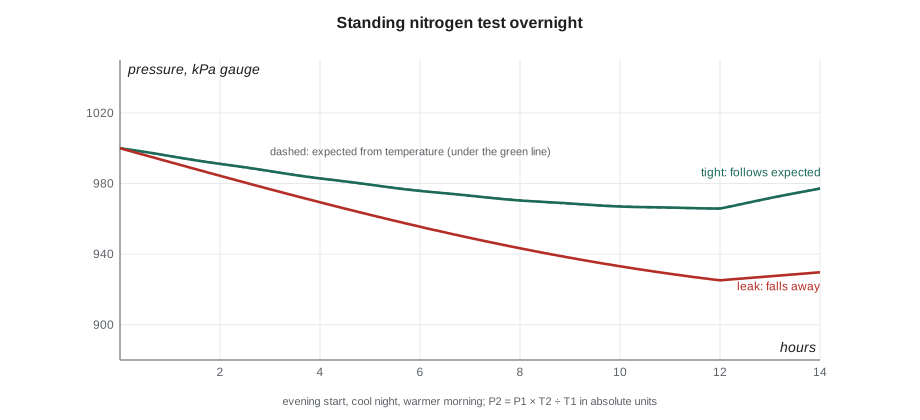
Absolute temperature is the temperature in kelvins, degrees Celsius plus 273.15, or in degrees Rankine, degrees Fahrenheit plus 459.67. A standing test on a rooftop that starts in morning shade and ends in afternoon sun can gain pressure; one that starts in the afternoon and ends at night can lose pressure that is not a leak. The test is judged by comparing the measured final pressure with the pressure expected from the temperature change.
# Standing nitrogen test with temperature correction
P_ATM = 101.3   # kPa

def expected(p1_gauge, t1_c, t2_c):
    p1_abs = p1_gauge + P_ATM
    p2_abs = p1_abs * (t2_c + 273.15) / (t1_c + 273.15)
    return p2_abs - P_ATM

tests = [  # (description, start kPa gauge, start C, end kPa gauge, end C)
    ("condenser coil, overnight",       1000, 18.0,  966,  9.0),
    ("same test, leaking joint",        1000, 18.0,  921,  9.0),
    ("rooftop, shade to sun",           1000, 12.0, 1042, 24.0),
]
tolerance = 7   # kPa allowed for gauge resolution and readings (illustrative)
for name, p1, t1, p2, t2 in tests:
    exp = expected(p1, t1, t2)
    diff = p2 - exp
    verdict = "tight" if abs(diff) <= tolerance else ("LEAK suspected" if diff < 0 else "recheck readings")
print(f"{name:34s}: expected {exp:6.0f} kPa, measured {p2:5d} kPa, difference {diff:+5.0f} -> {verdict}")condenser coil, overnight : expected 966 kPa, measured 966 kPa, difference +0 -> tight same test, leaking joint : expected 966 kPa, measured 921 kPa, difference -45 -> LEAK suspected rooftop, shade to sun : expected 1046 kPa, measured 1042 kPa, difference -4 -> tight
The first and third tests changed pressure noticeably, by about 35 to 40 kPa (5 to 6 psi), but both match the temperature change, so the systems are tight. The second test lost about 45 kPa (6.5 psi) more than the temperature explains, which means a leak. A digital gauge with good resolution and a temperature probe on the piping make the comparison reliable; the test pressures and hold times here are illustrative, and real ones come from the code and the equipment maker.
The capstone repair
Theo worked through the brewery chiller job in the order the course had taught.
- Diagnosis. With the chiller running on a brewing day, the suction pressure and subcooling were low and the superheat high, with low current: the low-charge pattern from lesson 10, not a restriction. The condenser split was low as well, consistent with too little refrigerant. The oily patch on the coil's bottom row matched a leak.
- Leak location. An electronic detector and bubble solution, as in RAC-120, found a pinhole in a bottom-row tube where caustic wash-down spray from the brewery had corroded the coil, a common problem with copper and aluminium coils near cleaning chemicals.
- Decision. The coil had several more corroded spots, so Dana and Priya agreed to replace it with a coil with a protective coating, rather than repair one pinhole, and to move the wash-down hose station away from the chiller. The chiller's charge was below the thresholds for mandatory leak repair reporting, but the leak was repaired before recharging, as the course's rules require for any known leak, and the work was recorded.
- Recovery and removal. With the chiller locked out and the glycol loop isolated, Theo recovered the remaining R-134a into a recovery cylinder, weighed it and recorded it, then removed the old coil.
- Installation. He cut, reamed and cleaned the connections, brazed the new coil with BCuP-silver filler and nitrogen flowing at a low flow, protected the nearby fan motor wiring and a pressure transducer with wet rags, and installed a new liquid line filter-drier.
- Pressure test. He pressurized the high side with nitrogen through a regulator and test relief valve to the test pressure on the chiller's nameplate, checked every new joint with bubble solution, and left a standing test overnight with a digital gauge and a temperature probe. In the morning, the pressure matched the temperature-corrected value within the gauge's resolution.
- Evacuation and charge. After releasing the nitrogen outdoors, he evacuated the system, confirmed it held a deep vacuum in a decay test, and weighed in the nameplate charge of R-134a.
- Start-up and verification. On the next brewing day, the chiller ran with a normal evaporating temperature, superheat, subcooling, condenser split and current, and the glycol supply held its set point. He leak-checked the new joints again under operating pressure.
- Records. He completed the service ticket with all readings, the recovered and charged quantities, the leak repair and verification, and a recommendation to wash the chiller's coil only with approved cleaners. He added the old coil, with its tag, to Dana's boneyard.
Worked problem
Checking the overnight test
Theo's test started at 1,000 kPa gauge (150 psig) at 18 °C (64 °F) in the evening. At 9 °C (48 °F) the next morning, the gauge read 967 kPa gauge (145.1 psig). Is the coil tight?
Show solution
- \[P_2 = (1000 + 101.3) \times \frac{9 + 273.15}{18 + 273.15} - 101.3 \approx 966\ \text{kPa gauge}\]
Answer: The measured pressure matches the expected value within the gauge's resolution, so the drop is explained by the cooler morning, not a leak. Theo can proceed to evacuation.
Where the course leads
Theo's chiller job used almost everything in the course: compressor knowledge to judge whether the compressor had been harmed by running short of charge, condenser knowledge to read the split, accessory knowledge to fit the drier, diagnosis to separate a leak from a restriction, and replacement, brazing and pressure testing to make the repair last. The next courses in the program take the same system further: metering devices and charging in RAC-220, controls in RAC-230, and commercial refrigeration, air conditioning and heat pump systems after that. The boneyard is still there, and every compressor on it still has a tag explaining what killed it.
Common mistakes
MistakeBrazing without flowing nitrogen.
InsteadFlow a gentle stream of dry nitrogen through the piping to stop oxide scale forming inside.
MistakeConnecting a nitrogen cylinder to a system without a regulator.
InsteadAlways use a regulator, and preferably a relief valve on the test rig.
MistakePressure-testing with oxygen or compressed air.
InsteadUse dry nitrogen only; oxygen with oil can explode and air brings in moisture.
MistakeTesting the low side to the high-side test pressure.
InsteadNever exceed the rating of the lowest-rated component in the section tested.
MistakeCalling a standing test failed because the pressure dropped overnight.
InsteadCorrect for temperature using absolute pressures and temperatures before deciding.
Summary and key terms
- Brazing uses fillers melting above about 450 °C (840 °F); BCuP alloys braze copper to copper without flux, silver alloys with flux join dissimilar metals.
- Good joints need square, reamed, clean tubes, even heating, filler drawn in by capillary action and protection of nearby parts.
- Flow dry nitrogen at a low rate through a regulator and flowmeter while brazing to prevent oxide scale.
- Never braze on a charged system; follow hot work procedures, with a fire watch and suitable extinguisher.
- Pressure-test with dry nitrogen to the nameplate and code pressures, never above the lowest-rated component.
- Judge standing tests with temperature correction: P₂ = P₁ × T₂ ÷ T₁ in absolute units.
- Brazing
- Joining metals with a filler melting above about 450 °C (840 °F) but below the base metals.
- Capillary action
- The drawing of molten filler into a narrow gap between close-fitting parts.
- BCuP alloy
- A copper-phosphorus brazing filler, with or without silver.
- Flux
- A chemical that cleans and protects surfaces during brazing.
- Oxide scale
- Black copper oxide formed inside tubes heated in air.
- Nitrogen purge
- Flowing dry nitrogen through piping during brazing to keep oxygen out.
- Flowmeter
- A device that sets and shows the flow rate of a gas.
- Hot work
- Work with flames, sparks or heat that can start a fire.
- Fire watch
- A person assigned to watch for and put out fires during and after hot work.
- Standing pressure test
- Holding a system at test pressure over time to show it does not leak.
Practice problems
Work each problem on paper first, then reveal the answer to check.
A standing test starts at 1,200 kPa gauge at 25 °C. What pressure is expected at 15 °C if the system is tight?
Show answer
(1,301.3 × 288.15 ÷ 298.15) − 101.3 ≈ 1,156 kPa gauge.
Which filler would you use to braze a copper tube to a brass valve?
Show answer
A silver-bearing alloy with flux, or BCuP-silver with flux on the brass.
Why must a nitrogen purge have an exit?
Show answer
So the hot piping is not pressurized and the filler is not blown out of the joint.
Name three things a hot work procedure requires before brazing.
Show answer
Removing or shielding combustibles, a suitable extinguisher at hand and a fire watch.
Lesson quiz · 5 questions
Score 60% or more to complete this lesson.
Create a free account to save your progress, take quizzes and earn a certificate.