
RAC-210 · Lesson 8 of 12 · 21 min
Evaporators, frost and defrost
The restaurant's walk-in freezer had been fixed twice in one year, once by Northfield, and now the kitchen manager was calling again: the freezer was at −9 °C (16 °F) instead of −20 °C (−4 °F), and ice was hanging from the ceiling near the evaporator. Inside, Theo found the evaporator coil a solid block of white frost and ice, the fans spinning against it with almost no air moving. The defrost heaters were wired and the defrost timer was clicking through its cycle on schedule, but the defrost termination thermostat, clipped to the coil, had broken loose from its bracket and was hanging in the air stream, where it warmed up within a minute of each defrost starting and ended the defrost long before the coil was clear. Combined with the worn door gasket that had iced the door switch the previous winter, warm, moist kitchen air was frosting the coil faster than the short defrosts could clear it. "An evaporator is a heat exchanger with air on one side," Raj said. "If the air can't get through it, nothing else matters."
The evaporator is where the refrigeration system does its useful work, absorbing heat from air, water, glycol or product. This lesson explains direct expansion and flooded evaporators, how air-cooled evaporator coils are built and selected, the evaporator temperature difference and its effect on humidity, how frost forms and reduces capacity, and the defrost methods used in coolers, freezers and heat pumps, with their controls and common faults.
Direct expansion and flooded evaporators
In a direct expansion, or DX, evaporator, the metering device feeds just enough liquid that it all boils away inside the coil, with a few degrees of superheat at the outlet. Almost all air conditioners, heat pumps, walk-ins, display cases and small chillers use DX evaporators. The brewery's glycol chiller, for example, has a DX brazed plate evaporator, with refrigerant boiling on one side of the plates and glycol cooled on the other.
In a flooded evaporator, the evaporator is kept full of boiling liquid, and vapour is drawn off the top, with no superheat in the evaporator itself. The residence chiller's evaporator is a flooded shell-and-tube: chilled water flows through tubes immersed in a pool of boiling R-134a in the shell. Flooded evaporators transfer heat very well because all their surface is wetted with liquid, but they need more refrigerant and a way to keep liquid from reaching the compressor. Industrial ammonia systems often use flooded or liquid-overfeed evaporators fed from a low-pressure receiver, a topic of a later course.
Air-cooled evaporator coils
Most evaporators in commercial refrigeration and air conditioning are finned-tube coils with fans: unit coolers in walk-ins, coils in display cases, and the indoor coils of air conditioners and heat pumps. Their design involves several trade-offs.
- Fin spacing. Air conditioning coils, which run above freezing, use closely spaced fins, often about 5 to 6 fins per centimetre (12 to 16 fins per inch). Coolers use wider spacing, and freezer coils, which must hold frost between defrosts, use the widest, about 1.5 to 2.5 fins per centimetre (4 to 6 fins per inch).
- Circuiting. Refrigerant enters through a distributor that feeds several parallel circuits of equal length. Even distribution ensures every circuit gets liquid. A blocked distributor tube or a damaged circuit starves part of the coil, showing as a cold section and a warm section.
- Airflow. Air conditioning coils commonly handle about 50 to 60 L/s per kW of cooling (350 to 450 cfm per ton). Too little air lowers the coil temperature, risks freezing the coil and returns liquid to the compressor; too much reduces dehumidification.
- Condensate. Coils running below the air's dew point remove moisture, which drips to a drain pan and through a trapped drain. In freezers, the drain pan and line need heaters to keep defrost water from refreezing.
Evaporator temperature difference and humidity
The evaporator TD is the temperature of the air entering the coil minus the refrigerant's evaporating temperature. In refrigeration it is chosen at design to suit the product. A small TD means a large coil and a warmer coil surface, so less moisture condenses and the room stays humid. A large TD means a smaller, cheaper coil, but its colder surface removes more moisture from the room and from unwrapped product.
| Design evaporator TD | Approximate room relative humidity | Typical use |
|---|---|---|
| About 4 to 6 K (8 to 10 °F) | About 85 to 90 per cent | Fresh produce, flowers, meat coolers |
| About 6 to 8 K (10 to 14 °F) | About 80 to 85 per cent | General-purpose coolers |
| About 8 to 11 K (14 to 20 °F) | About 65 to 80 per cent | Packaged products, beverage coolers |
| About 6 K (10 °F) | Not controlled in the same way | Freezers, where moisture freezes on the coil |
For air conditioning, technicians more often use the temperature drop of the air across the coil, or temperature split. With normal airflow and indoor conditions, a typical split for a cooling coil is around 10 to 12 K (18 to 22 °F), lower in very humid conditions when more of the capacity goes into removing moisture. A split well above normal suggests low airflow; one well below normal suggests low capacity, such as a low charge or a weak compressor.
Evaporator capacity
Like any heat exchanger, an evaporator's capacity depends on its overall heat transfer coefficient times its area, UA, and on the mean temperature difference between the air and the refrigerant. Because the air cools as it passes through the coil while the refrigerant stays at nearly constant temperature, the effective mean is the log mean temperature difference, LMTD:
Frost reduces UA in two ways. A layer of frost is an insulator, adding resistance between the air and the fin. More importantly, as frost fills the spaces between the fins, it chokes the airflow, so less air crosses the coil and the fans move less as the pressure drop rises. With less air, the air leaving the coil is colder, the LMTD shrinks and the suction pressure falls. Capacity falls slowly at first, then quickly as the coil plugs.
# Freezer evaporator: capacity as frost builds (illustrative model)
import math

t_room, t_evap = -20.0, -28.0              # C
cp, rho = 1.006, 1.40                      # kJ/kg.K and kg/m3 for cold air

def capacity(ua_kw_per_k, airflow_m3s):
    m_cp = airflow_m3s * rho * cp          # kW/K
    eff = 1 - math.exp(-ua_kw_per_k / m_cp)
    q = eff * m_cp * (t_room - t_evap)     # kW
    t_out = t_room - q / m_cp
    return q, t_out

print("frost  airflow  UA     capacity  leaving air")
for frost, ua, flow in [("clean", 0.62, 0.90), ("light", 0.58, 0.80),
                        ("medium", 0.50, 0.60), ("heavy", 0.38, 0.35), ("blocked", 0.25, 0.15)]:
    q, t_out = capacity(ua, flow)
print(f"{frost:7s} {flow:4.2f} m3/s {ua:4.2f} {q:5.2f} kW {t_out:6.1f} C")frost airflow UA capacity leaving air clean 0.90 m3/s 0.62 3.92 kW -23.1 C light 0.80 m3/s 0.58 3.63 kW -23.2 C medium 0.60 m3/s 0.50 3.02 kW -23.6 C heavy 0.35 m3/s 0.38 2.12 kW -24.3 C blocked 0.15 m3/s 0.25 1.17 kW -25.6 C
The pattern in the output matches what Theo saw in the restaurant: as frost builds, the airflow collapses, the air leaving the coil gets colder, and capacity drops far below what the box needs. A coil that is never fully cleared by defrost loses capacity with every cycle until the box warms up.
Why and how coils are defrosted
Any coil running below 0 °C (32 °F) collects frost from the moisture in the air: moisture from door openings, from product, from people and from infiltration through gaskets and walls. Frost must be removed periodically. The method depends on the room temperature and the system.
- Off-cycle defrost. In coolers held above about 2 °C (35 °F), the room air itself can melt the frost. The compressor or the liquid line solenoid is stopped while the evaporator fans keep running, and the warm room air clears the coil. Off-cycle defrost is often time-initiated with a defrost timer or controller, or simply happens in the normal off cycles of a lightly loaded cooler. The brewery walk-in uses timed off-cycle defrost four times a day.
- Electric defrost. Freezers use electric heater elements in or on the coil and in the drain pan. At the start of defrost, the controller stops the compressor, usually by closing the liquid line solenoid and pumping down, stops the evaporator fans so heat is not blown into the room, and energizes the heaters.
- Hot gas defrost. Hot discharge gas is routed to the evaporator, warming it from inside. Hot gas defrost is fast and efficient and common in supermarket racks and industrial systems with several evaporators, where other evaporators provide the load during defrost. The system design must handle the liquid condensed in the defrosting coil so it does not return to the compressors.
- Reverse cycle defrost. Heat pumps and some refrigeration units reverse the cycle, temporarily making the outdoor coil the condenser to melt its frost. Heat pump defrost was introduced in RAC-130 and is covered in detail in a later course.
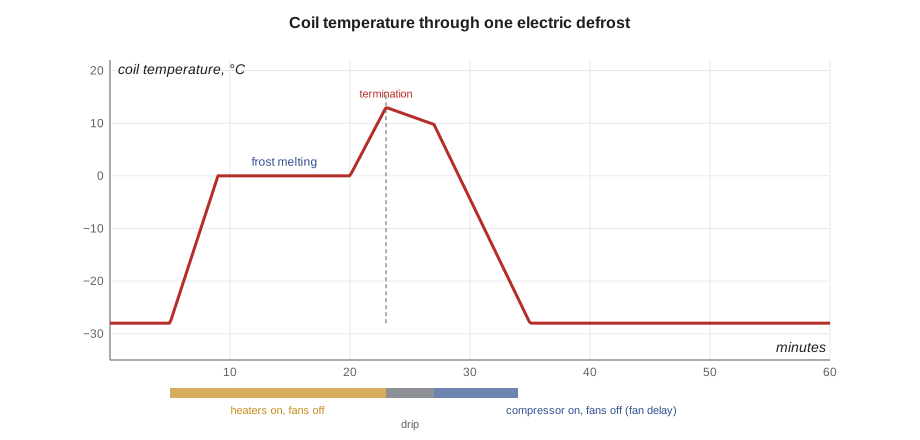
A complete electric defrost cycle on a freezer has several stages, managed by a defrost timer or electronic controller:
- Initiation, by time of day, elapsed run time or, on demand-defrost controllers, by sensed frost or coil conditions.
- Heating, with heaters on and fans off, until the coil reaches the termination temperature.
- Termination, by a temperature sensor or termination thermostat clamped to the coil at the last place to clear, commonly at about 10 to 15 °C (50 to 60 °F), with a time limit as a fail-safe.
- Drip time, a few minutes with heat off and compressor off so water drains from the coil and pan.
- Fan delay, keeping the fans off after the compressor restarts until the coil is below freezing, so remaining droplets freeze to the coil instead of being blown into the room, where they form ice on product and ceilings.
Worked problem
Why the restaurant freezer iced up
The freezer's controller starts four defrosts a day with a 30-minute (30-minute) fail-safe and termination at 13 °C (55 °F). With the termination thermostat hanging loose in the air, it reached 13 °C (55 °F) about 4 minutes after the heaters came on. A normal defrost on this coil takes about 18 minutes. What happened, and what should Theo do?
Show solution
- Each defrost ended after about 4 of the 18 minutes needed, so only part of the frost melted
- Partly melted water refroze on the coil, and frost accumulated cycle after cycle until the coil blocked
Answer: The coil never fully cleared. Theo must clear the coil completely with a manual defrost or by carefully melting the ice with the power to the fans and heaters locked out, never by chipping it with tools, which punctures tubes. Then he refastens the termination thermostat at the location the manufacturer specifies, usually high on the coil at the last area to clear, checks the heaters' current, checks the drain line heater, and reports the door gasket, which is adding moisture.
Defrost faults and checks
| Symptom | Possible causes |
|---|---|
| Coil iced only at the bottom or one side | Failed heater element, drain pan heater failed, poor air distribution |
| Ice in the drain pan and on the floor | Drain line heater failed, drain line not pitched or trapped outside the box |
| Coil iced evenly, defrosts too short | Termination sensor misplaced or faulty, too few defrosts for the moisture load |
| Ice on product and ceiling near the coil | Fan delay not working, defrost too long, water blown off the coil |
| Box warm after each defrost | Defrost too long or too frequent, termination too high, heaters not shutting off |
| Heavy frost on a cooler coil | Off-cycle defrost not long enough, door left open, low airflow, low charge |
Checks on a defrost system include measuring heater current with a clamp meter during defrost and comparing it with the heaters' ratings, checking heater resistance with the power locked out, verifying the controller's settings and clock, confirming the termination sensor is mounted correctly, and watching a complete defrost cycle from start to finish. Heaters, controller and wiring carry line voltage; the electrical safety rules from RAC-130 apply throughout.
Evaporator maintenance
Evaporator coils are cleaned with approved, food-safe cleaners where they are in food areas, with the power locked out and product protected or removed. Fan blades, guards and motors are checked for balance, current and bearing noise. Drain pans and lines are cleaned and treated to prevent slime, which can block drains and grow bacteria, a concern in any building. In air conditioning, filters are the most important evaporator maintenance item: a dirty filter is the commonest cause of low airflow, a frozen coil and liquid returning to the compressor.
Common mistakes
MistakeChipping ice off a coil with a screwdriver or ice pick.
InsteadMelt it with a controlled defrost or warm water, with power locked out; tools puncture tubes.
MistakeMoving a termination sensor to a convenient spot.
InsteadMount it where the manufacturer specifies, at the last part of the coil to clear.
MistakeIncreasing the number of defrosts to cure icing caused by a bad door gasket.
InsteadFix the moisture source; extra defrosts waste energy and warm product.
MistakeDisabling the fan delay because the fans start late.
InsteadThe delay keeps water on the coil; without it, ice forms on product and ceilings.
MistakeIgnoring a dirty air filter on a cooling coil.
InsteadLow airflow freezes the coil and floods the compressor.
Summary and key terms
- DX evaporators boil all their liquid with superheat at the outlet; flooded evaporators stay full of boiling liquid.
- Fin spacing widens from air conditioning to coolers to freezers so coils can hold frost.
- Evaporator TD sets room humidity: small TDs keep coolers humid, large TDs dry the room and product.
- Capacity = UA × LMTD; frost cuts both UA and airflow, so capacity falls quickly as coils plug.
- Defrost methods: off-cycle for coolers, electric and hot gas for freezers, reverse cycle for heat pumps.
- A defrost cycle has initiation, heating, termination, drip time and fan delay, each with its own faults.
- Direct expansion evaporator
- An evaporator fed so all liquid boils inside it, with superheat at the outlet.
- Flooded evaporator
- An evaporator kept full of boiling liquid, with vapour drawn off the top.
- Unit cooler
- A packaged evaporator coil with fans used in walk-in coolers and freezers.
- Distributor
- A fitting that divides refrigerant evenly among a coil's parallel circuits.
- Evaporator TD
- Entering air temperature minus evaporating temperature.
- LMTD
- Log mean temperature difference between a fluid and a heat exchanger surface.
- Off-cycle defrost
- Defrosting a cooler coil with room air while refrigeration is stopped.
- Termination thermostat
- A sensor that ends defrost when the coil reaches a set temperature.
- Drip time
- A period after defrost when water drains before refrigeration restarts.
- Fan delay
- Holding evaporator fans off after defrost until the coil is below freezing.
Practice problems
Work each problem on paper first, then reveal the answer to check.
A cooler is held at 3 °C with an evaporating temperature of −3 °C. What is the evaporator TD, and roughly what humidity will it hold?
Show answer
6 K; roughly 80 to 85 per cent.
Why are freezer coils built with wider fin spacing than air conditioning coils?
Show answer
To hold frost between defrosts without blocking airflow.
Name the five stages of an electric defrost cycle.
Show answer
Initiation, heating, termination, drip time and fan delay.
A freezer's floor has ice under the coil but the coil is clear. What do you check first?
Show answer
The drain line heater and the drain line's pitch and trap.
Lesson quiz · 5 questions
Score 60% or more to complete this lesson.
Create a free account to save your progress, take quizzes and earn a certificate.