
RAC-210 · Lesson 7 of 12 · 20 min
Water-cooled and evaporative condensers and cooling towers
Every spring, before the seniors' residence chiller is started for the season, Northfield's crew opens its condenser. Theo had seen the chiller's compressor on his first visit with Raj. This time he saw the other half of the machine. With the chiller locked out, the condenser water pumps stopped and the water drained, Raj unbolted the condenser's end covers, called water boxes, to reveal the tube sheet: hundreds of copper tube ends, each a little more than 2 cm (3/4 in) across. A thin brown film lined the inside of the tubes. Raj ran a rotating nylon brush through each tube with a cleaning machine that flushed water as it went. "That film doesn't look like much," he said. "But it's an insulating blanket on every tube, and the chiller pays for it on every hot day." Then they climbed to the roof to start up the cooling tower, where the residence's water treatment contractor was already testing the water for the building's water management program.
Larger systems often reject their heat to water instead of directly to air. This lesson explains water-cooled condensers, including shell-and-tube, tube-in-tube and brazed plate types; the condenser approach temperature and why fouling matters; cooling towers and their range, approach, evaporation and blowdown; evaporative condensers; and the health risk of Legionella bacteria in cooling towers and the water management programs that control it.
Why use water
Water has a much higher heat capacity and better heat transfer than air, so a water-cooled condenser is far smaller than an air-cooled one of the same capacity. More importantly, a cooling tower can cool water close to the outdoor wet-bulb temperature, which on a hot, humid summer day is often 8 to 12 K (15 to 20 °F) below the dry-bulb temperature. A chiller whose condenser is cooled by tower water therefore condenses at a lower temperature, with a lower compression ratio and lower power, than an air-cooled chiller on the same day. The cost is the water used, the chemicals and maintenance to keep the water clean, and the health risk that must be managed.
Types of water-cooled condensers
- Shell-and-tube condensers have water flowing through a bundle of tubes inside a steel shell, with refrigerant condensing on the outside of the tubes. Water boxes at the ends direct the water through one or more passes. Tubes are often internally and externally enhanced with grooves or fins. These are used on chillers and large refrigeration systems, and their tubes can be mechanically cleaned.
- Shell-and-coil condensers have a coil of tubing inside a shell. They are compact but cannot be cleaned mechanically, only chemically.
- Tube-in-tube or coaxial condensers have water flowing through an inner tube and refrigerant through the space between it and an outer tube, often in counterflow. They are used in water-source heat pumps, geothermal heat pumps and some ice machines.
- Brazed plate heat exchangers are stacks of thin corrugated stainless plates brazed together, with refrigerant and water in alternate channels. They are very compact and efficient but easily fouled and impossible to clean mechanically, so they need clean water and strainers.
Some water-cooled equipment, notably older ice machines and small refrigeration units, used once-through city water that went straight to the drain. That wastes very large amounts of water, and many jurisdictions now restrict or prohibit once-through cooling in new installations. Where it exists, a water regulating valve, controlled by head pressure, throttles the water flow to hold the condensing pressure.
Condenser approach and fouling
For a water-cooled condenser, the approach temperature is the condensing temperature minus the leaving water temperature. A clean, modern shell-and-tube condenser with enhanced tubes typically runs with an approach of only about 1 to 2 K (2 to 4 °F) at full load. As scale, biological slime, silt and corrosion products build up inside the tubes, the fouling layer adds thermal resistance, the approach rises, and with it the condensing pressure and compressor power.
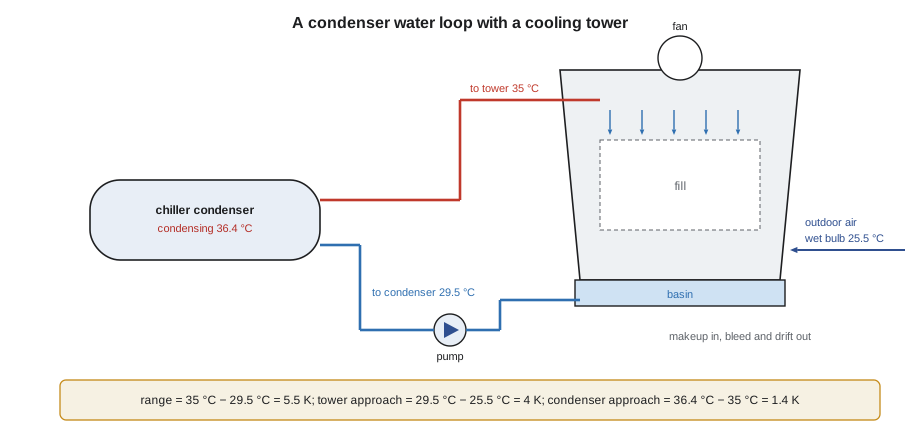
Raj logs the condenser approach at every visit because it is the best single indicator of tube condition. A rise of a degree or two over a season, at similar loads, means the tubes are fouling and the water treatment needs attention or the tubes need cleaning. A sudden rise can also come from non-condensables, low water flow or a refrigerant overcharge that floods the lower tubes with liquid. The chiller's controls often display the approach directly, calculated from the condenser pressure and the leaving water temperature.
Worked problem
What fouling costs
At full load the residence chiller's condenser leaves water at 35 °C (95 °F). With clean tubes, the condensing temperature is 36.4 °C (97.5 °F). By late summer, with a fouled condenser, it is 39.4 °C (103 °F). If compressor power rises roughly 2 to 3 per cent for each 1 K (1.8 °F) rise in condensing temperature, estimate the effect of fouling.
Show solution
- Approach clean: 36.4 − 35 = 1.4 K; fouled: 39.4 − 35 = 4.4 K
- Rise in condensing temperature 3 K × 2 to 3 % per K ≈ 6 to 9 % more compressor power
Answer: Fouling has tripled the approach and raised compressor power by roughly 6 to 9 per cent, every hour the chiller runs at that load, and reduced capacity on the hottest days. This is why condensers are brushed annually and why good water treatment pays for itself.
Cooling towers
A cooling tower cools condenser water by evaporating a small part of it into the air. Warm water from the condenser is distributed over a fill, a packing of corrugated plastic sheets or splash bars that spreads the water into thin films and droplets. A fan draws or pushes air through the fill. As some of the water evaporates, it takes its latent heat from the remaining water, which cools and collects in the basin, to be pumped back to the condenser.
- Range is the temperature drop of the water across the tower: water entering the tower minus water leaving it. At full load it is set by the heat rejected and the water flow. A common design is about 5.5 K (10 °F) with a water flow of about 0.054 L/s per kW of cooling (3 US gpm per ton).
- Approach is the temperature of the water leaving the tower minus the outdoor wet-bulb temperature. A tower cannot cool water below the wet-bulb temperature, and the closer the approach, the larger and more expensive the tower. Design approaches of about 3 to 4 K (5 to 7 °F) are common.
- Evaporation removes water and heat. As a rule of thumb, about 1 per cent of the circulating flow evaporates for every 5.5 K (10 °F) of range.
- Blowdown, or bleed, removes a little water deliberately. Evaporation leaves dissolved minerals behind, so they concentrate in the tower water. Cycles of concentration, the ratio of the dissolved solids in the tower water to those in the makeup water, are held at a target, often about 3 to 6, by bleeding water to drain and replacing it with fresh makeup water.
- Drift is the small amount of water carried out of the tower as droplets. Modern drift eliminators keep it to a tiny fraction of the flow. Drift matters mainly because it can carry bacteria into the air.
# Cooling tower water balance for the residence chiller (illustrative)
cooling_kw = 350
hr_factor = 1.18                     # water-cooled screw chiller: condenser heat / cooling
flow = 0.054 * cooling_kw            # L/s, about 0.054 L/s per kW of cooling
cond_heat = cooling_kw * hr_factor   # kW rejected
rng = cond_heat / (4.19 * flow)      # K, water temperature drop across the tower
evap = flow * 0.01 * rng / 5.56      # L/s, about 1 % of flow per 5.56 K of range
drift = flow * 0.00002               # L/s, 0.002 % of flow
print(f"condenser water flow {flow:.1f} L/s, heat rejected {cond_heat:.0f} kW, range {rng:.1f} K")
print(f"evaporation {evap * 3600:.0f} L/h at full load")
for cycles in [2, 3, 4, 6]:
    bleed = evap / (cycles - 1)
    makeup = evap + bleed + drift
    print(f"  {cycles} cycles: blowdown {bleed * 3600:4.0f} L/h, makeup {makeup * 3600:5.0f} L/h"
f" ({makeup * 3600 * 10 / 1000:5.1f} m3 per 10-hour day)")condenser water flow 18.9 L/s, heat rejected 413 kW, range 5.2 K evaporation 638 L/h at full load 2 cycles: blowdown 638 L/h, makeup 1278 L/h ( 12.8 m3 per 10-hour day) 3 cycles: blowdown 319 L/h, makeup 959 L/h ( 9.6 m3 per 10-hour day) 4 cycles: blowdown 213 L/h, makeup 852 L/h ( 8.5 m3 per 10-hour day) 6 cycles: blowdown 128 L/h, makeup 767 L/h ( 7.7 m3 per 10-hour day)
The program shows why water treatment contractors push for higher cycles of concentration: going from 2 to 4 cycles cuts the blowdown by two thirds and the total makeup by about a third. The limit is set by the water chemistry, because at high cycles minerals such as calcium carbonate begin to form scale on the condenser tubes. The treatment program balances water savings against scaling and corrosion.
Evaporative condensers
An evaporative condenser combines a condenser and a cooling tower in one unit. Refrigerant condenses inside a coil of tubes, while water is sprayed over the outside of the coil and air is blown or drawn through it. Evaporation of the water on the coil surface cools the refrigerant directly, so the condensing temperature can be lower than with a separate tower and condenser. Evaporative condensers are common in industrial ammonia refrigeration, including arena and cold storage plants, and in some supermarkets. They need the same water treatment, blowdown and Legionella control as cooling towers, plus care against scale on the coil, which is hard to remove.
Legionella and water management
Cooling towers and evaporative condensers have warm water, a large wetted surface where biofilm can grow, and a fan that produces fine droplets. They can grow and spread Legionella bacteria, which cause Legionnaires' disease, a severe pneumonia, when people breathe in contaminated droplets. Outbreaks linked to cooling towers have been reported in many cities in Canada and the United States. Older people, smokers and people with weakened immune systems, including many residents of a seniors' residence, are at the highest risk.
Control is through a water management program: a written plan, prepared by the building owner with the water treatment provider, that identifies where Legionella could grow and spread, sets control measures such as biocide treatment, blowdown, cleaning and disinfection, sets limits and monitoring, including routine bacterial testing, and says what to do when results are out of limits. Quebec has had a regulation on cooling tower maintenance and Legionella sampling since 2013, and New Brunswick adopted one in 2022. Ontario has no province-wide cooling tower registry, though public health units and municipalities have called for one and some local rules apply. ASHRAE Standard 188 sets out how to manage the risk in building water systems and is widely referenced across North America.
For a refrigeration technician, the program sets practical rules on site:
- Never start, drain or clean a tower without coordinating with the owner and the water treatment contractor, and follow the program's start-up and disinfection steps after a shutdown. Stagnant water in a tower left over the winter is a known risk.
- Wear the respiratory protection specified, commonly at least an N95 or equivalent filtering facepiece respirator, when working in or near the spray of an operating tower or cleaning one, and keep others away from the plume.
- Report problems the program depends on: failed drift eliminators, broken spray nozzles, dead legs in piping, failed chemical feed, algae or slime on the fill and basin, and out-of-range water temperatures.
- Lock out the fan and pumps before entering a tower. The basin and fill can be slippery, and fan blades can turn in the wind; use the confined space or fall protection procedures that apply to the tower's design.
Freeze protection and winter operation
In Kitchener, cooling towers that must run in winter, for example to cool interior zones or process loads, need freeze protection: basin heaters, fan cycling or reversing, bypass valves that send water directly back to the basin, and sometimes indoor sump tanks so the tower basin can be drained. The residence's tower is drained in autumn and the condenser water piping protected. That is why the spring start-up includes flushing, cleaning and disinfection before the chiller runs.
Common mistakes
MistakeTreating a rising condenser approach as normal ageing.
InsteadA rising approach at similar loads means fouling or another fault; clean tubes and review water treatment.
MistakeStarting a cooling tower after a long shutdown without the water management program's start-up steps.
InsteadCoordinate with the owner and treatment contractor; stagnant towers need cleaning and disinfection.
MistakeWorking in an operating tower's plume without respiratory protection.
InsteadUse the specified respirator and keep others clear.
MistakeRunning a tower at very high cycles to save water.
InsteadToo many cycles causes scale; the treatment program sets the limit.
MistakeCleaning a brazed plate condenser by rodding it.
InsteadBrazed plates cannot be cleaned mechanically; protect them with strainers and clean water.
Summary and key terms
- Water-cooled condensers are smaller than air-cooled ones, and tower water lets chillers condense close to the wet-bulb temperature.
- Types include shell-and-tube, shell-and-coil, tube-in-tube and brazed plate condensers.
- Condenser approach = condensing temperature − leaving water temperature; it rises as tubes foul.
- Tower range = water in − water out; tower approach = water out − wet bulb.
- Evaporation is about 1 % of flow per 5.5 K (10 °F) of range; blowdown = evaporation ÷ (cycles − 1).
- Cooling towers and evaporative condensers can spread Legionella; water management programs control the risk.
- Shell-and-tube condenser
- A condenser with water in tubes and refrigerant condensing in the surrounding shell.
- Brazed plate heat exchanger
- A compact exchanger of brazed corrugated plates with alternate refrigerant and water channels.
- Condenser approach
- Condensing temperature minus leaving condenser water temperature.
- Fouling
- Scale, slime and deposits that reduce heat transfer on tube surfaces.
- Range
- The temperature drop of water across a cooling tower.
- Tower approach
- Water temperature leaving the tower minus the outdoor wet-bulb temperature.
- Cycles of concentration
- The ratio of dissolved solids in tower water to those in the makeup water.
- Blowdown
- Water bled from a tower to limit the concentration of dissolved solids.
- Evaporative condenser
- A unit that condenses refrigerant in a coil wetted with water and cooled by air.
- Water management program
- A written plan to control Legionella growth and spread in building water systems.
Practice problems
Work each problem on paper first, then reveal the answer to check.
Water leaves a condenser at 34 °C and the condensing temperature is 36 °C. What is the approach?
Show answer
2 K.
A tower cools water from 35 °C to 29.5 °C on a day with a 24 °C wet bulb. What are the range and approach?
Show answer
Range 5.5 K, approach 5.5 K.
Evaporation is 400 L/h and the tower runs at 4 cycles. What is the blowdown?
Show answer
400 ÷ 3 ≈ 133 L/h.
Name two people a technician should coordinate with before starting a tower after winter.
Show answer
The building owner or manager and the water treatment contractor.
Lesson quiz · 5 questions
Score 60% or more to complete this lesson.
Create a free account to save your progress, take quizzes and earn a certificate.