
RAC-210 · Lesson 4 of 12 · 18 min
Rotary, screw and centrifugal compressors
The seniors' residence in Kitchener has the biggest machine on Northfield's maintenance contracts: a water-cooled chiller in the basement mechanical room, with a rooftop cooling tower, that cools the whole building in summer. Its R-134a charge of 95 kg (210 lb), and its leak repairs, had been a large part of Theo's level-one course on refrigerant rules. This time Raj brought him to the chiller for its spring start-up. Theo had expected a giant version of the compressors in the boneyard. Instead, the chiller had a single twin-screw compressor the size of a small car engine, with an oil separator beside it as large as the compressor itself, and a touchscreen controller that showed the slide valve position, oil pressure and motor current. "Different compressors for different jobs," Raj said. "This one would be silly in a window unit, and a window unit's compressor would be useless here."
This lesson covers the remaining compressor types. Rolling piston and rotary vane compressors are small rotary machines used in room air conditioners, ductless systems and small heat pumps. Screw compressors handle medium and large capacities in commercial refrigeration, process cooling, chillers and industrial plants. Centrifugal compressors, the main dynamic compressors in HVAC-R, are used in large water chillers. For each, the lesson explains how it works, how its capacity is controlled, what it needs from the system and how it typically fails.
Rolling piston rotary compressors
A rolling piston compressor has a cylindrical steel roller mounted on an eccentric on the motor shaft, inside a cylinder. As the shaft turns, the roller rolls around the inside wall of the cylinder, touching it along a line. A spring-loaded vane, or blade, rides in a slot in the cylinder wall and presses against the roller, dividing the space between the roller and the wall into a suction side and a compression side. As the roller rolls, the suction space grows, drawing in vapour through a port beside the vane, while the compression space shrinks, compressing gas until a discharge valve opens.
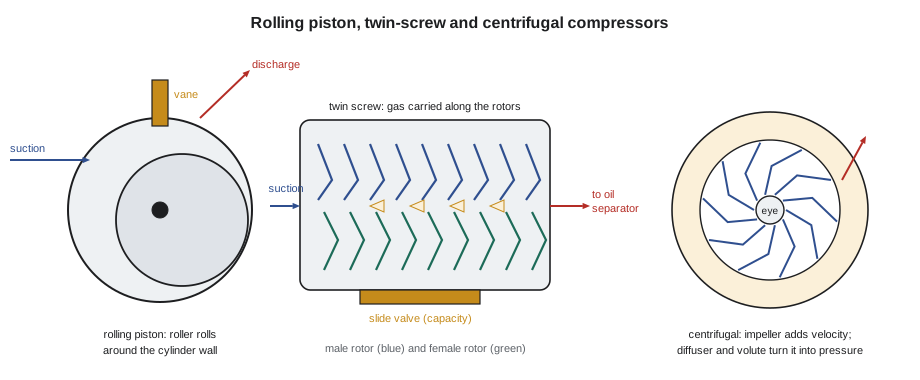
Rolling piston compressors are compact, have few parts and are well suited to small capacities. Many have the motor above the compressor in a vertical shell, with the shell at discharge pressure rather than suction pressure. This high-side shell design means the shell and the motor run hot, and suction gas enters the cylinder directly through an external accumulator mounted beside the compressor. The accumulator catches liquid and returns it slowly, with oil, through a small orifice, which matters because a rolling piston compressor is sensitive to liquid.
Rotary compressors are the usual choice for window and room air conditioners, ductless mini-splits and small heat pumps. Twin-rotary designs, with two rollers set 180 degrees apart, reduce vibration and work well with inverter drives at high and low speeds. The attic ductless heat pump on Northfield's list has an inverter-driven twin rotary.
Because the shell is at high pressure, a technician feeling a rotary compressor will find the whole shell hot, unlike a suction-cooled reciprocating or scroll compressor, whose lower shell is cool. That is normal, not a sign of overheating. Overheating is judged from the discharge temperature, the current and the manufacturer's data.
Rotary vane compressors
A rotary vane compressor has a rotor mounted off-centre in a cylinder, with several vanes sliding in slots in the rotor. As the rotor turns, centrifugal force and sometimes springs push the vanes out against the cylinder wall, forming pockets that grow on the suction side and shrink on the discharge side. Rotary vane compressors are found in some small systems, transport refrigeration and booster applications. They are less common in stationary HVAC-R than rolling piston rotaries, but the principle, trapping gas in pockets that shrink as a rotor turns, is the same.
Screw compressors
A twin-screw compressor has two meshing helical rotors in a close-fitting housing: a male rotor with convex lobes and a female rotor with concave flutes. As they turn, vapour fills the spaces between the lobes at the suction end. The meshing lobes then trap the vapour and carry it along the rotors toward the discharge end, while the trapped volume shrinks, raising the pressure. At the discharge end the compressed vapour leaves through a discharge port. Single-screw compressors use one main rotor and two star-shaped gate rotors and work on the same idea.
Like a scroll, a screw has a built-in volume ratio set by the size and position of its discharge port. Large screws often have a variable volume ratio, adjusting the port to match the system's actual pressure ratio for better efficiency.
- Oil injection. Most refrigeration screws are oil-flooded: large quantities of oil are injected into the rotors to seal the clearances between the rotors and the housing, lubricate the bearings and absorb some of the heat of compression. The oil leaves the compressor with the discharge gas and must be separated and returned. That is why the residence chiller has an oil separator nearly as large as the compressor, and an oil cooler, filter and oil pressure monitoring.
- Slide valve capacity control. A slide valve under the rotors can move to open a bypass path back to suction, so that only part of the rotor length compresses gas. Capacity can be varied smoothly from full load down to a low fraction, typically about 10 to 25 per cent depending on the design. Many newer screws also use variable-speed drives, alone or with slide valves.
- Economizers. Many screws have a port part way along the rotors where vapour at an intermediate pressure can be injected. Flashing part of the liquid to this intermediate pressure subcools the remaining liquid, increasing capacity and efficiency at high compression ratios, which is valuable in low-temperature refrigeration.
Screws tolerate high compression ratios and some liquid better than reciprocating compressors, run smoothly and last a long time. They are used in large commercial refrigeration, process chillers, air- and water-cooled chillers in the medium size range and many industrial ammonia plants, including the type that runs an arena's ice plant. A later course on industrial refrigeration covers ammonia screw packages in more detail.
Centrifugal compressors
A centrifugal compressor is a dynamic compressor. Vapour enters the centre, or eye, of a spinning impeller. The impeller's vanes fling the vapour outward at high velocity. In the diffuser and the spiral-shaped volute around the impeller, the vapour slows down and its velocity is converted to pressure. Large chillers use one, two or three impellers in series, called stages.
Centrifugal compressors handle very large volumes of vapour efficiently and are used in large water chillers for office towers, hospitals, campuses and district cooling. They are best suited to refrigerants with low pressure and high vapour volume, such as R-123 in older machines and R-1233zd(E) or R-514A in newer low-pressure chillers, as well as R-134a and R-513A in medium-pressure machines. Low-pressure chillers run with their evaporator below atmospheric pressure, so they need a purge unit to remove air and moisture that leak in.
The pressure a centrifugal compressor can produce depends on the speed of the impeller tip. The lift between evaporator and condenser is therefore limited by tip speed. If the condenser pressure rises above what the impeller can deliver at a given flow, the flow becomes unstable and briefly reverses through the impeller, a condition called surge. Surge makes a loud noise and stresses the machine. Chiller controls prevent it by limiting the minimum flow and the maximum lift, for example by keeping the condenser water temperature in range.
- Inlet guide vanes, adjustable vanes at the impeller eye, control capacity by changing the angle at which vapour enters the impeller.
- Variable-speed drives reduce impeller speed at part load and are common on newer chillers, often combined with guide vanes.
- Oil-free magnetic bearing centrifugals levitate the shaft on magnetic bearings and run at very high speeds with a variable-speed drive. With no oil to manage, they avoid oil return issues entirely and are efficient at part load. They are common in medium-sized chillers and retrofit projects.
Rating large compressors and chillers at part load
Large compressors spend most of their life at part load. Chillers are therefore rated not only at full load but also with a part-load value, the integrated part load value or IPLV, which weights the efficiency at 100, 75, 50 and 25 per cent load by how often each load typically occurs. In the rating standard used in North America, the weights are 1, 42, 45 and 12 per cent respectively. A chiller that is efficient at 50 and 75 per cent load, where it spends most of its hours, scores well even if its full-load efficiency is ordinary.
In this formula A, B, C and D are the efficiencies at 100, 75, 50 and 25 per cent load, expressed in a form where a higher number is better, such as the coefficient of performance or energy efficiency ratio. When efficiency is given in kilowatts of input per ton of cooling, where lower is better, the standard combines the values differently, so the simple weighted average must not be applied to kilowatts per ton.
# Part-load performance of the residence chiller's screw compressor
# COP at four load points (illustrative values for a water-cooled screw chiller)
capacity_kw = 350
loads = [1.00, 0.75, 0.50, 0.25]
weights = [0.01, 0.42, 0.45, 0.12]
cop = {"slide valve only": [5.6, 6.1, 5.9, 4.6],
       "variable speed":   [5.5, 6.8, 7.6, 6.9]}

for name, c in cop.items():
    iplv = sum(w * x for w, x in zip(weights, c))
    print(f"{name:17s}: COP at 100/75/50/25 % = {c}, IPLV = {iplv:.2f}")
    for load, x in zip(loads, c):
        q = capacity_kw * load
print(f" {load:4.0%} load: {q:5.0f} kW cooling for {q / x:5.1f} kW input")slide valve only : COP at 100/75/50/25 % = [5.6, 6.1, 5.9, 4.6], IPLV = 5.83
100% load: 350 kW cooling for 62.5 kW input
75% load: 262 kW cooling for 43.0 kW input
50% load: 175 kW cooling for 29.7 kW input
25% load: 88 kW cooling for 19.0 kW input
variable speed : COP at 100/75/50/25 % = [5.5, 6.8, 7.6, 6.9], IPLV = 7.16
100% load: 350 kW cooling for 63.6 kW input
75% load: 262 kW cooling for 38.6 kW input
50% load: 175 kW cooling for 23.0 kW input
25% load: 88 kW cooling for 12.7 kW inputThe example shows why chiller replacements so often choose variable-speed compressors. At full load the two machines are nearly the same, but at the 50 and 75 per cent loads where a building chiller spends most of its hours, the variable-speed machine uses noticeably less power. The figures are illustrative; real chiller selections use the manufacturer's certified ratings at the project's actual water temperatures.
Choosing a compressor type
| Type | Strengths | Limits and service concerns |
|---|---|---|
| Reciprocating | Handles high ratios; serviceable in semi-hermetic form; simple controls | Valves sensitive to liquid; noise and vibration; capacity falls fast at low suction |
| Scroll | Quiet, efficient, few parts, some liquid tolerance | Must not run under vacuum; three-phase rotation; built-in ratio |
| Rolling piston rotary | Compact, smooth, suits inverter drives in small sizes | Sensitive to liquid; relies on its accumulator; hot high-side shell |
| Screw | Rugged, smooth capacity control, tolerates high ratios | Large oil system: separator, cooler, filter, oil pressure |
| Centrifugal | Very large capacities, very efficient at design and part load with drives | Limited lift; surge; purge units on low-pressure machines |
For a service technician, the choice is usually already made; the job is to know what the type needs. A rotary compressor needs its accumulator in good condition. A screw needs its oil separator, oil level, oil filter and oil pressure watched. A centrifugal needs the water temperatures and flows kept in range to avoid surge, and a low-pressure machine needs its purge unit's run time watched as a leak indicator. A rising purge run time on a low-pressure chiller is one of the earliest signs of a leak letting air in.
At the residence chiller
Raj worked through the spring start-up checklist with Theo. They confirmed the condenser and chilled water pumps were running and flows were proven before allowing the compressor to start. They checked the oil level in the separator sight glass and the oil heater, which keeps refrigerant from dissolving in the oil during the off season. After start-up, they recorded the slide valve position, motor current, oil pressure difference, discharge temperature, evaporator and condenser approach temperatures and the water temperatures into the chiller's log. The log entry from last autumn showed a condenser approach of 1.4 K (2.5 °F); this spring it was the same, which told Raj the condenser tubes were still clean after the winter cleaning. Lesson 7 explains what approach temperature means and why it is such a useful number.
Common mistakes
MistakeThinking a hot rotary compressor shell means overheating.
InsteadMany rotaries have a high-side shell that is normally hot; judge by discharge temperature and current.
MistakeRemoving or bypassing a rotary compressor's accumulator.
InsteadIt protects a liquid-sensitive compressor and returns oil; replace it only with the correct part.
MistakeIgnoring the oil system on a screw compressor.
InsteadCheck separator level, oil filter pressure drop, oil temperature and oil pressure every visit.
MistakeAveraging kilowatts per ton with the IPLV weights.
InsteadThe simple weighted average applies to efficiencies where higher is better, such as COP or EER.
MistakeLetting a centrifugal chiller run with very cold evaporator water and very warm condenser water.
InsteadA large lift can push the compressor into surge; keep temperatures in the allowed range.
Summary and key terms
- Rolling piston rotaries use an eccentric roller and a sliding vane; they are compact and common in room units and ductless systems.
- Many rotaries have a hot high-side shell and an accumulator that protects them from liquid.
- Screw compressors trap gas along meshing helical rotors; most are oil-flooded and need large oil separators.
- Screws control capacity with slide valves and drives, and use economizer ports to improve low-temperature performance.
- Centrifugal compressors add velocity with an impeller; their lift is limited and surge must be avoided.
- Chillers are compared at part load with IPLV, weighting 100, 75, 50 and 25 per cent loads at 1, 42, 45 and 12 per cent.
- Rolling piston compressor
- A rotary compressor with an eccentric roller and a sliding vane.
- Rotary vane compressor
- A rotary compressor with vanes sliding in an off-centre rotor.
- Twin-screw compressor
- A compressor using meshing male and female helical rotors.
- Slide valve
- A movable valve that controls a screw compressor's capacity by bypassing part of the rotor length.
- Oil separator
- A vessel that removes oil from discharge gas and returns it to the compressor.
- Economizer port
- An intermediate-pressure inlet on a screw compressor used for subcooling and higher capacity.
- Impeller
- The spinning wheel of a centrifugal compressor.
- Surge
- Unstable reversing flow in a centrifugal compressor when the required lift is too high for the flow.
- Inlet guide vanes
- Adjustable vanes that control a centrifugal compressor's capacity.
- IPLV
- Integrated part load value, a weighted average of chiller efficiency at four load points.
Practice problems
Work each problem on paper first, then reveal the answer to check.
Why does a rolling piston compressor need an accumulator?
Show answer
It is sensitive to liquid; the accumulator catches liquid and meters it back slowly with oil.
What does a screw compressor's slide valve do?
Show answer
It opens a bypass along the rotors so only part of their length compresses gas, reducing capacity.
A chiller has COP 5.0, 6.0, 6.5 and 5.5 at 100, 75, 50 and 25 per cent load. What is its IPLV?
Show answer
0.01 × 5.0 + 0.42 × 6.0 + 0.45 × 6.5 + 0.12 × 5.5 ≈ 6.15.
What is surge, and what causes it?
Show answer
Unstable reversing flow in a centrifugal compressor when the lift required exceeds what the impeller can produce at that flow.
Lesson quiz · 5 questions
Score 60% or more to complete this lesson.
Create a free account to save your progress, take quizzes and earn a certificate.