
RAC-210 · Lesson 10 of 12 · 22 min
Diagnosing compressor, condenser and evaporator problems
Dana gave Theo a stack of six service tickets from the past summer, with the customer names covered and only the readings left: suction and discharge pressures, superheat, subcooling, compressor current, outdoor and indoor temperatures, and a note on the system type. "Each of these was a different problem," she said. "Every one of them shows up on the gauges and thermometers if you know what normal looks like and you read all the numbers together. The mistake is reading one number and grabbing a cylinder." By the end of the afternoon, Theo had a page of notes, a table of patterns, and a new respect for the techs who could look at four numbers and know where to walk next.
This lesson pulls together the compressor, condenser, evaporator and accessory knowledge of the course into a diagnostic method. It explains what to measure and how to work out what normal is for a given system and conditions, the characteristic patterns of the most common faults in the three main components and the refrigerant circuit, and how to confirm a diagnosis before replacing parts. Charging methods themselves are covered in detail in RAC-220; this lesson concentrates on recognizing the faults that are not charge problems, and on recognizing charge problems so that they are not blamed on components.
A method: measure, compare, think, confirm
- Ask and look. What does the customer report? When did it start? Is the equipment running? Look for obvious problems: dirty filters and coils, iced coils, failed fans, oil stains that mark leaks, damaged wiring, blocked airflow and missing panels.
- Measure the full set. Suction and discharge or liquid pressures and their saturation temperatures; suction line temperature at the evaporator outlet or compressor for superheat; liquid line temperature for subcooling; air or water temperatures in and out of each coil; compressor and fan currents; voltage. Record outdoor and indoor conditions.
- Compare with normal. Normal depends on the system type, the refrigerant, the metering device, the load and the outdoor temperature. Use the manufacturer's performance data or charging charts where available, the design condenser and evaporator TDs from lessons 6 and 8, and the history in previous service records.
- Think through the pattern. Which readings are high, which are low, which are normal? Match the pattern with the possible causes.
- Confirm before replacing. Test the suspected component directly, or make a reversible change, such as cleaning a filter, and watch whether the readings move as expected.
The four key numbers
Most refrigerant-side diagnosis rests on four numbers, read together:
- Evaporating temperature, from suction pressure. Compared with the air or water entering the evaporator, it gives the evaporator TD.
- Condensing temperature, from discharge or liquid pressure. Compared with the air or water entering the condenser, it gives the condenser split or approach.
- Superheat at the evaporator outlet, or total superheat at the compressor. It shows whether the evaporator is getting the right amount of refrigerant: high superheat means starved, low means flooded.
- Subcooling at the condenser outlet. It shows how much liquid is backed up in the condenser: high means a lot of liquid held there, low means little.
To these, the compressor current adds a measure of how hard the compressor is working, and the air or water temperature splits across the coils show how much heat is actually being moved. A useful habit is to write the readings in a fixed order on every call, so that comparisons with previous visits are easy.
Common fault patterns
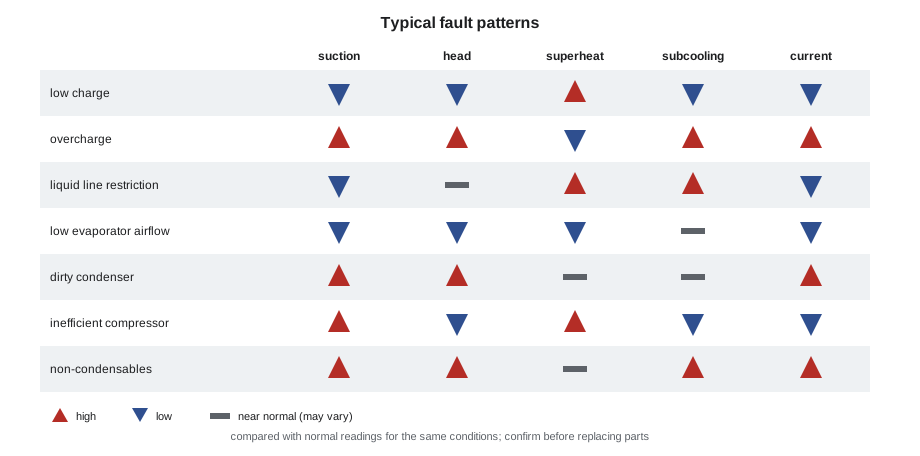
| Fault | Suction | Head | Superheat | Subcooling | Current |
|---|---|---|---|---|---|
| Low charge | Low | Low | High | Low | Low |
| Overcharge | High or normal | High | Low | High | High |
| Liquid line restriction | Low | Normal or low | High | High | Low |
| Low evaporator airflow | Low | Low | Low (fixed metering) or normal (TXV) | Normal or high | Low |
| Dirty condenser or low condenser airflow | High | High | Normal or low | Normal or low | High |
| Inefficient compressor | High | Low | High or normal | Low | Low |
| Non-condensables | High | High | Normal | High | High |
A few points help to separate patterns that look alike.
- Low charge and a liquid line restriction both starve the evaporator, with low suction and high superheat. The difference is subcooling: with a low charge there is little liquid anywhere, so subcooling is low; with a restriction, liquid backs up in the condenser and receiver behind the restriction, so subcooling is normal or high. A temperature drop across the restriction, as in lesson 9, confirms it.
- Low evaporator airflow and low charge both lower the suction pressure. With low airflow, the evaporator cannot boil all its refrigerant, so superheat is low on fixed-metering systems and liquid may return to the compressor. The air temperature drop across the coil is large, because the little air that passes is cooled a lot. Filters, blowers, belts and dirty or iced coils are the usual causes.
- A dirty condenser and an overcharge both raise the head pressure. A dirty condenser raises the condenser split while subcooling stays normal or falls; an overcharge fills more of the condenser with liquid, so subcooling is high. Cleaning the coil first is the easiest confirmation.
- An inefficient compressor is the only common fault with high suction and low head together, because the compressor cannot hold the pressure difference. Current is low because the compressor is doing less work. Before condemning it, check that its capacity control is not stuck unloaded, that a scroll is not running backward, and that a reversing valve or hot gas bypass valve is not leaking high-side gas into the suction.
- Non-condensables raise the head pressure without a dirty coil. After the system has been off long enough to settle at a steady temperature, the pressure in the condenser or receiver is higher than the saturation pressure for that temperature, because the trapped gas adds its own pressure.
Electrical and mechanical clues from the compressor
The compressor gives its own evidence. Current compared with the manufacturer's data at the measured pressures tells whether it is doing the expected work. Current that is high at normal pressures can mean a mechanical problem such as tight bearings, a failing capacitor or low voltage; current that is low at normal pressures can mean a compressor that is not pumping. Shell and line temperatures help too: the discharge line should be hot, the suction line cool, and the compressor's lower shell on a suction-cooled compressor cool to the touch. A hot compressor with a very hot discharge line, high superheat and a hot shell is overheating; a compressor with frost or heavy sweat on its shell and a cold crankcase is being flooded. Noises such as knocking, rattling, grinding or a high-pitched whine add information that should be noted.
A compressor that will not start at all is mainly an electrical problem, covered in RAC-130: check supply voltage, contactor, capacitor, start components, overload and windings. A compressor that starts and trips its internal overload may be overheating from a refrigerant-side problem, such as low charge or high head pressure, or from an electrical one. Internal overloads can take an hour or more to reset in a hot compressor, so a compressor that seems open between two terminals may simply be waiting for its overload to cool. A compressor shell too hot to hold a hand on is a clue; a measured open winding on a cool compressor is a failed winding.
A diagnostic helper
The program below turns the table into a simple scoring helper. It compares each reading with what would be normal, classifies it as high, low or normal, and scores each fault by how well its pattern matches. Real diagnosis needs judgement and confirmation, but the exercise shows how the patterns separate faults.
# Score fault patterns against observed readings (H = high, L = low, N = normal)
patterns = {
    "low charge":              {"suction": "L", "head": "L", "superheat": "H", "subcool": "L", "amps": "L"},
    "overcharge":              {"suction": "HN", "head": "H", "superheat": "L", "subcool": "H", "amps": "H"},
    "liquid line restriction": {"suction": "L", "head": "NL", "superheat": "H", "subcool": "H", "amps": "L"},
    "low evaporator airflow":  {"suction": "L", "head": "L", "superheat": "LN", "subcool": "NH", "amps": "L"},
    "dirty condenser":         {"suction": "H", "head": "H", "superheat": "NL", "subcool": "NL", "amps": "H"},
    "inefficient compressor":  {"suction": "H", "head": "L", "superheat": "HN", "subcool": "L", "amps": "L"},
    "non-condensables":        {"suction": "H", "head": "H", "superheat": "N", "subcool": "H", "amps": "H"},
}

def classify(measured, normal, band):
    if measured > normal + band: return "H"
    if measured < normal - band: return "L"
    return "N"

def diagnose(obs):
    scores = {}
    for fault, p in patterns.items():
        scores[fault] = sum(2 if obs[k] == p[k][0] else (1 if obs[k] in p[k] else 0) for k in p)
    return sorted(scores.items(), key=lambda kv: -kv[1])[:3]

tickets = {
    # name: {reading: (measured, normal, band)}  temperatures in degrees, current in amps
    "ticket A": {"suction": (2, 7, 2), "head": (38, 46, 3), "superheat": (22, 8, 3), "subcool": (1, 6, 2), "amps": (8.9, 11.0, 0.8)},
    "ticket B": {"suction": (1, 7, 2), "head": (45, 46, 3), "superheat": (20, 8, 3), "subcool": (13, 6, 2), "amps": (9.2, 11.0, 0.8)},
    "ticket C": {"suction": (11, 7, 2), "head": (40, 46, 3), "superheat": (14, 8, 3), "subcool": (2, 6, 2), "amps": (7.6, 11.0, 0.8)},
}
for name, readings in tickets.items():
    obs = {k: classify(*v) for k, v in readings.items()}
print(name, obs, "->", diagnose(obs))ticket A {'suction': 'L', 'head': 'L', 'superheat': 'H', 'subcool': 'L', 'amps': 'L'} -> [('low charge', 10), ('inefficient compressor', 8), ('liquid line restriction', 7)]
ticket B {'suction': 'L', 'head': 'N', 'superheat': 'H', 'subcool': 'H', 'amps': 'L'} -> [('liquid line restriction', 10), ('low charge', 6), ('low evaporator airflow', 5)]
ticket C {'suction': 'H', 'head': 'L', 'superheat': 'H', 'subcool': 'L', 'amps': 'L'} -> [('inefficient compressor', 10), ('low charge', 8), ('liquid line restriction', 5)]The program's temperatures are saturation temperatures for suction and head, in degrees of either scale; only the comparison with normal matters. Ticket A matches a low charge, ticket B a liquid line restriction, and ticket C an inefficient compressor. In Dana's stack, ticket A was the attic heat pump with a leaking flare nut; ticket B was the clinic's plugged drier from lesson 9; and ticket C was the restaurant's reach-in from lesson 2, with its broken suction reed.
Worked diagnoses
Worked problem
The brewery cooler on a hot afternoon
Readings on the brewery walk-in at 33 °C (91 °F) outdoors: condensing temperature 55 °C (131 °F), evaporating −6 °C (21 °F) with the box at 3 °C (37 °F), superheat at the evaporator 6 K (11 °F), subcooling 3 K (5 °F), compressor current 15 per cent above the chart. The condenser coil looks grey.
Show solution
- Condenser split = 55 − 33 = 22 K, about twice the design 11 K
- Superheat normal, subcooling low-normal, current high: the pattern of a dirty condenser, not an overcharge
Answer: Clean the condenser first, with the power locked out, then recheck. If the split returns near design and the current falls, the diagnosis is confirmed. Adding or removing refrigerant before cleaning would make the situation worse.
Worked problem
The clinic's cooling coil
On the clinic rooftop unit, the suction saturation temperature is −1 °C (30 °F), superheat 3 K (5 °F) at the compressor, head pressure a little low, and the air drop across the coil 17 K (31 °F). The return filters are dated eight months ago.
Show solution
- Low suction with low superheat and a large air temperature drop point to low airflow, not low charge
- A coil below freezing with low superheat risks icing and liquid floodback
Answer: Replace the filters, check the blower and belt, and check the coil face for dirt or ice. With airflow restored, the suction temperature should rise above freezing and the air drop return to about 10 to 12 K (18 to 22 °F). If the coil has iced, thaw it completely before rechecking.
Confirming before replacing
Parts cost money and replacing a compressor or coil involves recovering the charge, brazing, testing and evacuation, so diagnosis must be confirmed before work starts. Ways to confirm include:
- Making the simple corrections first, such as cleaning coils and filters, and rechecking.
- Measuring temperature or pressure drops across suspected restrictions: driers, solenoids, metering devices and distributors.
- Checking a compressor's current and pressures against the manufacturer's performance data at the actual conditions, rather than rules of thumb.
- Electrically testing windings, capacitors, contactors and protectors as in RAC-130.
- Looking for oil stains and testing for leaks with the methods of RAC-120 before adding refrigerant to a system that has lost charge. A system that is low on charge has a leak, and the leak must be found and repaired as the regulations require.
- Recording all readings and the conclusion on the service ticket, so the next technician, or the same technician next year, can compare.
Common mistakes
MistakeAdding refrigerant because the suction pressure is low.
InsteadLow suction has many causes: airflow, restrictions, a weak compressor or icing; read all the numbers first.
MistakeCondemning a compressor for low pumping without checking capacity control, rotation or leaking valves.
InsteadCheck the external causes of high suction and low head first.
MistakeReading superheat and subcooling at the wrong places.
InsteadSuperheat at the evaporator outlet or compressor; subcooling at the condenser or receiver outlet.
MistakeDiagnosing a system right after start-up.
InsteadLet it run until pressures and temperatures stabilize, commonly at least 10 to 15 minutes.
MistakeIgnoring the service history.
InsteadCompare with readings from previous visits under similar conditions.
Summary and key terms
- Diagnose by measuring the full set of readings, comparing with normal for the conditions, matching patterns and confirming.
- The four key numbers are evaporating temperature, condensing temperature, superheat and subcooling; current and air splits complete the picture.
- Low charge and restrictions both starve the evaporator; subcooling separates them.
- Low airflow lowers suction with low superheat and a large air temperature drop.
- Dirty condensers raise the split with normal subcooling; overcharge raises subcooling.
- Only an inefficient compressor or an internal leak gives high suction and low head together.
- Confirm the diagnosis before replacing major components, and record readings for the next visit.
- Evaporating temperature
- The saturation temperature at the suction pressure.
- Total superheat
- Superheat measured at the compressor inlet, including suction line heat gain.
- Liquid line restriction
- A partial blockage in the liquid line, often at a drier or solenoid.
- Inefficient compressor
- A compressor that pumps less than it should because of internal leakage.
- Temperature split
- The temperature change of air or water across a coil.
- Performance data
- Manufacturer's tables or charts of expected pressures, currents and capacity at given conditions.
- Internal overload
- A protector inside a compressor that opens on high temperature or current.
- Reversible check
- A simple change, such as cleaning a filter, used to confirm a diagnosis.
- Service history
- Readings and work recorded on previous visits.
- Pattern
- The combination of high, low and normal readings that identifies a fault.
Practice problems
Work each problem on paper first, then reveal the answer to check.
Suction low, head low, superheat high, subcooling low, current low. What is the likely fault?
Show answer
Low charge, which means a leak to be found and repaired.
Suction low, superheat high, subcooling high and a temperature drop across the drier. What is it?
Show answer
A liquid line restriction at the drier.
Suction high, head low and current low. What fault fits, and what do you check before condemning the compressor?
Show answer
An inefficient compressor; check capacity control, rotation and leaking reversing or bypass valves.
Head pressure high, condenser split twice normal, subcooling normal. What do you do first?
Show answer
Clean the condenser and check its fans, then recheck.
Lesson quiz · 5 questions
Score 60% or more to complete this lesson.
Create a free account to save your progress, take quizzes and earn a certificate.