
RAC-120 · Lesson 5 of 12 · 20 min
Refrigerant law in Canada: federal and provincial rules
Dana keeps a binder in the shop office labelled simply "The rules". It holds the federal regulations, the Ontario regulation, the federal code of practice and copies of the company's own procedures. When Theo asked why there were so many documents, she answered with a question: "Who owns the refrigerant in a heat pump at a house in Kitchener, who owns it in a cooler at a federal building, and who decides what we must do when we work on each?" The answer, it turns out, depends on where the equipment is and what it holds.
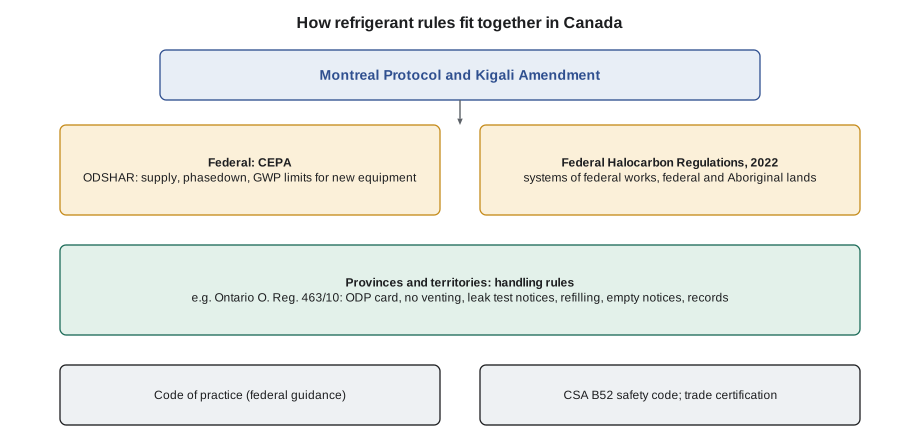
Canada's refrigerant rules come from two levels of government. The federal government controls the supply of ozone-depleting substances and HFCs, sets limits on the refrigerants allowed in many kinds of new equipment, and regulates refrigeration and air conditioning systems that fall under federal authority. The provinces and territories regulate most of the day-to-day handling by technicians: certification, venting, leak testing, recovery and records. This lesson maps those layers, with Ontario as the main provincial example, and shows how a technician works out which rules apply to a job.
The federal layer
The federal rules are made under the Canadian Environmental Protection Act, 1999, which allows the federal government to regulate toxic substances, a category that includes ozone-depleting substances and HFCs. Two sets of regulations matter most to refrigeration and air conditioning.
The Ozone-depleting Substances and Halocarbon Alternatives Regulations
These regulations, often called ODSHAR, implement Canada's commitments under the Montreal Protocol and the Kigali Amendment. They control the manufacture, import and export of ozone-depleting substances such as CFCs and HCFCs and of HFCs. For ozone-depleting substances, they implement the phase-out: new supply of HCFCs such as R-22 has ended, apart from very limited exceptions, so servicing of remaining R-22 equipment depends on recovered and reclaimed refrigerant. For HFCs, they set a consumption limit, the total carbon dioxide equivalent that may be manufactured or imported each year, and allocate allowances to companies. The limit fell 10 per cent from the baseline in 2019 and steps down in 2024, 2029 and 2034, reaching an 85 per cent reduction in 2036.
ODSHAR also prohibits the manufacture and import of many kinds of new products and equipment that contain, or are designed to contain, HFCs with a GWP above a set limit, with dates that vary by product type. For refrigeration and air conditioning, examples include limits from 2020 for several kinds of commercial refrigeration equipment, and from 2025 a limit of 750 for chillers and 150 for stand-alone residential refrigeration. Further changes for stationary air conditioning have been the subject of federal consultation. The prohibitions apply to manufacturers and importers of new equipment, not to existing equipment: a technician may keep servicing an existing system with the refrigerant it was built for.
| Equipment type (examples) | GWP limit for new equipment | In force from |
|---|---|---|
| Chillers | 750 | January 1, 2025 |
| Stand-alone residential refrigeration | 150 | January 1, 2025 |
| Mobile refrigeration systems | 2,200 | January 1, 2025 |
| Several commercial refrigeration categories, such as stand-alone and centralized systems | between about 1,400 and 2,200 depending on the category | January 1, 2020 |
The Federal Halocarbon Regulations, 2022
The Federal Halocarbon Regulations, 2022 govern the use of halocarbons in refrigeration, air conditioning, fire-extinguishing and solvent systems that are owned by the federal government, by federal works and undertakings such as airlines, banks, railways, telecommunications and interprovincial transport companies, or that are located on federal lands or on Aboriginal lands. They prohibit releases, require that work on these systems be done by certified persons, require leak testing and repair, recovery, labelling of systems and records, and require that releases above a threshold be reported. For a contractor, this means that the same type of cooler can fall under different rules depending on who owns it: a cooler in a federal office building or at an airport falls under the federal regulations, while an identical cooler in a restaurant falls under the province's.
The federal code of practice
The Environmental Code of Practice for the Elimination of Fluorocarbon Emissions from Refrigeration and Air Conditioning Systems, issued by Environment and Climate Change Canada in 2015, sets out recommended practices for design, installation, service, leak testing, recovery and record keeping. A code of practice is not itself a regulation, but it matters in two ways. It describes what good practice looks like across Canada, and some provincial regulations refer to it directly. Ontario's regulation, for example, requires leak tests to be carried out in accordance with the code of practice.
The provincial and territorial layer
Every province and territory regulates refrigerant handling within its borders, usually under its environmental protection law. The details vary, but the main elements are common: a ban on releasing refrigerant, a requirement that people who handle it hold a certificate or have completed an approved course, requirements for leak testing and for recovering refrigerant during service and disposal, and records. Examples include Ontario's regulation on ozone depleting substances and other halocarbons, Quebec's regulation respecting halocarbons, British Columbia's ozone depleting substances and other halocarbons regulation, and the regulations of Manitoba, Saskatchewan and New Brunswick. A technician who works in more than one province must know the rules of each.
Ontario: O. Reg. 463/10
Northfield works in Ontario, so the regulation in Dana's binder that she uses most is Ontario Regulation 463/10, Ozone Depleting Substances and Other Halocarbons, made under the Environmental Protection Act. It covers CFCs, HCFCs and HFCs and other halocarbons, but not hydrocarbon refrigerants such as propane. Its main requirements for refrigeration and air conditioning work are:
- Releases are prohibited. No one may discharge a regulated refrigerant into the natural environment or inside a building, with narrow exceptions, such as limited releases from purge units on low-pressure chillers. A discharge of 100 kg or more must be reported to the Ministry as soon as reasonably possible.
- Only a certified person may service or test equipment, and they must own recovery equipment or have a written arrangement giving immediate access to it. The certificate is the ozone depletion prevention card, earned by completing an approved course and passing its test; it is valid for five years and must be renewed before it expires.
- Leak tests must be carried out in accordance with the federal code of practice, and the person who tests must tell the owner the result. A leak test notice is attached to the equipment, showing the date, the tester's name, certificate number and employer, and the result; if a leak was found, the notice states that no refrigerant may be added until the leak is repaired. The notice may not be removed except to replace it.
- Equipment may be refilled only if it has a leak test notice no more than six months old showing no leaks, and the equipment shows no apparent damage. A narrow exception allows refilling where there is no reasonable alternative and failure to refill would pose an immediate danger to life or health, or to food, crops or animals, in which case the owner must report, and the equipment must be leak tested and repaired within seven days.
- Before equipment or a container that held refrigerant is dismantled, recycled, scrapped or sent to landfill, a certified person must determine that it holds no refrigerant and attach an empty notice to it.
- Service and testing records, leak test notices and empty notices must be kept for two years, and service records must include the refrigerant recovered and added.
- Containers filled with refrigerant must be refillable and recyclable and properly labelled, and sellers must charge and refund a deposit of at least $25.
- CFC refrigerants may no longer be used to refill larger equipment, and recovered CFCs must be returned to a wholesaler, who must accept them at no charge.
Ontario also regulates who may do the work as a trade. Refrigeration and air conditioning systems mechanic is a compulsory trade in Ontario, so a person doing that work must be a registered apprentice or hold a certificate of qualification. The ozone depletion prevention card is a separate requirement about refrigerant handling: it does not qualify someone to work on equipment on its own, and a qualified mechanic still needs the card.
Safety codes and trade rules
Environmental regulations are only part of the picture. The mechanical refrigeration code, CSA B52, adopted by the provinces, sets safety rules for refrigeration systems: how much refrigerant may be used in different occupancies, when a machinery room is needed, pressure relief, detection and ventilation. Pressure vessel and boiler laws in each province, administered in Ontario by the Technical Standards and Safety Authority, govern larger refrigeration plants. And occupational health and safety law governs the technician's own safety, from WHMIS and the SDS to confined spaces. A single job can therefore involve environmental, safety and trade rules at once.
Working out which rules apply
Worked problem
Sorting Northfield's customers
Dana gave Theo four jobs on the week's schedule and asked which rules applied to each: the brewery's R-448A walk-in cooler; an R-410A rooftop unit on a federal government office in Kitchener; the arena's ammonia ice plant; and a propane display cooler at a restaurant.
Show solution
- Brewery walk-in cooler: privately owned, in Ontario, using an HFC blend. O. Reg. 463/10 applies: certified technician, leak test notice, records. New supply is governed federally, but that does not change the service work.
- Rooftop unit on a federal office: the system is owned by the federal government, so the Federal Halocarbon Regulations, 2022 apply instead of the provincial handling rules, including their leak testing, labelling, record and reporting requirements.
- Arena ammonia plant: ammonia is not a halocarbon, so the halocarbon regulations do not apply. Pressure vessel, safety code and occupational health and safety rules do, along with ammonia-specific training covered in RAC-420.
- Propane display cooler: hydrocarbons are not covered by Ontario's halocarbon regulation, but flammable refrigerant safety rules, the equipment's certification and the manufacturer's instructions apply, and good practice is still to recover rather than release.
Answer: The owner and location of the equipment and the type of refrigerant decide which environmental rules apply. Safety and trade rules apply to all four.
# Which refrigerant-handling rules apply? A simplified decision helper for Canadian jobs
HALOCARBONS = {"R-22", "R-123", "R-134a", "R-404A", "R-407C", "R-410A", "R-448A", "R-32", "R-454B", "R-1234yf"}

def rules(owner, refrigerant, province="Ontario"):
    out = []
    if refrigerant in HALOCARBONS:
        if owner in ("federal government", "federal work", "federal land", "Aboriginal land"):
            out.append("Federal Halocarbon Regulations, 2022")
        else:
            out.append(f"{province} halocarbon regulation" + (" (O. Reg. 463/10)" if province == "Ontario" else ""))
    else:
        out.append("not a halocarbon: no halocarbon handling regulation; follow safety rules and good practice")
    out.append("CSA B52 and occupational health and safety rules")
    return out

def report_needed(release_kg, threshold_kg=100):
    return release_kg >= threshold_kg

jobs = [("brewery walk-in", "private", "R-448A"), ("federal office RTU", "federal government", "R-410A"),
        ("arena plant", "municipal", "R-717"), ("display cooler", "private", "R-290")]
for name, owner, ref in jobs:
    print(f"{name:20s} {ref:7s} -> " + "; ".join(rules(owner, ref)))
for kg in (4.5, 95.0, 120.0):
print(f"Release of {kg:5.1f} kg in Ontario: report to the Ministry? {report_needed(kg)}")brewery walk-in R-448A -> Ontario halocarbon regulation (O. Reg. 463/10); CSA B52 and occupational health and safety rules federal office RTU R-410A -> Federal Halocarbon Regulations, 2022; CSA B52 and occupational health and safety rules arena plant R-717 -> not a halocarbon: no halocarbon handling regulation; follow safety rules and good practice; CSA B52 and occupational health and safety rules display cooler R-290 -> not a halocarbon: no halocarbon handling regulation; follow safety rules and good practice; CSA B52 and occupational health and safety rules Release of 4.5 kg in Ontario: report to the Ministry? False Release of 95.0 kg in Ontario: report to the Ministry? False Release of 120.0 kg in Ontario: report to the Ministry? True
The helper is deliberately simple: real decisions also depend on the exact wording of each regulation, which can change, and on details such as whether equipment is mobile or stationary. But the logic is the one a technician follows: who owns it, where is it, and what refrigerant does it hold?
Enforcement
Provincial environment officers and federal enforcement officers can inspect records, equipment and recovery cylinders, issue orders and lay charges. Penalties under environmental protection laws can be substantial for individuals and companies, and a conviction can also affect a technician's certificate: Ontario's regulation allows the certificate to be refused or revoked based on past conduct. The records a technician keeps are often the main evidence that work was done properly. Lesson 6 covers certification and records in detail.
Common mistakes
MistakeAssuming one set of rules covers every job.
InsteadCheck the refrigerant, the equipment and who owns it and where it is; rules differ.
MistakeThinking a phasedown or new-equipment limit bans servicing existing systems.
InsteadLimits on new equipment and supply do not stop service of existing systems with their original refrigerant.
MistakeTreating a trade certificate and refrigerant certification as the same thing.
InsteadThey are separate requirements; a qualified technician still needs refrigerant certification.
MistakeVenting a small amount to save time.
InsteadKnowing releases are prohibited; only small unavoidable losses during proper recovery are excused.
Summary and key terms
- Federal law under CEPA controls supply and new equipment through ODSHAR and regulates federal systems through the Federal Halocarbon Regulations, 2022.
- Provinces regulate most handling by technicians: certification, venting bans, leak tests, recovery and records.
- Ontario's O. Reg. 463/10 requires an ozone depletion prevention card, leak test notices, refilling only after a recent clean leak test, empty notices before disposal and two-year records.
- The federal code of practice describes good practice, and Ontario requires leak tests to follow it.
- Safety codes, trade rules and workplace safety law apply alongside the environmental rules.
- CEPA
- The Canadian Environmental Protection Act, 1999, under which the federal refrigerant regulations are made.
- ODSHAR
- The Ozone-depleting Substances and Halocarbon Alternatives Regulations, controlling supply and new equipment.
- Federal Halocarbon Regulations, 2022
- The rules for halocarbon systems owned by the federal government or federal works, or on federal or Aboriginal lands.
- O. Reg. 463/10
- Ontario's regulation on ozone depleting substances and other halocarbons.
- Ozone depletion prevention card
- The Ontario certificate required to handle regulated refrigerants, valid five years.
- Leak test notice
- A notice attached to equipment recording the date, tester and result of a leak test.
- Empty notice
- A notice confirming that equipment or a container no longer contains refrigerant.
- Code of practice
- Federal guidance on good practice to eliminate fluorocarbon emissions.
Practice problems
Work each problem on paper first, then reveal the answer to check.
Which federal regulation would apply to an air conditioner on a railway company's maintenance building?
Show answer
The Federal Halocarbon Regulations, 2022, because railways are federal works and undertakings.
Under O. Reg. 463/10, when may a technician add refrigerant to equipment?
Show answer
When it has a leak test notice no more than six months old showing no leaks and no apparent damage, apart from a narrow emergency exception.
Does ODSHAR's GWP limit for new chillers stop a technician from servicing an existing R-134a chiller?
Show answer
No; the limits apply to manufacture and import of new equipment.
What must be attached to an old cooler before it is scrapped in Ontario?
Show answer
An empty notice from a certified person confirming that it holds no refrigerant.
Lesson quiz · 5 questions
Score 60% or more to complete this lesson.
Create a free account to save your progress, take quizzes and earn a certificate.