
RAC-120 · Lesson 12 of 12 · 17 min
Reclaim, destruction and certification review
On the last Friday of the month, the reclaimer's truck backed up to Northfield's shop and the driver loaded the pallet Theo had prepared: six recovery cylinders, each weighed, tagged and listed on the shipping document, and one cylinder labelled as mixed refrigerant from a cooler of unknown history. Two weeks later the reclaimer's report came back by email. Five cylinders had been accepted as recoverable product and credited to Northfield's account. The mixed cylinder had been sent for destruction, at a charge. "That's the whole story of this module on one page," Dana said. "Keep refrigerant clean, keep it separate, keep the records, and it comes back as something useful. Mix it up and it costs us money to burn."
This last lesson follows recovered refrigerant to the end of its path: recycling for reuse, reclaiming to new-product purity, or destruction. It then reviews the whole module through a capstone job and prepares you for your certification.
Three fates for recovered refrigerant
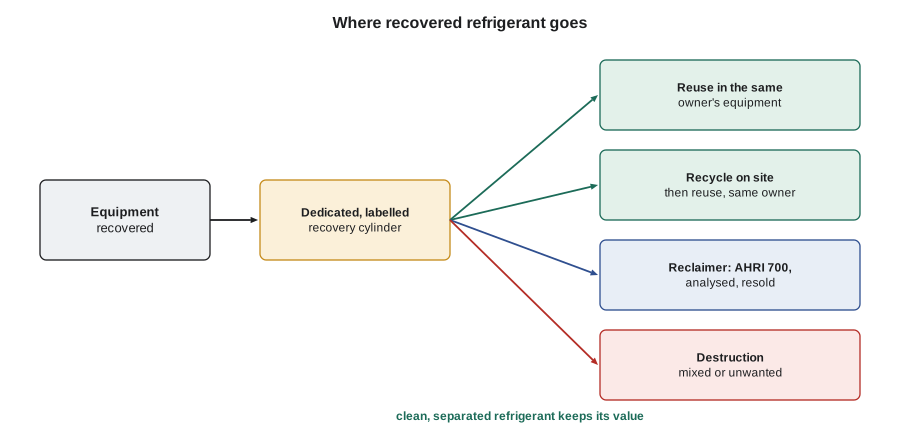
Recovered refrigerant can go three ways.
- Reuse in the same owner's equipment: refrigerant recovered during a repair can be returned to the system it came from, or to other equipment of the same owner, sometimes after recycling on site to remove moisture and particles. This is common when a system is opened for a component change and recharged with its own refrigerant.
- Reclaim: refrigerant that will be sold or used in another owner's equipment must first be reclaimed, reprocessed to the purity of new product and verified by laboratory analysis. Reclaimers distil the refrigerant, remove water, acid, oil and non-condensables, and test each batch.
- Destruction: refrigerant that is too mixed or contaminated to reclaim economically, and ozone-depleting refrigerant that is no longer wanted, is destroyed by high-temperature processes at facilities approved for the purpose, which break the molecules down and capture the resulting acids.
Which path refrigerant takes depends largely on how it was handled in the field. A cylinder that holds only one refrigerant, without air or excessive oil, is valuable. A cylinder that holds two refrigerants mixed together is waste.
The reclaim standard
Reclaimed refrigerant must meet the purity standard AHRI 700, the same specification that new refrigerant must meet. It sets limits on the contaminants that harm systems or show the product is not what it claims to be, such as:
| Contaminant | Why it matters | Typical limit in AHRI 700 (approximate) |
|---|---|---|
| Water | Forms acids, freezes in metering devices, attacks motor insulation | about 10 parts per million by weight for many refrigerants |
| Acidity | Corrodes metals, breaks down oil and insulation | about 1 part per million |
| High-boiling residue (oil) | Fouls heat exchangers and metering devices | about 0.01 per cent by volume |
| Particulates | Plug filters and wear moving parts | visually clean |
| Non-condensable gases (air) | Raise condensing pressure and reduce capacity | about 1.5 per cent by volume in the vapour phase |
| Other refrigerants | Change pressures, temperatures and safety class | about 0.5 per cent by weight |
Reclaimers in Canada operate under provincial environmental approvals, and many are also certified by EPA so that they can serve customers on both sides of the border. Refrigerant Management Canada, an industry-led program run by HRAI, collects surplus ozone-depleting refrigerants returned through wholesalers and arranges their destruction at no cost to the technician, which is how Ontario's requirement that wholesalers accept surplus CFCs is met in practice. HFCs and other halocarbons are reclaimed or destroyed through reclaimers and industry take-back programs, and as the HFC phasedown tightens supply, recovered HFCs are increasingly valuable.
Cylinders, heels and the shipping pallet
Recovery cylinders are shipped to the reclaimer as dangerous goods, as Lesson 4 explained. Each must be within its retest date, filled no more than its limit, labelled with the refrigerant and an accurate weight, and listed on the shipping document. Most reclaimers return empty recovery cylinders, evacuated and ready to use, or exchange them for clean ones.
Disposable cylinders of new refrigerant are never truly empty when the gauge reads zero at room temperature: some refrigerant, the heel, remains as vapour and sometimes liquid. Before a disposable cylinder is discarded or sent for scrap metal recycling, its heel should be recovered into a recovery cylinder, and in Ontario the cylinder needs an empty notice before it can be recycled or sent to landfill. Northfield recovers the heel of every disposable cylinder to a vacuum, attaches the empty notice, and then punctures or marks the cylinder so it cannot be mistaken for a full one, as the scrap dealer requires.
# Preparing a reclaimer shipment: net weights, limits and carbon dioxide equivalent
gwp = {"R-22": 1810, "R-404A": 3922, "R-410A": 2088, "R-134a": 1430, "R-448A": 1387, "mixed": 2000}
cylinders = [  # (cylinder number, refrigerant, water capacity kg, tare kg, gross kg)
    ("NM-114", "R-22", 21.6, 12.0, 29.1),
    ("NM-117", "R-22", 21.6, 12.0, 27.4),
    ("NM-121", "R-410A", 21.6, 12.1, 26.8),
    ("NM-122", "R-404A", 21.6, 12.0, 24.3),
    ("NM-130", "R-134a", 21.6, 11.9, 22.0),
    ("NM-131", "R-448A", 21.6, 12.0, 17.9),
    ("NM-140", "mixed", 21.6, 12.0, 15.6),
]
total_kg = total_t = 0.0
for num, ref, wc, tare, gross in cylinders:
    net = gross - tare
    limit = 0.8 * wc
    ok = "ok" if net <= limit else "OVERFILLED - do not ship"
    t = net * gwp[ref] / 1000
    total_kg += net
    total_t += t
    print(f"{num}  {ref:7s} net {net:5.1f} kg (limit {limit:4.1f})  {t:5.1f} t CO2e  {ok}")
print(f"Shipment: {total_kg:.1f} kg of refrigerant, about {total_t:.0f} t CO2e kept out of the air")NM-114 R-22 net 17.1 kg (limit 17.3) 31.0 t CO2e ok NM-117 R-22 net 15.4 kg (limit 17.3) 27.9 t CO2e ok NM-121 R-410A net 14.7 kg (limit 17.3) 30.7 t CO2e ok NM-122 R-404A net 12.3 kg (limit 17.3) 48.2 t CO2e ok NM-130 R-134a net 10.1 kg (limit 17.3) 14.4 t CO2e ok NM-131 R-448A net 5.9 kg (limit 17.3) 8.2 t CO2e ok NM-140 mixed net 3.6 kg (limit 17.3) 7.2 t CO2e ok Shipment: 79.1 kg of refrigerant, about 168 t CO2e kept out of the air
The check catches nothing this time, but it would have caught an overfilled cylinder before it went on a truck. The mixed cylinder is given an assumed GWP for the estimate only; the reclaimer's analysis determines what it actually contains.
Capstone: decommissioning the grocery rack
The grocery rack job from Lessons 8 and 9 brings together almost everything in this module. Here is how Northfield ran it, step by step, and where each step comes from.
- Identify: the rack's records, nameplates and standing pressures confirmed R-22, with a recorded full charge of 45 kg (100 lb). An identifier check of the receiver vapour confirmed it was not mixed (Lesson 2).
- Rules: a privately owned rack in Ontario, holding an HCFC, so O. Reg. 463/10 applied: certified technicians, recovery, records and an empty notice before scrapping (Lesson 5).
- Safety: the rack sat in a basement machine room. The team checked the oxygen level before entering, ran the exhaust fan, wore glasses and gloves, and kept torches off site until the refrigerant was recovered (Lesson 3).
- Cylinders: four dedicated R-22 recovery cylinders, inspected, within their retest dates, evacuated, weighed and tagged, with scales and float switches (Lesson 4).
- Equipment and setup: a certified recovery machine, short large-diameter hoses with ball valves, valve cores removed (Lesson 7).
- Method: push-pull from the receiver to move the liquid, watched on the scale, then vapour recovery from every section, both high and low sides (Lesson 8).
- Level: recovered to a vacuum that held for fifteen minutes, beyond the US EPA benchmark of 10 inches of vacuum for a large high-pressure system, and confirmed with a micron gauge; the empty notice was attached (Lesson 9).
- Records: each cylinder's net weight and number on the service record, the total recovered compared with the full charge, and the refrigerant added to the company's monthly reconciliation (Lesson 6).
- Oil and equipment: the rack's oil drained into a waste oil container after recovery, the rack labelled as recovered for the scrap dealer, and disposal paperwork completed (Lesson 9).
- Shipping: the recovered R-22 sent to the reclaimer on the next pallet (this lesson).
The recovered total was 42.6 kg (94 lb), about 95 per cent of the recorded full charge. The difference is consistent with the rack's history of slow leaks before it was shut down and with refrigerant dissolved in the oil. Dana signed off the job, and Theo's name went on the paperwork as the technician who did the recovery.
Certification review
Theo's ozone depletion prevention course, like the courses in other provinces, covered the material in this module in a single day. Its test checks that a technician understands why refrigerants are controlled and what the rules require in practice. The main topics to review are:
- Ozone depletion and climate change: the chlorine cycle, ODP, GWP, CO₂e and atmospheric lifetimes (Lesson 1).
- The Montreal Protocol, the Kigali Amendment and Canada's phase-out and phasedown (Lessons 1 and 5).
- Federal and provincial rules: ODSHAR, the Federal Halocarbon Regulations, 2022, the code of practice, and your province's regulation, including certification, venting, leak tests and notices, refilling, empty notices and records (Lessons 5 and 6).
- Refrigerant identification, safety groups and safe handling, including PPE, oxygen deficiency and decomposition (Lessons 2 and 3).
- Cylinders: types, the fill limit, inspection, retesting, storage and transport (Lesson 4).
- Recovery, recycling and reclaiming, recovery equipment and methods, and recovery levels (Lessons 7 to 9).
- Leak detection, leak testing, leak repair and verification (Lessons 10 and 11).
- Reclaim, destruction and the return of surplus refrigerants (this lesson).
A few habits help on any certification test. Read the whole question and every option before answering; many wrong options are true statements that do not answer the question asked. Watch for words such as always, never, except and first. When a question is about what to do, the safe and legal answer is almost always the one that keeps refrigerant out of the air and people out of danger. And for questions with numbers, such as fill limits, recovery percentages and leak rates, work the arithmetic rather than guessing.
# Self-check: score practice questions by topic and find the weakest areas
results = {  # topic: (correct, attempted)
    "ozone and climate": (9, 10),
    "rules and certification": (13, 18),
    "safety": (9, 10),
    "cylinders": (8, 10),
    "recovery equipment and methods": (11, 14),
    "recovery levels and small appliances": (6, 10),
    "leak detection and repair": (12, 15),
}
PASS = 0.75
total_c = sum(c for c, a in results.values())
total_a = sum(a for c, a in results.values())
print(f"Overall {total_c}/{total_a} = {total_c / total_a * 100:.0f} %")
for topic, (c, a) in sorted(results.items(), key=lambda kv: kv[1][0] / kv[1][1]):
    share = c / a
    note = "review" if share < PASS else "ready"
print(f"{topic:38s} {c:2d}/{a:2d} {share * 100:4.0f} % {note}")Overall 68/87 = 78 % recovery levels and small appliances 6/10 60 % review rules and certification 13/18 72 % review recovery equipment and methods 11/14 79 % ready cylinders 8/10 80 % ready leak detection and repair 12/15 80 % ready ozone and climate 9/10 90 % ready safety 9/10 90 % ready
Theo's own results looked much like the program's example: strong on the science and safety, weaker on the rules and on recovery levels. He spent his last study evening on those two lessons, and they were the topics he found easiest on the day.
The technician's part
The rules in this module can seem like a lot of paperwork around a simple job. Seen from Dana's red number on the shop door, they are something else: a system that turns thousands of ordinary service calls into one of the largest climate and ozone benefits any trade delivers. Every recovered cylinder, every leak found and fixed, every accurate record is part of it. The rest of the RAC program builds on these habits: when you charge a heat pump, braze a line set or commission a supermarket rack, you will be expected to handle refrigerant the way this module describes, every time.
Common mistakes
MistakeTreating recovered refrigerant as waste.
InsteadClean, separated refrigerant is valuable; it can be reused or reclaimed.
MistakeSelling recovered refrigerant to another owner without reclaiming it.
InsteadRefrigerant for another owner must be reclaimed to AHRI 700 first.
MistakeThrowing away a disposable cylinder with its heel.
InsteadRecover the heel and complete the required notice or certification first.
MistakeShipping cylinders without checking net weights against limits.
InsteadWeigh and check every cylinder before it goes on a truck.
MistakeStudying only the topics you already know.
InsteadUse practice results to find and review the weakest topics.
Summary and key terms
- Recovered refrigerant can be reused in the same owner's equipment, reclaimed to AHRI 700 for anyone, or destroyed.
- AHRI 700 limits water, acidity, oil, particulates, non-condensables and other refrigerants.
- Refrigerant Management Canada collects surplus ozone-depleting refrigerants for destruction; reclaimers handle HFCs.
- Recover disposable cylinder heels and attach an empty notice before recycling.
- Keeping refrigerant clean and separated decides whether it is reclaimed or destroyed.
- The capstone job applies identification, rules, safety, cylinders, equipment, methods, levels, records and shipping in sequence.
- Reclaimer
- A facility approved to reprocess refrigerant to new-product purity and verify it.
- AHRI 700
- The purity standard for new and reclaimed refrigerant.
- Destruction
- Breaking down unwanted refrigerant at an approved high-temperature facility.
- Refrigerant Management Canada
- An industry program that collects surplus ozone-depleting refrigerants for destruction.
- Heel
- Refrigerant remaining in a cylinder that reads empty.
- Surplus refrigerant
- Refrigerant that is no longer wanted and is returned for reclaiming or destruction.
Practice problems
Work each problem on paper first, then reveal the answer to check.
Why is a cylinder of mixed refrigerant more expensive to dispose of than a cylinder of pure R-22?
Show answer
It cannot be reclaimed into a pure product, so it must be destroyed, and destruction costs money.
A cylinder with a water capacity of 21.6 kg (47.7 lb) and tare 12.0 kg (26.5 lb) weighs 30.1 kg (66.4 lb). Can it be shipped?
Show answer
Net 18.1 kg exceeds the 17.3 kg limit: no; transfer some refrigerant first.
When may recovered refrigerant be returned to equipment without reclaiming?
Show answer
When it goes back into the same system or other equipment of the same owner.
The grocery rack's recovered total was 95 per cent of its recorded full charge. Give two reasons for the difference.
Show answer
Leaks before shutdown and refrigerant dissolved in the oil; also rounding and hose losses.
Lesson quiz · 5 questions
Score 60% or more to complete this lesson.
Create a free account to save your progress, take quizzes and earn a certificate.